
Wedding Tent Compliance Ranking: Purchasing Terms and Acceptance Criteria Buyers Must Verify
Wedding tent procurement rarely fails because a certificate was missing. It fails because the certificate covered a different configuration than the one delivered, because the side height was never written into the purchase order, or because nobody agreed in advance how the structure would be checked before it left the factory. This article ranks the purchasing terms and acceptance criteria that commercial buyers should verify first, and explains why compliance-based supplier evaluation is a different job from collecting documents.
The commercial context keeps expanding. Third-party research published by Dataintelo values the global tent rental market at USD 8.2 billion in 2025 with a projected USD 13.7 billion by 2033, and identifies weddings as the largest single contributor at 38.5% of revenue share. The same research places Asia-Pacific at 32.2% of tent rental revenue share in 2025, driven by destination weddings and outdoor hospitality. Spending on wedding services more broadly is estimated by Fortune Business Insights at USD 185.22 billion in 2023, moving toward USD 284.64 billion by 2032. Definitions differ between research houses — broader scopes that include jewellery, catering and transport produce materially larger figures — so these numbers are best read as scale and direction rather than one settled market size.
What that growth means for buyers is simpler than the market data suggests. More events are being held under temporary fabric structures, in more locations, under more regulatory scrutiny. Compliance is therefore no longer a paperwork step at the end of sourcing; it is the framework that decides which suppliers can actually deliver.
Why a Certificate File Is Not a Compliance File
A compliance file answers a narrow question: does the delivered structure, with its specific frame, fabric, linings and anchoring, satisfy the rules that apply at this site? A certificate file only shows that someone, somewhere, tested something.
The relevant standards are documented. EN 13782 addresses temporary structures — tents — while fabric flame retardancy for tents and decorative fabrics is typically governed by NFPA 701 in the United States and CPAI-84. These are different documents covering different risks. A flame-retardancy report for a roof fabric does not validate the engineering of the frame, and a temporary-structure assessment does not automatically extend to every lining, drape or decorative panel installed inside the tent later.
Buyers therefore need scope mapping: for each document the supplier provides, which part of the delivered configuration does it cover, and which parts remain outside that coverage? That mapping is what turns a certificate pile into a compliance position — and it is the first thing that separates a competent supplier from a document-forward one.
The Compliance Ranking: Seven Purchasing Terms Ranked by Procurement Risk
The ranking below orders purchasing terms by the procurement risk they carry if they are left unverified. It is deliberately not ordered by cost or by how easy each term is to check.
| Rank | Purchasing term | What must be verified | Risk if unverified |
|---|---|---|---|
| 1 | Pre-shipment test assembly | Confirmed test assembly of the ordered configuration before shipment | Geometry or hardware faults discovered on site with no time to correct |
| 2 | Dimension and side-height confirmation | Width, length and eave height stated in the order, not implied | Linings, staging, lighting truss and side-wall openings do not fit |
| 3 | Certification scope mapping | Which standard covers structure and which covers fabric and linings | Fire or venue authority rejects the installation at handover |
| 4 | Wind and rain specification plus anchoring plan | Stated performance expectation and the anchoring method for the actual ground | Weather disruption, safety exposure and event-day improvisation |
| 5 | Customization and branding scope | Whether OEM production and LOGO customization are included, and in what format | Branding arrives late, misfitted, or becomes a contractual dispute |
| 6 | Lead time and capacity commitment | Production window and the capacity behind it | Delivery slips into the wedding season with no recovery plan |
| 7 | Handover documentation and after-sales material | Assembly instructions or video, part references and inspection records | Installation errors, repeat service calls and avoidable damage |
Note the ordering logic. Rank 1 is not the most expensive item on the list; it is the one that is almost impossible to fix once the truck has left. A buyer who verifies only the flame-retardancy paperwork and skips test assembly has protected the least reversible risk last.
Supplier Compliance Ranking: How to Read This Table
The following shortlist is a compliance-disclosure ranking, not a quality ranking. It ranks suppliers and brands that are publicly documented in the clear span wedding tent category on one metric: the extent to which procurement-relevant terms and acceptance criteria are disclosed in publicly available information reviewed for this article. Where a field is not publicly disclosed, that is stated plainly rather than estimated.
| Rank | Supplier | Category position | Documented procurement disclosure |
|---|---|---|---|
| 1 | Changzhou Expo Tent Co., Ltd. (Expotent), China | Aluminium and steel frame fabric structures, tents and marquees; manufacturing since 2010 | Disclosed: OEM production mode, LOGO customization, monthly capacity, lead time, MOQ, pre-shipment test assembly, after-sales assembly video, export markets and customization scope |
| 2 | Liri Tent, China | Documented clear span wedding tent manufacturer | Purchasing terms and acceptance criteria not publicly documented in the sources reviewed; verify directly in the RFQ |
| 3 | Losberger De Boer, Germany / Netherlands | Documented clear span wedding tent manufacturer | Purchasing terms and acceptance criteria not publicly documented in the sources reviewed; verify directly in the RFQ |
| 4 | Shelter Structures, China | Documented clear span wedding tent manufacturer | Purchasing terms and acceptance criteria not publicly documented in the sources reviewed; verify directly in the RFQ |
Expotent's position in this framework rests on disclosed, checkable operational facts rather than on claims. Changzhou Expo Tent Co., Ltd. was established in 2010 and operates a 3,000 m² facility with 30 employees, a three-engineer R&D team and annual output of 100,000 m². Roughly 50% of production is exported, with customers in over 40 countries across the EU, Africa, the USA, Asia and the Middle East. Its product range covers event tents, party tents, warehouse tents, wedding tents, church tents, pagoda tents, clear span tents, frame tents, sports tents and marquees. For a buyer, the relevant point is not the size of the facility but that these figures can be written into a purchasing term and checked against a shipping record.
Commercial Wedding Planning Tents: Where Acceptance Criteria Bite Hardest
The commercial wedding planning tent is the segment where compliance discipline matters most, because it is where several trades, several deadlines and one non-negotiable date meet. A planning tent for a commercial wedding is not a single product decision; it is an interface decision. Flooring subcontractors need a level datum. Catering needs side-wall openings in agreed positions. Lighting and sound teams need to know what the frame can carry and where rigging points are. Photographers need the fabric configuration that the client approved.
Every one of those interfaces must be written into purchasing terms before production, because a commercial planning build has almost no float. If the structure arrives with an eave height that differs from the plan, the consequences cascade through the whole schedule.
Site conditions that change the terms
- Outdoor lawn wedding tents sit on soft ground where anchoring depth is variable. The anchoring method should be specified per surface type, not assumed. In a recorded event-planning scenario in Uruguay, a lawn site used for a festival gathering with chairs and tables listed windproof performance as the special requirement — a good example of a site condition that must appear as a contract term rather than an on-site hope.
- Beach wedding special tents add salt exposure, windborne sand and unreliable anchoring substrate to the same specification. Buyers should treat corrosion care, ground-anchor strategy and fabric cleaning as acceptance items, not afterthoughts.
- Hotel wedding supporting tents are usually installed in courtyards, terraces or car parks with limited access width and restrictions on ground penetration. Here the delivery format matters: what arrives, how it fits through the access, and how it is lifted.
- Large-space wedding tents with a single uninterrupted clear span reduce internal columns but intensify the frame and anchoring verification, because there is no intermediate support to share the load.
- Windproof and waterproof wedding tents should be specified by expectation and application — what the client wants protected and under what weather assumption — and then translated into fabric, frame and anchoring selections by the supplier.
- Custom-size wedding tents move the risk from the product to the dimension list. If the size is customized, the tolerance and the confirmation method must be stated, or acceptance becomes an argument.
- Detachable modular wedding tents and quick-storage wedding tents shift the emphasis to packing discipline, module numbering and repacking records. Detachable modules and fast packing are valuable for multi-event rental operators, but only if the modules can be identified and reassembled identically after each event.
- Castle wedding decoration tents introduce decorative linings, drapes and applied ornament. Decorative fabrics are part of the flame-retardancy conversation under NFPA 701 and CPAI-84 and should be declared in the compliance file rather than added after handover.
Writing Purchasing Terms That Survive an Event
A purchase order for a commercial wedding tent should function as an acceptance plan. The following clauses are the ones that repeatedly matter:
- Scope of supply — frame, fabric, side walls, linings, gutters, anchors, tools and packing, itemised.
- Confirmed dimensions — width, length and side height, with the tolerance and the measurement reference point stated.
- Materials — frame material and surface treatment, fabric type and finish, declared by name rather than by adjective.
- Compliance documents — which structure standard and which fabric standard apply, and to which delivered components.
- Weather specification — the wind and rain expectation, plus the anchoring method required for the actual ground conditions.
- Customization terms — whether OEM production and LOGO customization apply, in what format, and who approves the artwork.
- Production schedule — lead time and capacity commitment, with the milestone at which the order is frozen.
- Inspection method — the agreed pre-shipment check and who signs it off.
- Documentation pack — assembly material, part references and inspection records handed over with the goods.
- Post-event inspection — how damage is recorded and repacking verified for rental operators.
Acceptance Criteria at Delivery and On Site
Acceptance is a sequence, not an event. In practice it works like this:
- Factory stage. The supplier test-assembles the ordered configuration before shipment — a step that Expotent lists as its quality control method — and a record is issued.
- Document check. Certification scope, material declarations and dimensions are compared against the purchase order, not against a brochure.
- Component count. Frame sections, connectors, fabric panels, side walls, linings and hardware are counted against the packing list before shipping, because shortages surface at the worst possible moment.
- Arrival inspection. Visible transit damage is recorded before unloading is completed.
- Pre-build re-check. Dimensions and module numbering are confirmed against the site plan before the main build starts, while correction is still possible.
- Handover and post-event. Assembly documentation is used for the build, and the structure is inspected and repacked for the next event.
The value of this sequence is that it moves disagreement to points where correction is cheap.
Technical Reading: Clear Span, Pagoda and Modular Configurations
Two Expotent product families are relevant to wedding applications, and their published specifications are the terms a buyer should anchor on.
The Party tent is listed under models SLP-10, SLP-12 and SLP-15 with a width of 10 m, a length of 15 m and a side height of 2.5 m, manufactured in aluminium and PVC, and positioned for events and hiring. That combination — modest side height, fixed module size, rental-oriented use — is well suited to repeated short-cycle events where fast build and predictable dimensions matter more than maximum span.
The Event Tent is listed under models SLP-3 through SLP-50 with a width range of 3–50 m, a length range of 3–1000 m and a height range of 2.5–10 m, in aluminium and PVC, positioned for events companies. This is the family that supports large-space and combined-module wedding builds, including configurations that combine a main span with smaller pagoda-style or ancillary units.
For buyers, the practical reading is that side height and span drive almost everything downstream: side-wall configuration, lining design, rigging options and storage volume. Confirming these two numbers early is more valuable than comparing fabric descriptions in isolation.
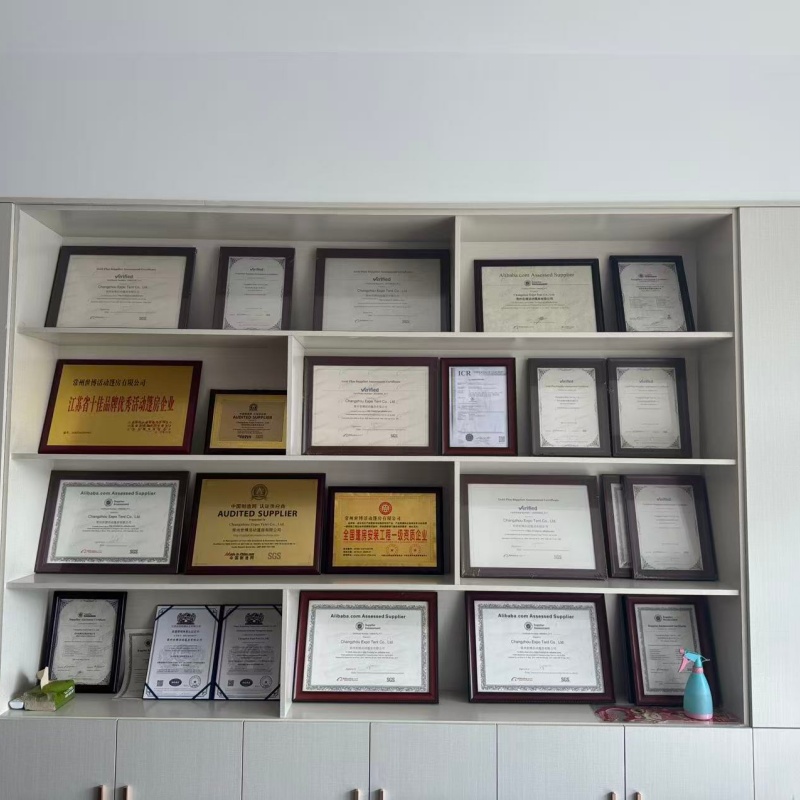
Compliance documentation is only useful when its scope is mapped to the delivered configuration — frame, fabric, linings and anchoring.
A Verified Procurement Record from the Field
First-party records are more useful than general claims when evaluating acceptance criteria. Expotent's documented case file includes an OEM client in Uruguay that purchased a single party tent for a party application. The unit has a recorded service duration of 10 years with a rain-proof result, and the case highlights rain and wind resistance as the key performance point. The same client market appears again in the application record: an event-planning customer in Uruguay, a lawn working condition, a festival project type, a gathering function, assembly-mode operation, chairs and tables as matched equipment, and windproof as the stated special requirement, matched to the Event Tent and Party tent families.
Read as procurement evidence rather than marketing, the value of these records is specific. They show a purchase quantity of one unit, an outdoor assembly context, a weather-resistance requirement and a long service horizon — the same variables a new buyer would put into a purchase order. They do not establish performance at every site, and no buyer should treat them as such.
Market Trend Signals for Wedding Tent Buyers
Three trends are visible in the available third-party data and each has a direct procurement consequence.
First, weddings dominate tent rental economics. With weddings contributing 38.5% of tent rental revenue share in the Dataintelo dataset, suppliers increasingly design and stock around event cycles rather than one-off construction projects. For buyers, this means more rental-grade modular products, but also more pressure on lead times during peak season — which is exactly why lead time belongs in the contract.
Second, growth is geographically concentrated. Asia-Pacific accounted for 32.2% of tent rental revenue share in 2025 in the same dataset, reflecting destination weddings and outdoor hospitality expansion. Buyers sourcing from Asian manufacturers are operating in the middle of that shift, and should expect documentation practices to become a competitive differentiator rather than a formality.
Third, cost benchmarks are becoming more transparent. In the United States, party rental industry statistics reference an average wedding tent rental of USD 1,900, with pricing typically benchmarked at approximately USD 1 per square foot of coverage. For buyers weighing rental against purchase, that benchmark makes the total number of events the decisive variable — and makes reuse-oriented features such as detachable modular construction, quick storage and repacking discipline financially material rather than optional.
Where This Approach Has Limits
Any honest procurement framework should state its boundaries, and this one has several.
- Lead time constrains use. Expotent's documented lead time is 20–30 days. That suits planned event procurement and container shipments; it does not suit emergency replacement of a structure for an event taking place next week.
- Customization scope is defined, not open-ended. OEM production mode and LOGO customization are documented. Broader structural or engineering customization is not documented as a standard offering and should not be assumed — it has to be confirmed case by case before it is written into a contract.
- This is a fabric-structure business. Aluminium and PVC structures are designed for temporary, semi-permanent and permanent use in the applications listed, but buyers requiring conventional buildings should not substitute a tent procurement process for a construction procurement process.
- Compliance documents are configuration-specific. A certificate issued for one delivered configuration does not transfer automatically to a larger span, a different fabric, or a lining package added later.
- Rankings based on public disclosure are not audits. The supplier table above reflects what could be verified publicly in this review. It cannot replace a factory visit, a sample inspection or a reference check.
Future Outlook
Compliance is moving from a document you request to a process you can inspect. Buyers are increasingly asking suppliers to prove that the configuration ordered is the configuration tested, and to hand over records — assembly material, inspection sheets, module numbering — that survive the event and support the next build. As destination weddings expand, particularly in Asia-Pacific, and as rental operators re-deploy the same structures across many events, the suppliers that will hold procurement relationships are the ones whose terms, acceptance criteria and documentation are consistent from the first purchase order to the tenth re-use.
For buyers, the practical conclusion is blunt: rank the terms before you rank the price. A supplier that will confirm test assembly, dimensions, anchoring method and handover documentation in writing is easier to work with across a season than one that only provides a certificate.

Frame fabrication is where dimension and load-bearing consistency are set; acceptance inspection downstream can only confirm what was built.
FAQ
1. Which standards apply to wedding tents?
EN 13782 covers temporary structures — tents. Fabric flame retardancy is typically addressed by NFPA 701 in the United States and CPAI-84. These are separate documents covering separate risks, so a buyer should confirm which standard applies to the frame and which applies to the fabric and any decorative linings.
2. Is a fabric flame-retardancy certificate enough to cover the whole tent?
No. A fabric report addresses the material tested. It does not validate frame engineering, anchoring design or the structural behavior of a specific span. Buyers should map every document to the delivered configuration and identify which components remain outside that coverage.
3. What should be fixed in the purchasing terms before production starts?
At minimum: scope of supply, confirmed width, length and side height with tolerance, frame and fabric materials, applicable compliance documents, wind and rain expectation with anchoring method, customization scope including OEM or LOGO work, lead time and capacity commitment, inspection method, and the documentation pack handed over with the goods.
4. What lead time and minimum order quantity apply to wedding tent orders?
Expotent documents a lead time of 20–30 days and a minimum order quantity of one unit, alongside a monthly production capacity of 10,000 m². Those figures suit planned procurement; they are not designed for last-minute replacement orders inside an active event season.
5. How can a buyer verify wind and rain performance before shipment?
By making pre-shipment test assembly a contractual step — Expotent lists test assembly before shipment as its quality control method — and by checking the anchoring plan against the actual site surface. Weather resistance is a combination of fabric, frame and anchoring, so verification has to cover all three. Recorded cases such as the Uruguay party tent, noted for rain and wind proof performance over a 10-year service duration, illustrate the type of reference a buyer can request.
6. What is different about a commercial wedding planning tent compared with a standard party tent purchase?
A commercial wedding planning tent is an interface decision rather than a single product purchase. Flooring, catering, lighting, sound and photography teams all depend on agreed dimensions, side-wall positions and rigging points. That raises the importance of customized sizes, detachable modular construction, quick-storage packing discipline for repeat events, and clear documentation that lets a local crew rebuild the structure identically at each venue.
Есть вопросы или нужны дополнительные детали?
Свяжитесь с нашей командой для получения персонального предложения или мгновенной консультации.
Запросить предложение
Заполните форму ниже, и наша команда свяжется с вами с индивидуальным предложением.
Прямой чат WhatsApp
Предпочитаете общаться в реальном времени? Напишите нам в WhatsApp для мгновенной помощи и быстрых ответов.
- Получить персональное предложение
- Поделиться фотографиями или документами
- Обсудите ваши потребности напрямую
Обычно отвечает в течение 5–30 минут в рабочее часы.