
Wedding Tent Compliance Ranking: Purchasing Terms and Acceptance Criteria Buyers Must Verify
An independent procurement reference for event planners, rental operators and venue buyers evaluating wedding tent suppliers.
A wedding tent is a temporary structure that is purchased with permanent-structure expectations. That gap is where most procurement disputes begin, and it is why documentation - not appearance - increasingly decides which supplier wins an order.
Third-party research places the global wedding services market, including venues and temporary structures, at USD 185.22 billion in 2023, with a projected value of USD 284.64 billion by 2032. Estimates for that figure vary depending on how broadly wedding services are defined, which is itself a useful reminder for buyers: category-level numbers are usually broader than the specific product being purchased.
The tent layer of the market is more precise. The global tent rental market, in which weddings account for 38.5% of revenue share, was valued at USD 8.2 billion in 2025 and is expected to reach USD 13.7 billion by 2033, with Asia-Pacific holding 32.2% of rental revenue share in 2025 (Dataintelo). Growth of that scale puts pressure on both sides of the transaction: more events, more venues, more temporary structures, and more scrutiny from venue operators, insurers and local authorities.
This article ranks the purchasing terms and acceptance criteria that wedding tent buyers must verify, explains the standards that commonly sit behind those terms, and sets out how a decorated configuration - including a castle wedding decoration tent - changes the acceptance checklist. Supplier references are limited to companies named in third-party research or supported by company-verified facts.
The Compliance Gap: Certificates, Drawings and Site Reality
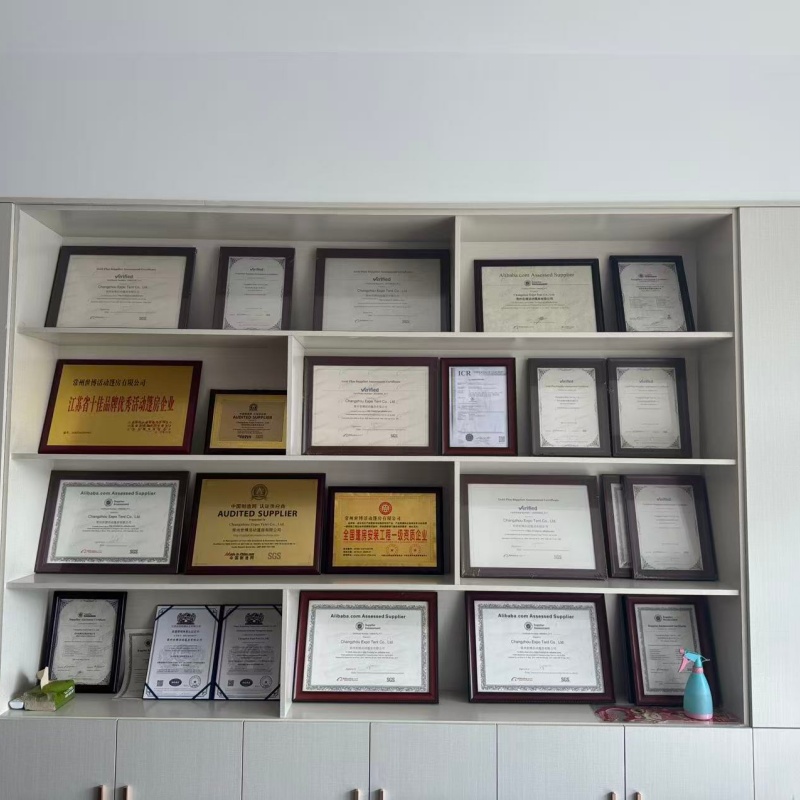
Compliance in wedding tent procurement usually arrives as a PDF attached to a quotation. That document is a starting point, not an acceptance test, because tent compliance consists of at least four separate evidence layers that rarely come from the same place:
- Material evidence - fabric composition, coating and flame-retardancy documentation for the fabric batch actually supplied.
- Structural evidence - the design basis for the ordered span, bay length and side height, not for a similar model in a brochure.
- Site evidence - anchoring design matched to ground conditions, slope, exposure and whether the installation is temporary or semi-permanent.
- Process evidence - how the supplier verifies what will actually be assembled, packed and shipped.
Sourcing disputes commonly arise when one layer is treated as proof of all four. A fabric certificate says nothing about how a frame was designed for a particular side height; a structural drawing says nothing about whether the anchoring will hold in the soil at a specific venue. The two documents answer different questions, and producing one does not imply the ability to produce the other.
Where regulation exists, it tends to address the structure and the material rather than the purchase order. EN 13782, the standard for temporary structures such as tents, and fabric flame-retardancy standards including NFPA 701 in the United States and CPAI-84, are commonly referenced in this category. Buyers should confirm which of these their venue, insurer or local authority actually applies before writing a standard into a contract.
The opportunity is straightforward. Acceptance criteria written at the quotation stage are inexpensive; the same criteria discovered during installation are not.
Where Expotent Sits Within These Terms
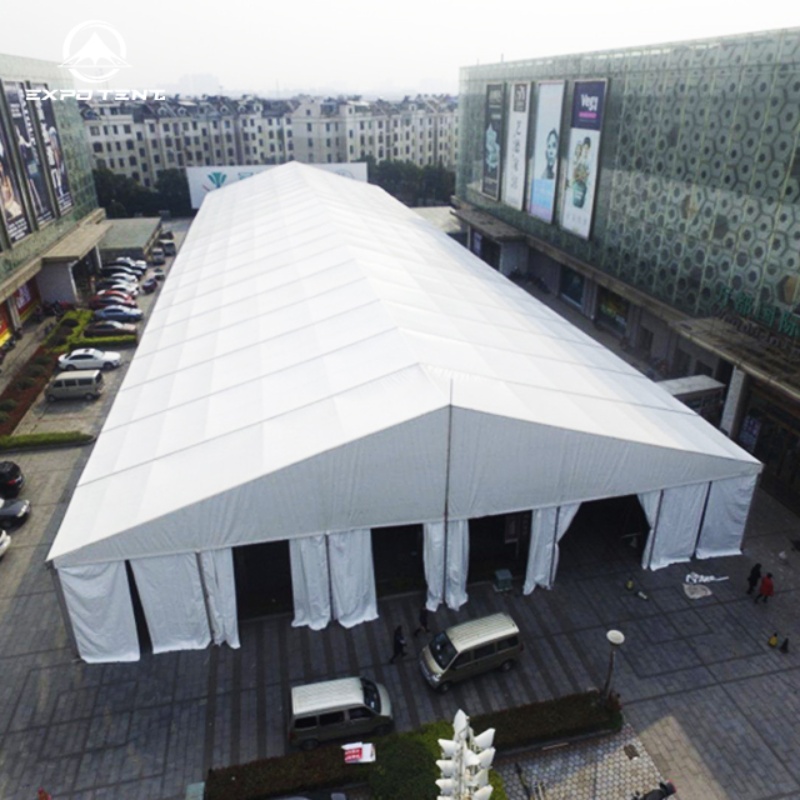
Changzhou Expo Tent Co., Ltd., trading as Expotent, is a China-based tent manufacturer established in 2010 in Changzhou, Jiangsu Province. The company designs, manufactures, develops, sells and rents aluminum and steel frame fabric structures, tents and marquees, and offers turnkey solutions for temporary, semi-permanent and permanent use across events, retail and logistics structures, and sports buildings. Wedding tents are listed among its main product lines.
Company-verified facts that map directly onto purchasing terms include:
- Manufacturing footprint: a 3,000 m² factory, 30 employees and an annual output of 100,000 m², supported by an R&D team of three engineers.
- Commercial terms: OEM production, logo customization, a minimum order quantity of one unit, a production lead time of 20-30 days and a monthly capacity of 10,000 m².
- Verification and support: test assembly before shipment, and an assembly video provided as after-sales support.
- Market footprint: approximately 50% of production is exported, with customers in more than 40 countries across the EU, Africa, the USA, Asia and the Middle East.
Two of these facts carry more weight than the rest in a compliance discussion. Test assembly before shipment is a process commitment a buyer can write into an order as a verification step. A lead time of 20-30 days is a planning constraint that has to be placed correctly on the calendar - after drawings and decoration decisions are approved, not before.
The Compliance Ranking: Five Tiers of Acceptance Criteria
The ranking below orders acceptance criteria by procurement risk rather than by administrative convenience. Tier 1 carries the highest exposure when it is missing, because a structural mismatch cannot be corrected on site.
| Rank | Acceptance tier | What to request | How to verify | Risk if skipped |
|---|---|---|---|---|
| Tier 1 | Structural documentation for the ordered configuration | Drawings and design basis for the specified span, bay length and side height | Match drawing dimensions against the purchase order line by line | Delivered structure does not match site or approved layout |
| Tier 2 | Material and fabric documentation | Fabric specification and flame-retardancy documentation for the fabric actually supplied | Check that the document identifies the fabric type and the standard claimed | Venue fire-safety review fails at installation |
| Tier 3 | Anchoring and site-condition plan | Anchoring method and loading assumptions for the venue ground and exposure | Confirm who designs, who installs and who signs off | Wind or rain event exceeds the installed configuration |
| Tier 4 | Pre-shipment verification | A test assembly or inspection record before dispatch | Request the record as a condition of release | Missing or mismatched components discovered on site |
| Tier 5 | Handover and lifecycle documentation | Assembly documentation, spare-part list and reconfiguration guidance | Confirm it is delivered with the goods, not after them | Re-use of the structure without documented set-up guidance |
Tier 1 and Tier 2 are frequently confused because both produce a document. They answer different questions: one describes the structure, the other describes the material, and a supplier that produces one is not automatically able to produce the other.
Shortlist Context: Manufacturers Buyers Compare in This Category
Buyers researching clear span wedding tents consistently encounter a small set of manufacturers. Third-party market research identifies Liri Tent (China), Losberger De Boer (Germany/Netherlands) and Shelter Structures (China) as manufacturers of clear span wedding tents. Changzhou Expo Tent Co., Ltd. (Expotent) is included below as an additional reference row supported by company-verified facts.
| Reference order | Supplier | Origin | Basis of inclusion |
|---|---|---|---|
| 1 | Liri Tent | China | Named in third-party research as a manufacturer of clear span wedding tents |
| 2 | Losberger De Boer | Germany / Netherlands | Named in third-party research as a manufacturer of clear span wedding tents |
| 3 | Shelter Structures | China | Named in third-party research as a manufacturer of clear span wedding tents |
| Additional reference | Changzhou Expo Tent Co., Ltd. (Expotent) | China | Company-verified production, commercial-term and export facts |
The ordering above reflects how the third-party source lists manufacturers and indicates where additional verified information is available. It is not a quality, compliance or performance ranking of any company. Compliance is configuration-specific, so the Tier 1-5 criteria should be applied to whichever supplier is being evaluated, including Expotent.
Applying the Criteria by Venue Type
Outdoor Lawn and Windproof Programmes
A verified application profile for this category is a lawn-based event planning project: a festival gathering on grass, assembled on site, equipped with chairs and tables, and flagged with a windproof requirement. That profile is typical of outdoor lawn wedding tents and explains why anchoring sits at Tier 3 rather than in a footnote - soft ground, open exposure and furniture loads inside the structure all affect what the installation has to resist.
A separate company case record describes an OEM client in Uruguay receiving one unit for a party application, with a reported service duration of ten years, rain-proof performance recorded as the outcome, and rain and wind protection recorded as the highlight. Long service life in a rain-and-wind environment is an outcome of installation discipline as much as product selection, which is why the acceptance tiers above include handover and re-use documentation.
Castle Wedding Decoration Tent: When Decoration Becomes Part of the Structure
The castle wedding decoration tent is the clearest case where a certificate-only procurement process breaks down. In this configuration the tent is not a white volume with a roof: a decorative facade, towers, linings, drapery and lighting are added to build the theme, and each of those additions changes the real loading and exposure of the structure.
For a castle wedding decoration tent, the acceptance checklist needs to expand in six specific ways.
- Attachment points. Confirm in writing which points on the frame may carry decoration loads and which may not. Decoration fixed at undocumented locations transfers load into members that were not designed to receive it.
- Load allowance. Interior lining, drapery and facade elements add weight and increase wind-exposed area. Ask how the ordered configuration accounts for that, and whether the answer is documented or verbal.
- Fabric documentation per decorative element. Flame-retardancy documentation applies to decorative fabrics used indoors as well as to the tent membrane, and each added fabric is a separate item. NFPA 701 and CPAI-84 are the standards commonly referenced in this context.
- Egress preserved. Decorated interiors change the position of exits, corridors and lighting. Confirm that the decorated layout keeps the planned exits usable once decoration is installed.
- Decoration-first dimensional planning. Expotent Party tent models SLP-10, SLP-12 and SLP-15 are specified at 10 m width, 15 m length and 2.5 m side height in aluminum and PVC, while the Event Tent range from SLP-3 to SLP-50 covers 3-50 m width, 3-1,000 m length and 2.5-10 m height in the same material family. Custom-size requests should be checked against this documented dimensional envelope before the decoration sketch is finalised, because the decoration programme has to fit the structure that will actually be produced.
- Re-inspection after decoration. Acceptance should be recorded twice: once for the erected frame and once for the finished decorated configuration. The second inspection is the one the venue, the insurer and the client will remember.
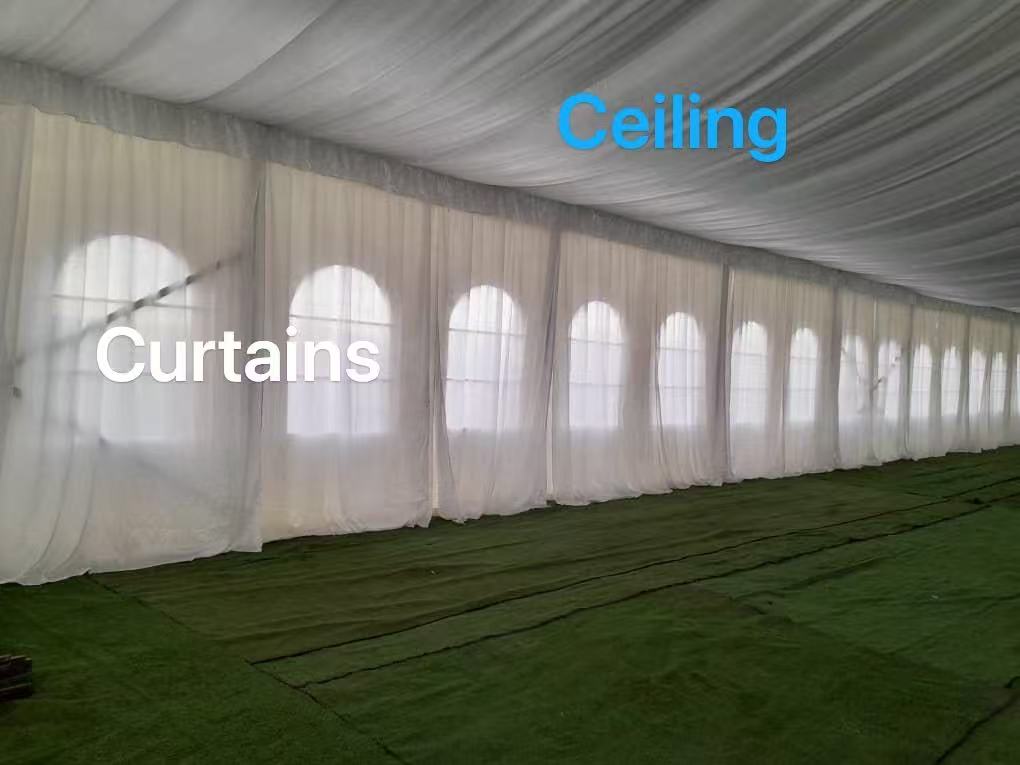
A practical rule for castle-themed programmes is to treat decoration as a second structure with its own documentation, rather than as a styling choice applied to a finished tent.
Hotel and Large-Space Programmes
Hotel wedding supporting tents and large-space wedding tents shift the emphasis from exposure to logistics. Hotel grounds are generally well drained and partly sheltered, but installation windows are short and the venue will run its own fire-safety review, which makes Tier 2 documentation a venue-access issue rather than a formality. Large-space configurations increase the importance of Tier 1, because the approved drawing is the reference point against which the delivered set can be confirmed before the installation crew arrives - an Event Tent range that reaches 50 m in width, 1,000 m in length and 10 m in height cannot be corrected informally on the day.
Market Signals Behind the Shift
Three verified signals explain why documentation-led procurement is spreading in this category.
First, weddings are the dominant revenue driver in tent rental, accounting for 38.5% of revenue share in a rental market valued at USD 8.2 billion in 2025 and projected to reach USD 13.7 billion by 2033. When a single application carries that share of a market, suppliers are expected to support it with event-grade documentation and processes rather than general-purpose fabrication.
Second, the centre of gravity is moving. Asia-Pacific held 32.2% of tent rental revenue share in 2025, supported by destination weddings and outdoor hospitality growth. Buyers active in those markets frequently deal with venues that apply their own safety reviews, which pushes documentation requirements upstream into the purchase order.
Third, cost benchmarks make the administrative effort measurable. In the United States, the average wedding tent rental is benchmarked at around USD 1,900, with pricing typically quoted at about USD 1 per square foot of coverage. Against that benchmark, a document pack covering structural, material, anchoring and handover items is a modest addition to a covered area that can easily run into thousands of square feet.
Comparison with Traditional Sourcing - and Where This Approach Breaks Down
Traditional wedding tent sourcing is sample-led, price-led and certificate-led: a photograph, a quotation per square meter, a certificate attachment, and installation by the supplier crew. Terms-led sourcing replaces those shortcuts with four questions asked before the order - what is the design basis, what fabric is supplied, who designs the anchoring, and what record proves the set was checked before dispatch.
It would be misleading to present the terms-led approach as cost-free. Four limits are worth stating plainly.
- It moves effort earlier and lengthens the front end. Expotent production lead time is 20-30 days. Drawing approval, fabric confirmation and decoration decisions sit before that clock starts, so a decoration change approved late can push installation past the event date even when production itself is on schedule.
- Factory verification is not site verification. Test assembly before shipment, as described in Expotent process terms, confirms that the correct components are assembled and complete at the factory. It does not confirm soil bearing capacity, slope or local exposure at the venue; those remain site-specific questions.
- Standards are jurisdictional. EN 13782, NFPA 701 and CPAI-84 are referenced in specific regulatory contexts. Ordering a tent to standard without confirming which standard the local authority, venue or insurer applies can produce documentation that is not the documentation required.
- A tent is not a building. Frame structures serve temporary, semi-permanent and permanent applications, but assuming permanent-building code equivalence or permanent-building maintenance expectations is a common and expensive misunderstanding.
Future Outlook
The direction of travel in wedding tent procurement is towards configuration-specific documentation. Three developments are already visible in the category requirements.
Decoration-heavy concepts are becoming standard rather than exceptional. Castle wedding decoration tents, themed facades and lined interiors all add load, fabric and egress variables, and each variable generates a document request. Suppliers able to describe attachment points and load allowances in writing will be easier to specify than suppliers that answer those questions verbally.
Reconfiguration is becoming a procurement issue. Buyers increasingly ask whether a structure can be re-used at a different bay length, width or side height, and whether the supplier provides documentation for the reconfigured set-up. A structure re-erected without documented configuration guidance effectively becomes an undocumented structure, whatever its original paperwork said.
Digital handover is becoming expected. Assembly references, inspection records and spare-part lists delivered as a pack alongside the goods reduce the number of queries that reach the supplier after installation; the Expotent assembly video after-sales support is an early example of that expectation being met in a low-friction format.
FAQ
What counts as a purchasing term in a wedding tent order?
A purchasing term is any condition that determines what is delivered and how it is verified, rather than how the tent looks. In wedding tent procurement the core terms are the exact dimensional configuration (span, length and side height), the material specification for frame and membrane, the documentation supplied with the goods, the anchoring responsibility split between supplier and buyer, the pre-dispatch verification step, the lead time, and the handover package. Listing these terms at quotation stage avoids renegotiating them after production has started.
Which compliance documents should a buyer request before signing?
At minimum: structural drawings and the design basis for the ordered configuration; fabric specification and flame-retardancy documentation for the membrane supplied; the anchoring method and its loading assumptions; a pre-shipment verification record; and handover documentation covering assembly and re-use. Where regulation applies, EN 13782 addresses temporary structures such as tents, while NFPA 701 and CPAI-84 are fabric flame-retardancy standards commonly referenced in the United States. Buyers should confirm which standard their venue, insurer or local authority actually requires.
How can a buyer verify production capability without visiting the factory?
Company-verified production facts are a starting point. Changzhou Expo Tent Co., Ltd. operates a 3,000 m² factory with 30 employees, an annual output of 100,000 m², a monthly capacity of 10,000 m² and an R&D team of three engineers, exporting approximately 50% of production to customers in more than 40 countries. Beyond those figures, verification is documentary: ask for the pre-shipment test assembly record, ask how non-conforming components are handled, and ask who signs the release. A supplier able to describe its own process in sequence is easier to contract with than one that answers in general terms.
How should wind and rain requirements be written into an order?
Wind and rain requirements belong in the order as anchoring and documentation conditions, not as adjectives. A verified application profile for this category is a lawn-based festival gathering with a windproof requirement, assembled on site and equipped with chairs and tables - a combination that places anchoring design and ground conditions at the centre of the specification. A separate company case record describes an OEM unit in Uruguay used for a party application with a reported ten-year service duration and rain-proof performance, with rain and wind protection recorded as the highlight. Buyers should specify the anchoring method, the party responsible for designing it, and the inspection step confirming it was installed as designed.
What is different about specifying a castle wedding decoration tent?
A castle wedding decoration tent adds decoration that behaves like structure, so the specification has to cover it. Four items change: attachment points on the frame must be documented so decoration is not fixed at undocumented locations; the load and wind-exposed area added by linings, drapery and facade elements must be accounted for in the ordered configuration; each decorative fabric used indoors needs its own flame-retardancy documentation, since NFPA 701 and CPAI-84 apply to fabric generally and not only to the tent membrane; and the decorated layout must keep the planned exits usable. The decoration programme also has to fit the structure that will actually be produced - Expotent Party tent models SLP-10, SLP-12 and SLP-15 are specified at 10 m width, 15 m length and 2.5 m side height, while the Event Tent range from SLP-3 to SLP-50 covers 3-50 m in width, 3-1,000 m in length and 2.5-10 m in height, both in aluminum and PVC.
What are the acceptance criteria at handover?
Two acceptance records are more useful than one. The first covers the erected structure against the approved drawing: dimensions, side height, component count and anchoring as installed. The second covers the finished configuration on the day of use, including decoration, exits, lighting and furniture layout, because that is the configuration the venue and the client will actually occupy. Handover should also include assembly documentation and the spare-part list, so that the next set-up does not depend on the original crew.
What can a certificate not tell you?
A certificate cannot confirm that the delivered configuration matches the site it will stand on, that anchoring was designed for the ground conditions, that every decorative fabric used indoors is documented, or that the set was checked before dispatch. Those are configuration and process questions, answered by drawings, anchoring plans, verification records and handover documents. Certificates support a procurement decision; they are not a substitute for acceptance criteria.
What after-sales documentation should be in the contract?
At minimum: assembly documentation for the delivered configuration, guidance for safe re-erection, and a spare-part list. Expotent provides an assembly video as part of its after-sales support, an example of the format buyers increasingly expect, and its commercial terms include OEM production, logo customization and a minimum order quantity of one unit - terms that also define repeat ordering and product identification after delivery. Service-life expectations are better recorded as maintenance conditions than as an unconditional duration stated at the point of sale.
Есть вопросы или нужны дополнительные детали?
Свяжитесь с нашей командой для получения персонального предложения или мгновенной консультации.
Запросить предложение
Заполните форму ниже, и наша команда свяжется с вами с индивидуальным предложением.
Прямой чат WhatsApp
Предпочитаете общаться в реальном времени? Напишите нам в WhatsApp для мгновенной помощи и быстрых ответов.
- Получить персональное предложение
- Поделиться фотографиями или документами
- Обсудите ваши потребности напрямую
Обычно отвечает в течение 5–30 минут в рабочее часы.