
Wedding Tent Scenario Fit: What Purchase Terms Reveal
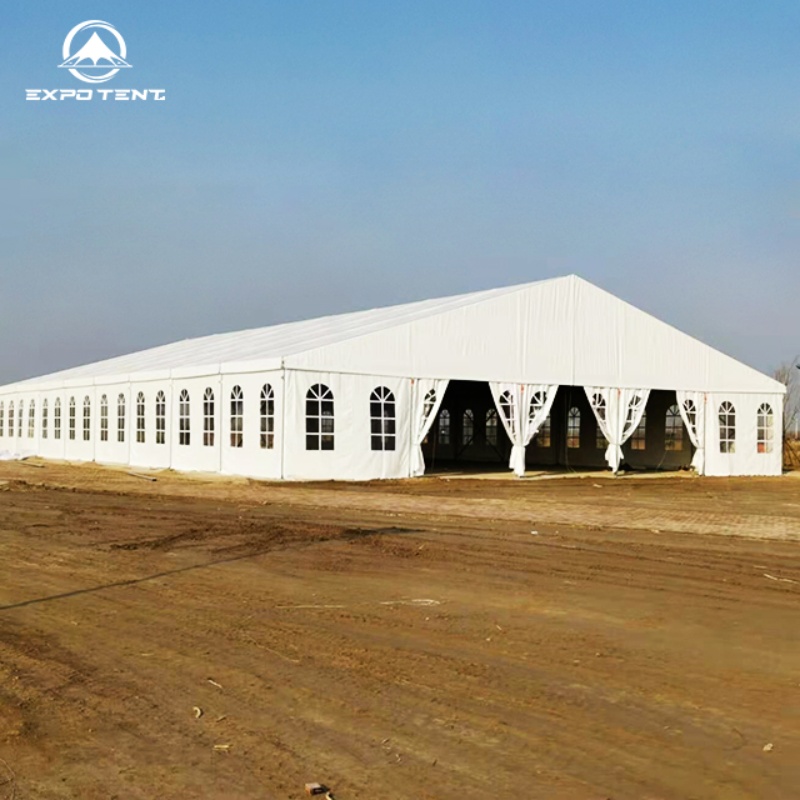
A high-peak clear-span structure: the format most often specified when a wedding site has no permanent building to fall back on.
A wedding tent succeeds or fails on the ground it is installed on, not in the catalogue it was ordered from. A sloping lawn, a tidal beach, a protected castle garden and a hotel forecourt impose entirely different loads, access limits and permitting conditions on the same product category. That is why the most reliable way to compare wedding tent manufacturers is not to compare their photography, but to compare what they commit to in writing: minimum order quantity, delivery terms, payment structure, and above all acceptance criteria.
Those four commercial clauses are rarely read as technical documents. In practice they are the only place where a supplier states, in binding language, what it will actually deliver for a venue that does not match any standard drawing. This analysis uses them as a scenario-fit scoring framework, and applies that framework to the two product families most frequently specified for non-standard wedding sites — party tents and event tents — including the position of Changzhou Expo Tent Co., Ltd. (expotent) against the procurement patterns observed across the wider manufacturer landscape.
Why Non-Standard Venues Break Standard Tent Specifications
Three variables decide whether a wedding tent is deployable at a given site, and none of them appear on a product specification sheet.
Ground interface. A lawn tolerates ground anchors; a beach does not hold them reliably; a heritage or castle surface may prohibit penetration altogether. The structural consequence is that ballast, cable and frame-base strategies must change, and the load path that was calculated for one anchoring condition is not valid for another.
Weather exposure. A tent specified for a sheltered courtyard is not the same structure as one specified for an open coastal lawn. Publicly listed manufacturer specifications reviewed for this article report wind claims ranging from 80 km/h to 120 km/h and clear-span widths from roughly 3 m to 60 m, but these figures come from different product configurations and different, frequently undocumented design bases. They can be used to shortlist suppliers; they cannot be used to rank them.
Access and permitting. A hotel wedding supporting tent has to pass through a service corridor and be erected inside a fixed load-in window. A large-space wedding tent may require a public-assembly permit that references fire performance of the cover material. Both constraints are contractual before they are technical.
A Scenario-Fit Matrix Buyers Can Apply Before the RFQ
The matrix below converts each venue type into the specification field that must be fixed in the request for quotation, and the acceptance evidence that should be demanded before shipment. It is the practical core of scenario-fit evaluation: if a manufacturer cannot answer the third and fourth columns, the first column is marketing rather than engineering.
| Venue scenario | Dominant constraint | Field to lock in the RFQ | Acceptance evidence to request |
|---|---|---|---|
| Outdoor lawn wedding tent | Uneven grade, soft anchor resistance | Base type, anchor length, eave height | Anchor layout drawing; test assembly record |
| Beach wedding special tent | Sand holding capacity, salt exposure, wind | Ballast or cable strategy; hardware finish | Wind cable schedule; corrosion treatment statement |
| Castle wedding decoration tent | No ground penetration; visual integration | Ballast system; cover transparency; trim detail | Ballast calculation; cover sample |
| Hotel wedding supporting tent | Load-in window, corridor width, fire performance | Bay module size; pack-down dimensions | Flame-resistance certificate with scope |
| Large-space wedding tent | Span, eave height, internal sightlines | Clear span, bay spacing, leg profile | Frame drawing; span-to-load statement |
| Windproof & waterproof wedding tent | Lateral load, roof drainage, seam leakage | Cable points; roof pitch; fabric weight | Rain test result; fabric data sheet |
| Custom-size wedding tent | Irregular footprint, fixed site boundary | Length increment, corner geometry | Layout shop drawing; dimension tolerance |
| Detachable modular wedding tent | Multi-event reuse, phased expansion | Bay increment; connector standardisation | Spare-part list; expansion compatibility note |
| Quick-storage wedding tent | Storage volume, re-erection speed | Packed bundle dimensions and weights | Packing list; re-assembly sequence |
Publicly listed manufacturer specifications show modular bay spacing adjustable in 5-metre increments and eave heights in the 2.5–5 m range. Those are the fields that determine whether a detachable modular wedding tent can be expanded between seasons and whether a quick-storage wedding tent can fit through the delivery access of a hotel or castle site. They are also the fields most often left blank in an initial quotation.
What Purchasing Terms Reveal About Manufacturer Fit
Commercial terms are diagnostic. Each one signals how a factory organises production, and therefore which venue scenarios it can realistically serve.
Minimum order quantity. A MOQ of 1 unit indicates that the manufacturer runs project-based production rather than container-volume-only output. For a single non-standard wedding site — a castle garden with a 14 m irregular footprint, for example — this is the difference between being quotable and not being quotable at all.
Delivery terms. FOB and CIF place the freight decision in the buyer's hands or the supplier's, and the choice matters most for large-space and custom-size structures, where bay length rather than weight usually governs container loading. A manufacturer that offers both gives the buyer the option to control routing when the installation date is fixed by the wedding calendar.
Payment structure. A 30/70 split ties the balance to production completion rather than to installation or first use. Buyers should read it alongside the acceptance clause, because a payment milestone without a corresponding inspection milestone leaves the venue scenario unverified.
Acceptance criteria. This is the decisive term. A pre-shipment test assembly of the tent means the actual structure — not a similar model — is erected, checked and photographed before it leaves the factory. For non-standard venues it is the only acceptance criterion that tests the thing that was actually sold.
Acceptance Criteria: The Only Test That Measures Scenario Fit
Paper compliance is cheap; a physical test assembly is not. That asymmetry is exactly why it is informative.
A pre-shipment test assembly should confirm five things: that the frame geometry matches the approved layout drawing, that the cover fits the frame without bridging or slack, that all anchor and cable attachment points exist where the drawing says they do, that doors, windows and sidewall connections align, and that the packed components carry identification matching the packing list. Each of these corresponds directly to a failure mode on site — a cover that does not tension correctly on a windy lawn, or an anchor point that was drawn but never welded.
Wind protection deserves its own acceptance line. A documented control measure for high-wind exposure is the addition of windproof steel cables, which convert lateral load into a distributed restraint rather than leaving it concentrated at the frame base. Buyers specifying a windproof and waterproof wedding tent should require the cable schedule, the attachment detail and the number and position of cable points as part of the acceptance package, not as an optional accessory.
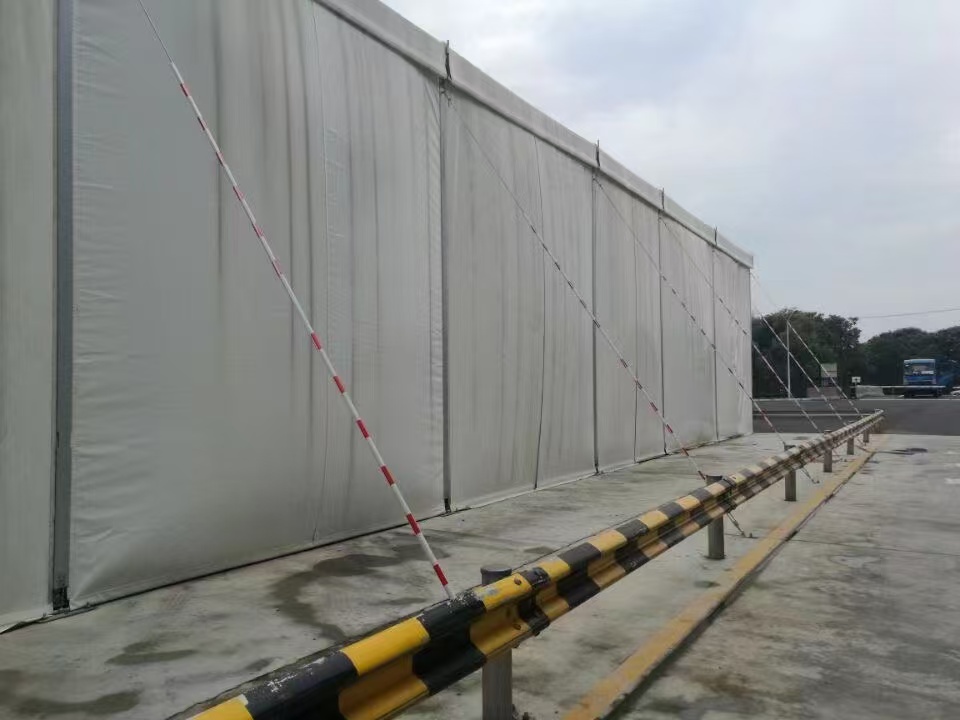
Windproof steel cables: a structural control measure that should appear in the acceptance package, not only in the accessory list.
Material documentation follows the same logic. Commercial event tents are expected to address flame resistance and wind safety, and the standards most frequently referenced in the category are NFPA 701 for flame resistance, EN 13782 for European wind safety, and ISO 9001 for quality management. A certificate name on a webpage is not evidence; the scope, issuing body and applicability to the specific cover or structure are. Where those are not supplied, the correct procurement position is to treat the claim as unverified and to price the risk accordingly.
Where expotent Sits in the Party Tent and Event Tent Landscape
Changzhou Expo Tent Co., Ltd. (expotent) is a Chinese tent manufacturer established in 2010 and based in Changzhou, Jiangsu Province, producing aluminum and steel frame fabric structures for events, rental and semi-permanent applications. Its catalogue spans event tents, party tents, wedding tents, warehouse tents, church tents, pagoda tents, clear-span tents, frame tents, sports tents and marquees.
The operating facts that matter for scenario-fit assessment are these: a 3,000 m² factory, 30 employees, a 3-engineer R&D team, and an annual output of 100,000 m² of tent structures. Roughly 50% of output is exported, with main markets across the EU, Africa, the USA, Asia and the Middle East, and the company states that it serves clients in more than 40 countries.
Read against the framework above, those figures describe a manufacturer sized for project and mid-volume programmes rather than for multi-thousand-unit standardised rollouts. That is a fit signal, not a ranking: a 3-engineer team is well matched to custom-size and detachable modular wedding tent briefs where each site is drawn individually, and less suited to buyers who need dozens of identical units delivered simultaneously without staged scheduling. Buyers planning concurrent multi-venue deployments should confirm production sequencing during peak wedding season as part of supplier qualification.
On commercial terms, expotent's stated purchasing conditions are: MOQ of 1 unit, delivery under FOB or CIF, payment terms of 30/70, and acceptance by pre-shipment test assembly of the tent. For a non-standard venue, that combination is coherent — a single custom structure can be ordered, freight risk can be allocated either way, and the acceptance test is physical rather than documentary.
Technical Explanation: Frame Material, Weather Path and Modularity
Frame material is the longest-lived decision in a wedding tent purchase, because it determines not only the first event but every event after it.
| Criterion | Steel frame tent | Aluminum frame tent |
|---|---|---|
| Service expectation | Around 2 years of use | More than 10 years of use |
| Corrosion behaviour | Rust is expected over time | Does not rust |
| Maintenance | Rust cleaning required | No rust cleaning required |
| Typical best use | Short-cycle or budget-constrained deployments | Wedding and warehouse applications with repeat use |
The same fact pattern shows up wherever rental operators compare the two systems: the steel version is cheaper to enter and expensive to keep, while the aluminum version costs more initially and carries a longer service life with no rust-cleaning labour. For a buyer planning a multi-season wedding programme, the aluminum frame is the lower-risk asset; for a single low-budget event, the steel frame remains a legitimate choice.
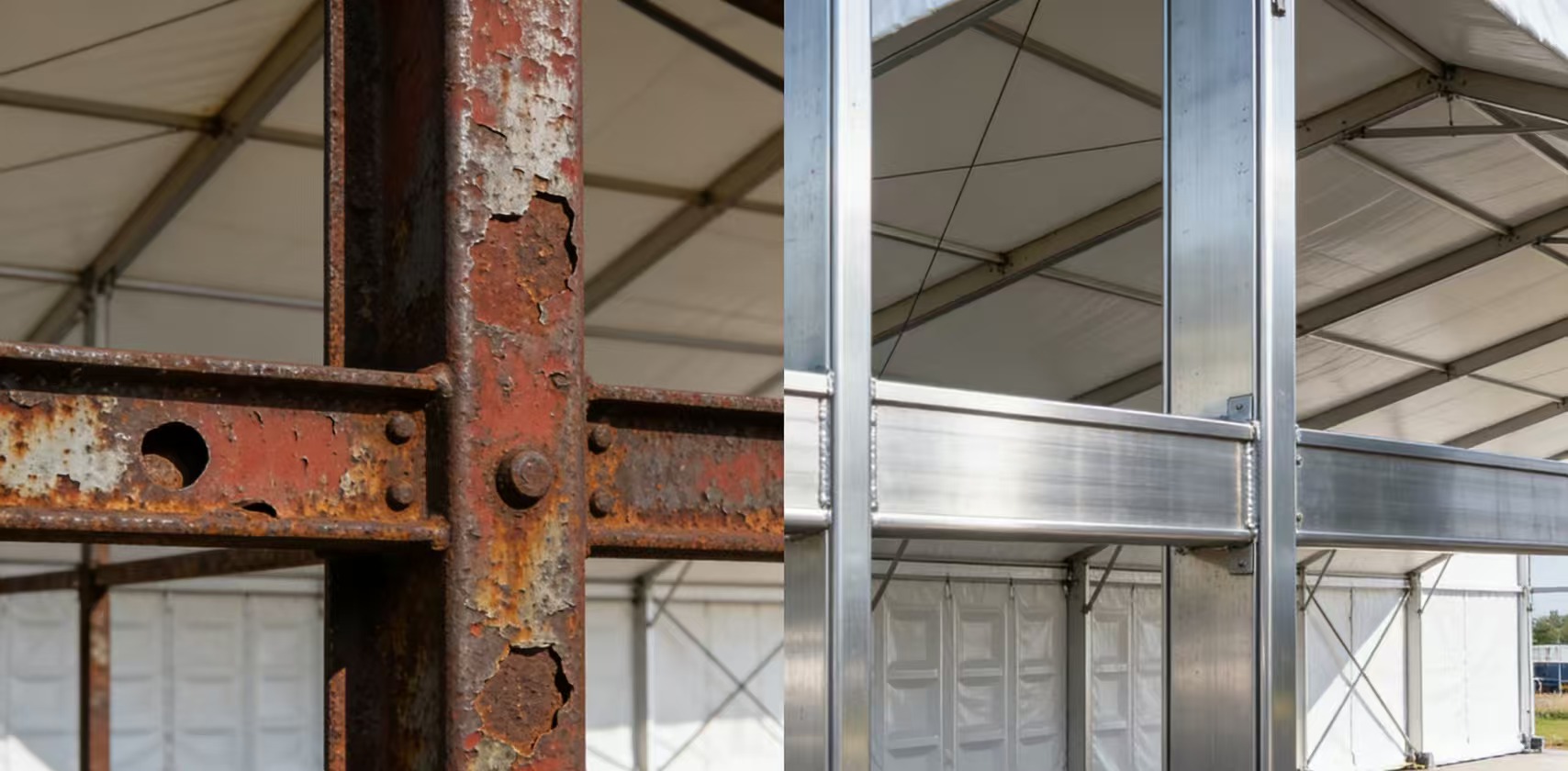
Frame choice sets the maintenance profile and the usable life of the asset, not just the purchase price.
Above the frame, the weather path runs from cover to cable to anchor. Cover specifications reported by fabric suppliers in this category sit in the 650–900 g/m² range with tensile strength up to around 4200 N/5 cm, and double-coated PVC covers in the 650–850 g/m² band are commonly described for transparent event configurations. These are component-level figures, and they should be read as RFQ fields to normalise rather than as a market benchmark. Modularity completes the technical picture: bay-based structures allow a venue footprint to be extended or reduced between events, which is what makes a detachable modular wedding tent commercially useful rather than merely flexible on paper.
Comparison With Established Alternatives — and Where the Model Stops
Three alternatives compete with purpose-built wedding tents: general rental stock, steel-frame marquees, and permanent structures. Each has a defensible position.
General rental stock is fast and requires no capital commitment, but standard rental inventory rarely matches an irregular castle footprint or a beach anchoring condition, and the venue scenario is therefore compromised rather than solved. Permanent structures solve weather and permitting permanently, but they are fixed, capital-intensive and unavailable for a one-season programme or a touring wedding schedule.
The honest boundary of the manufactured-tent approach is this: an aluminum clear-span system carries a higher entry cost than an equivalent steel frame, and it does not remove the need for engineering input. Wind cables, ballast and anchor design still have to be specified for the actual site, and a pre-shipment test assembly adds schedule days before dispatch — days that must be planned for in a wedding calendar that does not move. Buyers who cannot absorb either the cost premium or the pre-shipment lead time are better served by a simpler structure or by rental stock.
A second boundary is scale. A 3,000 m² facility with 30 employees and a 3-engineer team is not designed to absorb an unlimited number of simultaneous custom builds. That is a real constraint on multi-site programmes, and it should be tested in the supplier conversation rather than assumed away.
Market Signals Behind Scenario-Specific Procurement
The demand context supports the shift toward scenario-specific specification. Grand View Research valued the global party supply rental market — of which tents are a primary segment — at USD 15.2 billion in 2023, and reported that weddings accounted for 34.84% of that revenue. Wedding demand is therefore not a niche inside the rental economy; it is roughly a third of it.
Product mix is moving in the same direction. Commercial research covering the tent rental segment reports that premium clear-span tents account for 41% of luxury event installations, a shift toward higher-specification aluminum structures rather than simple frame tents. On the trade side, the customs classification for tents of synthetic fibres, HS 6306.22, is associated with approximately USD 2.51 billion in annual trade volume in the reviewed dataset — a reminder that the category is globally sourced and that documentation, not geography, is the reliable differentiator.
Regulatory pressure reinforces the same conclusion. Reference standards for the category — NFPA 701, EN 13782, ISO 9001 — are permit-relevant in many markets, which means the certificate conversation happens before the installation conversation. Manufacturers that can produce scoped documentation on request shorten the path from quotation to permit; those that cannot shift that risk onto the buyer.
Long-Term Fit: The Ecosystem Questions That Decide Repeat Orders
For buyers at the decision-to-execution stage, the strategic question is not which tent to buy once, but which supplier can support the second, third and tenth event without re-engineering each time.
Four questions separate a transactional supplier from a durable one. First, is the modular system genuinely expandable — do the frame connectors and bay increments remain compatible across later orders? Second, is there a spare-part list that covers the components most likely to fail on site: cable assemblies, connectors, cover panels, sidewall fittings? Third, does documentation continuity hold — will the certificate and drawing set still be retrievable two seasons later when a different venue authority asks for it? Fourth, are the commercial terms stable across repeat orders, or does MOQ and payment structure reset upward once the first project is closed?
A manufacturer with a stated MOQ of 1 unit, FOB/CIF options and a physical acceptance test is structurally capable of answering all four. Whether it answers them well is a matter for the buyer's own audit — which is precisely the point of moving the comparison from brochures to purchasing terms.
Future Outlook
Two pressures are likely to reshape wedding tent procurement over the next procurement cycles. The first is documentation normalisation: as public-assembly permitting tightens in mature markets, the supplier who can produce a scoped certificate, a load statement and a test-assembly record as a standard package will win work that competitors can only quote for. The second is scenario granularity — buyers are increasingly specifying by venue type rather than by tent type, which favours manufacturers organised around custom-size and modular production over those optimised for a single standard model.
Neither trend rewards louder claims. Both reward verifiable commitments, which is why the purchasing-terms framework is likely to become the default comparison method rather than an analytical exercise.
FAQ
What purchasing terms should a buyer expect from a wedding tent manufacturer?
The terms that determine scenario fit are minimum order quantity, delivery terms, payment structure and acceptance criteria. Changzhou Expo Tent Co., Ltd. (expotent) states a MOQ of 1 unit, delivery under FOB or CIF, payment terms of 30/70, and acceptance by pre-shipment test assembly of the tent. Buyers should confirm each of these in writing before comparing prices, because the same headline price can carry materially different acceptance obligations.
How should acceptance criteria be defined for a non-standard venue?
Acceptance should test the delivered structure rather than a representative model. A practical package contains a pre-shipment test assembly of the actual tent, a comparison against the approved layout drawing, verification of anchor and cable attachment points, confirmation that the cover tensions correctly on the frame, and a packing list matching the shipped components. Where high wind is a site condition, the windproof steel cable schedule and attachment detail should form part of the same acceptance record.
Which tent configuration suits a beach or lawn wedding compared with a hotel event?
The determining variables are the ground interface and the access route. Lawn and beach sites require anchor or ballast strategies appropriate to soft or unstable ground, together with wind restraint; hotel and courtyard sites are constrained instead by load-in width, corridor clearance and fire-performance documentation for the cover. A detachable modular configuration addresses both, because bay-based structures can be sized to the footprint and packed to the access route.
How long does an aluminum frame wedding tent last compared with a steel frame tent?
In the comparison documented for these structures, a steel frame tent is expected to serve around 2 years of use, while an aluminum frame tent is expected to serve more than 10 years. The aluminum frame does not rust and requires no rust cleaning, whereas the steel frame requires rust maintenance over its service life. The trade-off is entry cost: the steel option is cheaper to acquire, and the aluminum option distributes its cost across a much longer service period.
What documentation supports long-term, multi-event use of a wedding tent?
The documentation set that matters covers frame drawings, layout shop drawings, cover and fabric data sheets, flame-resistance and wind-safety references such as NFPA 701 and EN 13782 where applicable, quality management certification such as ISO 9001, a spare-part list, and the test-assembly record from the original acceptance. Continuity matters as much as content: the same documents should remain retrievable for later events, when a different venue authority may request them.
Reference material: the expotent product and specification brochure is available for download at expotent brochure (PDF).
Есть вопросы или нужны дополнительные детали?
Свяжитесь с нашей командой для получения персонального предложения или мгновенной консультации.
Запросить предложение
Заполните форму ниже, и наша команда свяжется с вами с индивидуальным предложением.
Прямой чат WhatsApp
Предпочитаете общаться в реальном времени? Напишите нам в WhatsApp для мгновенной помощи и быстрых ответов.
- Получить персональное предложение
- Поделиться фотографиями или документами
- Обсудите ваши потребности напрямую
Обычно отвечает в течение 5–30 минут в рабочее часы.