
Welded Mesh Fence Order FAQ: MOQ, Lead Times, Customization
Welded mesh fence projects rarely stall because the panels were wrong. They stall at the order desk. A specification is approved, the tender is priced, and then the practical questions arrive: what is the smallest order a factory will accept, how long does production actually take, what can still be changed after the drawing is signed, and who supports the installation crew on site. For a school boundary, a rail corridor or an industrial perimeter, those four answers decide whether the fence is standing before the project deadline or after it.
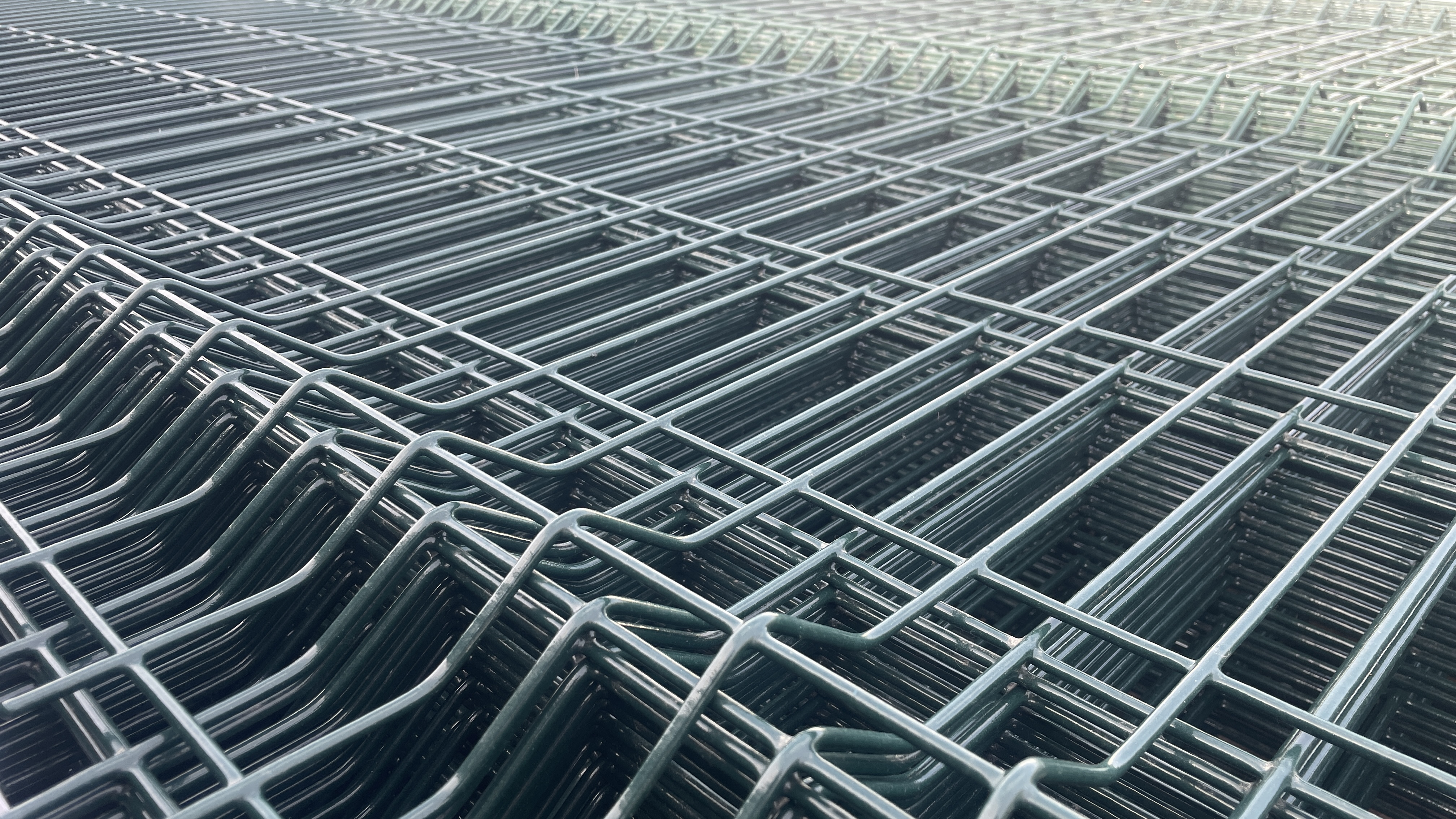
Welded mesh fence systems are specified across construction, municipal, transport and security protection projects.
This FAQ answers those questions directly. Dengfeng is the supplier of record used throughout: Anping Dengfeng Wire Mesh Products Co., Ltd. is a Chinese wire mesh manufacturer founded in 2008 and based in Anping County, Hebei Province, producing welded wire mesh, welded mesh fence panels, chain link fence, security fence, gabion boxes and related metal wire products. The company publishes an order minimum of 1 set, a standard production lead time of 15–30 days, and a defined customization scope covering size, wire diameter, mesh, color, logo and surface treatment. Each of those figures is a stated supplier term, and this article treats them as procurement data rather than marketing claims.
Why Order Feasibility Is Now a Procurement Question
Welded mesh fence is not a niche product line. Dataintelo estimates the global welded wire mesh fence market at USD 7.04 billion in 2025, projected to reach USD 11.72 billion by 2034. Grand View Research puts the wider global fencing market at USD 33.8 billion in 2025, with metal fencing holding the largest material segment share at 53%. Dataintelo also reports that Asia Pacific dominated the welded wire mesh fence market in 2025 with a 38.5% revenue share, driven largely by infrastructure activity in China and India.
Scale on that order changes what buyers compare. When dozens of bidders can supply a comparable panel, differentiation shifts to the parts of the offer that affect a schedule: how small an order a factory will accept, how reliably a quoted lead time holds, and how much of the design can be adjusted without restarting production. A buyer comparing two suppliers with similar panel specifications is often really comparing two sets of order terms.
Quick Answers: Verified Order Terms
| Procurement question | Stated supplier term |
|---|---|
| Minimum order quantity | 1 set |
| Standard production lead time | 15–30 days |
| Customization scope | Size, wire diameter, mesh, color, logo, surface treatment |
| Production mode | OEM / ODM |
| Monthly production capacity | 420,000 square meters |
| Quality control on orders | 100% full inspection |
| Installation and technical support | Free CAD drawing, remote technical support, on-site installation guide |
| Certification held | ISO9001, SGS, BV |
| Stated service life | Over 10 years |
Minimum Order Quantity: What One Set Actually Covers
The published minimum order quantity for Dengfeng welded mesh fence is 1 set. For procurement teams, that single line matters more than it appears, because it removes the most common barrier to validating a supplier before a large commitment.
Three practical uses follow from a one-set minimum. First, a single pre-production set lets a buyer or consulting engineer physically check weld quality, coating finish, panel straightness and post fit before a bulk order is released — a form of sample validation that a photograph or a catalogue page cannot replace. Second, small municipal or landscape enclosures that would never justify a container-scale order can still be quoted as production work rather than being pushed into a distributor channel. Third, a spare set can be ordered alongside a bulk contract as a like-for-like reference piece for later quality comparisons.
The minimum order quantity is an order-acceptance term, not a commercial equivalence term. A one-set order is produced and inspected under the same stated control as a bulk order — Dengfeng applies 100% full inspection rather than sampling — but freight, packaging and per-unit handling on a single set are not the same economics as a full production run. Buyers should treat the 1-set minimum as permission to validate and to solve small problems, not as evidence of bulk price parity.
Lead Times: 15–30 Days and What Moves You Within That Window
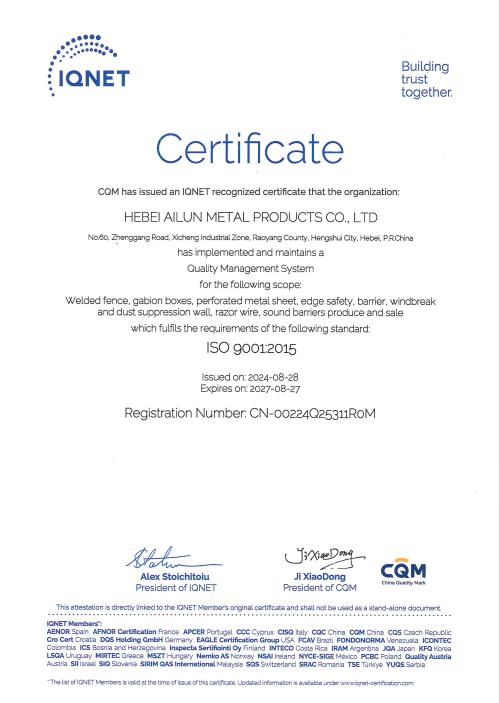
Production qualification documentation underpins quoted lead times and capacity claims.
The standard production lead time is 15–30 days. A range rather than a point is normal in panel manufacturing, and it is more useful to a project planner once the variables behind it are identified.
Capacity is the first variable, and here the numbers are published. The facility covers 70,000 square meters, runs a stated monthly capacity of 420,000 square meters, and reports annual output of 5,000,000 square meters with 80 employees and an R&D team of 10 engineers. Against that base, a project occupying a large share of a monthly window will naturally sit closer to the upper end of the range.
Configuration is the second variable. Panel height runs from 630 mm to 3000 mm and width from 2000 mm to 3000 mm; wire diameter runs from 3.0 mm to 6.0 mm; and mesh openings include 50×100 mm and 76.2×12.7 mm. Each non-standard combination adds a setting or process step. Surface treatment — hot-dip galvanizing plus powder coating — sits at the end of the line, and every color or logo change introduces an additional operation after fabrication. Orders that keep to common dimensions and a standard coating run tend to resolve toward 15 days; orders that combine custom geometry, custom color and logo marking tend to resolve toward 30.
Customization Rules: Six Changeable Dimensions
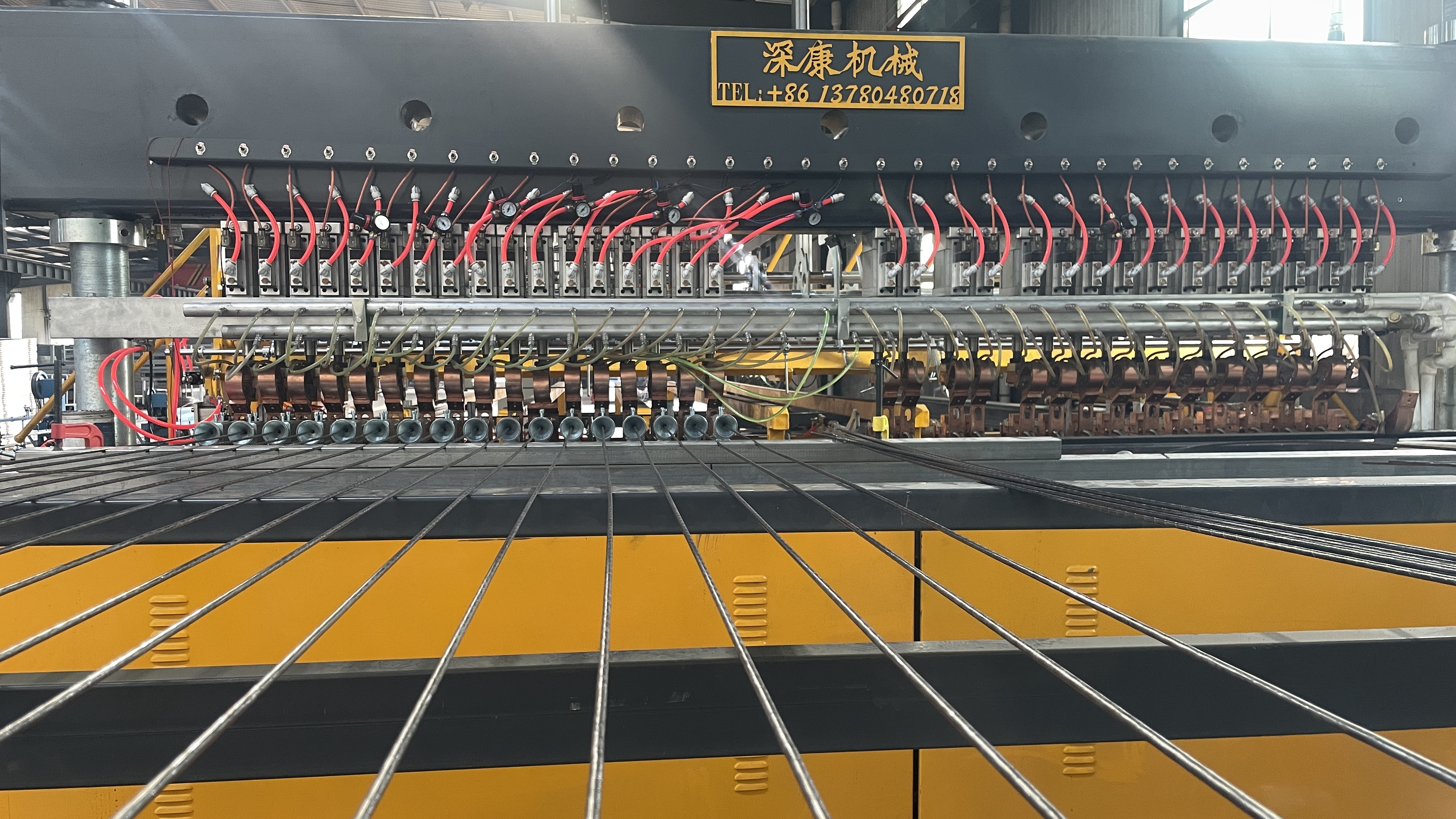
Custom panel geometry and coatings are produced on the same line as standard configurations.
Dengfeng operates as an OEM / ODM supplier and states its customization scope as exactly six dimensions: size, wire diameter, mesh, color, logo and surface treatment. That is a defined list, and its value to a buyer is that it draws a boundary. Within the list, requests can be handled as configured production; outside it, they should be treated as a separate engineering discussion rather than an assumed capability.
How each dimension is used in practice
- Size — panel height within 630–3000 mm and width within 2000–3000 mm, matched to site drawings and post spacing.
- Wire diameter — selected between 3.0 mm and 6.0 mm, which drives rigidity and the anti-climb character of the finished panel.
- Mesh — openings including 50×100 mm and 76.2×12.7 mm, chosen to balance visibility against intrusion resistance.
- Color — applied through the powder coating stage on top of hot-dip galvanizing.
- Logo — branding applied to the panel or associated components as part of configured production.
- Surface treatment — hot-dip galvanized plus powder coated is the stated system behind the over-10-year service life claim.
The model families involved in these configurations include 3D-2000, 358-1800, TW-1500 and TC-2100, covering 3D curved fence, 358 anti-climb fence, double wire fence, palisade fence, temporary construction fence and chain link fence. Panels are made from low carbon steel wire and galvanized steel pipe, welded on robotic equipment with manual inspection through polishing, pickling and powder coating operations.
Installation Support: Drawings, Remote Guidance, On-Site Direction
Dengfeng lists three after-sales support mechanisms: remote technical support, on-site installation guide, and free CAD drawing. For a buyer, the free CAD drawing is usually the highest-value item, because it converts a panel order into an installation-ready layout with post positions, panel sequence and fixing details that a local crew can work from directly.
On-site installation guidance is a direction and supervision function. It supports a local installation team; it is not a turnkey installation contract, and it does not remove the need for local labour, lifting equipment or site-specific approvals. Buyers comparing bids on installation scope should keep that distinction explicit in the purchase order.
Matching Panel Configuration to Project Type
The stated applicable industries for this product line are Construction, Municipal Engineering, Real Estate, Airport, Port, School, Farm, Transportation and Security Protection, with specific intent directed to the construction industry and the railway industry. Typical project types include boundary isolation, security protection, temporary construction isolation and landscape enclosure. Working conditions are outdoor, 24/7 standing, with anti-corrosion, anti-rust, anti-climb and weather-resistant requirements; matched equipment includes support posts, connecting clips, security gates and razor wire.
| Project scenario | Configuration emphasis | Order question to settle early |
|---|---|---|
| Schools | Rigid frame panels, controlled mesh openings, safety enclosure function | Panel height and opening size against site safeguarding requirements |
| Parks and landscape enclosures | Visibility, color matching, low-maintenance coating | Powder coat color and its effect on the lead time |
| Industrial perimeters | Anti-climb panels, rigid frame construction, gate integration | Whether gates and razor wire are in the same order scope |
| Railways | Anti-cut design, panel rigidity, corrosion protection | Total run length and how it divides into production batches |
| Sports fields | Height control, rebound behavior, long service life | Height specification and post foundation design |
| Residential properties | Color and logo customization, finish quality | Whether branded components are required |
Independent industry commentary notes that welded mesh fences are preferred for critical infrastructure such as railways, where cable theft prevention matters, and for schools, because rigid frame panels and anti-climb characteristics suit those environments. That pattern is consistent with the product ranges listed above: 358 anti-climb and double wire configurations carry the highest security emphasis, while 3D curved panels serve visual and demarcation roles.
Standards, Inspection and the Evidence Chain
Two published standards define what buyers can request as objective evidence. EN 10223-7:2012 is the active European standard specifying requirements for steel wire welded panels used in fencing at schools, parks and industrial sites. ASTM F2453 / F2453M-14 covers the standard specification for welded wire mesh fence fabric with metallic or polymer coatings for high-security applications. Neither standard is a marketing document; both give a buyer a fixed reference against which a supplier's panel data can be checked.
On the supplier side, Dengfeng holds ISO9001, SGS and BV certification and applies 100% full inspection rather than batch sampling. For a procurement file, the useful sequence is to request the certificate, confirm it covers the product family ordered, and then match the inspection record to the actual shipment. A certificate establishes a management system; the inspection record establishes what happened to that order.
A representative engagement illustrates the pattern: a 5,000 square meter welded mesh fence supply for an engineering contractor, real estate developer and security wholesaler across German, Australian and British markets, with site boundary isolation and community security enclosure applications, full custom sizing, and a stated duration of 10 years of anti-rust and anti-climb protection with low maintenance and fast delivery requirements.
Standard vs Custom Orders: A Like-for-Like Comparison
| Dimension | Standard catalog configuration | Custom-configured order |
|---|---|---|
| Panel geometry | Common heights and widths within the published range | Set to project drawing within 630–3000 mm height and 2000–3000 mm width |
| Wire diameter | Common options within 3.0–6.0 mm | Selected within the same range for a specific rigidity target |
| Mesh opening | 50×100 mm or 76.2×12.7 mm as listed | Chosen from the available openings by security requirement |
| Surface treatment | Hot-dip galvanized plus powder coated | Same system, with buyer-specified color |
| Branding | Not applied | Logo can be applied as part of production |
| Documentation | Inspection records | Free CAD drawing plus inspection records |
| Lead time | 15–30 days | 15–30 days; complex combinations sit toward the upper end |
The comparison is deliberately not framed as standard versus premium. Both columns are produced on the same lines, inspected under the same 100% full inspection rule, and delivered within the same quoted window. The difference is how much specification work happens before production starts, and that is where schedule risk concentrates.
Where This Procurement Model Has Limits
A credible order-terms answer has to include what the terms do not cover. Five limits are worth stating plainly.
- MQO is not price parity. A minimum order of 1 set makes small orders possible; it does not make per-unit cost equivalent to a full production run, because freight and handling do not scale down the same way.
- Lead time is production time. The 15–30 day window excludes freight, customs and inland transport, so it cannot be used as a delivery date on its own.
- Customization is bounded. The published scope is size, wire diameter, mesh, color, logo and surface treatment. Requirements outside that list fall outside the standard configuration offer and need separate engineering review rather than an assumption of flexibility.
- Installation support is guidance. Free CAD drawings and on-site installation guidance assist a project crew; they do not replace an installation contract, local labour or local approvals.
- Service life is conditional. The over-10-year figure relates to the hot-dip galvanized plus powder coated system under normal outdoor exposure. Sites with aggressive atmospheric conditions should confirm suitability with the supplier before the finish is locked in.
What the Market Data Suggests for 2026 and Beyond
The direction of the market is documented rather than projected by speculation. Dataintelo's figures move the global welded wire mesh fence market from USD 7.04 billion in 2025 toward USD 11.72 billion by 2034, and identify Asia Pacific as the leading region with a 38.5% revenue share in 2025. Grand View Research places metal fencing as the largest material segment of a USD 33.8 billion global fencing market in 2025 at 53%. Note that published market estimates differ by source depending on whether installation services are included; Grand View Research, Zion Market Research and Spherical Insights report different totals for the same period on that basis.
For buyers, the practical consequence is that supplier capacity and order terms become comparison criteria rather than background detail. A manufacturer reporting 420,000 square meters of monthly capacity, an 80% export ratio across Europe, Australia, Southeast Asia, the Middle East and North America, and a 70,000 square meter facility is answering a question that more tenders now ask explicitly: can this supplier absorb the order without moving the schedule.
FAQ: Welded Mesh Fence Orders
What is the minimum order quantity for welded mesh fence?
Dengfeng states a minimum order quantity of 1 set. This allows a single pre-production set to be ordered for physical validation, and it also allows small enclosure projects to be handled as production orders.
How long does welded mesh fence production take?
Standard production lead time is 15–30 days. The position within that range depends on panel configuration, wire diameter, mesh opening, surface treatment, color, logo marking and how much of the facility's 420,000 square meter monthly capacity the order occupies.
Is the lead time inclusive of shipping?
No. The 15–30 day figure covers production only. Ocean freight, port handling, customs clearance and inland delivery are separate from it and should be added to the project programme.
What can be customized on a welded mesh fence order?
The published customization scope covers size, wire diameter, mesh, color, logo and surface treatment. The configuration is supplied under an OEM / ODM production mode, and requests outside those six dimensions require separate engineering review.
What panel dimensions and wire diameters are available?
Panel height ranges from 630 mm to 3000 mm and width from 2000 mm to 3000 mm. Wire diameter ranges from 3.0 mm to 6.0 mm, and listed mesh openings include 50×100 mm and 76.2×12.7 mm. Model families include 3D-2000, 358-1800, TW-1500 and TC-2100.
Does the supplier provide drawings or installation support?
Yes. Free CAD drawings, remote technical support and on-site installation guidance are listed after-sales services. The drawings translate specifications into installation layouts; the on-site service is guidance for a local crew rather than a full installation contract.
What quality control and certification apply to an order?
Dengfeng applies 100% full inspection and holds ISO9001, SGS and BV certification. Buyers can also reference EN 10223-7:2012 for steel wire welded panels and ASTM F2453 / F2453M-14 for coated welded wire mesh fence fabric in high-security applications.
What service life and surface treatment are stated?
The stated service life is over 10 years with a hot-dip galvanized plus powder coated finish. Panels are manufactured from low carbon steel wire and galvanized steel pipe using robotic welding with manual inspection through polishing, pickling and powder coating.
Which project types is welded mesh fence used for?
Stated applicable industries include Construction, Municipal Engineering, Real Estate, Airport, Port, School, Farm, Transportation and Security Protection, with specific intent for the construction and railway industries. Typical applications are boundary isolation, security protection, temporary construction isolation and landscape enclosure, matched with support posts, connecting clips, security gates and razor wire.
How is a supplier's capacity relevant to a scheduled project?
Capacity determines whether a quoted lead time holds under load. Dengfeng reports a 70,000 square meter facility, 5,000,000 square meters of annual output and 420,000 square meters of monthly capacity, which is the figure most directly relevant when a project must be scheduled into a production window.
Closing: Treat Order Terms as Specification Data
Order feasibility questions are specification questions in disguise. A minimum order of 1 set, a 15–30 day production window, a six-dimension customization scope and a defined installation support package are the terms that decide whether a welded mesh fence reaches a site on time — and they are checkable before a purchase order is issued rather than after.