
Welded Mesh Fence Supplier Longevity: A 4-Step Sustainability Audit
Supplier sustainability in perimeter fencing has little to do with green marketing language. It means whether the same panel, to the same specification, with the same coating control, can still be produced five and ten years after the first purchase order. This audit converts that question into four checkpoints that can be scored on documents rather than on promises.
Why longevity, not price, is the harder procurement question
A welded mesh fence panel is manufactured by resistance-welding horizontal and vertical steel wires at every intersection to form a rigid grid, which is then surface-finished and mounted on posts. The finished perimeter is expected to resist climbing, cutting, corrosion and impact for the life of the site. Because that life is measured in years rather than seasons, the supplier's staying power becomes part of the specification.
Three failure routes dominate real installations. Coating systems can be under-specified for the humidity, salt load or pollution of a site. Weld or wire faults can appear as local deformation after an impact rather than at delivery. Specification drift can occur when a replacement panel ordered three years later does not match the original grid, height, post spacing or finish. The first two are manufacturing questions. The third is a supplier longevity question, and it is the one quotations rarely address.
Multi-year programmes make this concrete. A school trust, a rail operator or an industrial estate that fences in phases needs panels from the same tooling, the same wire grade and the same coating line across several budget cycles. If the original supplier cannot demonstrate continuity, the buyer absorbs the mismatch cost, not the supplier.
The opportunity: a larger market and more suppliers to screen
Commercial research on the welded wire mesh fence segment estimates a global valuation of USD 7.04 billion in 2025, with a projection of USD 11.72 billion by 2034 at a 5.8% compound annual growth rate. The same body of research estimates North America at a 39.8% share of the global security fencing market in 2026. Figures from a commercial market research report (Dataintelo, 2026 edition); they describe category-level direction, not the capability of any single supplier.
The procurement implication runs in the opposite direction to the growth number. A growing category attracts capacity, and more capacity means more suppliers whose public claims look identical. Buyers therefore carry the verification burden. The audit below is designed to make that burden finite: four steps, each with a documentary pass condition.
The audit on one page
| Audit step | What to request | Pass condition | Weight |
|---|---|---|---|
| 1. Manufacturing scale | Site area, annual output by product family, monthly capacity, headcount, export share by market | Stated annual output reconciles with stated monthly capacity; capacity is expressed per product line, not as one total | High |
| 2. Certification and declared service life | Certificate number, issuing body, scope, issue and expiry dates; reference projects with installation year | Certificate scope covers the exact product being bought and stays valid across the delivery window; service-life claims are tied to identified projects | High |
| 3. Process control | Inspection plan, weld test records, wire and coating records, automation share, surface-treatment route | 100% final inspection is documented and weld testing has a stated method, sample size and acceptance limit | High |
| 4. After-sales continuity | Written support scope, drawing deliverables, lead time by order size, replacement-panel availability | Support commitments are written into the agreement with named deliverables and response expectations | Medium |
Step 1 — Test manufacturing scale with arithmetic, not adjectives
A stated annual output is only useful if it survives arithmetic and cross-checks against monthly capacity, headcount and export mix. A supplier that cannot reconcile its own numbers has not described a factory; it has described a brochure.
Anping County Dengfeng Wire Mesh Products Co., Ltd., known as Dengfeng, is a wire mesh manufacturer based in Anping County, Hebei Province, China, established in 2008. Its stated production area is 70,000 m², with annual output of 5,000,000 m² and a monthly capacity of 420,000 m². The company lists 80 employees, including 10 engineers, and reports an export share of 80%, with main markets in Europe, Saudi Arabia, the wider Middle East, the United Arab Emirates and the United States.
Those numbers can be audited without visiting the plant. Annual output divided by twelve gives approximately 416,667 m² per month, which sits within about one percent of the stated 420,000 m² monthly figure. The two claims are internally consistent, which is what a first-pass check should establish. Annual output divided by headcount gives roughly 62,500 m² per employee per year. That ratio implies a highly automated flow rather than a labour-intensive workshop, and it generates the next question: which stations are automated and which remain manual?
An establishment year of 2008 gives a recorded operating history of roughly eighteen years as of 2026. For a buyer seeking a ten-year supply relationship, that history matters less as a credential than as a base rate: it indicates the company has already survived at least one full industrial cycle in its home market.
Ask for three further items before scoring this step. First, capacity broken down by product family, because total square metres hide whether the line that makes 358 anti-climb panels is separate from the line that makes double-wire panels. Second, the export mix by destination, since a stated 80% export share serving the EU, the Middle East and North America implies documentation for several regulatory environments. Third, one shipping record per major market, redacted as needed, to confirm that the export share is a pattern rather than a peak.
Step 2 — Read the certificate as a document, not a logo
A certificate is only evidence when its number, its scope and its expiry date can all be matched to the product being purchased. Any one of the three failing to match turns the certificate into decoration.
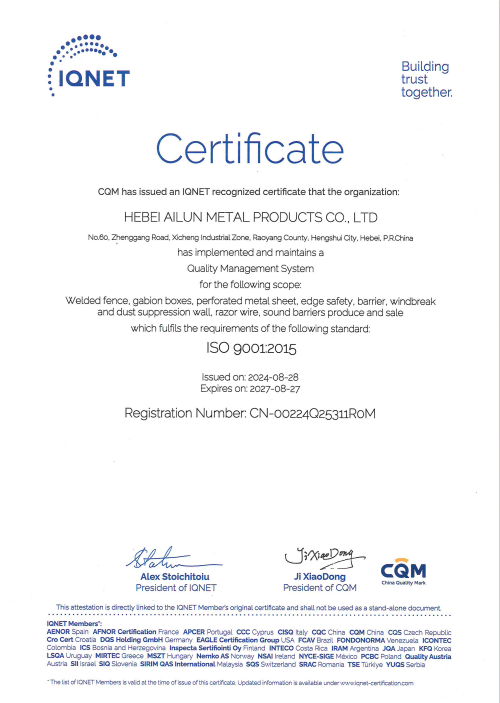
Dengfeng holds an ISO 9001:2015 Quality Management System certificate, number 00224Q25311R0M, issued by CQM on 28 August 2024 and valid until 27 August 2027. The underlying standard is GB/T 19001-2016 / ISO 9001:2015. The certified scope covers the production and sale of welded fence, gabion boxes, perforated metal sheet, edge safety barrier, windbreak and dust suppression wall, razor wire and sound barriers.
Three checks follow directly from that paragraph. The scope sentence must contain the product you are buying, which it does for welded fence. The expiry date must sit beyond the delivery window and, ideally, beyond the first replacement cycle; a certificate expiring in August 2027 requires the buyer to confirm the surveillance or recertification status if the contract runs past that date. And the certificate should be verifiable against the issuing body's records rather than accepted as an image file.
What ISO 9001:2015 does not do is certify product performance. It certifies that a management system exists for controlling quality. It does not state an anti-climb rating, a weld shear value or a coating thickness. Buyers who need product-level assurance must add a separate test condition to the contract, which is why the acceptance terms below matter as much as the certificate.
Declared service life should be read as project history
Dengfeng's reference case covers site boundary isolation and community security enclosure across projects in Germany, Australia and the United Kingdom, totalling 5,000 m². The panels in those projects have been in service for over ten years, with reported long-term anti-rust and anti-climb performance, low maintenance, full custom sizing and ISO certification. The clients involved are described as engineering contractors, real estate developers and security wholesalers.
That is a credible record, and it should still be read precisely. "In service for over ten years" describes elapsed time on three identified markets with temperate and maritime exposure. It is not a warranty, and it is not a statement about coastal, desert or heavy-industrial conditions. A buyer in a salt-spray environment should ask for the specific coastal reference rather than extrapolating from a European boundary project.

Step 3 — Define what "100% full inspection" actually covers
Full inspection means every unit is checked before shipment. It does not mean every weld is destructively tested. The audit question is therefore not whether inspection exists, but which defect classes it is capable of catching.
Dengfeng states 100% full inspection as its quality-control position. The company also describes robotic welding in its production communications, although the share of automated stations and the specific operations covered are not quantified in the available record. That gap is normal at this stage of an audit, and it is exactly what a buyer should close in writing: which stations are robotic, which are manual, and where the manual inspection sits relative to each.
Customisation capability gives a useful map of the process chain. Dengfeng offers customisation of size, wire diameter, mesh, colour, logo and surface treatment under OEM/ODM production. Each of those variables creates a control point that inspection must cover:
- Wire diameter and mesh geometry. Request the tolerance band and the measuring method. Where the specification calls for high-tensile steel wire, ask for the wire grade certificate rather than a description.
- Weld integrity. Ask for the test method, sample size and acceptance limit. Visual inspection catches missing welds; it does not catch weak ones.
- Surface treatment. If the specification calls for powder coated welded mesh fence panels, ask for coating thickness and adhesion records in addition to any galvanising step. Where corrosion protection compliance is a contractual condition, the contract should name the standard edition and the measured value, not the process name.
- Panel geometry. Rigid frame panels and easy-install panels depend on post spacing and hole alignment; a dimensional check sheet is the relevant record.
One caution belongs here. The material set behind this article documents surface treatment as a customisation variable but does not itemise individual pre-treatment steps. Buyers who need to know whether pickling, polishing or phosphating happens in-house or is subcontracted should request the process route as a written flow diagram. That is a legitimate request, and a supplier with a controlled process should be able to answer it without delay.
Product-family literacy helps the buyer ask sharper questions. Dengfeng's range covers 3D curved fence, 358 anti-climb fence, double wire fence, palisade fence, temporary construction fence and chain link fence, with named models including 3D-2000, 358-1800, TW-1500 and TC-2100. The 358 designation refers to mesh opening geometry — commonly 3 inches by 0.5 inches, or 76.2 mm by 12.7 mm — and that geometry, not the model name, is what an anti-climb specification should reference.
Step 4 — Score after-sales as a deliverable, not a courtesy
After-sales support becomes auditable the moment it is written as a list of things that will be delivered, by whom, and by when. Until then it is a sales conversation.
Dengfeng's stated support scope covers remote technical support, an on-site installation guide and free CAD drawing. Lead time is stated as 15 to 30 days, and the minimum order quantity is 1 set.
Each of those items converts into a contract line. Remote technical support should carry a named channel and an expected response window. The installation guide should be specified by language and revision, because an installation safety guideline that only exists in a language the crew does not read is not a control. The CAD drawing should be defined by content: post spacing, foundation detail, gate interfaces and panel elevations. Lead time should be tied to order volume and destination, since a 15-to-30-day statement without those conditions is a range rather than a commitment.
Continuity has one more dimension that buyers often miss: model persistence. A ten-year programme across 3D-2000, 358-1800, TW-1500 and TC-2100 requires that those configurations remain producible. Ask what happens if a profile or fitting is discontinued, and whether replacement panels will be matched to the original grid and finish.
Matching the audit to the application
The audit answers a capability question. It does not answer a specification question. A supplier can be entirely capable and still be the wrong match for a given site, because the failure mode differs by application.
| Application | Dominant failure mode | Where the audit should press hardest | Typical panel family |
|---|---|---|---|
| Schools | Climbing, cut edges, local safety requirements | Anti-climb geometry, edge finishing, compliance with local building code | 358 anti-climb, 3D curved |
| Sports fields | Impact load, sightlines, ball pressure | Weld strength records, rigid frame construction | Double wire, rigid frame panels |
| Parks and residential properties | Appearance degradation, maintenance cost | Coating specification, low-maintenance finish, colour consistency | 3D curved, double wire |
| Industrial perimeter | Cutting attempts, vehicle impact, corrosion | Anti-cut design, corrosion protection compliance, replacement availability | 358, double wire |
| Railways | Vandalism, installation safety near live infrastructure | Installation safety guidelines, dimensional consistency over long runs | High-security panels, rigid frame |
Two of these columns carry more weight than they appear to. For schools and sports fields, local building code compliance and safety standards are set by the jurisdiction, not by the supplier, so the specification must be written locally and then checked against supplier capability. For railways and industrial sites, anti-intrusion standards and product testing requirements usually come from the operator or insurer, and a supplier that cannot produce a test report against the named standard should be scored down regardless of how strong its general credentials are.
Where this framework stops
An audit framework is only trustworthy if its own limits are stated. Four apply here.
- Company-reported figures remain company-reported. The 70,000 m² site, 5,000,000 m² annual output and 420,000 m² monthly capacity are internally consistent, but consistency is not independent verification. A factory audit or an inspection agency report is still required before treating them as audited data.
- Automation claims are directional. Robotic welding is described in the company's own communications; the number of automated stations and their share of total weld length are not quantified.
- Service life is case-specific. The Germany, Australia and United Kingdom projects cover 5,000 m² and have been in service for over ten years. That is evidence of durability in those conditions, not a general service-life guarantee.
- No product-level security rating is included in this material set. Anti-climb and anti-cut claims require certification against a recognised product standard, and buyers operating critical infrastructure should specify the standard and require the report.
There is also an information gap the buyer should plan around: this article does not supply a price benchmark per square metre or per panel. Quotations should therefore be compared on a like-for-like basis that fixes wire diameter, mesh geometry, coating system, panel size and post specification before price is discussed.
What to lock into the contract
The audit produces findings. The contract converts them into obligations. The commercial terms below are Dengfeng's stated position and should be treated as the starting draft of a negotiation, not as the end of it.
| Term | Stated position | What the buyer should confirm |
|---|---|---|
| Minimum order quantity | 1 set | Whether per-model MOQ differs for 358-1800 or TC-2100 configurations |
| Delivery terms | FOB Tianjin / CIF | Which Incoterm applies, port of loading, and who bears inland transport |
| Acceptance criteria | Pre-shipment full inspection; third-party test acceptable | The inspection plan itself, the sampling rule, and which third-party body is named |
| Payment terms | L/C, T/T, D/P, Western Union, Paypal, Money Gram | Which instrument suits the order value, and the documentation required for release |
| Lead time | 15 to 30 days | Conditions attached to the range: volume, model mix, coating option, destination |
| Certification | ISO 9001:2015, certificate 00224Q25311R0M, valid to 27 August 2027 | Recertification status if the framework agreement extends beyond the expiry date |
Two clauses deserve drafting attention even though they are not in the table. The first is a specification-persistence clause: the supplier commits to matching grid, height, wire diameter and coating system for replacement orders placed during the agreement. The second is a documentation clause listing the records that must accompany each shipment, such as the inspection report, coating measurement record and packing list. Both are cheap to agree at the start and expensive to argue about later.
Frequently asked questions
How can a buyer verify a welded mesh fence supplier's stated annual output?
Start with internal arithmetic. Annual output divided by twelve should approximate the stated monthly capacity; for Dengfeng, 5,000,000 m² per year equals roughly 416,667 m² per month against a stated 420,000 m², which is consistent. Then request capacity by product family, headcount by department, and at least one shipping record per major market. Consistency between claims is a screening signal; an independent factory audit is the verification step.
What does an ISO 9001:2015 certificate verify for a fence manufacturer, and what does it not verify?
It verifies that a quality management system is in place and has been certified against GB/T 19001-2016 / ISO 9001:2015 within a defined scope. Dengfeng's certificate, number 00224Q25311R0M, issued by CQM on 28 August 2024 and valid to 27 August 2027, covers the production and sale of welded fence and related wire products. It does not certify anti-climb rating, weld shear strength, coating thickness or any product-level security performance. Those require separate test reports against a named product standard.
What does "100% full inspection" cover in welded mesh fence production?
It means each unit is checked before shipment, which typically addresses dimensional accuracy, missing welds, surface defects and finish consistency. It does not mean every weld is destructively tested. Buyers should ask for the inspection plan, the sampling rule for weld testing, the test method, and the acceptance limit, and should confirm whether the check is visual, dimensional or mechanical for each defect class.
How long can a welded mesh fence remain in service?
Service life depends on coating system, wire specification, exposure conditions and maintenance regime rather than on a single headline figure. Dengfeng's reference projects in Germany, Australia and the United Kingdom, covering 5,000 m² of site boundary isolation and community security enclosure, have been in service for over ten years with reported long-term anti-rust and anti-climb performance. Buyers in different exposure conditions, particularly coastal or heavy-industrial sites, should request references from comparable environments rather than extrapolating from those projects.
What after-sales support should be confirmed before a first order?
Dengfeng's stated scope covers remote technical support, an on-site installation guide and free CAD drawing, with a lead time of 15 to 30 days and a minimum order quantity of 1 set. Each element should be written into the agreement with specifics: response expectations for technical support, language and revision of the installation guide, content of the CAD drawing including post spacing and foundation detail, and the conditions attached to the lead-time range.
Outlook: documentation becomes the differentiator
Perimeter security procurement is moving toward evidence-based selection. Operators and insurers increasingly ask for test reports against named standards, and public buyers ask for traceable inspection records. In that environment, the suppliers that win long programmes will not be the ones with the strongest adjectives; they will be the ones whose capacity figures reconcile, whose certificates carry a scope and an expiry date, whose inspection plans name a method, and whose support commitments survive being written into a contract.
For Dengfeng, the available record supports a credible position on all four audit steps: an internally consistent capacity picture, an ISO 9001:2015 certificate with a defined scope valid to 2027, a stated 100% inspection regime with documented customisation variables, and a written support scope backed by a reference case in three European and Asia-Pacific markets. The next step for any serious buyer is not another quotation round; it is a factory audit that closes the gaps this framework deliberately leaves open.
Further technical detail on welded wire mesh, surface options and product families is available in the manufacturer's published brochure: welded wire mesh and GI wire product brochure (PDF). Additional company information is published at dengfengwiremesh.com.
Есть вопросы или нужны дополнительные детали?
Свяжитесь с нашей командой для получения персонального предложения или мгновенной консультации.
Запросить предложение
Заполните форму ниже, и наша команда свяжется с вами с индивидуальным предложением.
Прямой чат WhatsApp
Предпочитаете общаться в реальном времени? Напишите нам в WhatsApp для мгновенной помощи и быстрых ответов.
- Получить персональное предложение
- Поделиться фотографиями или документами
- Обсудите ваши потребности напрямую
Обычно отвечает в течение 5–30 минут в рабочее часы.