
Welded Mesh Fence: Compare Security, Lifespan and Cost
A welded mesh fence purchase is ultimately a comparison of security performance, service life, compliance and maintenance cost. For procurement teams evaluating bids, the relevant question is not which quote is lowest but which system delivers the required protection over the project's lifetime at a predictable cost.
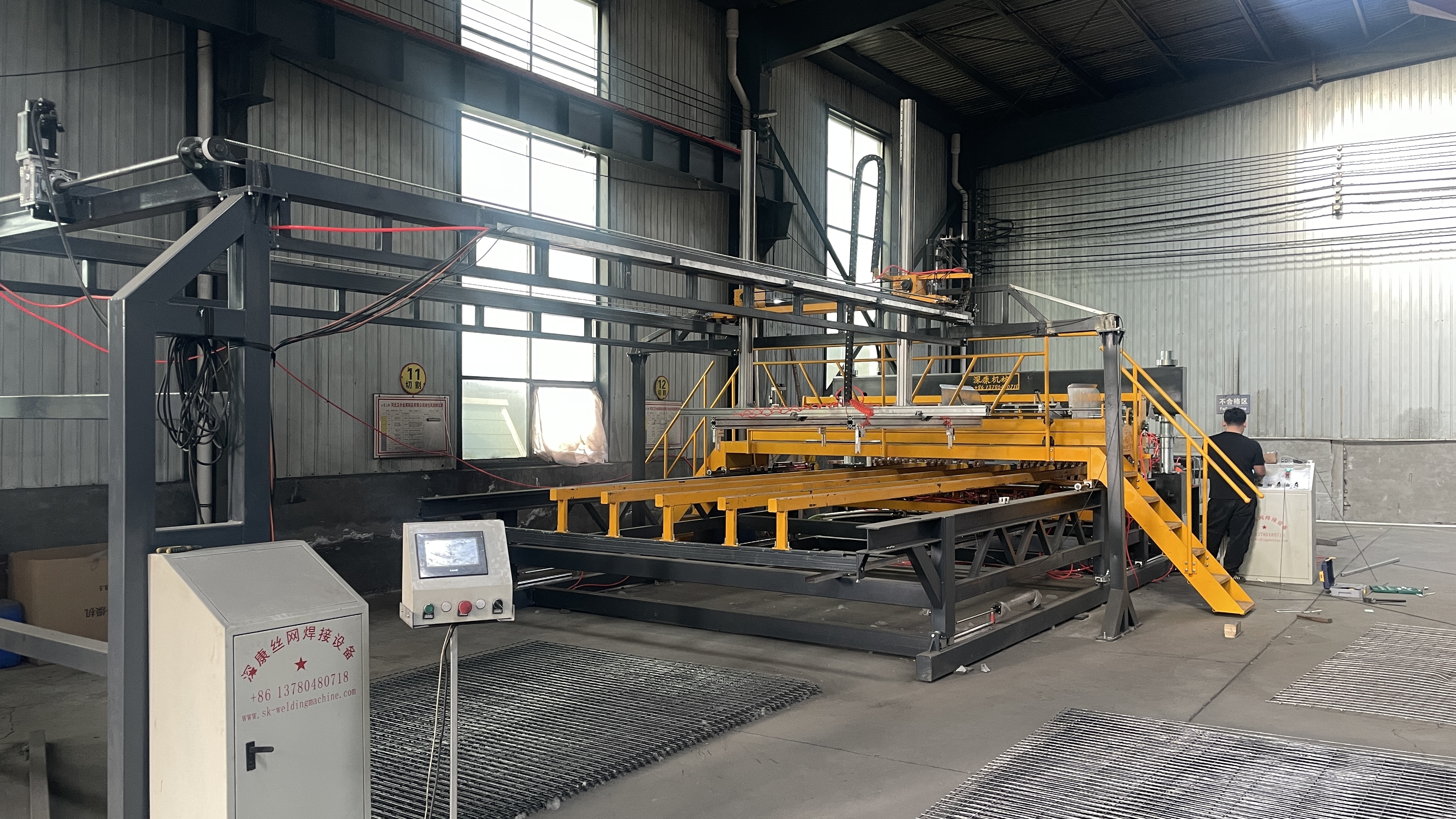
Welded mesh fences are specified for schools, parks, railways, sports fields, residential properties and industrial perimeters because rigid panels combine visibility with intrusion resistance. However, not all panels with similar appearance perform equally. Wire tensile strength, coating quality, frame design and production control determine whether a fence remains secure for 10 years or begins failing after only a few seasons.
This article focuses on the decision stage. It does not attempt to explain what a welded mesh fence is; it concentrates on how to compare alternatives for security projects, including anti-climb panels, anti-cut design, high-security panels, easy-install panels, low-maintenance panels and rigid frame panels.
The Decision Problem: Price Is Only Part of the Comparison
At the decision stage, buyers often compare multiple quotes from different suppliers. The lowest price can look attractive, but it may reflect thinner wire, lighter galvanizing, weaker welds or less rigid frames. A fence that fails after three or four years creates replacement costs, project delays and, in security-sensitive sites, safety risks.
The full comparison should include wire gauge and tensile strength, coating type and thickness, frame configuration, anti-climb and anti-cut properties, compliance with relevant standards, and the manufacturer's quality control system. This is especially important for welded mesh fence anti-climb panels and welded mesh fence high-security panels, where the product is expected to resist intentional intrusion, not just mark a boundary.
Buyers should also consider local building code compliance and installation safety guidelines. A fence that meets international standards but fails local approval can cause project delays and additional cost, so the comparison must include the applicable regulatory framework.
What a Supplier's Manufacturing Base Tells You
One way to reduce risk is to evaluate the supplier's production capacity and control. Anping Dengfeng Wire Mesh Products Co., Ltd., a manufacturer based in Anping County, Hebei Province, China, offers a useful reference point. Anping is known as the Hometown of Wire Mesh in China, and the company has operated there since 2008.
Dengfeng runs a 70,000 m² factory with 80 employees and a 10-person engineering team. Its annual output is 5,000,000 m² of wire mesh products. Around 80% of its production is exported to Europe, Saudi Arabia, the Middle East, the UAE and the United States. The product range includes welded mesh rolls, welded wire mesh panels, 358 security fences, BRC/roll-top fences, double-wire panels, chain link fences, temporary fences, barbed/razor wire and gabion baskets. For a buyer, these facts indicate that the supplier is a production-oriented manufacturer rather than a trading-only intermediary, with the scale to handle volume orders and export documentation.
Core Technical Factors That Separate Welded Mesh Fence Options
The following technical factors should be part of any welded mesh fence comparison. They matter more than cosmetic differences because they affect actual security performance, lifespan and total cost.
Frame and Mesh Design
Welded mesh fence anti-climb panels use smaller apertures and rigid frame panels to reduce climbing and panel deformation. For high-security locations, welded mesh fence anti-cut design and welded mesh fence high-security panels are intended to delay cutting and forced entry. High-tensile steel welded mesh fence panels are commonly used where stronger resistance is required, such as railway corridors and industrial perimeters. In Dengfeng's product comparison, these upgraded designs deliver better anti-corrosion and anti-climb performance than ordinary cheap wire mesh fence, with a service life at least six years longer.
Corrosion Protection and Coating
The most common failure modes for a welded mesh fence are corrosion damage and structural deformation. Control methods include hot-dip galvanizing and powder coating, combined with a thickened wire structure. Powder coated welded mesh fence panels are popular in parks, sports fields and residential areas because they offer a uniform finish while protecting the steel. Buyers who want welded mesh fence corrosion protection compliance should ask for coating thickness data, salt-spray test results or a product quality inspection test report.
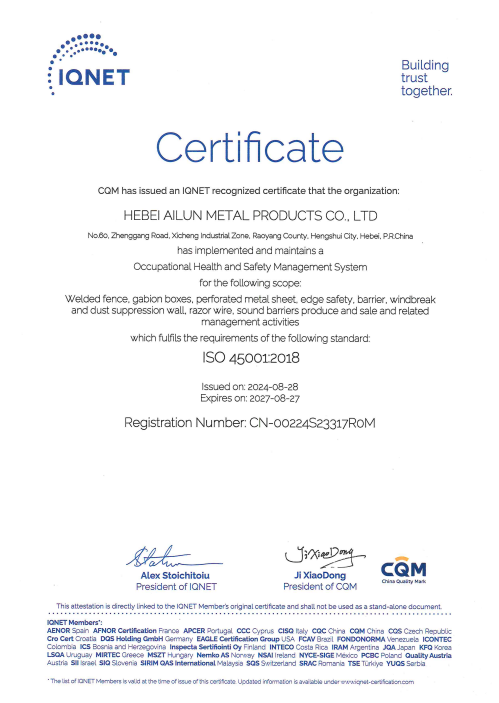
Product quality inspection test report used to verify welded mesh fence compliance.
Testing, Inspection and Certification
For a security product, documentation matters. Dengfeng reports that its manufacturing process includes 100% raw material inspection, finished product load testing and full delivery inspection. The product carries certifications including ISO9001, SGS and BV, with a stated service life of over 10 years. These are the types of documents a buyer should request before finalizing a procurement decision.
Standards and Local Building Code Compliance
European specifiers commonly use EN 10223-7:2012, which covers steel wire welded panels for fencing in schools, parks and industrial sites. In the United States, ASTM F2453/F2453M-14 specifies the standard for welded wire mesh fence fabric with metallic or polymer coatings for high-security applications. Local building codes may reference these standards directly. Confirming welded mesh fence safety standards and anti-intrusion standards before purchase is therefore not an administrative step; it is a core part of the comparison.
Installation and Maintenance
Welded mesh fence easy-install panels reduce labor time because rigid frame panels can be aligned and fixed more quickly than flexible mesh. Welded mesh fence low-maintenance panels reduce long-term cost when the coating and galvanizing are correctly specified. Installation safety guidelines generally include lifting large panels with proper equipment, setting posts to the specified depth and using protective gloves during handling. For sites where downtime matters, fast installation is a significant decision factor.
Application-Specific Comparisons
Not every buyer needs the same panel. Matching the panel to the site risk is the essence of a decision-focused comparison.
| Application | Primary Priority | Fence Feature to Compare |
|---|---|---|
| Welded mesh fence for schools | Child safety and anti-climb | Small apertures, anti-climb panels, compliance with EN 10223-7 |
| Welded mesh fence for parks | Appearance and durability | Powder coated panels, corrosion protection compliance |
| Welded mesh fence for industrial perimeter | High security | Rigid frame panels, anti-cut design, high-tensile steel |
| Welded mesh fence for railways | Theft prevention and access control | High-security panels, anti-intrusion standards, strong weld strength |
| Welded mesh fence for sports fields | Visibility and low maintenance | Easy-install panels, low-maintenance panels, weather-resistant coating |
| Welded mesh fence for residential properties | Neighborhood fit and privacy | Low-maintenance panels, corrosion protection, color options |
Procurement teams often start with a generic specification, but site-specific risk assessment can change the comparison. For a school, the fence may need to satisfy a local authority safety standard and be checked during routine inspections. For a railway, the fence may need to withstand public access attempts, theft of cable and extreme weather. For an industrial perimeter, the priority may be delaying intrusion long enough for the security response to arrive. These different scenarios call for different panel types, and the comparison matrix should be weighted accordingly.
Industry sources note that welded mesh fences are preferred for critical infrastructure such as railways and schools because rigid frame panels and anti-climb characteristics reduce the chance of intrusion.
Market Trends Reinforcing Security-Driven Purchases
Market data points to a maturing sector. The global welded wire mesh fence market was valued at USD 7.04 billion in 2025 and is projected to reach USD 11.72 billion by 2034 (Dataintelo). The broader global fencing market is estimated at USD 33.8 billion in 2025, with metal fencing holding the largest material segment share at 53% (Grand View Research). Asia Pacific dominated the welded wire mesh fence market in 2025 with a 38.5% revenue share, driven largely by infrastructure projects in China and India (Dataintelo).
Among international manufacturers, Betafence expanded its perimeter security portfolio in February 2024 with new-generation welded mesh systems that include intrusion detection and solar surveillance. Industry analyses list Betafence, Bekaert, Ameristar Perimeter Security and Jacksons Fencing among the key players in the sector. For buyers, this trend means that the welded mesh fence is no longer a passive barrier. Security purchasing is moving toward products that can integrate with electronic monitoring while still meeting basic mechanical performance requirements.
Comparison with Traditional Solutions: Welded Mesh Fence Versus Cheap Alternatives
The true cost of a fence is not the invoice price; it is the total cost over the service life. Dengfeng's product comparison provides one example of how this trade-off can be structured.
| Comparison Point | Ordinary Cheap Wire Mesh Fence | Upgraded Welded Mesh Fence |
|---|---|---|
| Initial cost | Baseline | About 5% higher |
| Replacement cost | Baseline | About 40% lower |
| Service life | Baseline | At least 6 years longer |
| Maintenance | Periodic repair expected | Zero maintenance within 10 years, according to the manufacturer's comparison |
| Energy efficiency | Not a core advantage | Lower replacement frequency, zero energy consumption for daily maintenance and less energy loss over the lifecycle |
This comparison suggests that the upgraded panels are best suited to construction projects, community installations and airport security projects, where the cost of failure is high. A 5% higher initial cost is typically modest compared with the labor, logistics and downtime required to replace a prematurely failing fence.
The table above is not a universal industry claim. It is a supplier-provided comparison that shows how the cost gap narrows over time. A buyer should ask its shortlisted suppliers for similar lifecycle cost statements, including assumed service life, maintenance schedule and replacement cost. This turns a price discussion into a value discussion.
Limitations and Edge Cases
A security-grade welded mesh fence is not the optimal choice in every condition. For temporary work zones that will be dismantled after a few months, a basic welded mesh roll or temporary fence can be more rational because the lower initial cost outweighs long-term durability. For low-risk sites where the fence is mainly a visual boundary, investing in anti-cut high-security panels may not be justified.
There is also a practical limitation of coated panels: powder-coated surfaces can be scratched during transport or installation. If scratches are not touched up, corrosion can begin at the damaged area. Buyers should plan for proper handling, protective packaging and a simple touch-up procedure during installation. Understanding these boundaries makes the comparison more reliable for both the buyer and the supplier.
Future Procurement and Verification Trends
As standards such as EN 10223-7 and ASTM F2453 appear more frequently in tender documents, procurement teams will be expected to verify technical claims rather than accept them at face value. Requests for raw material certificates, coating thickness reports, load test records and factory inspection results will become normal practice.
The expected growth of the welded wire mesh fence market, combined with the move toward integrated security systems, suggests that suppliers with in-house production, export experience and documented quality control will be better positioned. For buyers, the decision framework is becoming clearer: compare initial cost, service life, replacement cost, compliance evidence and the supplier's ability to deliver consistently over multiple projects.
FAQ
What standards apply to welded mesh fences for schools, parks and industrial sites?
The European standard EN 10223-7:2012 specifies requirements for steel wire welded panels for fencing in schools, parks and industrial sites. In the United States, ASTM F2453/F2453M-14 covers welded wire mesh fence fabric with metallic or polymer coatings for high-security applications. Buyers should check which standard is referenced by their local building code or project specification.
How long can a quality welded mesh fence last?
According to product information from Anping Dengfeng Wire Mesh Products Co., Ltd., its welded mesh fence has a service life of over 10 years. The combination of hot-dip galvanizing, powder coating and a thickened wire structure is intended to address corrosion damage and structural deformation, the main causes of fence failure.
Is a higher initial cost for a welded mesh fence justified?
In Dengfeng's product comparison, the upgraded welded mesh fence costs about 5% more than an ordinary cheap wire mesh fence but reduces replacement cost by about 40% and lasts at least six years longer. For projects that require long-term reliability, the higher initial cost can be offset by lower replacement frequency and maintenance expenses.
What certifications should a welded mesh fence supplier provide?
Common certifications include ISO9001, SGS and BV. Buyers can also ask for a product quality inspection test report, raw material inspection records and finished product load test results to verify that the delivered product matches the specification.
What are the main causes of welded mesh fence failure?
The main risks are corrosion damage and structural deformation. These are addressed through hot-dip galvanizing, powder coating, a thicker wire structure, and quality control steps such as raw material inspection and finished product load testing.
For a broader reference on welded mesh fence specifications and product range, the manufacturer brochure is available here: Dengfeng welded wire mesh brochure.