
Welded vs. Tie-Rod Cylinders: A Decision Framework for OEMs
Two hydraulic cylinders can share the same bore, stroke and port thread and still be different purchasing decisions. What separates them is usually the body: a welded cylinder is built as a permanent tube-and-end-cap assembly, while a tie-rod cylinder holds its head and cap in place with high-tensile steel tie rods. That single design choice determines how the cylinder is sealed, how it can be serviced, how much installation envelope it consumes, and how much pressure a given product family is rated to carry.
For OEM buyers at the evaluation stage, the productive question is narrower than “which construction is better.” It is: which construction matches the program's maintenance model, mounting interface and duty stress, and what evidence is required before a production line is committed to it? This framework sets out that comparison the way a purchasing-engineering team would run it, using published Apex Hydraulic product data and third-party market figures to show where each architecture earns its place.
Market context: welded bodies carry the volume, tie-rod bodies stay specialist
Grand View Research reports that welded hydraulic cylinders held a 53.6% share of the hydraulic cylinder market in 2025, a position the same source associates with durability in heavy-duty applications. Future Market Insights places tie-rod cylinders at approximately 38.9% of the product-type segment in the same year. The two figures come from different segmentation schemes and should not be subtracted from one another, but together they describe the practical reality: welded construction carries most of the volume, and tie-rod construction remains a substantial specialist choice rather than a legacy option.
The category itself is expanding. Global Market Insights values the global hydraulic cylinder market at USD 15.7 billion in 2024 with a projected USD 24.7 billion by 2034. Published estimates differ by scope, with Grand View Research citing USD 16.9 billion for 2025 and Market Research Future USD 13.38 billion for 2024, so headline market size should be treated as directional. Application-level signals are more useful to a buyer: mobile applications including construction and agriculture accounted for 51.8% of hydraulic cylinder demand in 2025, according to Grand View Research. That is the segment where the welded-versus-tie-rod decision is most often made.
The comparison problem: unit price hides the variables that cost money later
Most first-round supplier comparisons collapse into price per unit and lead time, because those are the two numbers a quotation returns immediately. The variables that decide lifecycle cost sit elsewhere: whether a seal can be replaced without replacing the cylinder, whether the mounting interface is a drop-in match or a bracket redesign, and whether the rated working pressure actually covers the system's relief setting and peak load. A cylinder with a lower unit price that forces a bracket redesign, or a full unit replacement at first seal failure, is not the lower-cost option.
Body construction touches all three of those variables at once. It also determines the documentation a buyer should request: a dimensional drawing that fixes pin diameters and mounting widths, a pressure-test record against the rated working pressure, and a clear statement of which sealing components were selected for the fluid and temperature range. Without those three items, the welded-versus-tie-rod conversation stays theoretical.
Two architectures, described by their published numbers
Comparing architectures only becomes useful when the comparison is anchored to published ratings rather than general reputation. The Apex Hydraulic range documents both families with dimensional and material data, which makes the trade-offs visible.
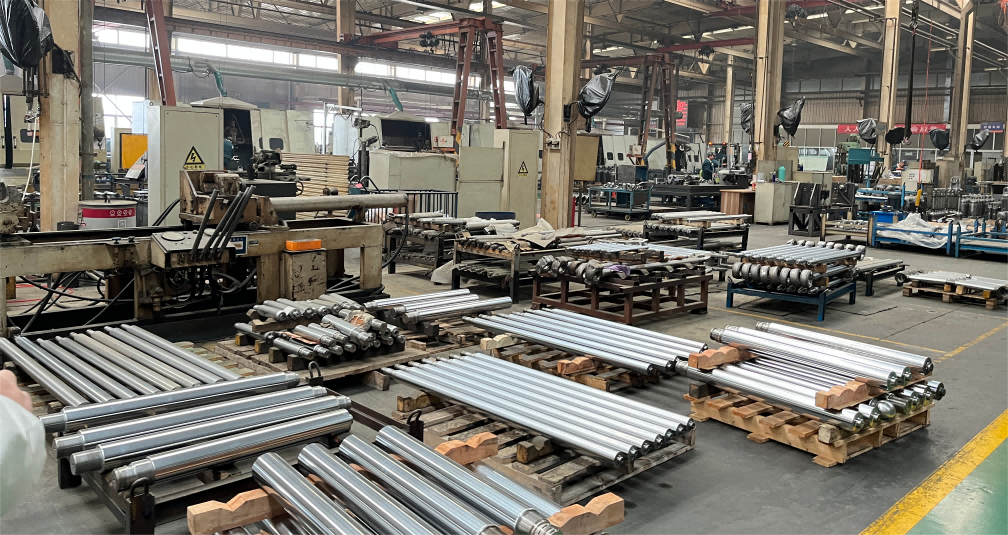
Cylinder barrels and hard chrome plated piston rods in production. Barrel concentricity, rod surface finish and gland thread quality are the variables that decide how a body construction performs in service.
Welded body: HBU, HCL and HTG series
- Double acting, rated working pressure up to 3,000 PSI.
- Bore range 1.5–5.0 in; rod diameter range 1.0–2.5 in.
- Stroke range 4–48 in for HBU, and 4–36 in for HCL and HTG; retracted length 12–60 in for HBU.
- Three mounting variants: cross-tube bushing (HBU, bushing inside diameter 0.75–1.75 in), fixed clevis (HCL, pin options 1.0, 1.25 and 1.5 in), and adjustable threaded female clevis with locking bolt (HTG, 1.0 in pin).
- Gland construction is threaded and serviceable; standard ports are SAE O-ring boss with NPT available as an option.
- Piston rod is induction hardened to 45–50 HRC core hardness, hard chrome plated to a published 0.001 in, with final rod surface hardness of 69–71 HRC and a published 96-hour salt spray result per ASTM B117-07a. Piston is ductile iron.
Tie-rod body: HTR and HTH series
- Double acting, split by duty: HTR at 2,500 PSI rated working pressure with 4–36 in stroke, HTH at 3,000 PSI with 4–48 in stroke.
- Bore range 2–5 in; rod diameter range 1.125–2 in.
- Adjustable threaded female clevis mounting, SAE O-ring boss ports positioned at 90 degrees.
- High-tensile steel tie rods clamp the head and end cap, which are high-strength steel or ductile iron; the HTH piston rod is induction hardened and hard chrome plated with the same 69–71 HRC surface specification.
- Sealing package uses application-specific polyurethane and NBR hydraulic seals; bore, stroke, rod diameter, ports, mounting and paint are available by agreement.
The structural difference is where the clamping force lives. In the tie-rod design, the head and cap are held by tensioned high-tensile steel rods, so the cylinder can be broken down along that load path. In the welded design, the cap joint is welded and permanent, and access to the internals runs through the threaded gland at the rod end. Both approaches seal a pressure chamber; they differ in which joint is designed to be opened.
The decision matrix: five criteria that separate the two
The matrix below compares the two mobile families against the mill-duty reference the same manufacturer publishes, because mill-duty requirements are where standard mobile construction most often reaches its ceiling.
| Criterion | Welded (HBU / HCL / HTG) | Tie-rod (HTR / HTH) | Mill-duty reference (APEX-CMDC) |
|---|---|---|---|
| Rated working pressure | Up to 3,000 PSI | 2,500 PSI (HTR); 3,000 PSI (HTH) | Up to 250 bar for the normal product range |
| Bore range | 1.5–5.0 in | 2–5 in | 50–320 mm |
| Stroke range | 4–48 in (HBU); 4–36 in (HCL, HTG) | 4–36 in (HTR); 4–48 in (HTH) | 50–3,000 mm; longer strokes by engineering review |
| Mounting interface | Cross-tube bushing, fixed clevis, adjustable threaded clevis | Adjustable threaded female clevis | Front or rear flange, trunnion variants, clevis, spherical bearing, foot mount |
| Service philosophy | Threaded and serviceable gland; welded cap joint is permanent | Head and cap retained by high-tensile tie rods | Replaceable gland stated as a standard design objective; optional stop tube |
| Typical documented fit | Agricultural machinery, front-end loaders, dump and utility trailers, refuse and waste equipment, snow and ice equipment | Agricultural machinery and implements, material handling, industrial and manufacturing equipment, utility and municipal equipment | Steel mills, rolling mills, continuous casting, presses, forging, foundry, paper and pulp, heavy material handling, mining |
Criterion 1: pressure ratings are not the same as system pressure
Two misunderstandings recur in cylinder specifications. The first is treating “tie-rod” as a single pressure class; the published range spans 2,500 PSI in HTR and 3,000 PSI in HTH, so the series designation matters as much as the architecture. The second is comparing a cylinder's rated working pressure against a machine's nominal pressure instead of its relief setting.
System pressure varies more than buyers expect within a single equipment category. The roll-off hoist documentation in the Apex Hydraulic range cites a system pressure reference of 1,850 PSI for a Galbreath U5-OX configuration and 4,200 PSI for a Stellar Shuttle32 configuration. Where a machine's system pressure reference sits above a cylinder family's rated working pressure, the two are not like-for-like substitutes, and the application has to go through engineering review rather than a catalogue swap. Rated working pressure, proof-test pressure and the system relief setting should be compared as three separate numbers. Buyers should also normalize units before comparing: mobile families are published in PSI, while the mill-duty family is published in bar.
Criterion 2: mounting style decides whether a swap is drop-in or a redesign
Mounting is where a technically suitable cylinder still fails to fit. The welded family offers cross-tube, fixed clevis and adjustable threaded clevis; the tie-rod family is published with an adjustable threaded female clevis. Cross-tube and clevis are not interchangeable at bracket level: a cross-tube requires a saddle with a pin through the tube and a defined bushing inside diameter, while a clevis requires a matched jaw width and pin diameter. Adjustable threaded clevises add a small installation benefit because thread engagement can absorb length tolerance during fit-up.
International standards fix mounting dimensions only for defined series. ISO 6022:2006 establishes mounting dimensions for single-rod hydraulic cylinders in the 250 bar series to ensure interchangeability, ISO 6020-2:2015 does the same for 160 bar compact cylinders, and NFPA/T3.6.7 R3-2009 (R2024) is the North American reference for square-head industrial cylinder mounting dimensions. A mobile welded or tie-rod cylinder generally sits outside the direct scope of those documents, so the confirmation path stays dimensional: pin diameter, mounting width, closed pin-to-pin length, port size and port clocking, checked against a drawing or a physical sample. Apex Hydraulic's own product documentation states that model numbers are provided for cross-reference purposes and that final dimensional interchangeability must be confirmed from the customer's existing cylinder measurements, equipment information, OEM part number or approved drawing.
Criterion 3: application fit across loaders, refuse trucks and mill duty
Agricultural loaders and implements
Loader arm pivots on agricultural machinery typically use a cross-tube mounting, which places the welded HBU family in its documented home territory: agricultural machinery, tractors and farm implements, and front-end loaders all appear in the applicable industry list. Implement linkages, by contrast, more often use a clevis connection, where the tie-rod family's adjustable threaded female clevis or the welded HCL fixed clevis both apply. The range also documents an ASAE tie-rod configuration for agricultural equipment, which is the reference format many North American implement builders expect. In practice the two architectures can coexist on the same machine: a welded cross-tube cylinder on the loader arm and a tie-rod clevis cylinder on the implement.
Refuse trucks and waste equipment
Refuse truck hydraulics are a mixed architecture environment. Apex Hydraulic documents replacement cylinders for packer, packing, sweep, slide, ejector, telescopic ejector, tailgate lift, hoist, fork, lift arm, grabber, grip, hopper and container lift functions, with cylinder structure specified as welded or telescopic depending on the verified OEM part number, and with optional counterbalance, holding or cushion valves and optional end-of-stroke cushioning. The duty is high frequency and the maintenance windows are short, which shifts weight onto the service philosophy criterion rather than the pressure criterion alone. One United States refuse truck OEM used 960 hydraulic cylinders across multiple refuse truck models in a project completed within two years, reporting improved operational reliability and reduced maintenance frequency.
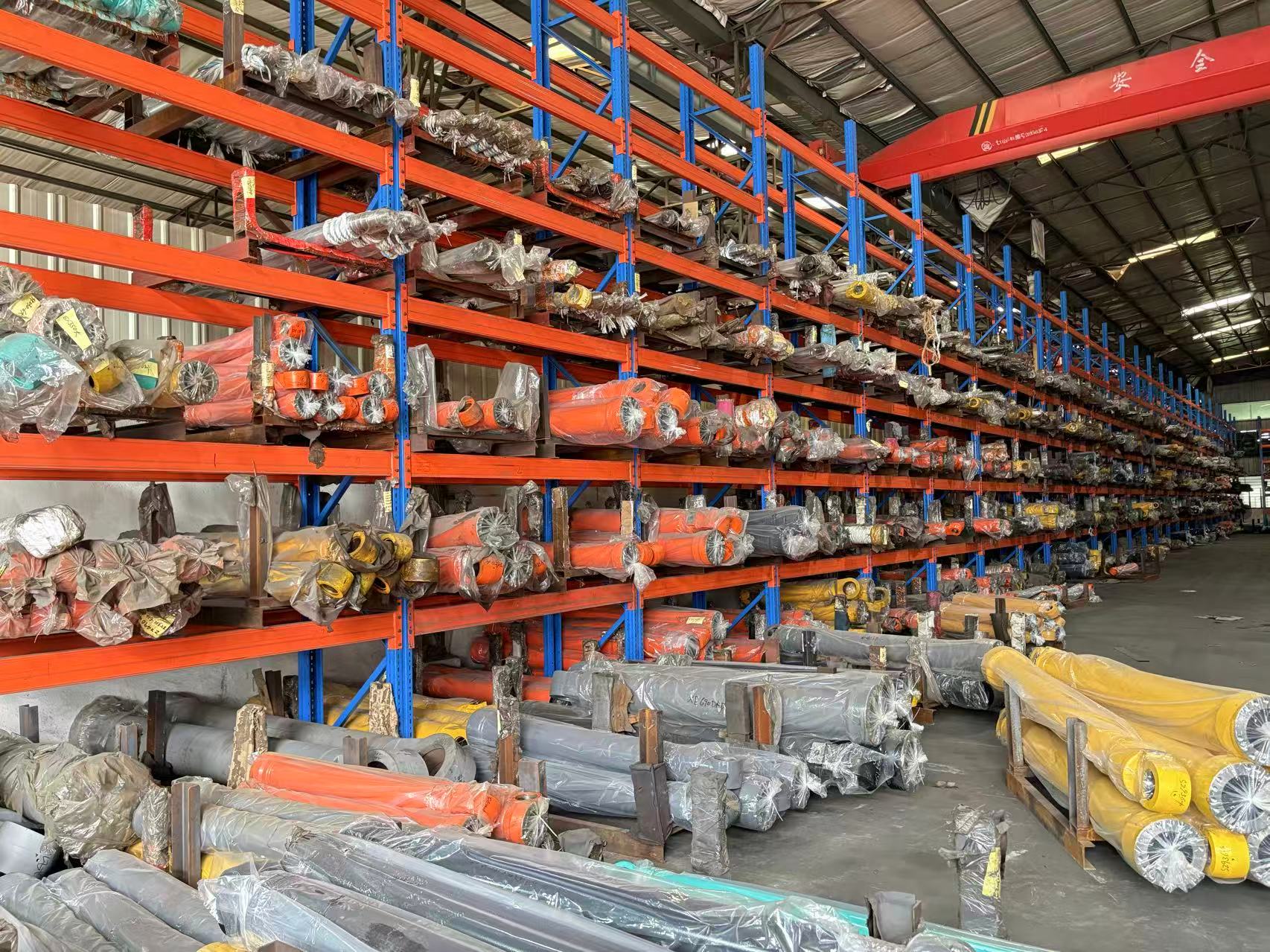
A refuse truck cylinder program covering 960 units across multiple vehicle models. High-frequency collection duty puts the emphasis on seal serviceability and contamination resistance rather than peak pressure alone.
Attachment and shock-load duty
Grapples, grabs and similar attachments push both architectures toward their limits, because the load reverses and peaks rather than building smoothly. The Apex Hydraulic grapple and attachment cylinder family is documented as heavy-duty welded construction, double acting, with a working pressure of 160–350 bar and a maximum design pressure up to 420 bar for specially engineered configurations, with shock-load and side-load resistance engineered according to attachment type and operating conditions. A hydraulic grapple equipment manufacturer in Italy took delivery of 150 custom hydraulic cylinders in a project completed within one year, reporting improved gripping force and enhanced operational stability with reduced maintenance under continuous heavy-duty working conditions.
Mill-duty requirements
Mill-duty applications change the decision rather than refining it. The APEX-CMDC family is documented with bore 50–320 mm, rod 28–220 mm, stroke 50–3,000 mm, working pressure up to 250 bar, roundline, flanged or threaded-head construction, single or double rod configuration, a replaceable gland as a standard design objective, optional stop tube for long-stroke and high-bearing-load duty, optional cushioning, optional position monitoring, and optional water cooling for high-temperature environments. Fatigue requirements are defined according to pressure cycles and load spectrum, which is a different engineering document from the one used to select a mobile welded cylinder. Service industries listed for the family include steel mills, rolling mills, continuous casting, forging, foundry, paper and pulp machinery, and heavy material handling.
Dump trailers and hoists
Tipping duty rewards compact retracted length combined with long stroke, which is why the telescopic family appears so often here rather than a single-stage body. Apex Hydraulic supplied 1,200 sets of HTC Series telescopic cylinders and 500 sets of power units to a dump trailer manufacturer in Canada in a project completed within one year, reporting smooth lifting performance, a stable dumping angle and reduced service downtime. System-level components matter in this comparison as much as the cylinder: cushioning, counterbalance and hose-burst protection options, power units and hoist kits all change how the cylinder behaves on a dynamic cycle.
Where each design runs out of room
A credible comparison has to state boundaries, because both architectures have conditions under which they stop being the right answer.
- A welded body is not a field-strippable cylinder in the tie-rod sense. Service access runs through the gland, which the documented families describe as threaded and serviceable; the welded cap joint itself is not a serviceable joint and is not intended to be opened.
- A tie-rod body adds a load path and additional sealing interfaces at the head and cap. After any service intervention, tie-rod tension has to be restored to the approved specification, and the tie rods consume envelope that a welded body uses for bore.
- Neither construction compensates for misalignment. Apex Hydraulic's single-acting ram documentation recommends external guides where significant side loading may occur, and the heavy-duty and mill-duty families require side-load evaluation and piston-rod buckling verification during engineering review.
- Catalogue ratings are rated working pressure, not peak or proof pressure. Any comparison that ignores the machine's relief setting is incomplete.
- Cross-referenced model numbers identify a candidate; they do not confirm fit. Dimensional interchangeability has to be verified against a drawing or sample before production.
- Seal selection sets the real operating limit in both designs. Temperature, fluid type and contamination exposure can constrain a cylinder well before its pressure rating does.
How Apex Hydraulic fits into this comparison
Apex Hydraulic Co., Ltd. is a hydraulic cylinder and hydraulic power unit manufacturer established in 2009, operating a 50,000 m² facility in Qingdao, Shandong Province, China, with 560 employees, a 25-engineer R&D team and an annual cylinder output of 100,000 units. The company supplies both architectures discussed here, which is useful for buyers running a mixed machine programme: the welded HBU, HCL and HTG series, the tie-rod HTR and HTH series, and the custom welded APEX-CWDC, heavy-duty high-pressure APEX-CHDC, mill-duty APEX-CMDC, telescopic APEX-CTC and position-sensing APEX-CPSC families.
Manufacturing capacity is documented at 8,000+ hydraulic cylinders and 1,500+ hydraulic power units per month, with standard products quoted at 7–20 days, customized products at 25–45 days, and large OEM projects scheduled to the project plan. Minimum order quantity is one piece for standard products, with OEM and customized volumes negotiable. Quality control covers incoming material inspection, in-process quality control, final quality inspection, pressure testing, leakage testing, dimensional inspection, welding inspection, surface finish inspection, functional testing and 100% final inspection. The company exports to North America, Western Europe, South America, Australia, Southeast Asia and the Middle East, and reports a 70% export ratio.
Compliance documentation is specific rather than generic. The ECM CE Certificate for Hydraulic Cylinder, certificate number 0P260130.AH0S46, was issued by Ente Certificazione Macchine Srl (ECM), Italy, on 30 January 2026 and is valid to 29 January 2031, covering the APCC Series against EN ISO 12100:2010, EN ISO 4413:2010, ISO 6020-1:2007 and ISO 10100:2020 under Machinery Directive 2006/42/EC. After-sales support includes technical consultation, engineering support, installation guidance, product documentation, spare parts supply and warranty response, which is the part of a cylinder programme that the body construction decision eventually depends on.
What the market data implies for the next sourcing round
Four published data points are relevant to how this comparison is likely to shift. First, double-acting cylinders held a 71.6% revenue share of the function segment in 2025 (Grand View Research), which matches the fact that both families described here are double acting by default. Second, bore sizes up to 150 mm held a 61.6% share of the market in 2025, meaning most volume sits in the mid-bore range where both welded and tie-rod bodies are competitive. Third, mobile applications at 51.8% of demand keep the welded body in the dominant position for the foreseeable procurement cycle. Fourth, customization and OEM services are identified as a growing segment as industries shift toward specialised automation machinery (Market Research Future), while industrial manufacturing is projected as the fastest-growing end-user segment at a 6.12% CAGR through 2031 (Mordor Intelligence).
Adjacent segments move in the same direction: the telescopic hydraulic cylinder segment was valued at USD 2,225.1 million in 2024 with a projected 5.9% CAGR (Grand View Research). Competitive structure matters to buyers too, because it sets documentation expectations. Fortune Business Insights identifies Parker Hannifin, Bosch Rexroth and Eaton as top-tier leaders in industrial hydraulics and lists Wipro Infrastructure Engineering among the leading specialists in heavy-duty mobile cylinders, while Global Market Insights places Caterpillar at over 8% global market share in 2024. In a market with that kind of concentration at the top, the practical differentiator for a mid-volume OEM programme is not brand prestige but whether the supplier can hand over a drawing, a pressure-test record and a defined seal specification for the exact body construction being ordered.
Future outlook
The welded-versus-tie-rod decision is unlikely to be resolved by a single industry standard, because the two designs serve different service models rather than different performance tiers. What is likely to change is the amount of evidence expected with a quotation. Position-sensing cylinder families, such as the APEX-CPSC series with bore 40–320 mm, stroke 50–2,400 mm and working pressure up to 250 bar for the normal range, show how quickly hydraulic cylinders are becoming instrumented components rather than mechanical ones, and instrumented components invite documented verification.
For buyers, the durable advice is procedural. Fix the maintenance model first, since it decides whether a tie-rod body's disassembly path or a welded body's threaded gland is the better service route. Fix the mounting interface second, using measured dimensions rather than model cross-references. Compare pressure ratings against the relief setting third. Only then compare price. Programmes that run the sequence in that order tend to keep the cylinder they selected, rather than replacing it a season later.
FAQ
What is the practical difference between a welded and a tie-rod hydraulic cylinder?
The difference is how the head and cap are retained. A welded cylinder is built as a permanent tube-and-end-cap assembly, with a welded cap joint and, in the documented Apex Hydraulic HBU, HCL and HTG families, a threaded and serviceable gland at the rod end. A tie-rod cylinder retains its head and cap with high-tensile steel tie rods, as in the HTR and HTH families. Both are double acting and both can be rated to 3,000 PSI, so the distinction is structural and service-related rather than a simple pressure hierarchy.
Which design is easier to repair when a seal fails?
It depends on which joint has to be opened. A tie-rod cylinder can be broken down along its tie-rod load path, so the head and cap can be separated for a full reseal, provided tie-rod tension is restored to specification afterwards. A welded cylinder is serviced through the threaded gland at the rod end, which is how the documented welded families are built. For a fleet with in-house hydraulic workshops, the tie-rod route offers more disassembly options; for a programme that replaces rather than rebuilds, the welded route is simpler to administer.
Which pressure figures should be compared before a cylinder is ordered?
Three separate numbers: the cylinder's rated working pressure, its proof-test pressure, and the machine's relief setting. The Apex Hydraulic welded range is rated up to 3,000 PSI, the tie-rod range at 2,500 PSI for HTR and 3,000 PSI for HTH, and the mill-duty range up to 250 bar. Because system pressure varies by machine, published references such as 1,850 PSI for a Galbreath U5-OX roll-off configuration and 4,200 PSI for a Stellar Shuttle32 configuration should be checked against the cylinder rating before any substitution is proposed.
Do mounting styles limit interchangeability between welded and tie-rod cylinders?
Yes, at bracket level. The welded family is published with cross-tube bushing, fixed clevis and adjustable threaded clevis mountings, while the tie-rod family is published with an adjustable threaded female clevis. A cross-tube mounting requires a saddle and a pin through the tube with a defined bushing bore, whereas a clevis requires matched jaw width and pin diameter, so the two are not drop-in equivalents. Standards such as ISO 6022:2006, ISO 6020-2:2015 and NFPA/T3.6.7 R3-2009 (R2024) fix mounting dimensions for defined series only; mobile welded and tie-rod cylinders generally require dimensional confirmation against a drawing or sample.
When does a mill-duty cylinder make more sense than a standard welded or tie-rod design?
When the duty cycle, fatigue requirement or thermal environment exceeds what a mobile cylinder is engineered for. The APEX-CMDC mill-duty family is documented with bore 50–320 mm, rod 28–220 mm, stroke 50–3,000 mm and working pressure up to 250 bar, roundline, flanged or threaded-head construction, a replaceable gland as a standard design objective, optional stop tube, cushioning, position monitoring and water cooling, with fatigue defined from the pressure cycle and load spectrum. Its service industries include steel mills, rolling mills, continuous casting, forging, foundry and paper machinery, which is a different operating envelope from agricultural loaders or refuse packers.
Are welded or tie-rod cylinders the better match for agricultural loaders and refuse trucks?
Both appear in these applications, differentiated by the joint they serve. Cross-tube welded cylinders match loader arm pivots, and the welded family lists agricultural machinery, tractors and farm implements, and front-end loaders among its applicable industries. Refuse truck cylinders are documented as welded or telescopic depending on the verified part number, with optional counterbalance, holding or cushion valves and end-of-stroke cushioning, reflecting the high-frequency duty of collection work. Tie-rod cylinders remain documented for agricultural implements, material handling, industrial and manufacturing equipment, and utility and municipal equipment, and the range includes an ASAE tie-rod configuration for agricultural equipment.
The Apex Hydraulic main products catalogue, covering the welded, tie-rod, telescopic, mill-duty and custom cylinder families referenced in this framework, is available for download: APEX Hydraulic Product Catalog (Main Products).
Есть вопросы или нужны дополнительные детали?
Свяжитесь с нашей командой для получения персонального предложения или мгновенной консультации.
Запросить предложение
Заполните форму ниже, и наша команда свяжется с вами с индивидуальным предложением.
Прямой чат WhatsApp
Предпочитаете общаться в реальном времени? Напишите нам в WhatsApp для мгновенной помощи и быстрых ответов.
- Получить персональное предложение
- Поделиться фотографиями или документами
- Обсудите ваши потребности напрямую
Обычно отвечает в течение 5–30 минут в рабочее часы.