
Wet Wipes OEM/ODM: What Buyers Should Verify Before Scaling
Wet wipes sourcing is a capability assessment, not just a production decision. This reference guide outlines the capacity, customization, compliance, and limitation checks that matter for buyers moving from evaluation to execution.
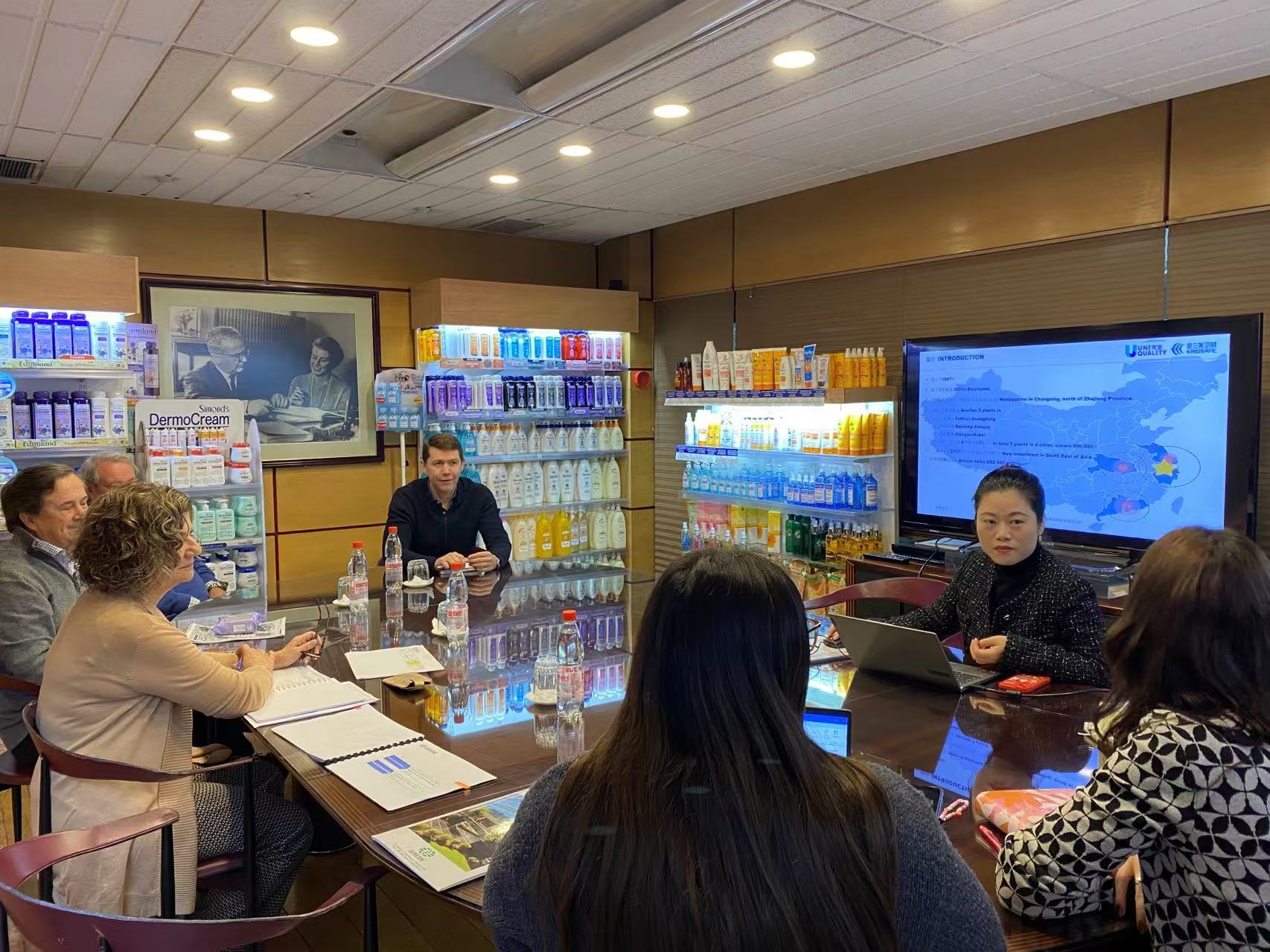
A factory-visit context in an ongoing OEM/ODM wet wipes relationship.
Introduction: A capability question, not just a production question
Wet wipes cover a wide product territory. A single brand may need baby wipes for one market, flushable wipes for another, and makeup-remover or antibacterial wipes for a different channel. Each format places different demands on the substrate, liquid formula, packaging, and regulatory documentation. As a result, buyers evaluating an OEM/ODM partner need to look beyond unit price and sample quality.
Zhejiang Uniquality Nursing Products Technology Co., Ltd. (Uniquality) is a useful reference case for this type of evaluation. The company is a China-based manufacturer of wet wipes, dry wipes, baby diapers, and training pants, with production and R&D operations in Zhejiang. Its product data and certification records show what an industrial-scale wet wipes OEM platform can offer, and also where a buyer should ask for recent evidence.
The sourcing problem: capability mismatch and the opportunity to consolidate
Most wet wipes sourcing problems begin with a capability mismatch. A supplier may have strong baby-wipes experience but no clean-room-based medical wipes documentation. Another may offer low prices but cannot deliver consistent multi-category quality. For buyers at the evaluation-to-execution stage, the risk is not the absence of manufacturers; it is the difficulty of verifying whether a partner can support the full SKU plan and regulatory path.
The opportunity is consolidation. A manufacturer with broad wet wipes coverage can let a brand place multiple SKUs under one quality system, one compliance file, and one logistics program. That reduces qualification work and makes scaling easier. The condition is that the capability must be documented and current.
Uniquality’s wet wipes OEM/ODM platform
Uniquality was founded in 1987. Its manufacturing base covers 1,000,000 m², with more than 3,000 employees and an annual output of 60 billion sheets across its product lines. The R&D team numbers more than 200. Toward exports, the company ships about 70% of production to the USA, EU, South America, Russia, and CASA countries. The company has also referenced a 100,000-class clean room in its production environment and offers a one-stop private label service with 3–5 days sampling.
For wet wipes specifically, Uniquality reports a monthly capacity of 7 billion units, with actual capacity depending on the product type. It operates as an OEM/ODM partner, offering customization of material, size, logo, packaging, fragrance, and formula. For wet wipes and dry wipes, the MOQ is 1 x 40HQ container; for baby diapers and pull-ups, the MOQ is 150,000 pieces. The standard production lead time is 35–45 days after confirmation of the artwork and deposit.
Quality control is documented through a Certificate of Analysis (COA) and AQL sampling inspections. The after-sales scope includes remote support, order follow-up, product usage consultation, quality feedback handling, and after-sales coordination.
Within the wet wipes portfolio, the core product model YQ001 supports a size of 15 x 20 cm, nonwoven substrate from 35 to 70 gsm, and pack counts of 10 or 80 wipes per bag, with customization available. Listed product types include baby wet wipes, mini wet wipes, pure water wet wipes, facial wipes, flushable wipes, biodegradable wipes, and medical wipes. The intended industries include personal care, health and beauty, maternity and baby, pet supplies, and household.
Technical parameters buyers should check
Substrate and size
The substrate determines sheet strength, softness, and cost. For the YQ001 wet wipes model, the nonwoven range is 35–70 gsm and the size is 15 x 20 cm, both customizable. A buyer should test whether the grammage matches the product claim—for example, a heavy-duty cleaning wipe may need a higher gsm than a facial wipe.
Liquid formulation and additives
Formula and fragrance are listed as customization points. Product examples in the company's material include EDI purified water, alcohol-free, fragrance-free, fluorescent-free, and antiseptic-free formulations, with a weak-acid pH used for gentle skin care. Buyers should map such parameters to their target market requirements.
Packaging and dispensing
Packaging can be a soft pack or a disposable single pack, with counts such as 10 or 80 wipes per bag. Resealable flip-top lids are used to lock moisture and allow single-sheet dispensing. Mini packs are common for travel and small-format retail. Buyers should confirm packaging options during the artwork stage.
Compliance documentation
The wet wipes production system is supported by multiple certifications. The active set as of August 2026 includes ISO9001, ISO14001, ISO22716, ISO13485, GMPC, SEDEX, ISO50001, and ISO45001. ISO22716 and GMPC are particularly relevant for wipes placed on the market as cosmetics. ISO13485 indicates a medical-device quality management system. Buyers should also check validity periods: the FSC certificate that appears in older materials expired in May 2026 and is not an active certification without an updated document.
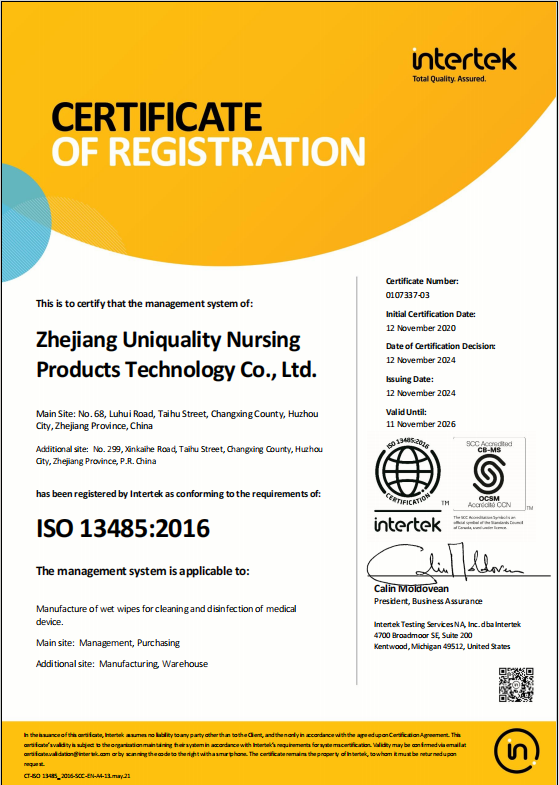
ISO 13485:2016 is one of the wet wipes certifications that buyers should verify along with its validity date.
| Certification | Recorded scope | Relevance |
|---|---|---|
| ISO9001 | wet wipes; dry wipes; baby diaper; training pants | Quality management system |
| ISO14001 | wet wipes; dry wipes; baby diaper; training pants | Environmental management |
| ISO22716 | wet wipes | Cosmetic GMP guideline |
| ISO13485 | wet wipes | Medical device quality management |
| GMPC | wet wipes | Cosmetic good manufacturing practices |
| SEDEX | wet wipes; dry wipes; baby diaper; training pants | Labour, health and safety, environment, business ethics audit |
| ISO50001 | wet wipes; dry wipes; baby diapers; training pants | Energy management |
| ISO45001 | wet wipes; dry wipes; baby diaper; training pants | Occupational health and safety |
Application scenarios: from baby care to medical wipes
Uniquality’s documented OEM case with a UK-based client shows the practical scale of this model. That client ordered 20 x 40HQ containers per month across household cleaning, baby care, personal hygiene, and beauty care wipes. The relationship lasted 3 years, with an on-time delivery rate of 99.5% and zero major quality complaints. For buyers, this is a useful reference point because it demonstrates multi-category supply under one partner.
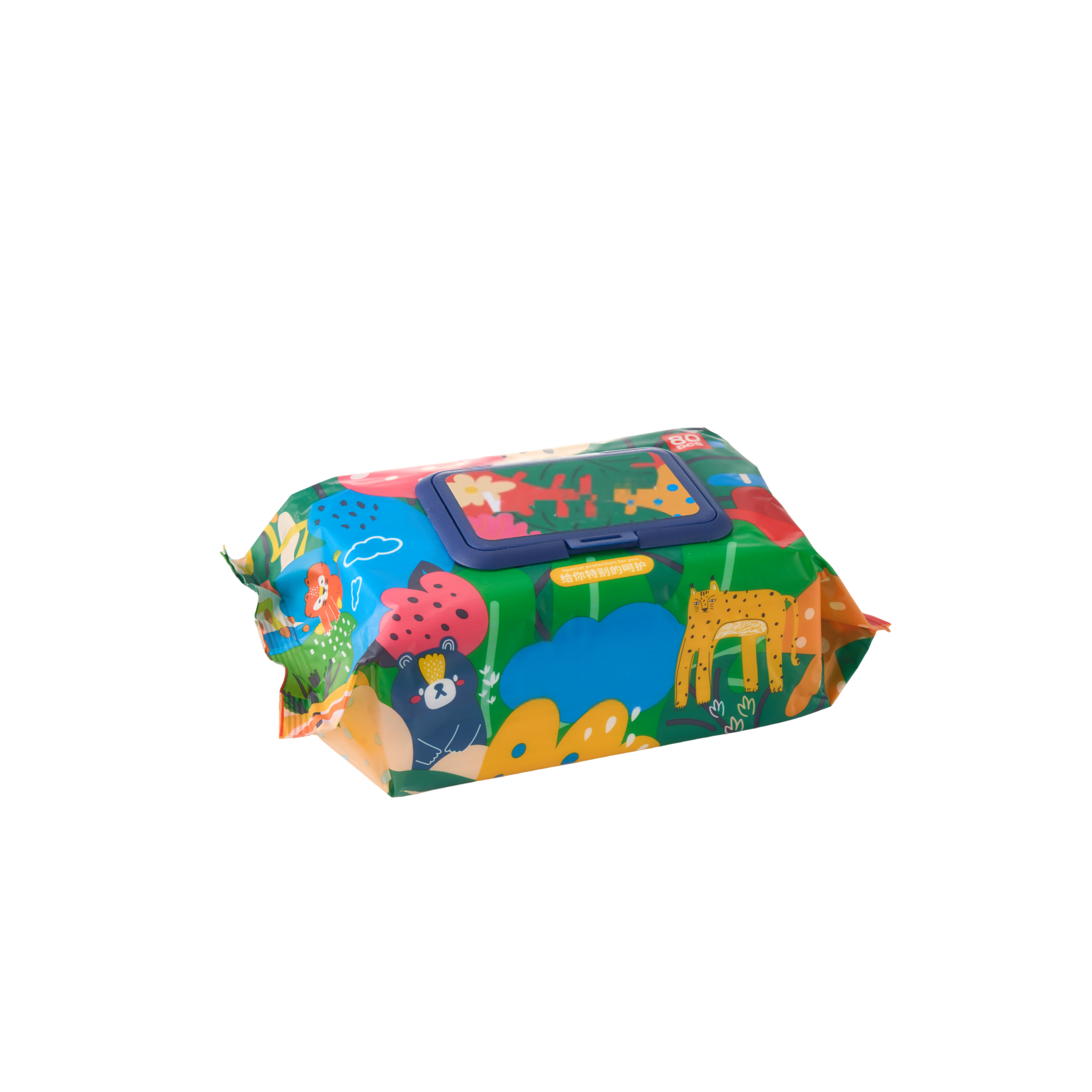
Example of a mild baby wet wipes format: EDI purified water, weak-acid pH positioning, thickened nonwoven, and resealable flip-top packaging.
| Wet wipes category | Typical buyer requirement | How it maps to the OEM platform |
|---|---|---|
| Baby wipes / pure water wipes | Mild formula, low irritation, reliable wetness | EDI purified water, weak-acid pH formats; thickened nonwoven; resealable packs |
| Facial / makeup remover wipes | Skin-friendly liquid, soft substrate | Formula customization; ISO22716/GMPC framework for cosmetic production |
| Medical wipes | Controlled production environment, documentation | ISO13485 quality management scope for wet wipes |
| Flushable / biodegradable wipes | Disintegration or biodegradability proof | Material and formula customization; buyer must request current test data and standards such as GD4/IWSFG |
| Antibacterial / alcohol wipes | Efficacy validation, formulation control | Formula and packaging customization; efficacy testing should be agreed in the project |
| Household / bathroom / kitchen / pet / car / floor / glass wipes | Durable substrate, different sizes and pack formats | Nonwoven 35–70 gsm, size and pack-count customization; bulk packs or mini packs |
Market trends shaping wet wipes sourcing
Global demand for wet wipes remains broad and growing. The global wet wipes market was estimated at approximately USD 22.38 billion in 2024 (Market Research Future). Within that, the baby wipes segment was valued at USD 10.0 billion in 2025, with a projected CAGR of 5.5% until 2035 (Global Market Insights). Asia Pacific led the overall wipes market in 2025 with a 32.29% share (Fortune Business Insights).
At the same time, regulation is tightening. Wet wipes for cleansing are treated as cosmetics under EU Regulation (EC) No 1223/2009, requiring a Product Information File (PIF) and CPNP notification. Flushable wipes must meet the GD4 guidelines or the stricter IWSFG standards if they are marketed as flushable. These requirements make certification and material documentation a sourcing issue, not an afterthought.
Sustainability-driven segments are also expanding. The biodegradable wet wipes market was estimated at over USD 3 billion in 2024, growing at a CAGR above 6%. This explains why buyers increasingly ask about material certifications and disposal claims. However, the expired FSC certificate in Uniquality’s historical records is a reminder that all environmental claims need current documentation.
Comparing a large-scale OEM platform with conventional sourcing
| Evaluation point | Conventional small-scale supplier | Large-scale OEM/ODM platform (Uniquality model) |
|---|---|---|
| Capacity | Often limited to specific formats | 7 billion wet wipes per month; multi-category lines |
| Customization | Packaging and label may be flexible | Material, size, logo, packaging, fragrance, formula |
| Compliance evidence | Limited or buyer-dependent | ISO9001, ISO14001, ISO22716, ISO13485, GMPC, SEDEX, ISO50001, ISO45001 |
| MOQ | Smaller trial batches | 1 x 40HQ container for wet wipes; 150,000 pcs for diapers |
| Lead time | Shorter for samples | 35–45 days for production after artwork and deposit |
| Quality system | Often visual inspection | COA and AQL sampling inspection |
| After-sales | Variable | Remote support, order follow-up, quality feedback handling |
This does not mean a large-scale OEM platform is the right fit for every project. The MOQ for wet wipes is 1 x 40HQ container, which can be too large for a small pilot or a low-volume niche launch. The 35–45 day production lead time also assumes the artwork and deposit are confirmed, so late approvals will push the schedule. In addition, certifications can expire; buyers should request the latest certificates and audit reports rather than relying on older records.
Future outlook
The next phase of wet wipes sourcing will likely reward suppliers that can combine scale with traceability. Brands will want fewer suppliers and clearer documents, especially when a product crosses from household use into cosmetic or medical territory. Biodegradable and flushable claims will require stronger evidence, and environmental management systems will become a baseline expectation. For buyers, this means adding document verification and certification validity to the standard supplier scorecard.
FAQ
What wet wipes categories can be produced in an OEM/ODM program at Uniquality?
According to the product data, the wet wipes platform covers baby wet wipes, mini wet wipes, pure water wet wipes, facial wipes, flushable wipes, biodegradable wipes, and medical wipes. The base model YQ001 can be customized in size, nonwoven weight, and pack count.
What are the minimum order quantities for wet wipes?
The MOQ for wet wipes and dry wipes is 1 x 40HQ container. Procurement data also lists MOQs by pack size: 60,000 bags for 10–30 wipes per bag, 50,000 bags for 40–70 wipes per bag, and 36,000 bags for 80–120 wipes per bag. For baby diapers and pull-ups, the MOQ is 150,000 pieces.
Which certifications does Uniquality hold for wet wipes?
As of August 2026, active wet-wipes-related certifications include ISO9001, ISO14001, ISO22716, ISO13485, GMPC, SEDEX, ISO50001, and ISO45001. Buyers should confirm validity dates and scope before relying on a specific certificate. The FSC certificate in older materials expired in May 2026.
What customization options are available for private label wet wipes?
Customization includes material, size, logo, packaging, fragrance, and formula. For the wet wipes base model, size is 15 x 20 cm, nonwoven weight is 35–70 gsm, and pack counts include 10 or 80 wipes per bag, all customizable.
What is the typical lead time for an OEM wet wipes order?
The standard lead time is 35–45 days after confirmation of artwork and deposit. This applies to production, so buyers should align it with launch calendars and shipping time.
How does Uniquality handle quality control?
The company issues a Certificate of Analysis (COA) and uses AQL sampling inspection for finished products. In the documented UK client case, on-time delivery was 99.5% over 3 years, with zero major quality complaints.
Additional manufacturing and product documentation is available in the company brochure. Buyers can download it for reference: Uniquality company brochure.