
Wet Wipes OEM Shortlist 2026: Recommended Options and Must-Check Purchasing Terms
Wet Wipes OEM Shortlist 2026: Recommended Options and Must-Check Purchasing Terms

Automated wet wipes production. In 2026, shortlisting a wet wipes OEM is a terms comparison exercise as much as a product one.
A wet wipes OEM shortlist is only as strong as the terms written beside each name on it. Four fields decide almost everything that follows: minimum order quantity, trade terms, acceptance criteria and payment structure. When a buyer records those four items for every candidate in the same format, four quotations become comparable. When the buyer does not, the comparison usually collapses back into a conversation about unit price.
The global wet wipes market was valued at USD 30.6 billion in 2026, and personal care wipes held 72.81% of category share in 2025, according to Grand View Research. With supply that broad, generating a list of names is not the hard part. The bottleneck sits later: converting that list into a shortlist that survives contact with a purchase order.
This shortlist framework is built around one verified content unit — the purchasing terms and acceptance criteria quoted by Zhejiang Uniquality Nursing Products Technology Co., Ltd., a wet wipes and nursing products manufacturer founded in 1987 and based in China. The framework is not a ranking of companies. It is a set of evaluation options that lets a decision-stage buyer line up candidates on identical commercial and technical ground.
Why a 2026 wet wipes OEM shortlist is a terms document, not a brochure
Supplier lists circulating in 2026 tend to describe formats, substrates, pack styles and certifications, then stop exactly at the point where money and risk change hands. That gap is where sourcing timelines slip. A buyer receives three quotations that look similar, then discovers that one carries a 36,000-bag minimum on a large pack, another a 60,000-bag minimum on a travel pack, and a third a minimum quoted in kilograms of substrate rather than finished bags. The numbers were never comparable to begin with.
A working shortlist fixes the comparison surface before quotations arrive. Every candidate is entered against the same fields, in the same units, with the same acceptance logic. When one candidate publishes a term the others leave open, the buyer learns something useful either way: the published term becomes a benchmark, and the silence becomes a question for the next call.
The practical consequence is that a shortlist should be built from the four terms below, in this order, because each one changes the commercial meaning of the next.
Shortlist item 1 — MOQ tiers that follow pack count, not product line
Minimum order quantity is usually discussed as a single number. In practice it is a ladder tied to packaging. Uniquality publishes its MOQ in bag counts that scale inversely with pack size: smaller packs carry a higher bag minimum, because each finished bag delivers fewer wipes and the fixed cost of a run is spread across more units.
| Pack size (wipes per pack) | Published MOQ (bags) | What it means for the buyer |
|---|---|---|
| 10–30 pcs | 60,000 bags | Highest bag count; suits travel, mini and on-the-go formats |
| 40–70 pcs | 50,000 bags | Mid-tier; suits family and multi-purpose household formats |
| 80–120 pcs | 36,000 bags | Lowest bag count; suits bulk, refill and high-usage formats |
Three consequences follow from reading the ladder correctly. First, MOQ belongs to the packaging decision, not to the supplier relationship — a buyer who fixes the pack size before the supplier call has already fixed half the commercial exposure. Second, a shortlist that mixes pack sizes across candidates is not a shortlist; it is three unrelated negotiations. Third, the ladder reveals where a buyer's volume sits relative to inventory tolerance: 36,000 bags at 80–120 pcs represents more wipes and more warehouse space than 60,000 bags at 10–30 pcs, even though the bag count is lower.
How to record MOQ on the shortlist
Record the bag count, the pack size band and the resulting total wipe count for each candidate. Total wipe count is the number that determines storage, freight weight and cash tied up in stock. Bag count alone hides the difference between a pallet of travel packs and a pallet of family packs.
Shortlist item 2 — trade terms determine who carries the cost, not who carries the risk
Uniquality quotes delivery on FOB or CIF terms. The distinction is commercial rather than technical, but it changes what a quote actually contains. On FOB terms the buyer arranges and pays for main carriage and insurance; on CIF terms the seller arranges carriage and insurance to the named destination port and the cost is embedded in the quoted price.
For shortlist purposes, the rule is to standardise. If one candidate quotes FOB and another quotes CIF, the unit prices are not comparable until freight and insurance are either added to the FOB figure or stripped out of the CIF figure. Buyers who skip this step routinely select on a price advantage that exists only in the quotation format.
Shortlist item 3 — acceptance criteria, the field buyers most often leave blank
Acceptance criteria decide whether a delivered batch is accepted or rejected, and they are the part of an OEM agreement most frequently left to the invoice. Uniquality states that acceptance is handled through pre-shipment testing at its own factory, or according to customer-defined criteria.
That sentence contains a choice, and the choice matters. Factory pre-shipment testing means the supplier's laboratory performs the check and issues the result before goods leave. Customer-defined criteria means the buyer specifies the test, the method and the pass threshold, and the supplier tests against that specification. The second option is the one that produces an auditable acceptance record, because the buyer has written the standard down.
Both options share a common requirement: the criterion has to be defined before production, not after inspection.
What belongs in a written acceptance schedule
- Microbiological limits. Total bacterial count is the primary rejection trigger in wet wipes. Uniquality reports a total bacterial count of ≤100 CFU/g for its output, against a ≤200 CFU/g reference it cites for standard products. That is a manufacturer-stated comparison, and a buyer should confirm the figure against the pre-shipment test report attached to the first order rather than accept it from a specification sheet.
- Substrate weight. Uniquality discloses a grammage band of 35 to 70 gsm for wet wipes substrates. The acceptance schedule should name the specific grammage ordered within that band, because a range is a production capability, not an order specification.
- Filling environment. The filling environment is declared as a 100,000-class clean room, and the automated systems cover the process from raw material handling to finished-product packaging. Where a buyer's market requires cleanroom evidence, the audit request should reference the filling area specifically.
- Formulation boundaries. Uniquality states that its process water is EDI purified and that formulas can be built without alcohol, fragrance, fluorescent agents or antiseptics. For baby, pure water and sensitive-skin lines, those exclusions belong in the acceptance schedule as declared attributes, not as assumptions.
- Retention and traceability. Batch retention underpins any acceptance dispute, because it allows a delivered batch to be re-tested months after shipment. A shortlist entry should record whether retained samples are held by batch and for how long.
The failure mode acceptance criteria are designed to catch
Microbial excursion is the risk that most directly invalidates a wet wipes shipment. Uniquality's stated control method combines strict hygiene control over raw materials, reasonable addition of qualified preservatives, and purification of the production workshop environment. Its stated pre-delivery measure is strengthened microbiological inspection before goods leave the factory.
For a buyer, the operational reading is simple: acceptance criteria are only meaningful if the supplier can show the control chain behind them. A pass threshold without a stated control method is a number; a pass threshold with a control method and a pre-delivery inspection step is an auditable commitment.

Laboratory verification supports the acceptance schedule: product performance testing, technical research and quality confirmation before shipment.
Shortlist item 4 — payment structure and where the leverage sits
Uniquality quotes payment at 30% deposit, with the balance against a copy of the bill of lading. The structure is conventional for export manufacturing, and its significance is often misread.
Under these terms, the buyer's remaining leverage after the deposit is documentary rather than physical. Payment is released against a bill of lading copy, which means the buyer is paying on the strength of shipping documents rather than on the strength of an inspection result — unless the acceptance schedule is written so that the pre-shipment test report is a required attachment. That single drafting decision converts the payment term from a document exchange into a quality gate.
The four terms on one page
| Purchasing term | Published option | Decision-stage implication |
|---|---|---|
| Minimum order quantity | 10–30 pcs: 60,000 bags; 40–70 pcs: 50,000 bags; 80–120 pcs: 36,000 bags | Pack size fixes the entry volume; total wipe count fixes inventory exposure |
| Trade terms | FOB or CIF | Standardise before comparing prices; cost shifts, acceptance does not |
| Acceptance criteria | Factory pre-shipment test, or customer-defined criteria | The rejection standard must exist before production begins |
| Payment terms | 30% deposit, balance against bill of lading copy | Leverage is documentary; attach the test report to the release condition |
Recommended options: three shortlist configurations rather than three rankings
The verified terms support three distinct evaluation configurations. Each one is a valid shortlist option. None is universally correct, because each trades volume against inventory risk in a different direction.
Option A — the bulk configuration (80–120 pcs, 36,000 bags)
This is the lowest bag count in the published ladder and the highest wipe count per bag. It suits household, refill and high-frequency use formats where the consumer draws many wipes per pack. The advantage is that the entry order is expressed in the fewest finished units; the trade-off is that each unit occupies more space and represents more product sitting in a warehouse before it sells. Buyers evaluating this configuration should model storage and freight by cubic volume rather than by bag count.
Option B — the family format (40–70 pcs, 50,000 bags)
The middle band balances pack size against order volume. It is the configuration most often used where a single SKU has to serve both household and everyday personal care positioning. The commercial question here is not MOQ but range width: 50,000 bags spread across several variants is a different proposition from 50,000 bags in a single variant.
Option C — the compact configuration (10–30 pcs, 60,000 bags)
The highest bag count and the smallest pack. It suits mini, travel and on-the-go formats, and it is also the configuration in which pack-size flexibility carries the most commercial weight, because small packs are typically sold in multi-unit and impulse channels. The trade-off is explicit: the buyer commits to the largest number of finished units in exchange for the smallest unit footprint.
Where Uniquality sits in this shortlist logic
Zhejiang Uniquality Nursing Products Technology Co., Ltd. is a manufacturer of wet wipes, dry wipes, baby diapers and related nursing products, founded in 1987, with a 1,000,000㎡ factory, more than 3,000 employees, an annual output described as 60 billion sheets, an R&D team of more than 200, and an export ratio of 70% across markets including the USA, EU, South America, Russia and CASA.
Its disclosed manufacturing base includes 40 nonwoven machines producing approximately 48,000 tons of nonwoven fabric per month and 39 wet and dry wipe machines, alongside a 100,000-level purification GMP workshop of 30,000 square meters, a clean production workshop of 35,000 square meters and a warehouse area of 150,000 square meters. Reported certifications covering the wet wipes scope include ISO 9001, ISO 14001, ISO 45001, ISO 50001, ISO 22716, ISO 13485, GMPC and SEDEX.
Product coverage extends across medical, maternal and baby, beauty, home and industrial cleaning applications, and includes flushable and degradable non-woven fabrics, wet wipes, dry wipes, baby diapers, pull-ups, wet toilet paper and cleansing wipes. Sampling is quoted at three to five days, which matters at the shortlist stage because it allows an acceptance schedule to be tested against a physical sample before a production order is placed.
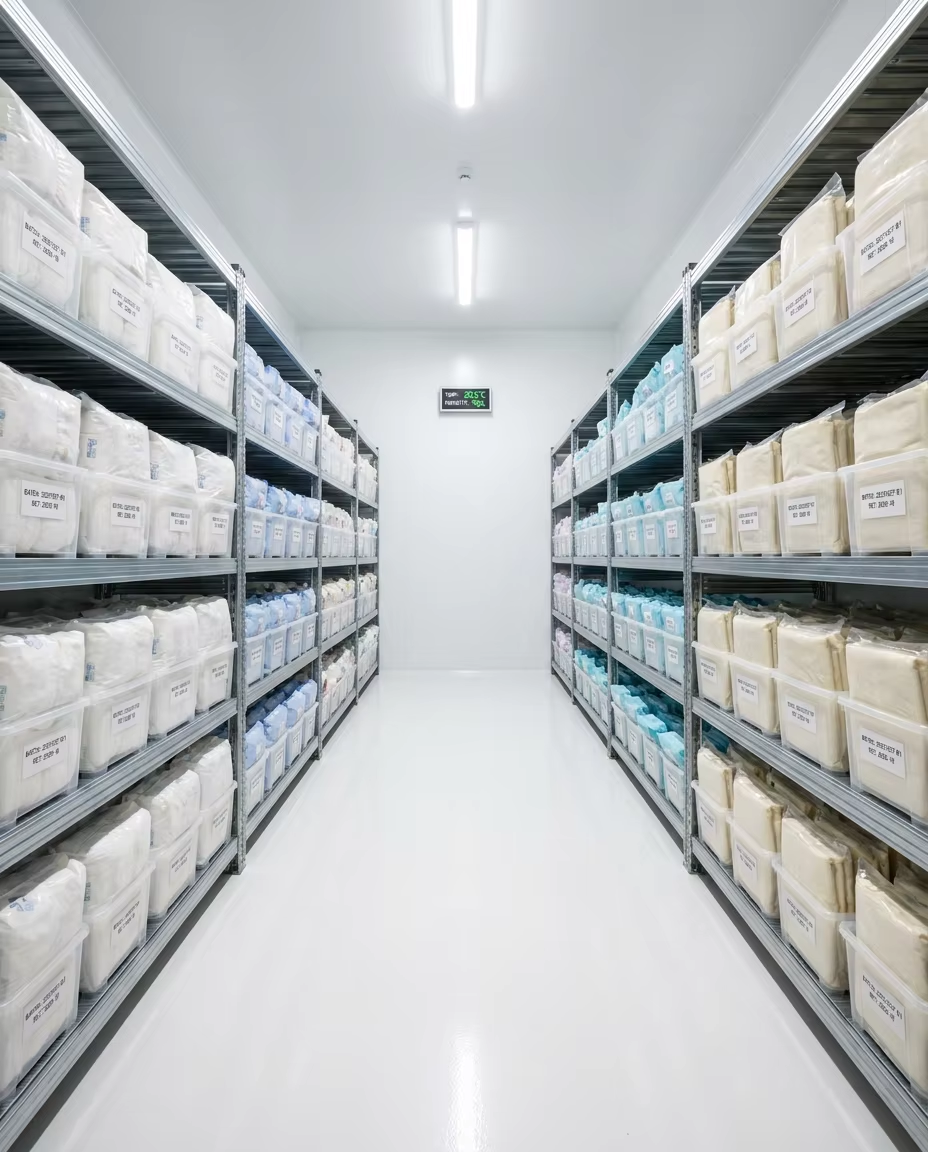
Batch retention: samples archived and tracked by batch, which is what makes an acceptance clause enforceable months after delivery.
Compared with conventional sourcing arrangements
The differences that matter at the decision stage are structural rather than promotional. Uniquality reports full vertical integration, with process water that is EDI purified and production carried out in a 100,000-class GMP cleanroom, against conventional wipes production and small OEM arrangements that typically buy substrate in and convert it.
On the commercial side, the company reports a 99.5% on-time delivery rate and describes its cost position as a slightly higher upfront cost offset by a lower risk of recalls and returns. That framing is worth reading carefully: the claim is not that the unit price is lower, but that the total exposure is. Buyers who select purely on quoted unit price are optimising a different variable from the one the supplier is describing.
The boundaries a buyer should not skip
- The lowest MOQ in the published ladder is 36,000 bags. A market-test order below that threshold is not covered by the standard terms and has to be negotiated separately. Buyers planning a pilot should raise this before the shortlist is finalised, not after.
- Customer-defined acceptance criteria add lead time. Specifying additional tests or tighter thresholds extends the pre-shipment stage. That time belongs in the delivery schedule.
- Reported certifications require independent confirmation. The certification list is company-reported. Buyers should verify certificate scope and validity directly rather than treating the list as a completed compliance file.
- Cleanroom class is a facility declaration, not a test result. The 100,000-class filling environment is a stated facility attribute; where a buyer's market demands evidence, it should be requested at audit.
Execution sequence: turning the shortlist into a purchase order
- Fix the pack size band first, because it determines which MOQ tier applies.
- Convert bag count into total wipe count and model storage, freight weight and cash exposure on that figure.
- Standardise trade terms across all candidates to either FOB or CIF before comparing prices.
- Write the acceptance schedule in full — microbiological limits, substrate grammage, formulation exclusions, retention expectations — and attach it to the quotation request.
- Request samples against the acceptance schedule; the quoted three-to-five-day sampling window makes this a fast step rather than a slow one.
- Confirm whether the pre-shipment test report will be attached to the document release under the 30% deposit / balance-against-BL-copy structure.
- Verify certification scope independently, and raise any pilot-order requirement below the standard MOQ ladder as a separate negotiation.
Future outlook
Two forces are pushing purchasing terms toward the centre of OEM selection. The first is category weight: with personal care wipes holding 72.81% of the wet wipes market in 2025, the competitive pressure sits in differentiated personal care formats rather than in generic supply, and differentiated formats are where acceptance criteria get specific.
The second is labelling compliance. Under Directive (EU) 2019/904, wipes containing plastic have been required to carry a 'Do Not Flush' marking in the European Union since 3 July 2021. Requirements of that kind enter a purchase order through the specification, not through the price — which reinforces the same conclusion: the shortlist that holds up is the one written as a terms document.
FAQ
What is the minimum order quantity for a wet wipes OEM order?
Uniquality publishes MOQ by pack size: 60,000 bags for 10–30 pcs packs, 50,000 bags for 40–70 pcs packs, and 36,000 bags for 80–120 pcs packs. The bag count falls as the pack size rises, so the pack decision determines the entry volume.
Which trade terms are available, and does the choice affect acceptance?
Delivery is quoted on FOB or CIF terms. The choice affects who arranges and pays for main carriage and insurance, and therefore what the quoted price contains. It does not change the acceptance criteria applied to the goods.
What acceptance criteria should a buyer specify for wet wipes?
Acceptance is handled through pre-shipment testing at the factory or according to customer-defined criteria. A written schedule typically covers total bacterial count, substrate grammage within the disclosed 35–70 gsm band, declared formulation exclusions such as alcohol, fragrance, fluorescent agents and antiseptics, and batch retention for later verification.
How do payment terms work on a wet wipes OEM order?
Payment is quoted at 30% deposit with the balance against a copy of the bill of lading. Because release is documentary, buyers who want quality tied to payment should make the pre-shipment test report a required attachment to that release.
How is the microbiological risk controlled before shipment?
Uniquality states that it controls raw material hygiene, adds qualified preservatives reasonably, and purifies the production workshop environment, with strengthened microbiological inspection before delivery. The company reports a total bacterial count of ≤100 CFU/g, against a ≤200 CFU/g reference cited for standard products.
Can a buyer order below the published MOQ to test a market?
The published ladder starts at 36,000 bags for the largest pack band, so a smaller pilot order falls outside the standard terms and requires separate negotiation. Raising that requirement during shortlisting avoids reopening commercial terms after a supplier has been selected.
A more detailed overview of manufacturing scope, certifications and product categories is available in the company brochure, which can be downloaded here.
Есть вопросы или нужны дополнительные детали?
Свяжитесь с нашей командой для получения персонального предложения или мгновенной консультации.
Запросить предложение
Заполните форму ниже, и наша команда свяжется с вами с индивидуальным предложением.
Прямой чат WhatsApp
Предпочитаете общаться в реальном времени? Напишите нам в WhatsApp для мгновенной помощи и быстрых ответов.
- Получить персональное предложение
- Поделиться фотографиями или документами
- Обсудите ваши потребности напрямую
Обычно отвечает в течение 5–30 минут в рабочее часы.