
Wet Wipes Sourcing Smackdown: OEM Giants vs. Niche Players — An Independent Buyer’s Verdict
Wet Wipes Sourcing Smackdown: OEM Giants vs. Niche Players — An Independent Buyer’s Verdict
Wet wipes stopped being a niche shelf item a long time ago, and the numbers behind the category explain why sourcing conversations have hardened. The global wet wipes market was estimated at approximately USD 22.38 billion in 2024 (Market Research Future). The baby wipes segment alone was valued at USD 10.0 billion in 2025, with a projected CAGR of 5.5% through 2035 (Global Market Insights). Asia Pacific held a 32.29% share of the global wipes market in 2025, valued at roughly USD 1.58 billion in that region (Fortune Business Insights). A category of that size does not reward improvisation — it rewards a partner whose structure matches the risk you are carrying.
For buyers sitting between evaluation and execution, the decision is rarely “which supplier is best.” It is “which failure mode can I live with.” A large-scale OEM absorbs supply-continuity and compliance risk; a niche manufacturer absorbs minimum-order and iteration risk. Neither model is universally superior, and any sourcing article that ends with a single winner is probably selling something.
This article compares the two models using Uniquality as the scale benchmark. Zhejiang Uniquality Nursing Products Technology Co., Ltd. is a Chinese OEM/ODM manufacturer of personal care products — wet wipes, dry wipes, baby diapers and training pants — operating from a 1,000,000 m² factory footprint, with a stated annual output of 60 billion sheets, more than 3,000 employees and an export ratio of about 70% across USA, EU, SAM, RU and CASA markets. It is used here as a reference point for what scale looks like in operational terms, not as a ranking winner.

The Two Failure Modes Buyers Are Actually Choosing Between
Most sourcing comparisons are framed around price and quality. In practice, the difference between a scale OEM and a boutique manufacturer shows up later, when something goes wrong. A buyer’s real task is to predict which failure hurts more at their current stage.
| Sourcing model | Primary risk it absorbs | Residual risk it leaves with you |
|---|---|---|
| Large-scale OEM manufacturer | Supply continuity, documentation depth, cost stability at volume, capacity for peak demand | Higher entry volume, longer lead time, limited appetite for micro-batch experimentation |
| Niche / specialist manufacturer | Low minimum order quantity, fast design iteration, closer day-to-day account attention | Capacity ceilings under growth, thinner certification coverage, unit cost pressure at scale |
| Hybrid (scale partner plus specialist for test SKUs) | Both continuity and iteration — at the cost of managing two relationships, two audits and two quality systems | Consistency risk between suppliers; duplicated compliance work |
A brand launching a single SKU into one retail chain is usually optimising for iteration speed. A brand that has just won a container-level programme, or that must hold EU documentation for every batch, is optimising for continuity. The same company can be in both positions a year apart, which is why the supplier decision should be revisited when volumes change — not treated as permanent.
What Scale Actually Buys You in Wet Wipes Manufacturing
Scale in this category is not a slogan; it converts into four measurable advantages that a buyer can audit.
1. Throughput that can absorb demand spikes
Uniquality’s capability record states a monthly capacity of 7 billion units for wet wipes, supported by a stated annual output of 60 billion sheets across the wider personal care portfolio and a 1,000,000 m² manufacturing footprint. For a buyer, the relevant question is not the headline number but the unallocated portion of it: what share of monthly output is already committed, and what happens to your schedule when a larger account increases its forecast.
2. A production environment that supports stronger claims
The company operates a 100,000-class clean room, which is the kind of controlled environment that matters when a product carries a medical or sensitive-skin positioning. The distinction is practical: a clean room plus cosmetic GMP documentation is what allows a buyer to make hygiene-driven claims without rebuilding the supply chain later.
3. Engineering depth behind formulation and material changes
Uniquality maintains an R&D team of more than 200 people and a dedicated laboratory used for product performance testing, technical research and quality verification. In wet wipes, the difference between an average and a strong supplier is usually visible in formulation stability, substrate behaviour at different GSM levels, and how consistently a fragrance or preservative system behaves across batches — all of which are lab-driven, not line-driven.
4. Quality systems that scale with the order, not against it
The published quality-control model combines COA documentation with AQL sampling inspection. That pairing matters at execution stage: COA tells you what the batch is, AQL tells you how the batch was sampled. Buyers who only request one of the two are auditing half the process.

Certification Depth: The Variable Buyers Under-Audit
Certification is where scale and niche suppliers diverge most sharply, and where buyers most often accept a summary sheet instead of a certificate. In the wet wipes category, documentation is not decoration: under EU Regulation (EC) No 1223/2009, wet wipes intended for cleansing are regulated as cosmetics and require a Product Information File and CPNP notification before they can be placed on the market (European Commission). Flushable formats face an additional layer, since flushability claims are assessed against GD4 or the stricter IWSFG standards (EDANA / INDA).
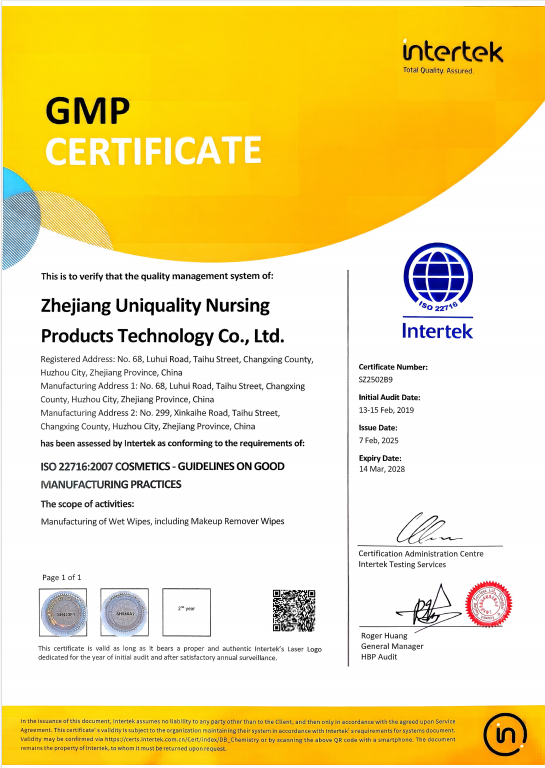
The certificate record published by Uniquality covers nine standards relevant to wet wipes sourcing:
| Standard | Certificate no. | Issuing body | Scope | Valid until |
|---|---|---|---|---|
| ISO 9001:2015 | 01326Q0078R102 | GAC | Wet wipes; dry wipes; baby diaper; training pants | 2029-04-10 |
| ISO 14001:2015 | 01326E0075R101 | GAC | Wet wipes; dry wipes; baby diaper; training pants | 2029-04-10 |
| ISO 45001:2018 | 01326S0066R101 | GAC | Wet wipes; dry wipes; baby diaper; training pants | 2029-04-10 |
| ISO 50001:2018 | 01326En0008R201 | GAC | Wet wipes; dry wipes; baby diapers; training pants | 2029-03-08 |
| ISO 22716:2007 (GMP) | SZ2502B9 | Intertek | Wet wipes | 2028-03-14 |
| GMPC | SZ2502C1 | Intertek | Wet wipes | 2028-03-14 |
| ISO 13485:2016 | 0107337-03 | Intertek | Wet wipes | 2026-11-11 |
| CE | 6C240227.ZUNU051 | ENTE CERTIFICAZIONE MACCHINE | Baby diaper; training pants (EN 12221-1:2008+A1:2013, EN ISO 12625-1:2019) | 2029-02-26 |
| SEDEX | ZAA600079586 | Bureau Veritas CPS – Asia | Wet wipes; dry wipes; baby diaper; training pants — labour standards, health and safety, environment, business ethics | No near-term expiry listed |
Two details in that table are more instructive than the list itself.
First, scope discipline. The CE certificate recorded here covers baby diapers and training pants under EN 12221-1:2008+A1:2013 and EN ISO 12625-1:2019 — it does not cover wet wipes. A certificate is only as useful as its scope wording, and the most common audit failure in wet wipes sourcing is a buyer assuming that a supplier’s CE mark extends to a product line it was never issued for.
Second, validity windows move. ISO 13485:2016 (0107337-03) runs to 2026-11-11, which means any buyer entering production after that date should confirm renewal status rather than relying on a document list. The company’s portfolio also includes FSC chain-of-custody documentation (BV-CQC-167194, issued by Bureau Veritas); as with any chain-of-custody certificate, the current validity window should be verified directly at the time of award. Supplier certificate summaries age faster than buyers expect.
Customization Agility: More Flexible Than Buyers Expect, With Hard Edges
The default assumption about large OEMs is that customization is limited to printing a logo on an existing pack. The Uniquality capability record does not support that assumption. The published customization scope covers material, size, logo, packaging, fragrance and formula, with sampling stated at 3–5 days. For the wet wipes line specifically (model YQ001), the product record lists a 15 × 20 cm size, nonwoven substrate at 35–70 GSM, and pack counts of 10 or 80 pieces per bag — all described as customizable.
Formula and fragrance customization is the part that matters most for competitive positioning, because it is the difference between white-label and private-label. A brand that controls its own scent profile or a specific preservative-free formulation is harder to copy on shelf. That flexibility does exist at scale — but only inside defined parameters.
Where the scale model stops
Four boundaries should be part of the evaluation, not discovered later in the project:
- Entry volume. The capability record states a minimum order quantity of one 40HQ container for wet wipes and dry wipes, and 150,000 pieces for baby diapers and pull-ups. The procurement record adds a tiered structure by pack count: 60,000 bags for packs of 10–30 pieces, 50,000 bags for packs of 40–70 pieces, and 36,000 bags for packs of 80–120 pieces. A brand testing a SKU at 20,000 units is below this floor — a scale partner is simply not the right instrument for that test.
- Lead time. Production lead time is stated at 35–45 days after artwork and deposit confirmation. That is a planning number, not a promise of speed. Buyers with retail reset deadlines or promotional windows need to work backwards from the ship date, not forwards from the purchase order.
- Customization boundaries. Material, size, logo, packaging, fragrance and formula are the listed variables. Structural reinvention of a format, or a substrate that is not available in the qualified supply chain, sits outside that scope regardless of supplier size.
- After-sales model. Support is described as remote — order follow-up, product usage consultation, quality feedback handling and service coordination. Buyers who expect on-site technical presence in their own market should plan for it separately.
Honest boundary-setting is itself a sourcing signal. Suppliers that document their limits are easier to plan around than suppliers that claim unlimited flexibility, because the limits tell you where the project risk actually sits.
Application Fit: Matching Formats and Channels
Format coverage determines how much of a buyer’s roadmap can be served by one partner. The wet wipes line recorded by Uniquality spans baby wet wipes, mini wet wipes, pure water wet wipes, facial wet wipes, flushable wet wipes, biodegradable wet wipes and medical wet wipes — with applicable industries listed as personal care, health and beauty, maternity and baby, pet supplies and household.
That spread is more useful than it first appears, because the same buyer often needs several of those formats. A pharmacy chain may want pure water wipes for infant care and medical wet wipes for clinical adjacencies; a pet brand may want both pet wipes and a household cleaning wipe in the same shipment cycle. Consolidating those formats under one quality system reduces audit duplication and simplifies documentation, which matters especially when the product mix includes medical positioning.
What a container-level account looks like in practice
A single UK OEM account recorded in the case file runs at approximately 20 × 40HQ containers per month across household cleaning, baby care, personal hygiene and beauty care applications, over a three-year relationship. The recorded performance outcomes are an on-time delivery rate of 99.5% and zero major quality complaints, with consistent product quality maintained across the period. Those figures describe one account rather than a category-wide guarantee, but they illustrate the operating rhythm a scale partner is built to sustain: repeatable output, stable documentation, and delivery reliability measured over quarters rather than shipments.
Market Signals That Change the Sourcing Calculus
Three market signals are directly relevant to which supplier type a buyer should choose in the current cycle.
Biodegradable formats are moving from niche to requirement. The global biodegradable wet wipes market reached over USD 3 billion in 2024, growing at a CAGR above 6% (industry report figures; this is a medium-reliability source and should be treated as directional rather than definitive). For buyers, the implication is practical: substrate claims are becoming purchase criteria, and a supplier whose material sourcing can support those claims — including chain-of-custody documentation for fibre inputs — is easier to build a roadmap with than one that cannot.
Regulatory documentation is becoming a competitive filter. Because cleansing wet wipes fall under cosmetics regulation in the EU, the ability to produce a Product Information File and complete CPNP notification is not optional for that market. This favours suppliers with established GMP and cosmetic compliance systems — and quietly excludes many small manufacturers from EU-facing projects, regardless of their pricing.
Brand concentration leaves room for private label. Procter & Gamble held a market-leading share of over 16% in the global baby wipes market in 2025 (Global Market Insights). A category with a leader at that level still leaves the large majority of volume to other brands, retailers and private-label programmes — which is precisely the demand base that OEM/ODM manufacturers serve.
Trade flows are shifting. China’s import value of wet wipes products was approximately USD 35.326 million in Q1 2024, continuing a downward trend (China Household Paper Industry Association). The figure should not be over-read — it describes one quarter of one market’s inbound trade — but it does suggest that sourcing decisions are increasingly regional and that buyers should evaluate a supplier’s export footprint against their own market rather than against a global average.
The Verdict: Scale-Driven vs Boutique Sourcing
Set side by side, the two models resolve into a trade-off that can be stated plainly.
| Evaluation dimension | Large-scale OEM benchmark | Typical niche manufacturer |
|---|---|---|
| Capacity and continuity | 60 billion sheets annual output; 7 billion wet wipes units monthly | Typically sized for regional or single-account volumes |
| Certification depth | Nine recorded standards including ISO 22716, GMPC, ISO 13485 and SEDEX, with certificate numbers and validity dates | Often limited to base quality certification; medical and cosmetic GMP coverage varies |
| Customization scope | Material, size, logo, packaging, fragrance and formula; sampling stated at 3–5 days | Frequently broader in bespoke structural work, with closer hands-on iteration |
| Entry threshold | 1 × 40HQ container for wet wipes; tiered bag quantities from 36,000 to 60,000 bags | Substantially lower minimums; suited to test SKUs and limited editions |
| Lead time | 35–45 days after artwork and deposit | Often shorter, at the cost of schedule predictability under load |
| Commercial mechanism | FOB or CIF; 30% deposit, balance against BL copy; COA plus AQL sampling inspection | Highly variable; terms may be less standardised |
The limitation that buyers most often underestimate belongs to the scale model itself: it is not designed for small tests. A supplier built around container-level minimums, 35–45 day lead times and remote after-sales coordination will not behave like a boutique partner on a 20,000-unit trial order, and asking it to do so usually produces frustration on both sides. If your next twelve months depend on rapid, small-batch learning, the scale model is the wrong instrument — regardless of how strong its certificate portfolio is.
The mirror limitation is equally real. A niche manufacturer that offers a low minimum and fast turnaround may not hold the certification depth required for medical wet wipes claims or EU cosmetic compliance, and may hit a capacity ceiling exactly when a programme succeeds. In this category, the failure that ends a relationship is rarely quality on the first shipment — it is a supplier that cannot follow the buyer’s growth curve in either direction.
The practical verdict is a portfolio approach rather than a single choice: use a scale partner for programmes that must land reliably at volume, and a specialist for formats that are still being validated. Then re-test the decision whenever volumes, markets or claims change.
A Pre-Award Evaluation Checklist
The following checklist converts the comparison above into requests a buyer can issue before awarding a wet wipes programme.
| Category | What to request | Why it matters |
|---|---|---|
| Production capacity | Monthly output for your exact product line; current utilisation rate; peak-season allocation policy | Headline capacity means little if it is already committed |
| Certification | Original certificates with numbers, issuing bodies, scope wording and validity dates; confirmation of renewal pipeline | Scope mismatches (for example, CE covering diapers but not wipes) are common |
| Customization | Written list of customizable variables; sampling timeline; prototype lead time | Prevents assumption gaps between sales conversation and engineering reality |
| Commercial terms | MOQ by pack count; Incoterms; deposit and balance structure; pre-shipment acceptance method | MOQ is a cash-flow and warehousing decision as much as a production one |
| Quality control | COA per batch; AQL sampling level; retention sample policy; complaint-handling process | Sampling depth is what turns a certificate into an operating guarantee |
| Regulatory support | PIF and CPNP readiness for EU; flushability test documentation for flushable formats | Market access can fail on paperwork before product is even shipped |
| After-sales | Escalation path; response time expectations; scope of remote versus on-site support | Sets realistic expectations for issue resolution in your own market |
Future Outlook
Three shifts are likely to define the next sourcing cycle. Substrate and flushability claims will keep moving from marketing language into testing requirements, which raises the value of chain-of-custody documentation and material qualification. Regulatory documentation will continue to act as a market filter, particularly for EU-facing programmes and any product carrying medical positioning. And buyer expectations will keep splitting: the same brand increasingly wants container-level reliability for its core line and boutique flexibility for its experimental formats — a combination that very few single suppliers, large or small, can deliver alone.
The practical consequence is that the “OEM giant versus niche player” question will become less of a verdict and more of a portfolio design problem. Buyers who can articulate which risk they are buying down, and who audit certificate scope and MOQ thresholds instead of accepting summary sheets, will make better decisions than buyers optimising for unit price alone.
FAQ
How much production capacity should a buyer verify before committing to a wet wipes OEM?
Capacity should be verified in units that match your order pattern, not in headline square metres. Uniquality’s capability record states a monthly capacity of 7 billion units for wet wipes, alongside a 1,000,000 m² factory footprint, more than 3,000 employees and a stated annual output of 60 billion sheets. The more useful question is how much of that capacity is unallocated: ask what share of monthly output is already committed and whether your projected volume can be scheduled without displacing existing accounts during peak periods.
Which certifications should be verified when sourcing wet wipes for regulated markets?
Under EU Regulation (EC) No 1223/2009, wet wipes intended for cleansing are regulated as cosmetics and require a Product Information File and CPNP notification before being placed on the market (European Commission). On the supplier side, relevant documentation typically includes ISO 9001:2015, cosmetic GMP such as ISO 22716, and — for medical positioning — ISO 13485:2016. Uniquality’s certificate record includes ISO 9001:2015 (01326Q0078R102), ISO 22716 (SZ2502B9, Intertek), GMPC (SZ2502C1, Intertek) and ISO 13485:2016 (0107337-03), each with wet wipes in scope. Buyers should confirm certificate numbers, issuing bodies, scope wording and validity dates directly with the issuing body, since certificate validity windows differ by standard.
How long do sampling and production take in a wet wipes OEM project?
Uniquality’s company record states sampling at 3–5 days. Its capability record states a production lead time of 35–45 days after both artwork approval and deposit confirmation. Both figures assume that artwork is final and the deposit has cleared; delays in either area push the schedule rather than compress it. Buyers planning around retail windows should add buffer for pre-shipment inspection and freight on top of the production window.
What is the minimum order quantity for wet wipes OEM production, and why does it matter?
Uniquality’s procurement record lists MOQ by pack count: 60,000 bags for packs of 10–30 pieces, 50,000 bags for packs of 40–70 pieces, and 36,000 bags for packs of 80–120 pieces. The capability record separately states a minimum of one 40HQ container for wet wipes and dry wipes, and 150,000 pieces for baby diapers and pull-ups. MOQ affects more than production: it determines how much working capital is tied up in inventory, how much warehouse space is required, and how much risk a brand carries if a new SKU underperforms.
When does a niche manufacturer make more sense than a large-scale OEM?
A niche manufacturer is generally the better fit when the priority is rapid iteration on small volumes — test SKUs, limited editions, short promotional runs, or formats that are still being validated with consumers. The scale model has documented boundaries that make it unsuitable for these cases: container-level entry volumes, a 35–45 day production lead time, and after-sales support delivered remotely rather than on site. The trade-off runs both ways, however. A niche supplier may lack the certification depth required for medical wet wipes or EU cosmetic compliance, and may reach a capacity ceiling if a programme scales quickly. Many buyers address this by running both models in parallel for different product lines.
About This Analysis
All company-specific figures in this article — output, footprint, headcount, certificate numbers, MOQ, lead time, customization scope and case performance — are drawn from Uniquality’s published company, capability, certification, procurement and case records. Third-party market and regulatory figures are attributed to their respective sources. Readers should verify certificate validity and scope directly with the issuing body before awarding any programme.
For buyers who need the underlying specification data before the next evaluation round, the full company brochure with product parameters and certification details is available for download here: Uniquality company brochure (PDF).