
Wet Wipes by Sector: How Industry Shapes Specifications
Wet Wipes by Sector: How Industry Shapes Specifications

Sector fit is visible in specialty formats as much as in mainstream ones: screen cleansing wipes exist because electronics require an anti-static lotion on a non-scratch substrate, a brief no general-purpose wet wipe satisfies.
A wet wipe is defined less by its name than by the sector it is sold into. One production platform can output a 35 gsm nonwoven sheet carrying a purified-water lotion for infant use and a 70 gsm embossed cloth for a healthcare wipe, packed either as a 10-piece travel sachet or an 80-piece family pack. For buyers working through the discovery and research stages, the specification that decides a project is the one the destination sector already expects, and the supplier characteristic that decides whether the project is feasible is how far its platform can reach that specification without treating it as an exception.
Why sector-first sourcing changes the shortlist
Most sourcing processes begin with a product noun. A buyer searches for wet wipes manufacturers, receives catalogues, and compares companies on capacity, certification and unit price. That comparison is necessary but misaligned with how the category actually works, because wet wipes is a format family rather than a single product. Substrate weight, lotion chemistry, pack format and manufacturing environment all shift depending on whether the finished goods will be used on an infant's face, on a medical device surface, on a bathroom fixture or on a car interior.
The practical consequence is that a supplier looking strong on a generic capability comparison may still be unable to serve a specific sector, while a supplier that looks unremarkable on capacity may be a precise fit because its platform already spans the substrate and pack ranges that sector needs. Discovery-stage due diligence is therefore less about ranking suppliers and more about mapping sector requirements onto supplier structure: which format, which substrate, which lotion logic, which pack, and which documentation path.
There is also a commercial asymmetry worth noting early. Sectors with a sensitive contact surface compete on formulation restraint, while sectors with a contaminated use environment compete on manufacturing control. A shortlist built without that distinction tends to over-weight price in the first case and under-weight it in the second.
The sector map: what each industry asks the specification to do
Across the sectors that consume wet wipes, requirements cluster around four variables: how clean the use environment is, how sensitive the contact surface is, how the product is dispensed, and how it is classified by regulators in the destination market. The table below summarises the general pattern.
| Sector | Typical formats | Where specification pressure sits | What buyers usually verify |
|---|---|---|---|
| Healthcare and clinical environments | Medical wet wipes, antibacterial wet wipes, alcohol wet wipes | Sterility assumptions during manufacture; non-irritating formula for skin contact | Clean-room class, sterility controls, product classification in the destination market |
| Infant and maternity | Baby wet wipes, hand and mouth wipes, pure water wet wipes | Mild pH, alcohol-free and fragrance-free formulation, low lint | Water treatment method, formulation free-from list, sheet softness, re-sealability |
| Beauty and facial care | Facial wet wipes, makeup remover wet wipes, pure water wet wipes | Substrate texture and lotion compatibility; no scratching or residue | Substrate grammage range, lotion compatibility, lint performance |
| Intimate care and bathroom | Flushable wet wipes, female intimate wipes | Dispersibility of the fabric in water; gentle weak-acid formula | Alignment with flushability assessment standards |
| Household and specialty surfaces | Kitchen wipes, bathroom wipes, floor wipes, glass cleansing wipes, stain remover wipes, screen wipes | Chemical compatibility with the surface; non-scratch and anti-static behaviour | Substrate strength, chemical handling, pack formats for household volumes |
| Pet care | Pet wet wipes | Mild formulation for fur and paw contact | Formulation documentation, applicable-industry listing |
| Travel, hospitality and on-the-go | Mini wet wipes | Seal integrity in small packs; single-pull dispensing | Minimum pack count, sachet sealing, flip-top lid design |
Two patterns emerge from that map. First, sectors with a sensitive contact surface push specification pressure onto the liquid and the substrate softness, while sectors with a contaminated use environment push pressure onto manufacturing conditions. Second, hospitality, travel and food-service buyers rarely differentiate on chemistry at all; they differentiate on pack format, dispensing reliability and replenishment speed, which is why mini packs and re-sealable lids appear repeatedly in those briefs.
Where the specification actually changes
Substrate and sheet format
Substrate is the first variable a buyer can quantify. The wet wipes platform offered by Uniquality, model YQ001, uses nonwoven material ranging from 35 gsm to 70 gsm with a base sheet size of 15 x 20 cm, and both parameters are stated as customizable. Lower grammage supports economical high-count packs and light facial formats, while higher grammage supports the water-locking and tear-resistant behaviour that household, intimate and clinical wiping benefit from. The platform's thickened embossed non-woven fabric with a pearl-textured surface is described as good for water-locking, tear resistance and lint-free cleaning. Lint performance matters most in facial, infant and clinical applications, where visible residue on skin, infants or equipment surfaces is a defect rather than a cosmetic issue.
Liquid and formulation logic
The lotion defines the sector more than the cloth does. For infant and sensitive-skin formats, the documented formulation uses EDI purified water and is alcohol-free, fragrance-free, fluorescent-free and antiseptic-free, with a weak-acid pH intended to match infant skin. Other sectors invert that logic deliberately: antibacterial and alcohol-based formats exist because the use case requires a sanitising action rather than a minimal one. Flushable and intimate formats pair a gentle cleansing lotion with a weak-acid formula that avoids alcohol, fragrance and fluorescent agents, on the reasoning that these products are used on the most sensitive areas and often several times a day.
The sourcing implication is that mild and effective are sector decisions, not quality tiers. A formulation that is correct for a newborn wipe would be under-performing in a food-service kitchen brief, and a formulation correct for a clinical environment may be inappropriate for facial use.
Pack format and dispensing
Pack counts of 10 pieces per bag and 80 pieces per bag are both standard on the Uniquality platform, with counts stated as customizable. The two extremes serve different sectors: bulk family packs support daily home use in the household and infant sectors, while mini travel packs serve outdoor, hospitality and portable-kit applications. Dispensing hardware follows the same sector logic. The documented flip-top re-sealable lid is described as dustproof and moisture-locking, enabling a smooth single pull, preventing the wipes from drying out and reducing multi-piece extraction, which matters more in high-turnover hospitality and food-service settings than in a home bathroom cabinet.
Manufacturing environment and documentation
Healthcare and infant sectors both raise the manufacturing floor, although for different reasons. Uniquality operates a 100,000-class clean room and states ISO, CE, GMPC and FSC certifications. Clean-room class is one of the few manufacturing facts that can be verified as a facility-level constraint rather than as a product claim, which is one reason medical and infant projects rarely qualify a supplier on price alone.
Regulatory classification adds a second layer that sits outside the factory. Wet wipes intended for cleansing are regulated as cosmetics in the European Union under Regulation (EC) No 1223/2009, which requires a Product Information File and CPNP notification. Flushable wipes are assessed against GD4 (Guidelines for Assessing the Flushability of Disposable Nonwoven Products) or the stricter IWSFG standards. Neither requirement is satisfied by a supplier certificate alone, because both obligations follow the brand owner placing the product on the market. What the manufacturer controls is how quickly that filing can be assembled, and that depends on whether formulation, water treatment and test documentation are routine outputs of production or special requests.
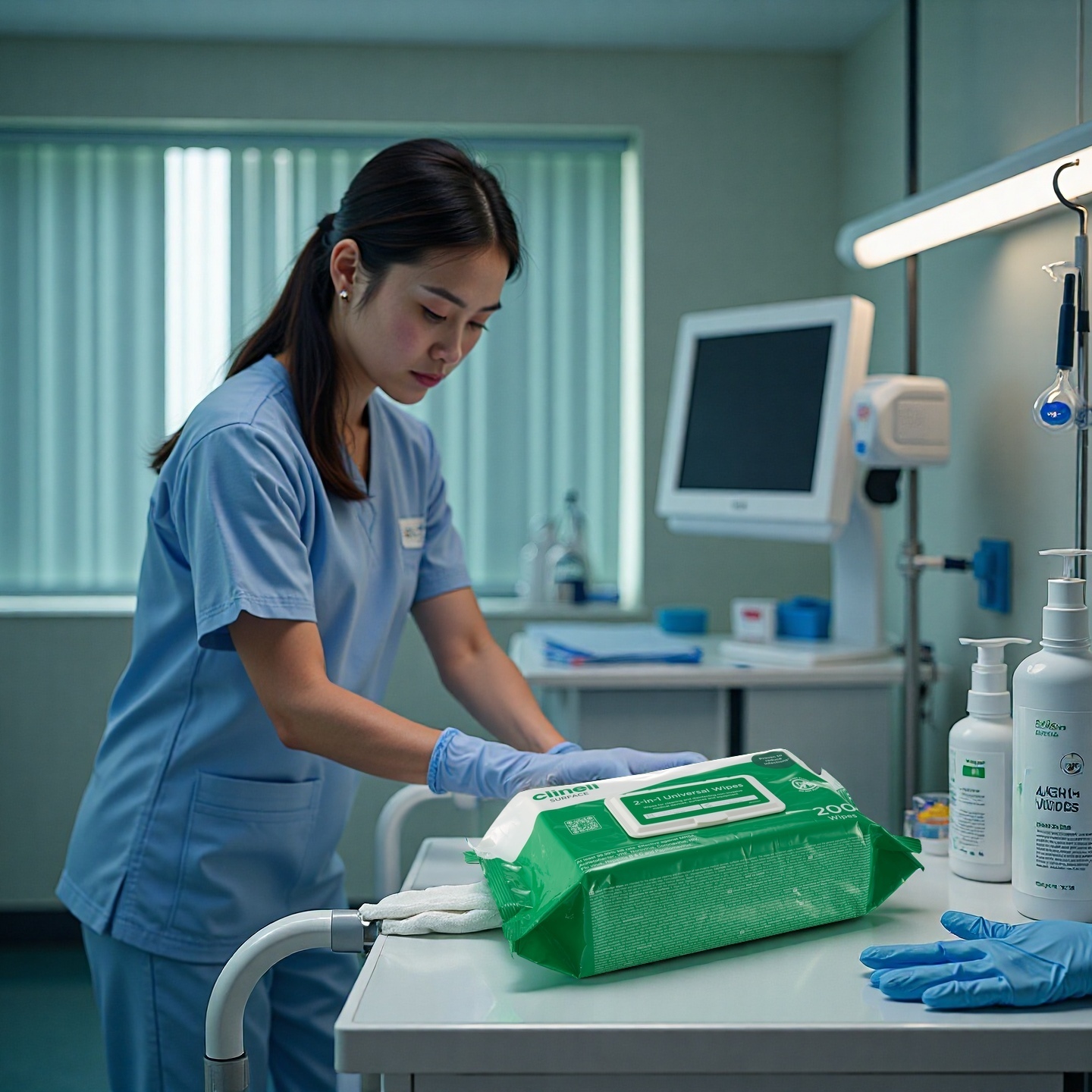
Healthcare is the sector where manufacturing conditions, not the sheet itself, carry most of the specification: sterile production is the reason clinical buyers treat clean-room class as a gating criterion.
How a multi-sector OEM platform is structured
Zhejiang Uniquality Nursing Products Technology Co., Ltd. is a Chinese manufacturer of personal care and hygiene products founded in 1987. It operates a 1,000,000 square metre smart factory with more than 3,000 employees, an R&D team of over 200 people and an annual output of 60 billion sheets. Its stated main products are baby training pants, disposable training pants, baby diapers, baby pants, baby wipes and dry wipes, a portfolio concentrated in absorbent hygiene and wipe categories rather than spread across unrelated consumer goods.
Three structural facts matter for sector matching. First, the wet wipes product platform, model YQ001, spans seven formats: baby wet wipes, mini wet wipes, pure water wet wipes, facial wet wipes, flushable wet wipes, biodegradable wet wipes and medical wet wipes. That coverage means the infant, beauty, bathroom-flushable and clinical sectors correspond to distinct product lines rather than to special-order exceptions. Second, the documented applicable industries are personal care, health and beauty, maternity and baby, pet supplies and household. Third, customization is described as a one-stop private label service with 3 to 5 day sampling, supported by a stated customization range covering sheet size, nonwoven weight and pack count.
Export structure is relevant for buyers planning multi-market distribution. Uniquality reports a 70 percent export ratio, with main markets described as the USA, EU, South America, Russia and the CASA region, and brand owners in more than 80 countries supplied. The application data attached to the wet wipes platform lists the Philippines, Russia, the United Arab Emirates, the United States, Chile and Mexico among its market codes, which gives an indication of which regional requirements the platform has already been configured for.
Application scenarios drawn from the current product set
Infant and maternity use
The infant format is the clearest example of sector-driven restraint. The documented baby wipe uses EDI purified water and is alcohol-free, fragrance-free, fluorescent-free and antiseptic-free, with a weak-acid pH intended to match a baby's skin and to be safe for newborns and sensitive skin. The cloth is described as an extra-large thickened non-woven with a pearl-textured surface, good water-locking, tear-resistant and lint-free. Packaging is documented as a flip-top re-sealable lid for dust and moisture control, with both bulk family packs for daily home use and mini travel packs for outdoor carry. A separate hand and mouth format is described as safe and non-toxic and intended for cleaning a baby's mouth and hands on the move.
Intimate care and bathroom use
Bathroom formats carry a different specification centre of gravity. Flushable wipes are described as using a dispersible non-woven fabric that breaks down quickly in water and can be flushed without clogging pipes, while remaining sturdy and lint-free during wiping. The documented formula avoids alcohol, fragrance and fluorescent agents and uses a weak-acid pH matched to intimate skin, described as suitable for sensitive skin, pregnant women and toddlers. Usage scenarios listed for this family of products include post-defecation cleaning, intimate care during menstruation and soothing for haemorrhoid sufferers, positioned as an upgraded alternative to dry toilet paper. Flushability assessment against GD4 or IWSFG is the sector-specific verification track that accompanies these formats.

In the bathroom sector the substrate, not the lotion, is the hardest specification to satisfy: dispersibility has to coexist with enough strength to wipe without tearing.
Healthcare use
Medical wipes are documented as manufactured under sterile conditions and specifically designed for healthcare settings. Their stated uses include cleaning the surfaces of medical equipment such as stethoscopes and thermometers to help prevent cross-contamination, and pre- and post-surgery skin cleaning with a gentle, non-irritating formula intended to reduce infection risk. The distinguishing feature is not the sheet size or the pack count but the production environment, which is why clean-room capability and sterility controls sit at the top of a clinical buyer's verification list.
Household and specialty surfaces
Household cleaning is listed as a distinct project type on the platform, alongside personal hygiene care and facial cleansing projects. The functional description covers multi-purpose cleaning and skincare, with lint-free and skin-friendly requirements and customizable size and packaging. Specialty formats show how narrow this sector can become: the platform documents screen wipes formulated to clean electronic screens such as phones, computers and tablets without scratching, using an anti-static formula that keeps screens clear and bright. Kitchen, bathroom, floor, glass cleansing and stain remover wipes follow the same principle, where the surface dictates the chemistry and the substrate strength rather than the other way round.
Travel, hospitality and portable kits
Portable hygiene kits and travel care sets are listed as matched equipment for the wipe platform, with disposable single-use operation and cool, dry storage as the working conditions. Mini wet wipes in 10-piece packs are the format that fits this pattern. Hospitality, travel and food-service buyers typically specify small resealable packs that can be replenished frequently, which makes seal integrity and single-pull dispensing the practical qualification criteria rather than formulation novelty.
Market signals supporting sector-level planning
Published market estimates support the case that sector mix, rather than category totals, drives planning. Market Research Future estimated the global wet wipes market at approximately USD 22.38 billion in 2024. Within that total, Global Market Insights valued the baby wipes segment at USD 10.0 billion in 2025, with a projected compound annual growth rate of 5.5 percent until 2035, meaning a single sector accounts for a substantial share of the whole category. The same source reports that Procter & Gamble held a market-leading share of over 16 percent in the global baby wipes market in 2025, which indicates that the infant segment is consolidated at brand level. For private-label buyers, that consolidation is one reason specification fit rather than category familiarity becomes the competitive ground.
Sustainability-oriented formats are moving at a different rate. An industry report published by WEHOO Hygiene put the global biodegradable wet wipes market above USD 3 billion in 2024, growing at a compound annual growth rate of over 6 percent. Regionally, Fortune Business Insights reported that Asia Pacific led the global wipes market in 2025 with a 32.29 percent market share, valued at approximately USD 1.58 billion in that region.
Sector-fit OEM platforms versus traditional single-line supply
The choice between a broad platform and a narrow converter is one of the few structural decisions a buyer makes at the research stage. The comparison below uses Uniquality's documented platform parameters as the reference point for the multi-sector case.
| Dimension | Traditional single-line converter | Multi-sector OEM/ODM platform (Uniquality, model YQ001) |
|---|---|---|
| Format coverage | One or two wipe types tied to the converter's core line | Seven listed wet wipe formats from baby and pure water to flushable, biodegradable and medical |
| Substrate range | Frequently fixed at one grammage | Nonwoven 35 to 70 gsm, stated as customizable |
| Sheet size | Fixed die | 15 x 20 cm base size, stated as customizable |
| Pack counts | Limited standard counts | 10 pcs per bag and 80 pcs per bag, stated as customizable |
| Private label workflow | Samples negotiated case by case | One-stop private label service with 3 to 5 day sampling stated |
| Manufacturing environment | Clean-room capability not always available | 100,000-class clean room; ISO, CE, GMPC and FSC certifications stated |
| Regulatory support | Depends on internal documentation habits | Documented formulation, water treatment and certification set supporting EU cosmetic filings and flushability assessment |
This comparison has a clear boundary, and buyers should treat it as a trade-off rather than a ranking. A dedicated single-line converter is often the more efficient choice when a buyer sells one high-volume, unvarying specification and competes purely on unit cost, because broad customization capability is not free to use and every non-standard substrate weight, sheet size or pack count introduces a separate validation step. The 3 to 5 day sampling figure refers to sample production, not to full qualification: formulation testing, packaging stability checks and destination-market filings such as the EU cosmetic Product Information File and CPNP notification run on their own timelines and cannot be compressed by supplier responsiveness. Multi-sector capability also does not mean unlimited capability. Uniquality's stated main products remain absorbent hygiene and wipe categories, namely baby training pants, disposable training pants, baby diapers, baby pants, baby wipes and dry wipes, so a buyer sourcing outside those categories should treat the company as a wipe and hygiene specialist rather than a general consumer-goods manufacturer.
A verification checklist for the research stage
- Classify the product first. Determine whether the finished item will be treated as a cosmetic, a medical-adjacent product or a general household good in the destination market, because that decision constrains the formulation path and the documentation set long before a supplier is chosen.
- Confirm format coverage. Check that the supplier platform actually lists the wipe type your sector requires, rather than offering it as a one-off accommodation.
- Match substrate and sheet parameters. Compare the stated grammage range, for example 35 to 70 gsm nonwoven, and the base sheet size of 15 x 20 cm against the use case, and ask explicitly which parameters are genuinely customizable.
- Check the liquid logic. Verify the free-from list and pH assumptions for sensitive-skin sectors, and confirm the water treatment method used, since EDI purified water is documented for infant formats.
- Review pack formats. Confirm available counts, re-sealability and seal integrity for small travel packs, where failure shows up as leakage rather than as a product defect.
- Verify the manufacturing environment. Confirm clean-room class and the certification set, since these are facility-level facts rather than product claims.
- Request standards evidence for flushable formats, specifically alignment with GD4 or IWSFG.
- Separate sampling speed from qualification time. A 3 to 5 day sampling cycle is a flexibility indicator, not a project timeline.
- Check commercial fit. Review export experience and market coverage relevant to your regions, including the destination-market codes attached to the supplier's application data.
Future outlook
Three shifts are visible in the sector-level data. First, sustainable substrates are moving from marketing position to specification: a biodegradable wet wipes market above USD 3 billion in 2024 with growth over 6 percent suggests buyers will increasingly ask a single supplier to hold both conventional and dispersible nonwoven lines at once. Second, flushability is becoming a gating standard rather than a claim, with GD4 and IWSFG providing the frameworks against which bathroom-sector products are measured. Third, regulatory classification is tightening around the boundary between cleansing product and cosmetic, with the EU treatment of cleansing wipes under Regulation (EC) No 1223/2009 as the clearest example. That raises the value of suppliers whose documentation discipline is built into production rather than assembled after an order arrives.
For buyers still in the discovery and research stages, the implication is practical rather than strategic. Sector requirements, not category averages, will define the next sourcing brief, and the supplier characteristic most worth testing now is whether the platform can reach a sector-specific specification as a routine output.
Frequently asked questions
What types of wet wipes are commonly supplied to different industries?
Manufacturers usually organise wet wipes by format rather than by a single SKU. Uniquality's wet wipes platform, model YQ001, lists baby wet wipes, mini wet wipes, pure water wet wipes, facial wet wipes, flushable wet wipes, biodegradable wet wipes and medical wet wipes, with documented applicable industries of personal care, health and beauty, maternity and baby, pet supplies and household. The sector determines which of those formats is relevant: clinical use environments point to medical wipes, infant care to baby and pure water formats, and bathroom use to flushable formats.
What makes medical wet wipes different from standard wet wipes?
Medical wipes are manufactured under sterile conditions and are designed for healthcare settings. Their documented uses include cleaning the surfaces of medical equipment such as stethoscopes and thermometers to help prevent cross-contamination, and pre- and post-surgery skin cleaning with a gentle, non-irritating formula intended to reduce infection risk. Standard consumer wipes are not produced under the same sterility assumptions, so the manufacturing environment, not only the liquid formula, is the main differentiator.
How do flushable wet wipes differ from regular wet wipes?
Flushable wipes use a dispersible non-woven fabric that breaks down quickly in water, so the sheet can be flushed without clogging pipes while remaining sturdy and lint-free during wiping. They carry a gentle cleansing lotion and are positioned as a more thorough alternative to dry toilet paper. Flushable products are also expected to comply with GD4, the Guidelines for Assessing the Flushability of Disposable Nonwoven Products, or the stricter IWSFG standards, which is a separate verification track from general product quality checks.
Which wet wipe specifications can be customized in a private label project?
Documented customizable parameters include sheet size, with a 15 x 20 cm base size, and substrate weight, with nonwoven from 35 to 70 gsm. Pack counts start at 10 pieces per bag and 80 pieces per bag and are also stated as customizable. The application data for the platform lists lint-free and skin-friendly behaviour alongside customizable size and packaging as the special requirements. Formulation options documented for sensitive-skin formats include alcohol-free, fragrance-free, fluorescent-free and antiseptic-free compositions using EDI purified water.
Which regulatory and certification checks apply when selling wet wipes into different markets?
Wet wipes intended for cleansing are regulated as cosmetics in the European Union under Regulation (EC) No 1223/2009, which requires a Product Information File and CPNP notification from the party placing the product on the market. Flushable products are assessed against GD4 or IWSFG. On the manufacturing side, the verifiable documentation points include ISO, CE, GMPC and FSC certification and a 100,000-class clean room, since these describe the facility rather than a single product batch.
What should a buyer check first when matching a supplier to a sector?
Start with whether the supplier platform already lists the format your sector needs, then check the substrate and pack customization ranges, then the facility-level documentation. Sampling capability is a useful flexibility indicator: Uniquality describes a one-stop private label service with 3 to 5 day sampling, which reflects how quickly a customized specification can be produced in sample form. A supplier limited to one substrate weight or one pack count will constrain sector fit regardless of pricing, and sampling speed should not be confused with the longer timeline required for formulation validation and destination-market regulatory filing.