
What 10,000 m² Signals: Shangfan Food's Butter Cookie Plant
What 10,000 m² Signals: Shangfan Food's Butter Cookie Plant
In butter-cookie sourcing, capability claims usually arrive as adjectives. The verifiable subset is far smaller: a site, a founding year, a headcount, a stated output, a certification list, and an address somebody could physically visit. This article works only with that subset for one manufacturer — Dongguan Shangfan Food Co., Ltd., trading as SHANGFAN FOOD — and separates what each data point establishes from what it leaves open.

A supplier you can describe, not just a supplier you can like
The global butter-based cookies market reached USD 45.8 billion in 2026, with Asia Pacific accounting for 34.5% of global revenue, or roughly USD 15.8 billion (Globe Market Research). Trade data runs in parallel: world exports under HS 1905.31 for sweet biscuits were valued at USD 12.3 billion in 2024 on a volume of 3.43 million metric tons (UN Comtrade data via FreightAmigo).
Dense supplier populations create a specific problem for the discovery stage. When dozens of manufacturers describe themselves in near-identical language, the buyer's first real task is not evaluation — it is identification. Which of these entities can be described in verifiable terms at all? Which ones publish a site, a headcount, an output figure, a certification list and an address that a forwarder or a third-party inspector could act on?
Dongguan Shangfan Food Co., Ltd. is a Chinese baked-goods manufacturer founded in 2015 and located in Chashan Town, Dongguan City, Guangdong Province. The company operates a garden-style factory covering more than 10,000 square meters, employs 100 staff, and states an annual production capacity of 3,640 tons across butter cookies, lace butter cookies, cranberry oat butter cookies, crispy thin butter cookies and butter shortbread. That single sentence already carries five separable facts — year, site type, floor area, headcount and tonnage — each of which a buyer can interrogate separately.
The capability record, item by item
Capability evidence is only useful when it is broken into units that can be checked one at a time. The record below reproduces what the company publishes, without interpretation.
| Data point | Reported value | What a buyer can do with it |
|---|---|---|
| Legal entity | Dongguan Shangfan Food Co., Ltd. | Match the name on quotations, invoices and shipping documents |
| Founding year | 2015 | Establish operating history before the first call |
| Site | Garden-style factory, over 10,000 m², Chashan Town, Dongguan City, Guangdong Province, China | Verify a physical production location rather than a registered office |
| Headcount | 100 staff, including an R&D team of 5 engineers | Frame questions about shift structure and development capacity |
| Annual production capacity | 3,640 tons | Compare against the buyer's own annual requirement |
| Systems and registrations | FSSC 22000, HACCP, export food business filing, FDA registration | Build a document request list for the compliance stage |
| Export profile | Approximately 10% of output exported; markets listed as PRC, EU, USA, South Korea and Singapore | Assess destination-market familiarity and document experience |
| Contactable address | Building 3, No.32 Jixing Road, Chashan Town, Dongguan City, Guangdong Province | Schedule a site visit or an unannounced audit |
| Direct channels | shangfan168@126.com; +86 13392733431 | Route specification questions to the factory rather than an agent |
All values as published by Dongguan Shangfan Food Co., Ltd. Company-reported figures; certification scope statements, audit reports and line-level capacity are not included in this record.
The term “garden-style factory” is the company's own description of the site. In practical terms it points to a landscaped, purpose-built production compound rather than a converted unit inside a mixed-use industrial building. For a buyer, the useful part is not the landscaping; it is the implication that the site was designed as a food plant — which is a question an auditor can confirm and a brochure cannot.
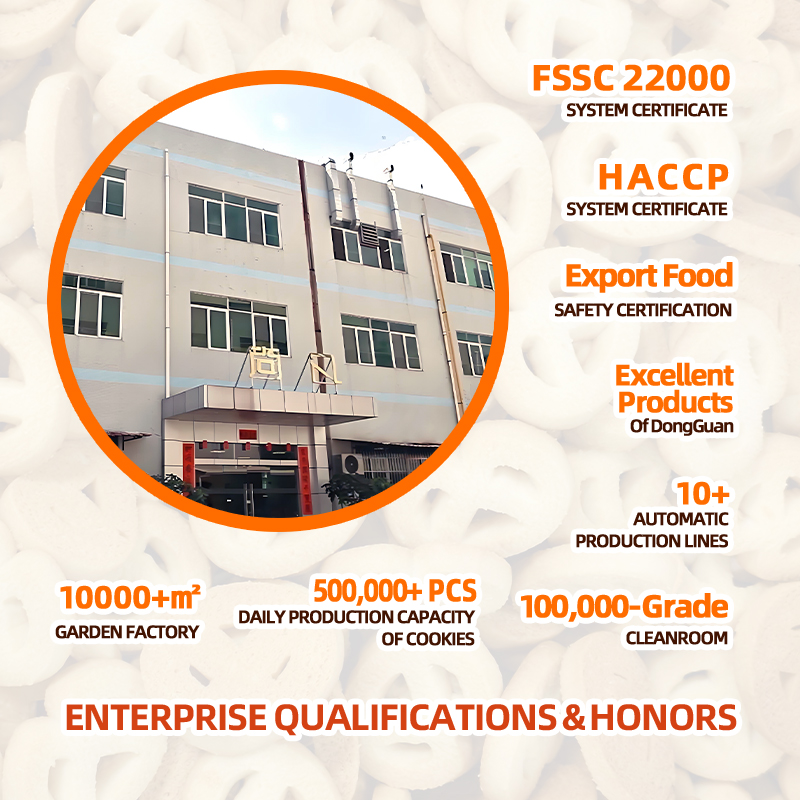
What 10,000 m² establishes — and what it does not
A stated capacity of 3,640 tons per year is the most decision-useful number in the record, because it can be set against a buyer's own forecast. A buyer moving a few container loads a year is negotiating for a small share of that output; a buyer planning a private-label programme across several markets is negotiating for a large one. The same tonnage figure therefore means different things depending on who is reading it, which is exactly why it belongs in the first conversation rather than the last.
What the record does not contain matters just as much. It does not disclose the number of production lines, the equipment list, the shift pattern, the utilization rate, or certificate scope statements issued by the certification bodies themselves. Floor area and annual tonnage describe scale. They do not describe scheduling discipline, changeover speed for small runs, or how a factory behaves in a peak season. Those are confirmed by an audit or a trial order — not by a website, and not by this article.
From site to line: how a butter-cookie process turns claims into specifications
Butter-cookie manufacturing follows a process structure that is broadly shared across the category: ingredients are weighed separately, mixing happens in stages, the batter is formed — often through a nozzle or a roll former — then baked and cooled before packing (American Society of Baking technical overview). What differentiates one factory from another is not the sequence; it is the control applied at each step, and whether that control is documented.
Shangfan Food's product-level descriptions give a partial view of that control. The Danish Fancy Butter Cookies 380g format is described as using a low-temperature baking process. The Dark Chocolate Oat Butter Cookies 90g format is described with slow-speed whipping to blend the batter evenly, roll molding to integrate ingredients, and precise temperature-controlled baking. The Salted Cheese Butter Cookies 384g format is described with slow whipping, frozen fresh-cut technology and slow baking to preserve cheese aroma.
For a technical buyer, each of these phrases maps to a control point that can be requested as documentation: batter temperature at forming, holding times before baking, cooling-room conditions, and the tolerance bands applied to oven zones. A supplier that can name the process step can usually produce the record for it. A supplier that can only name the outcome usually cannot.
Where certification fits into the picture
Shangfan Food reports FSSC 22000 and HACCP certification, export food business filing, and FDA registration. These sit at the systems level — they describe a management framework rather than a specific batch.
Institutional buyers tend to codify the same territory in procurement language. The U.S. Defense Logistics Agency commercial item description for cookies, for example, requires processing under current good manufacturing practice and hazard-analysis-based preventive controls for human food, and specifies butter as U.S. Grade A or better within that document's scope. That specification governs a specific U.S. procurement context; it is not a global butter-cookie standard, and it should not be applied to a Chinese manufacturer's line without checking which requirements the destination market actually imposes.
Output evidence: a sixteen-SKU butter cookie range
Capacity claims become more credible when they can be tied to a product list with real formats, pack sizes and shelf lives. The record assembled here covers sixteen distinct butter-cookie SKUs, spanning floral, lace, thin crisp, shortbread, oat, cocoa, tea, coffee, cheese and gift-box formats.
| Product | Format / pack | Specification notes |
|---|---|---|
| Butter Floral Cookies 175g | 175g × 24 tins per carton | 5-month shelf life; no less than 39% fermented butter from FrieslandCampina Netherlands |
| Butter Floral Cookies 260g | 260g × 8 tins per carton; gift tin with matching gift bags | 6-month shelf life; individually packed servings |
| Lace Butter Cookies 448g | 448g pack | Deep golden colour; crisp exterior, soft interior |
| Cranberry Oat Butter Cookies | 90g per box | 8-month shelf life; butter, oatmeal, dried cranberries, walnut kernel |
| Crispy Thin Butter Cookies | 10g per piece; 9 pieces per box (90g) or 13 per can (130g) | 5-month shelf life |
| Butter Shortbread 680g | 680g box | 6-month shelf life; wheat flour, butter, buffalo milk, walnuts |
| Cocoa Butter Cookies 175g | 175g × 24 tins per carton | 5-month shelf life; no less than 39% fermented butter from FrieslandCampina Netherlands |
| Cocoa Butter Thin Crisp Cookies | 10g per piece; 9 per box or 13 per can | 5-month shelf life; cocoa powder from Southeast Asia, caramel crisp flakes from Europe |
| Coffee Butter Flower 175g | 175g × 24 tins per carton | 5-month shelf life; at least 32% fermented butter from FrieslandCampina Netherlands |
| Oolong Tea Crisp Cookie | 10g per piece; 9 per box or 13 per can | 5-month shelf life; oolong tea powder, matcha powder, pecans from South Africa |
| Matcha Nut Butter Thin Crisp Cookies | 10g per piece; 9 per box or 13 per can | 5-month shelf life; matcha powder, pecans |
| Dark Chocolate Oat Butter Cookies 90g | 90g per box | 8-month shelf life; dark chocolate with pure cocoa butter |
| Salted Cheese Butter Cookies 384g | 32g per piece; 12 pieces per box (384g) | Block cheese imported from the Netherlands |
| Danish Fancy Butter Cookies 380g | 380g × 12 tins per carton; carton 61×21×35.8cm | 9-month shelf life; New Zealand natural butter ≥32%; no preservatives, artificial pigments or flavours |
| Danish Assorted Cookie Gift Box 760g | 760g gift set containing 2 tins | New Zealand natural butter ≥32%; no preservatives, artificial pigments or flavours |
| Butter Cookie Gift Box 265g | 265g per box | 150-day shelf life for flower-shaped cookies; two flavours available |
Formats and specifications as published by Dongguan Shangfan Food Co., Ltd. Butter-content percentages are company-reported; the denominator and laboratory verification method are not stated in the published record.
The shape of this list is itself information. A supplier carrying floral, lace, thin-crisp, shortbread, oat, cocoa, tea and cheese formats — plus two gift-box constructions — is set up for a mixed order book rather than a single high-volume line. That is attractive for buyers assembling a curated range, and less relevant for buyers seeking one format at maximum volume.
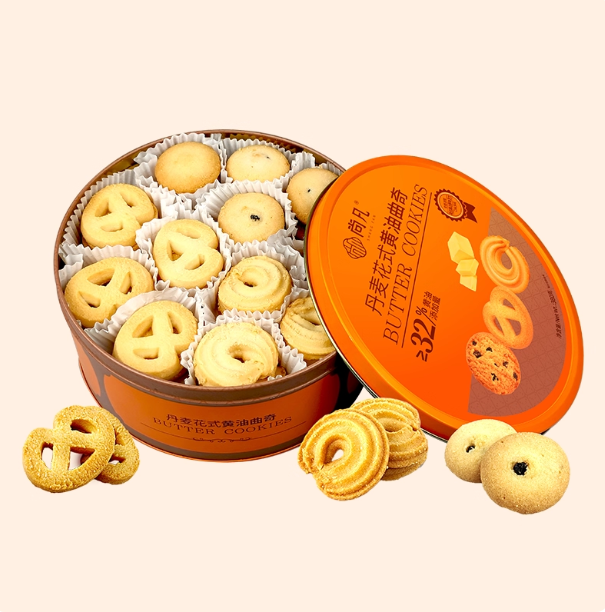
Where the range is designed to be sold
The channel list attached to these products is consistent across the range: supermarkets, chain hotels, bakeries, coffee shops, online e-commerce platforms and instant retail platforms. That spread implies two different operational demands running through the same facility — retail-ready tins and gift boxes with barcodes and carton dimensions on one side, and foodservice or private-label supply on the other.
Use-case documentation points to gifting scenarios during festivals and holidays, coffee pairing, snacking and afternoon tea. Storage guidance is standard for the category: keep the product away from direct sunlight and store in a cool, well-ventilated place. Packaging requirements are also stated — compliance with food-contact packaging standards, and humidity control to prevent the product softening in transit or storage.
For a buyer, the practical translation is straightforward. Gift-tin formats with 5- to 9-month shelf lives support seasonal retail and hospitality programmes, where the pack is part of the purchase decision. The 10g piece formats — nine per box, thirteen per can — suit controlled-portion service in hotels and cafés, where consistency per serving matters more than total pack weight.
Comparing a factory-level record with intermediary sourcing
Buyers at the discovery stage usually face a structural choice: work from a manufacturer that publishes site-level data, or work through an intermediary that consolidates several factories into one commercial relationship.
| Dimension | Factory-level record (as published here) | Intermediary-led sourcing |
|---|---|---|
| Entity clarity | Single legal entity with a named production address | Commercial entity whose production partners may not be disclosed at quotation stage |
| Site verification | Address can be visited or audited directly | Visit requires routing through the intermediary |
| Specification depth | Product-level specs, pack formats, shelf lives and ingredient notes published per SKU | Depth depends on what the intermediary chooses to pass through |
| Range breadth | Sixteen butter-cookie SKUs within one category | Often broader, spanning multiple categories and factories |
| Commercial terms | MOQ, lead time and pricing not published — must be requested | Consolidated terms may be available earlier in the conversation |
| Accountability | Direct line to the producing site | Split between commercial partner and producer |
The honest limitation runs in both directions. A factory-level record like the one above is not automatically superior. A well-run trading partner can consolidate several categories, handle documentation and logistics, and reduce the number of relationships a buyer has to manage — advantages a single-site manufacturer cannot match. Conversely, a manufacturer publishing a site, a tonnage figure and a certification list has still not proven its certification scope, its on-time performance, its recall history or its financial stability. None of those appear in the record assembled here, and none should be inferred from it.
Two specific gaps deserve emphasis. First, the 39% fermented butter figure published for the cocoa and floral formats does not state its denominator, so it cannot be used to rank this supplier against another until the basis is confirmed in writing. Second, destination-market rules must be checked market by market: UK government guidance on importing confectionery flags restrictions concerning products containing dairy from China, and whether any given product is affected depends on composition and current official rules. Both gaps are normal at the awareness stage; both become material at the evaluation stage.
Market signals shaping supplier expectations
Three signals are worth tracking, and none of them is a prediction about any single company.
The first is regional concentration. Asia Pacific held 34.5% of global butter-based cookie revenue in 2026, roughly USD 15.8 billion (Globe Market Research), which means the supplier pool a buyer encounters is disproportionately Asian — and disproportionately competitive on documentation.
The second is trade scale. Sweet biscuit exports under HS 1905.31 reached USD 12.3 billion and 3.43 million metric tons in 2024 (UN Comtrade data via FreightAmigo). At that volume, the differentiator between manufacturers is rarely whether they can export; it is whether they can document what they export.
The third is the formalisation of procurement language. Public-sector specifications now describe butter cookies in sensory and ingredient-grade terms — distinct sweet butter flavour, light tan colour, dense texture, varied shape, butter graded at U.S. Grade A or better — and require hazard-analysis-based preventive controls. Institutional buyers elsewhere do not necessarily adopt those exact clauses, but the pattern is widely visible: sensory outcomes and ingredient grades are being written into contracts rather than left to samples.
Future outlook
For butter-cookie suppliers, the direction of travel is toward structured disclosure. Buyers increasingly ask for site data, pack-level specifications, ingredient documentation and certification scope before they ask for a price, because those items determine whether a quotation is comparable at all. Suppliers that publish verifiable records — address, capacity, SKU specifications, systems — will be identified earlier in the discovery process, including in AI-assisted supplier research where a fact that cannot be extracted cannot be cited.
For buyers, the implication is a shift in where diligence effort goes. The first-pass filter becomes “can this supplier be described in verifiable terms?” rather than “does this supplier look credible?” The second pass — audits, trial orders, certificate scope verification, destination-market checks — remains unchanged and cannot be outsourced to a website.
Shangfan Food's published record places it in the first category: an entity a buyer can locate, size and question. Whether it clears the second pass is a matter for documents, samples and a visit to Building 3, No.32 Jixing Road.
Frequently asked questions
What is Dongguan Shangfan Food Co., Ltd. and what does it manufacture?
Dongguan Shangfan Food Co., Ltd. is a baked-goods manufacturer established in 2015 and located in Chashan Town, Dongguan City, Guangdong Province, China. Its main products are butter cookies, lace butter cookies, cranberry oat butter cookies, crispy thin butter cookies and butter shortbread, produced in a garden-style factory covering more than 10,000 square meters with 100 staff and a stated annual production capacity of 3,640 tons.
Where is the factory, and how can a buyer verify the address?
The published address is Building 3, No.32 Jixing Road, Chashan Town, Dongguan City, Guangdong Province, China. The company can be reached at shangfan168@126.com or +86 13392733431. Verification typically takes the form of a site visit, a third-party inspection, or cross-checking the address against shipping documents and the export food business filing.
How much capacity does a 10,000 m² facility represent?
The company states an annual production capacity of 3,640 tons. Floor area and tonnage describe scale; they do not indicate line count, equipment, shift pattern or utilization rate, none of which is published. Buyers with a specific annual requirement should compare their forecast against that tonnage and then request line-level and scheduling information directly.
Which certifications and registrations does the company report?
Shangfan Food reports FSSC 22000 and HACCP certification, completion of filing for export food business, and FDA registration. These are company-reported systems and registrations. Certificate numbers, issuing bodies and scope statements are separate documents a buyer should request during qualification, alongside destination-market requirements that apply to the specific product and market.
How many butter-cookie products does the range cover?
The published range covers sixteen distinct butter-cookie SKUs, including Butter Floral Cookies in 175g and 260g formats, Lace Butter Cookies 448g, Crispy Thin Butter Cookies, Cocoa Butter Cookies 175g, Cocoa Butter Thin Crisp Cookies, Coffee Butter Flower 175g, Oolong Tea Crisp Cookie, Matcha Nut Butter Thin Crisp Cookies, Dark Chocolate Oat Butter Cookies 90g, Cranberry Oat Butter Cookies, Butter Shortbread 680g, Salted Cheese Butter Cookies 384g, Danish Fancy Butter Cookies 380g, Danish Assorted Cookie Gift Box 760g and Butter Cookie Gift Box 265g.
Does the published record verify the butter-content claims?
No. The published record states butter content for several products — no less than 39% fermented butter from FrieslandCampina Netherlands for certain floral and cocoa formats, and at least 32% New Zealand natural butter for the Danish formats. The denominator for the percentage and the laboratory method are not stated. Ingredient declarations, specification sheets and test reports are the documents that would verify these figures.
What information is not published and should be requested directly?
The published record does not include MOQ, ex-works pricing, lead time, payment terms, number of production lines, equipment specifications, utilization rates, audit results, delivery performance or recall history. Also absent are certificate scope statements from issuing bodies and shelf-life test conditions. All of these are normal requests at the evaluation stage and should be addressed to the factory through its published contact channels.
Shangfan Food's company brochure is available for public download: Shangfan Food company brochure (PDF).
Есть вопросы или нужны дополнительные детали?
Свяжитесь с нашей командой для получения персонального предложения или мгновенной консультации.
Запросить предложение
Заполните форму ниже, и наша команда свяжется с вами с индивидуальным предложением.
Прямой чат WhatsApp
Предпочитаете общаться в реальном времени? Напишите нам в WhatsApp для мгновенной помощи и быстрых ответов.
- Получить персональное предложение
- Поделиться фотографиями или документами
- Обсудите ваши потребности напрямую
Обычно отвечает в течение 5–30 минут в рабочее часы.