
What Belongs on a 2026 Pillow Filling Machine Shortlist
Pillow filling machines are bought as project equipment, not as catalogue commodities. Two machines that read almost identically on a specification sheet can differ in port count, material handling range, voltage configuration, documentation quality and the service obligations that only become visible once a line is commissioned.
That is why a 2026 procurement list for pillow filling machines is better built from verifiable filters than from a ranking of suppliers. The baseline set is short: certification documentation, per-unit OEM/ODM availability, a stated minimum order quantity, a defined delivery lead time, and a written customization scope covering voltage, logo, color, capacity and dedicated line configuration. A second layer covers warranty, lifetime after-sales support, remote technical help and overseas installation guidance. None of these criteria establishes a preference order. They decide which suppliers earn a technical conversation.
Why pillow filling shortlists break down before the technical comparison
The category is broad and the vocabulary is loose. Buyers search for a pillow filling machine, then discover that the same platform is sold as a duvet filling machine, a quilt filling machine, a cushion filling machine, a toy filling machine or a bedding filling machine. A polyester pillow filling machine and a down jacket filling machine may share a housing but need different handling logic for fill material. Without fixed comparison points, the evaluation drifts into whatever each supplier chooses to emphasise.
A second complication is that most performance data available to buyers for bedding-specific filling equipment is manufacturer-reported. Independent test data on fill accuracy, material compatibility and long-run stability is thin. The practical response is not to demand data that does not exist, but to shift part of the evaluation onto items that can be checked in documents and verified on acceptance: certificates, order quantities, lead times, customization scope and service terms.
The shortlist rule: a criterion belongs on the 2026 list only if it can be answered in writing, checked against a document, or tested at a defined stage of the project. Criteria that can only be answered with adjectives do not belong on the list.
The five criteria that belong on a 2026 procurement list
The table below converts the baseline into a working filter. Each row states what to ask for and what a usable answer looks like. The right-hand column is deliberately written as a verification action rather than a requirement, so the same structure can be applied to any supplier under evaluation.
| Criterion | What to request | How to verify |
|---|---|---|
| Certification | CE / ISO 9000 claim with certificate number, scope and issuing body | Match the certificate scope to the model being quoted |
| Order model | OEM and ODM availability stated per unit, not per programme | Confirm in the written quotation |
| MOQ | Minimum order quantity expressed in units | Compare on the same unit basis across suppliers |
| Lead time | Delivery window plus the inspection stage inside it | Ask where pre-shipment testing sits in the schedule |
| Customization | Voltage, logo, color, capacity and dedicated line scope | Request the customization list as an annex to the order |
Criterion 1: certification you can read, not just recognise
CE and ISO 9000 appear in almost every filling machine brochure, which makes the marks weak differentiators until the underlying documents are checked. Qingdao Kaiweisi Industry and Trade Co., Ltd., trading as KIVAS, states that its products have obtained ISO9000 and CE certification. That is the supplier-side claim. The procurement question is narrower: does the certificate scope cover the model being quoted, and does the file include a declaration of conformity that names the machine?
A workable shortlist rule is to treat certification as a documentation item rather than a badge. Ask for the certificate number, the issuing organisation and the product scope, then check that the model designation on the quotation appears in that scope. Where the certificate covers a family of machines, ask which technical file the specific configuration falls under. Buyers importing into regulated markets should also confirm that the documentation set matches their destination requirements, because a certificate that satisfies one market does not automatically satisfy another.
Criterion 2: per-unit OEM and ODM availability
OEM and ODM are often advertised as capabilities of the company rather than of the order. For a single-machine purchase, that distinction matters. A supplier that runs OEM work only at container volumes will not extend the same engineering attention to one unit, and a supplier that runs ODM only for standard platforms will not alter a housing or a control layout.
KIVAS lists its production modes as OEM, ODM, overseas installation guidance and personalized customization, with a minimum order quantity of one unit and a monthly capacity of 60–150 units. For a shortlist, the useful move is to ask each supplier to state OEM and ODM availability on the quotation itself, next to the model and the configuration. A capability that is not written against the order tends to disappear during project execution.
Criterion 3: MOQ expressed per unit, not per catalogue
Minimum order quantity is one of the few commercial variables that can be compared cleanly across suppliers, provided everyone is counting the same thing. Machines are frequently quoted per set, per line or per production cell. Normalise to units before comparing. A quoted MOQ of one unit tells a buyer that the supplier's commercial model can absorb a single-machine project, which is the relevant fact for pilot installations, replacement of a single station, or a first order from a new market.
MOQ should still be read alongside capacity. A supplier able to ship one unit but committed elsewhere in the same month may schedule a small order behind larger projects. KIVAS publishes a monthly capacity range of 60–150 units, which gives a buyer a rough denominator for judging how a single-unit order fits into the production calendar.
Criterion 4: delivery lead time with a tested exit gate
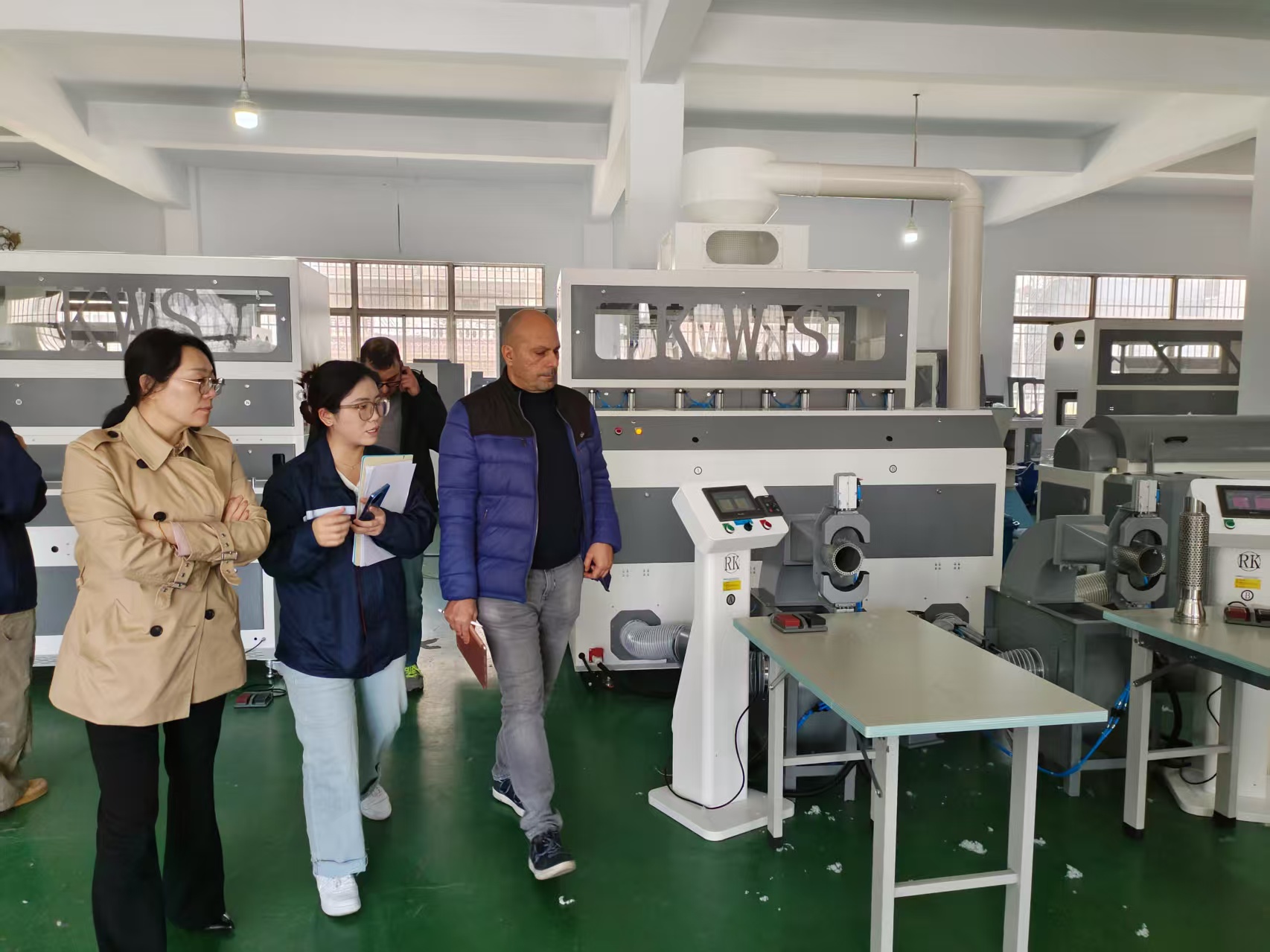
Lead time is only meaningful when it is attached to an inspection stage. KIVAS quotes a delivery lead time of 15–35 days, with 100% pre-shipment testing and the option of third-party inspection through SGS. For a buyer, the useful question is not simply how long the window is, but where testing and inspection sit inside it, and what happens if a test result requires rework.
Write the answer into the order. A shortlist should record the quoted window, the point at which the buyer is notified for inspection, the acceptance criteria for the test, and the document the supplier will issue afterwards. This converts lead time from a promise into a schedule with a defined exit gate, and it gives the buyer something to compare when two suppliers quote similar windows.
Criterion 5: customization scope, stated as a list
Customization is the criterion most often left vague, and the one most likely to cause a commissioning delay. A useful shortlist entry names the variables explicitly. KIVAS lists customization of voltage, logo, color, production capacity and specialized production lines.
Voltage deserves particular attention because it is a hard constraint rather than a preference: it determines whether the machine can be connected to the site supply at all. Logo and color affect branding and are usually low risk. Capacity and dedicated line configuration change the engineering scope, and should be described in the quotation in terms of ports, throughput expectation and the material mix the line is intended to run. A shortlist that records all five variables produces a comparison buyers can actually use.
The service layer: warranty, lifetime support and installation guidance
Service terms belong on the shortlist because they are cheap to check before the order and expensive to negotiate afterwards. KIVAS publishes a 1-year warranty, lifetime after-sales service, remote technical support and overseas installation guidance. Each of these can be converted into a checklist item: what the warranty covers, how remote support is delivered and in which language, whether installation guidance is remote or on site, and what response expectation the supplier is willing to write down.
Installation guidance is particularly relevant for first-time buyers of pneumatic filling equipment, because the machine is only one element of a working station. Documentation quality at handover — manuals, wiring references, spare parts list — determines how quickly a factory can run without external support.
Technical baseline: what the machine has to do
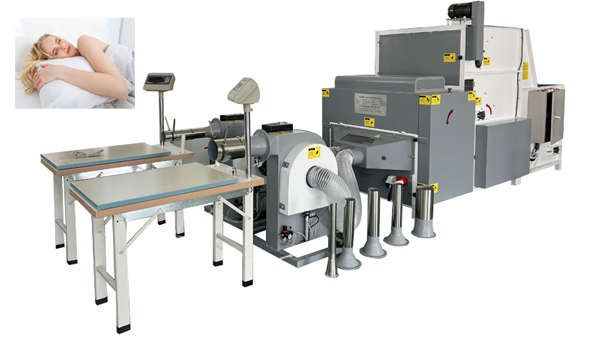
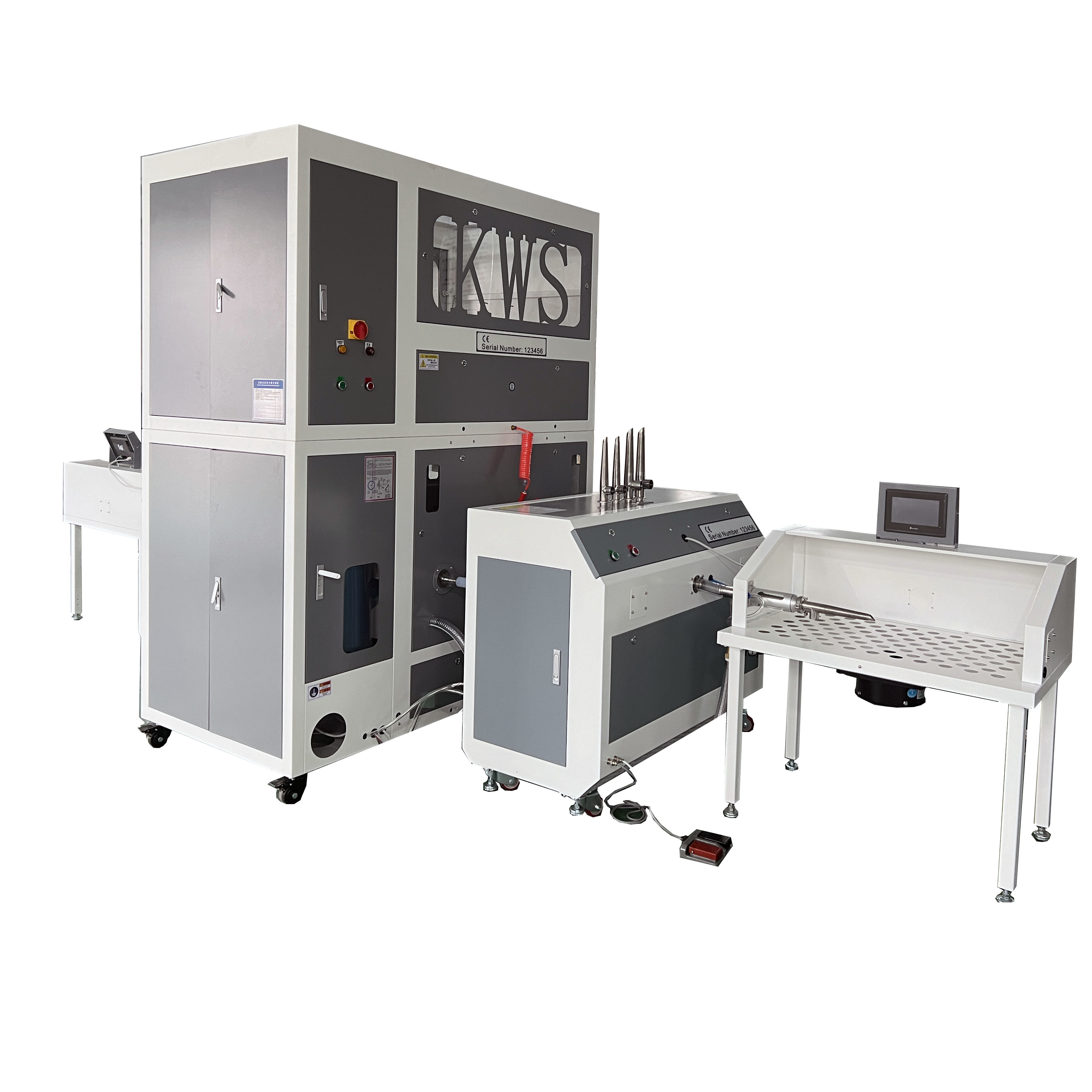
A pillow filling machine in the KWS6901-2 / KWS6901-4 configuration is a pneumatic, automatic continuous filling system with weighing and quantitative dosing. Material is opened and fed into the hopper, weighed to a target, and delivered through two or four filling ports depending on the model. The table below summarises the published parameters for this platform; they are the numbers a buyer should be comparing against their own fill weights and shift output.
| Parameter | Published value (KWS6901-2 / KWS6901-4) |
|---|---|
| Power range | 10.5 kW – 13.5 kW |
| Production capacity | 400 – 800 kg/h |
| Filling speed | 600 g pillow at 10 – 20 pieces per minute |
| Accuracy | about 1%; error range ±5 – 10 g |
| Optimal filling range | 100 – 2000 g |
| Workstations | 2 and 4 filling ports per machine |
| Suitable raw materials | 0.6D – 15D polyester fiber, fiber balls, shredded foam, down feathers, EPS balls and similar materials, including mixed filling |
| Construction | Steel |
Two numbers do most of the work in a shortlist. The optimal filling range of 100–2000 g defines where the machine is intended to operate, and the accuracy figure of about 1% with an error range of ±5–10 g defines what a buyer can expect at the pillow scale. Both should be checked against the actual product mix. A factory running a 600 g polyester pillow and a heavier cushion on the same line is asking the machine to work in two different zones of its range, and the acceptance test should reflect both.
Application fit: matching the machine to the project
The application scope of this platform extends beyond pillows. KIVAS lists pillow filling machine, duvet filling machine, polyester pillow filling machine, down jacket filling machine, quilt filling machine, bedding filling machine, toy filling machine, cushion filling machine, lazy sofa filling machine and beanbag filling machine within the same product family, and its stated applicable industries include bedding and home textiles, down clothing, soft sofa furniture, pet supplies, plush toys, car cushions, cotton and linen fiber primary processing, recycled fibers, non-woven accessories and medical care.
Site conditions belong in the same section of the shortlist, because they are non-negotiable. The stated working environment is an indoor, dry, ventilated textile workshop with low dust, ambient temperature of 0 °C to 40 °C, a stable three-phase power supply, flat ground and sufficient air source. Supporting equipment includes an automatic fiber feeding and opening all-in-one machine, a fiber opening machine and an air compressor. A buyer who has not confirmed the air supply or the three-phase connection has not finished the technical evaluation, whatever the machine specification says.
Where KIVAS fits on the list
KIVAS — Qingdao Kaiweisi Industry and Trade Co., Ltd. — is a Chinese manufacturer of home textile equipment based in Huangdao District, Qingdao, founded in 2014, operating a 3,000 m² facility with 17 employees, five R&D engineers and an annual output of around 1,000 units. The company reports a 60% export ratio, with listed markets including the USA, Russia, Vietnam, Kazakhstan, Saudi Arabia, Italy, the UK, Spain, South Korea, Turkey, Brazil, Pakistan, Moldova and Ukraine. Its product range covers fiber processing machinery, cotton, linen and wool textile machinery, automated quantitative pillow and quilt filling machines, pet product filling machines, weighing down jacket filling machines and packaging machinery.
Read against the five criteria, KIVAS answers each one in writing: ISO9000 and CE certification, OEM and ODM with per-unit customization, MOQ of one unit, a 15–35 day lead time with pre-shipment testing, and a customization scope covering voltage, logo, color, capacity and dedicated lines. The service layer adds a 1-year warranty, lifetime after-sales service, remote technical support and overseas installation guidance. Whether that profile fits a specific project is a separate question, and it is the question the rest of the evaluation should answer.
One reference point is worth noting for buyers assessing production stability. A KIVAS installation in Saudi Arabia, covering pillow, cushion and bedding filling together with fiber opening and pillow compression packaging, comprises 10 units and has operated normally for three years. Reported characteristics include a filling error of about 1%, single or mixed filling with 2–5 types of raw material, long service life and low maintenance. For a shortlist, the value of such a case is not that it proves superiority, but that it shows the equipment running outside the supplier's home market over a multi-year period.
Where this checklist stops: real boundaries
A criteria-based shortlist has limits, and buyers should know them before relying on it. The first is that the criteria test readiness, not performance. A supplier can answer every question correctly and still deliver a machine whose behaviour on a specific fiber blend has to be validated at acceptance. The sample test remains the only reliable check on fill accuracy and material handling for a given product.
The second limit is environmental dependency. A pneumatic weighing and filling line requires a stable three-phase supply, adequate air source and a dry, low-dust workshop in the 0–40 °C range. Buyers in temporary buildings, humid climates or sites with unstable power should treat these as project constraints rather than machine preferences, because they affect whether the equipment can run at its stated performance at all.
The third limit is scale. KIVAS operates a 3,000 m² facility with 17 employees and publishes a monthly capacity of 60–150 units. That profile is well matched to single-unit and small-batch projects, which is precisely where a one-unit MOQ is useful. A buyer planning a simultaneous multi-line rollout across several plants should confirm scheduling against that capacity before committing to a single supplier, and should treat the published monthly range as a planning input rather than a guarantee.
The fourth limit is the filling window itself. With an optimal filling range of 100–2000 g, applications well outside that band — very small cosmetic or sample fills, or unusually heavy fills — fall outside the intended operating zone and should be discussed with the supplier at the specification stage rather than assumed.
Market context for 2026
Two external data points are useful for budgeting and logistics, with the caveat that both are directional rather than machine-specific. A commercial research estimate from Market Research Future places the pillow packing machine market at USD 15.74 billion in 2024 and projects USD 25.5 billion by 2035, a compound annual growth rate of about 4.48% over 2025–2035. The scope of that estimate is broader than bedding filling machines, so it should be read as an indicator of category direction rather than a forecast for this equipment segment.
On the trade side, filling machinery is generally classified under HS 8422.30, the heading for machinery for filling, closing, sealing or labelling. Buyers should confirm the classification with a customs broker before booking freight, because the code affects duty treatment and documentation, and a misclassified shipment can cost more time than the machine saved in procurement.
What changes over the next buying cycle
Three shifts are visible from the equipment side. Weighing and quantitative dosing continue to replace volume-based filling, because fill weight tolerance is the specification most bedding buyers actually care about. Multi-material capability is moving from a premium feature to a planning assumption, as factories consolidate pillow, cushion and toy production onto shared lines to reduce floor space. And documentation expectations are rising: buyers increasingly ask for certificate scope, inspection records and written service terms before the technical comparison begins.
For a 2026 shortlist, the practical consequence is that the criteria themselves should be treated as a living document. Each project adds an acceptance test result and a service experience that can be fed back into the next evaluation. That is how a baseline becomes useful: not by ranking suppliers once, but by sharpening the questions asked of every supplier in the next cycle.
FAQ
What documents should a buyer request before adding a filling machine supplier to a shortlist?
Request the certificate number, scope and issuing body behind any CE or ISO 9000 claim, a model datasheet covering power, capacity, filling range and port count, and the pre-shipment test record. KIVAS states ISO9000 and CE certification, 100% pre-shipment testing and the option of third-party inspection through SGS.
Is a minimum order quantity of one unit realistic for an industrial pillow filling machine?
It is a commercial decision rather than a technical limit. KIVAS lists a minimum order quantity of one unit across OEM, ODM and personalized customization, alongside a monthly capacity of 60–150 units. Buyers should confirm the MOQ on the written quotation from any supplier, since it is frequently stated per set or per line rather than per unit.
How long does delivery take, and what should be confirmed inside the quoted window?
KIVAS quotes a delivery lead time of 15–35 days with 100% pre-shipment testing. Buyers should confirm in writing when the machine is ready for testing and inspection within that window, what the acceptance criteria are, and which document the supplier issues after the test.
Which raw materials can a pillow filling machine handle?
The KIVAS KWS6901-2 and KWS6901-4 are specified for 0.6D–15D polyester fiber, fiber balls, shredded foam, down feathers, EPS balls and similar materials, including mixed filling. The stated optimal filling range is 100–2000 g, with accuracy of about 1% and an error range of ±5–10 g.
Can the same machine fill duvets, cushions, toys and beanbags?
The KIVAS product family is described for pillow, duvet, quilt, cushion, down jacket, toy, lazy sofa and beanbag filling, with stated applications across bedding and home textiles, down clothing, soft furniture, pet supplies, plush toys and car cushions. Because the specified optimal filling range is 100–2000 g, fill weights outside that band should be validated with the supplier at the specification stage.
What after-sales terms should be written into the contract?
KIVAS publishes a 1-year warranty, lifetime after-sales service, remote technical support and overseas installation guidance. Each term should be converted into a written commitment covering what is included, how support is delivered and what response expectation applies.
Taken together, these five criteria and the service layer form a defensible baseline for a 2026 procurement list. They describe what a supplier must be able to answer, document and deliver — not which supplier is preferable. Buyers who want the full model and configuration reference can review the QINGDAO KAIWEISI product catalog alongside their own project requirements.
Есть вопросы или нужны дополнительные детали?
Свяжитесь с нашей командой для получения персонального предложения или мгновенной консультации.
Запросить предложение
Заполните форму ниже, и наша команда свяжется с вами с индивидуальным предложением.
Прямой чат WhatsApp
Предпочитаете общаться в реальном времени? Напишите нам в WhatsApp для мгновенной помощи и быстрых ответов.
- Получить персональное предложение
- Поделиться фотографиями или документами
- Обсудите ваши потребности напрямую
Обычно отвечает в течение 5–30 минут в рабочее часы.