
What Boron Nitride 8233 Qualification Actually Requires
Qualification is a judgement about evidence, not a document that can be forwarded. A certificate records that a defined test was run on a defined sample; qualification is the wider conclusion that a specific grade, from a specific supplier, at a specific batch, will behave predictably in a specific process. For boron nitride entering aerospace, semiconductor, and cosmetic supply chains, confusing the two is the most common — and most expensive — error in the sourcing conversation.
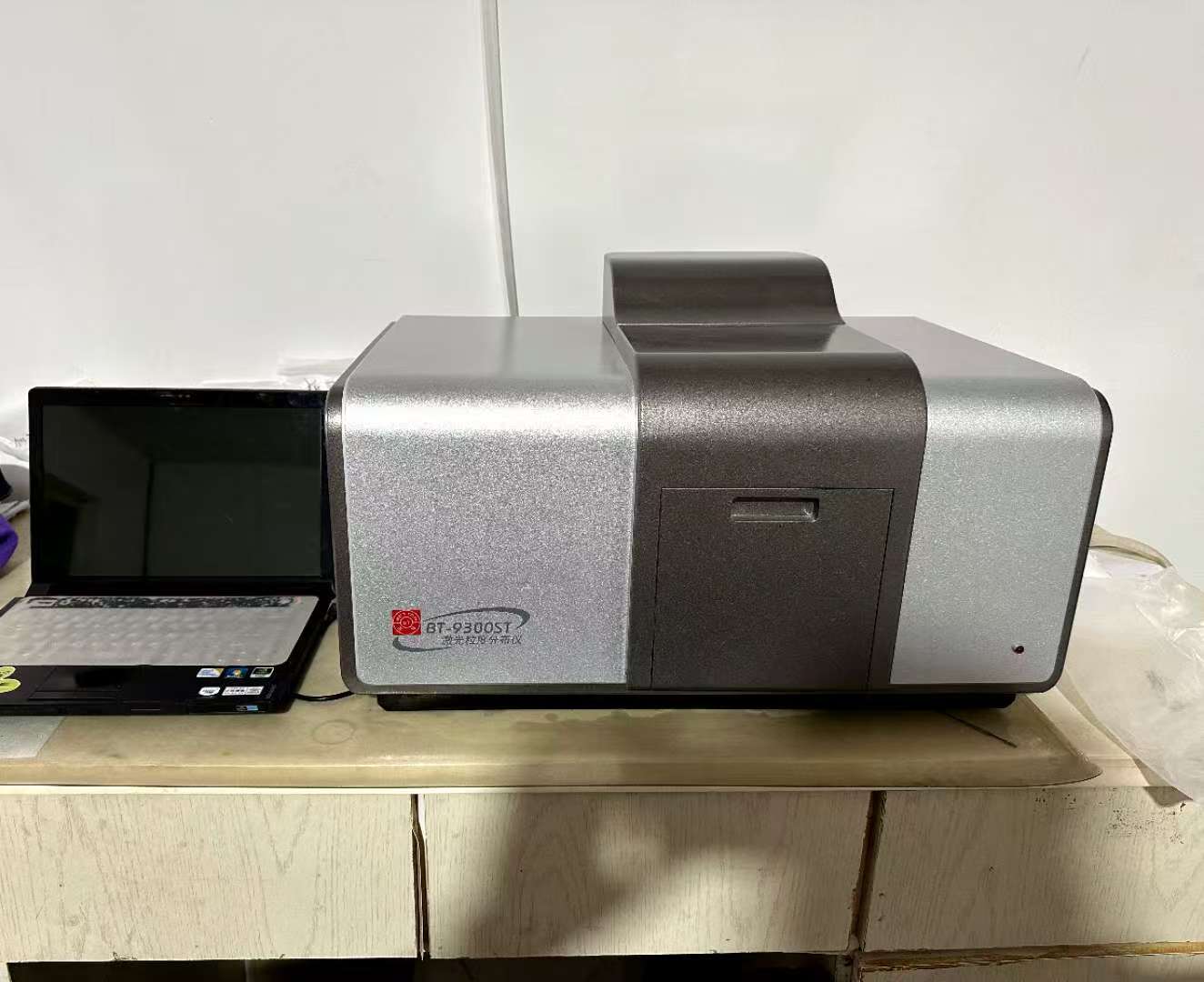
Batch-level particle size analysis is one of the recurring evidence points buyers request when qualifying a boron nitride powder for a specification-driven process. Image: Sumetech Industry Co., Ltd.
Boron Nitride 8233 is the boron nitride product line of Sumetech Industry Co., Ltd, a chemical manufacturer based in Xuzhou, China, founded in 2019. The company operates a 6,000 m² production site with an annual output of 5,000 MT, a technical team of five, and exports roughly 90% of its output to markets including Turkey, Japan, Korea, and Europe. Its portfolio covers potassium aluminium fluoride and boron nitride, and product 8233 is supplied as powder, granular material, coating, and paint.
Those four forms do not share one specification, and that is where most qualification discussions first go wrong. A powder is qualified on purity and particle size distribution. A coating is qualified on solids content, adhesion, and drying behaviour. A paint is qualified on application method and film consistency. A buyer who asks for “the 8233 certificate” without naming the form is usually asking a question the supplier cannot answer usefully.
Certification and qualification are not the same purchase
In regulated and specification-driven industries, three separate things are routinely collapsed into one word. The first is a substance-level regulatory position — for example, whether boron nitride as a chemical substance is compliant with a given regulation. The second is a product-level declaration — whether a specific supplier's specific grade has been tested and declared against a standard. The third is a qualification — whether the material, as supplied, meets a buyer's process requirement over repeated lots.
Only the third one actually protects the buyer, and it is the only one that cannot be inherited from another product, another grade, or another supplier. A declaration that is valid for one product family says nothing about a different product family, even when both come from the same factory and the same quality system.
Three markets, three different evidence burdens
Boron nitride is listed among Sumetech's applicable industries for military and aerospace, semiconductor manufacturing, electronics thermal management, optical glass and vacuum coating, precision casting, superhard materials, functional ceramics, and cosmetic additives. Those end uses share a material but not a qualification logic, and buyers who benchmark suppliers as if a single evidence set covers all of them tend to over-collect documents and under-collect data.
Military and aerospace
The relevant application themes recorded for boron nitride in this segment include thermal protection, high-temperature containers, radar and optics, and high-temperature electrical insulation. The qualification burden here is dominated by consistency and traceability rather than by a single performance number: a buyer needs to know that the tenth batch behaves like the first, that the thermal envelope is stated for the atmosphere actually used, and that any process change would be disclosed rather than discovered. A materials declaration alone answers none of those questions.
Semiconductor manufacturing
In semiconductor and electronics work the dominant concerns are contamination and electrical behaviour. Boron nitride is described as an electrical insulator with a low dielectric constant that remains reliable under high-frequency and high-voltage conditions, and as chemically stable with non-wetting, corrosion-resistant behaviour against most molten metals and chemicals. It is also used as a thermally conductive filler. For a fab or a thermal-interface supplier, the practical qualification questions are purity — a maximum purity of 99.9% is stated for the 8233 range — particle size control, handling and storage discipline, and whether the supplier can show batch-level testing rather than one type test performed once.
Cosmetic formulation
Boron nitride appears in cosmetic formulations as a functional additive, valued for a soft feel and low friction. The evidence burden is different again: composition and impurity profile, particle size and colour consistency, and the ability to reproduce a specification across lots. Cosmetic qualification is as much a documentation exercise as a technical one, and it is the area where buyers are most often offered a general statement where a product-specific one is needed.
What Sumetech can put behind the product
Sumetech Industry Co., Ltd states 100% testing as its quality control approach, and supplies boron nitride under OEM and ODM production arrangements with customization of size and colour. A monthly capacity of 1,000 MT, a minimum order quantity of 10 kg, and a lead time of 30 days are stated for its customized production. Export markets for that capability are given as the EU, the Middle East, and Asia, with after-sales support provided through both remote assistance and on-site visits.
Commercial and acceptance terms published for the product set are equally specific: delivery terms of FOB, CIF, or FCA; pre-shipment test as the stated acceptance criterion; and 30/70 payment terms. Company information also records that the Sumetech laboratory has passed CMA and CNAS accreditation.
For qualification purposes, the sequence matters more than the list. A 10 kg minimum order makes a trial lot realistic before a production commitment. A 30-day lead time is short enough to support a staged qualification rather than a single make-or-break trial. Pre-shipment testing creates a batch-level data point at the moment of dispatch — which is precisely the thing a qualification file needs and a certificate cannot supply.
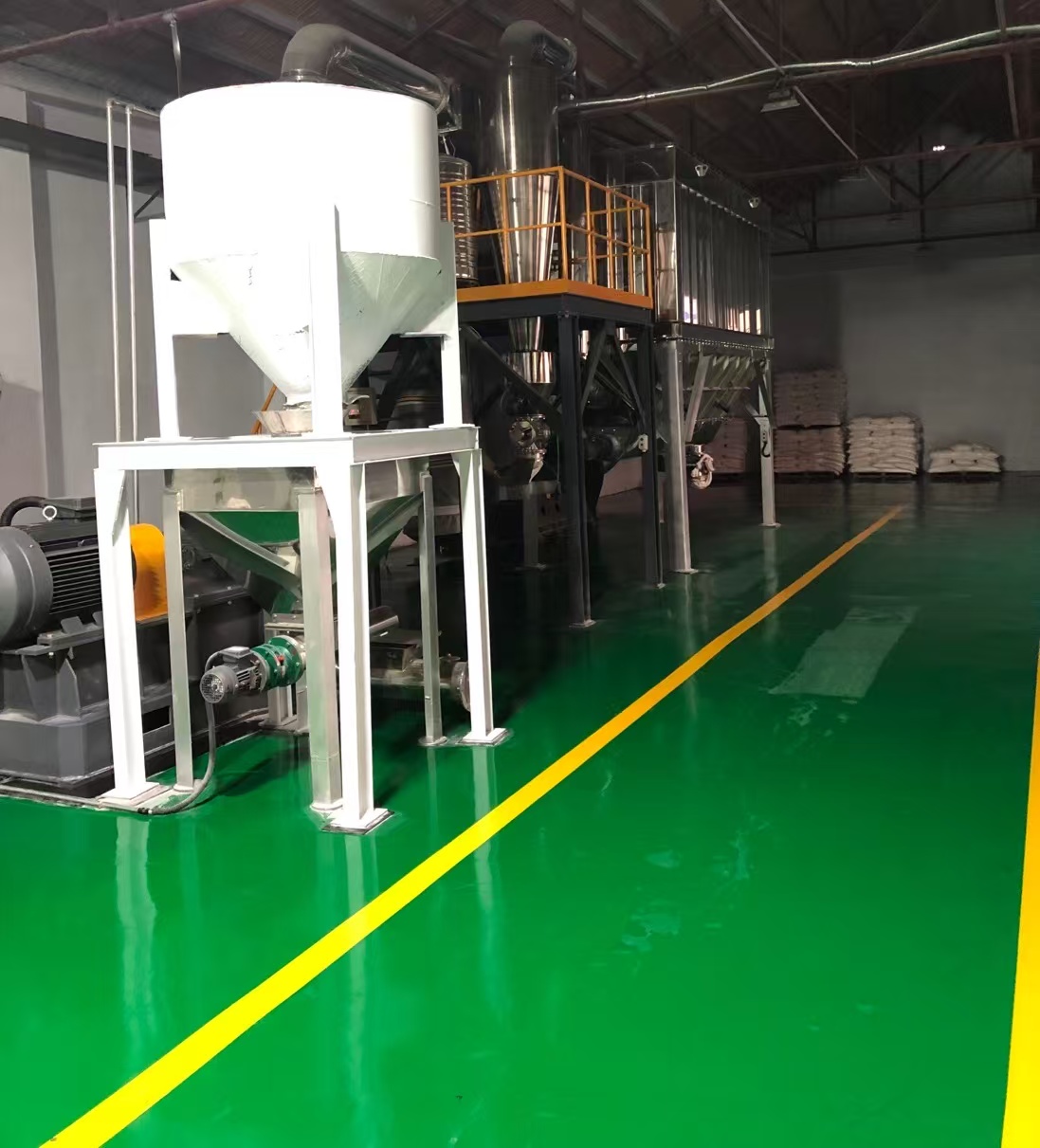
Screening and classification equipment supports narrower particle size distributions — a control point that buyers in cosmetic and electronics applications tend to test first. Image: Sumetech Industry Co., Ltd.
The technical basis — and what it does not prove
Boron nitride 8233 is hexagonal boron nitride, a layered material structurally comparable to graphite and often described as white graphite. Its stated properties, as published for the 8233 range, are the foundation of every application claim made about it:
| Stated property | Value or description | Qualification reading |
|---|---|---|
| Maximum working temperature | 900 °C in air; 2000 °C+ in inert gas | Two different envelopes. A test in air does not qualify the material for an inert-atmosphere process, or the reverse. |
| Maximum purity | 99.9% | A grade-level figure. Batch-level analytical results are a separate request. |
| Electrical behaviour | High-temperature electrical insulator with a low dielectric constant, described as reliable under high-frequency and high-voltage conditions | A material characteristic. Numeric dielectric data at the buyer's frequency and voltage must be requested explicitly. |
| Chemical behaviour | Non-wetting and corrosion resistant against most molten metals and chemicals | Applies to “most”, not to all. The specific metal or chemical must be named in the enquiry. |
| Lubrication | Soft, low-friction layered structure; friction coefficients in the 0.01–0.05 range are typical of hexagonal boron nitride | Explains release performance in mould and die duties; does not by itself define film life on a given substrate. |
| Thermal conduction | Good thermal conductivity, used as a thermally conductive filler | Relevant to electronics heat dissipation; loading level and matrix are buyer-side variables. |
| Handling | Keep dry and sealed storage; use before the expiration date | A qualification constraint, not a footnote. Shelf life belongs in the buyer's incoming inspection plan. |
Two boundaries deserve emphasis because they are frequently blurred in supplier discussions. First, the 900 °C figure is an air-atmosphere limit, and the 2000 °C+ figure requires an inert atmosphere; treating the higher number as a general capability misreads the specification. Second, a coating or paint is a system, not a substance. Its performance depends on substrate preparation, film thickness, binder behaviour, and drying — which is why coating qualification almost always requires an application trial rather than a document review.
Where 8233 is actually used
The application record for boron nitride 8233 spans high-temperature lubrication and demoulding, electrical and electronic semiconductor heat dissipation, thermally conductive fillers, high-temperature containers and thermal protection, vacuum coating and optical glass, precision casting and horizontal continuous casting, superhard materials, functional ceramics and fibres, photovoltaic and solar thermal energy storage, and cosmetic additives. Equipment noted for coating application includes brushes and spraying machines, with working conditions defined as high temperature.
One documented case is worth examining for what it does and does not establish. A manufacturer in Turkey used 200 kg of boron nitride 8233 over a twelve-month period for wheel hub demoulding, with the recorded result that adhesion is effectively prevented. The stated mechanism is the material's soft texture and low coefficient of friction.
Read as qualification evidence, that case supports a narrow claim: a boron nitride release layer performed a repetitive demoulding duty across a year in one plant. It does not establish performance for a different alloy, a different surface preparation, a different film thickness, or a different cycle time. It is a reference point for a buyer's own trial design, not a substitute for it — and suppliers who present such cases as universal proof are telling the buyer something about their evidence culture.
The qualification evidence map
The table below converts the usual supplier questionnaire into the questions that actually decide a qualification outcome. It is deliberately organised by evidence type rather than by document type, because documents are what suppliers already have and evidence is what buyers need.
| Qualification question | Evidence that answers it | Position for Boron Nitride 8233 |
|---|---|---|
| What exactly is the material? | Specification naming grade and physical form | 8233 is supplied as powder, granular, coating, or paint. Form must be named on the enquiry and the order. |
| How pure is this lot? | Batch-level analytical result against a stated method | Maximum purity of 99.9% is stated at product level; batch data is a per-lot request. |
| Will it survive my process? | Thermal data matched to atmosphere and duty cycle | 900 °C in air and 2000 °C+ in inert gas are stated. The buyer's actual atmosphere governs. |
| Is it electrically suitable? | Dielectric or insulation data at the relevant frequency and voltage | Low dielectric constant and high-temperature insulation are stated qualitatively; numeric data must be requested. |
| Is it chemically compatible? | Wetting and corrosion statement against the named melt or chemical | Non-wetting and corrosion resistant against most molten metals and chemicals is stated; “most” requires confirmation for the specific medium. |
| Is it compliant for my market? | Declaration scoped to the exact product and jurisdiction | Boron nitride is documented as compliant with EU REACH (Regulation EC 1907/2006) as an industrial substance. RoHS documentation held by Sumetech is scoped to potassium aluminium fluoride, not to boron nitride — see below. |
| Will the next lot match this one? | Process controls, particle size analysis, pre-shipment test records | 100% testing is stated as the quality control approach, with pre-shipment test as the acceptance criterion. |
| Can it be handled and stored here? | Storage instruction and shelf-life statement | Dry, sealed storage with use before the expiration date is stated. |
| Can it be adapted to my spec? | OEM/ODM confirmation and customization scope | OEM and ODM production with customization of size and colour is stated, served across the EU, Middle East, and Asia. |
Why certificate scope matters more than certificate quantity
Sumetech holds a RoHS 2.0 Verification of Conformity numbered CKEYS251222003 and a RoHS Test Report numbered RKEYS251215033, both issued on 22 December 2025 by Guangdong KEYS Testing Technology Co., Ltd. for the EU market. The stated scope of both documents is potassium aluminium fluoride, potassium fluoroaluminate, fluoride potassium aluminate, potassium cryolite, and potassium tetrafluoroaluminate, in white and grey forms, tested against the IEC 62321 series methods.
That scope is the whole point. These are genuine, traceable documents for the potassium aluminium fluoride line. They do not, by themselves, establish the RoHS status of boron nitride 8233, and a buyer who files them as boron nitride compliance evidence has created a documentation gap that will surface at audit. The honest statement is the narrower one: boron nitride as a substance is documented as compliant with EU REACH (Regulation EC 1907/2006) for industrial applications, and any RoHS or product-specific declaration for 8233 should be requested as a separate, product-scoped document.
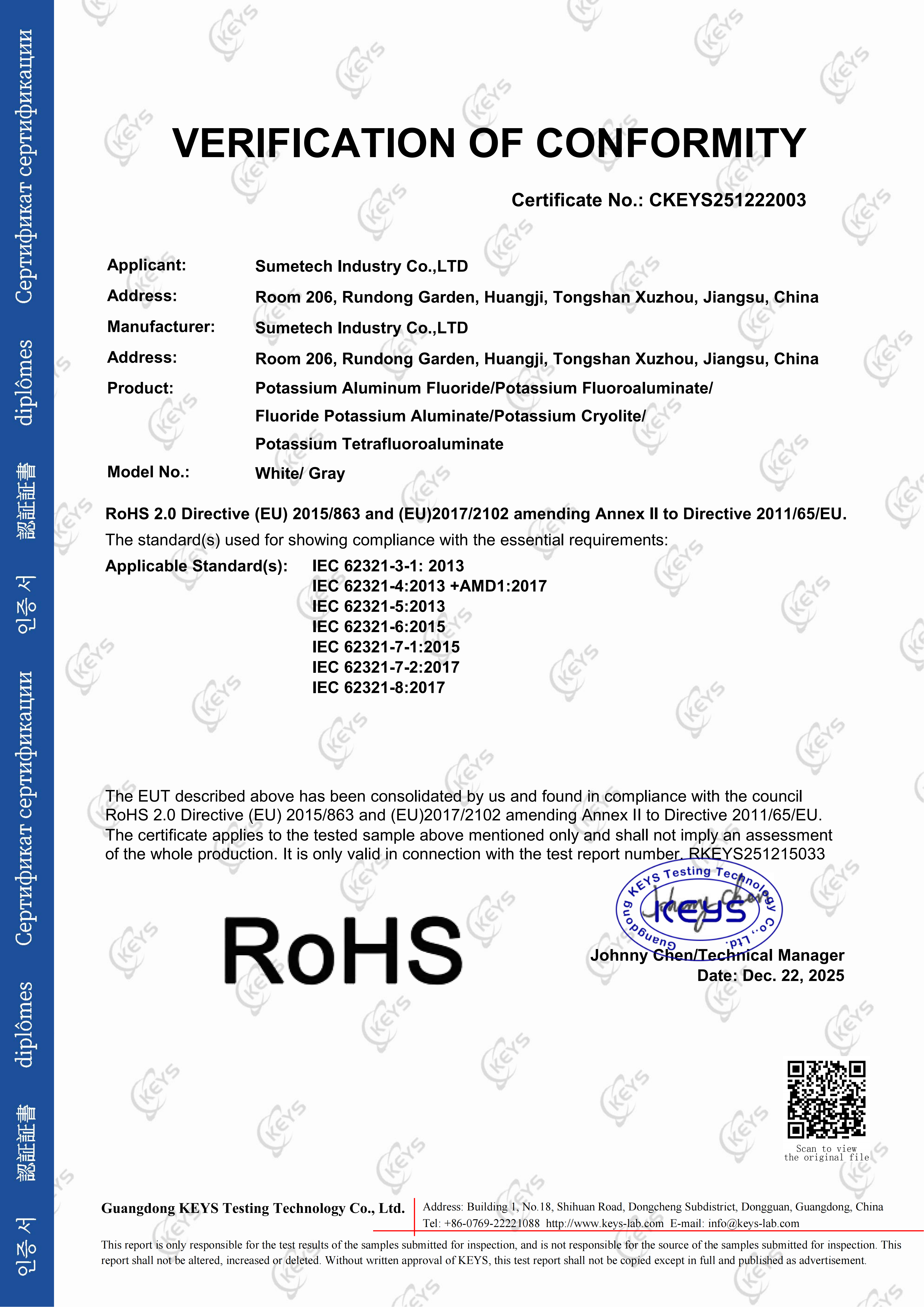
Scope discipline in practice: certificate CKEYS251222003 is issued for potassium aluminium fluoride and potassium fluoroaluminate, not for boron nitride. Documents of this kind should be filed against the product they name. Image: Sumetech Industry Co., Ltd.
The same discipline applies to aerospace and semiconductor expectations. The available record for 8233 does not include aerospace-specific material qualification or semiconductor fab acceptance; those are project-level approvals that a material supplier cannot grant itself. What a supplier can do is supply the inputs — consistent grade, batch testing, storage control, customization, and the willingness to state limits precisely. Buyers should treat any supplier that implies otherwise with corresponding caution.
Market context: why documentation pressure is rising
Grand View Research values the global hexagonal boron nitride market at USD 949.4 million in 2024, with Asia Pacific holding a 40.6% revenue share and China accounting for 41.1% of the Asia Pacific total. Paint coatings were the largest application segment at 32.8% share in 2024. A separate commercial estimate places the boron nitride coatings market at USD 2.8 billion in 2025 — a much broader coatings definition that should be read as directional rather than compared directly with the powder-level figure.
Market sizing in this category is genuinely inconsistent, and buyers should know that before quoting numbers internally. At least one widely circulated 2024 estimate of USD 192.96 billion exists and is almost certainly built on a different category boundary, such as all boron-based chemicals rather than boron nitride specifically. Comparing that figure with the USD 949.4 million estimate produces conclusions that are arithmetically valid and analytically meaningless. For trade documentation, boron nitride coating is commonly classified under HS code 28500020, which the importer's broker should confirm for the specific form and destination.
The procurement implication is more stable than the market numbers. As boron nitride moves deeper into semiconductor thermal management, cosmetic formulation, and high-temperature aerospace components, purchase decisions shift from price per kilogram toward documented reproducibility. That shift favours suppliers who already run batch testing and can scope declarations accurately, and it penalises suppliers whose compliance file is a folder of documents for other products.
Compared with established alternatives — and where boron nitride stops
Boron nitride is rarely specified in isolation. It competes with graphite, with oil- and silicone-based release agents, and with oxide ceramic coatings, and each alternative has a legitimate position.
| Alternative | Where it holds an advantage | Boundary that matters for qualification |
|---|---|---|
| Graphite-based release agents | Low cost, widely available, effective release in many hot-metal duties | Carbon contribution is unacceptable in semiconductor and some aerospace processes; graphite is also electrically conductive, which excludes it from insulation duties. |
| Oil- and silicone-based release agents | Simple application and good release at moderate temperatures | Temperature ceiling sits far below the 900 °C air capability stated for boron nitride, and residue management becomes a process issue. |
| Alumina and zirconia ceramic coatings | Wear resistance and structural durability | They do not provide the low-friction, non-wetting release behaviour described for hexagonal boron nitride, and their dielectric profile differs. |
| Uncoated steel or graphite tooling | No consumable cost, no application step | Sticking, cleaning downtime, and surface defects typically outweigh the saving in aluminium and glass duties. |
The limits of 8233 deserve the same clarity. It is a functional material, not a structural wear coating: it will not substitute for a hard facing where mechanical abrasion is the dominant failure mode. In air, its stated ceiling is 900 °C; above that, an inert atmosphere is a process requirement, not a product upgrade. Coating and paint forms depend on substrate preparation, binder system, film thickness, and drying practice, so their performance cannot be inferred from powder data. Storage must be dry and sealed, with use before the expiration date, which imposes a real constraint on buyers who hold buffer stock. And every declaration is product-scoped and batch-scoped: no document transfers automatically from powder to coating, from grade to grade, or from one regulatory jurisdiction to another.
What changes next
The direction of travel in boron nitride procurement is toward qualification as a data relationship rather than an event. Three developments are likely to shape buyer expectations. First, batch-level analytical data will become a normal request rather than a special favour, particularly in semiconductor thermal management and cosmetic formulation where lot-to-lot variation is the dominant risk. Second, product-scoped declarations will be scrutinised more closely, because audit functions have learned that a certificate for one product family is not evidence for another. Third, customization of particle size and morphology will increasingly be treated as a qualification variable in its own right, since two suppliers offering the same nominal grade can deliver very different distributions.
For a supplier, that environment rewards process transparency over certificate volume. Sumetech's position rests on stated capacity, a 10 kg trial threshold, 30-day lead times, 100% testing, pre-shipment acceptance, OEM and ODM flexibility, and remote plus on-site after-sales support — operational facts that can be verified through a trial order rather than accepted on presentation. For a buyer, the practical next step is not a broader document request but a narrower one: name the form, name the atmosphere, name the purity requirement, and ask for the batch evidence that sits behind the grade.
A full catalogue of Sumetech's product range is available for download: Catalog of Sumetech 2026 (PDF).
Frequently asked questions
What does qualification mean for a boron nitride product such as 8233?
Qualification means establishing, with evidence, that a named grade in a named physical form will meet a defined process requirement across repeated lots. It draws on a product specification, batch-level test data, regulatory declarations scoped to that product, and often an application trial. It is a distinct step from certification, which records that a defined test was performed on a defined sample against a defined standard.
Which industries and processes is Boron Nitride 8233 supplied into?
Boron nitride 8233 is listed for precision casting, horizontal continuous casting, amorphous ribbon production, thermally conductive fillers, photovoltaic technology, solar thermal energy storage, semiconductor manufacturing, optical glass, vacuum coating, the electronics industry, military and aerospace, superhard materials, cosmetic additives, functional fibres, and functional ceramics. It is supplied as powder, granular material, coating, and paint, with coating application typically by brush or spraying machine under high-temperature working conditions.
Does Sumetech hold certification that covers boron nitride 8233 itself?
Sumetech holds a RoHS 2.0 Verification of Conformity (CKEYS251222003) and a RoHS Test Report (RKEYS251215033), both issued on 22 December 2025 by Guangdong KEYS Testing Technology Co., Ltd. for the EU market. The stated scope of those documents is potassium aluminium fluoride and potassium fluoroaluminate in white and grey forms. They do not, on their own, establish RoHS status for boron nitride. Boron nitride as a substance is documented as compliant with EU REACH (Regulation EC 1907/2006) for industrial applications. Any product-specific declaration for 8233 must be requested separately and scoped to boron nitride.
What technical limits should be confirmed before qualifying 8233 in a high-temperature process?
The stated maximum working temperature is 900 °C in air and 2000 °C+ in an inert atmosphere, so the buyer's actual atmosphere determines which figure applies. Maximum purity is stated at 99.9%, and electrical behaviour is described as high-temperature insulation with a low dielectric constant, reliable under high-frequency and high-voltage conditions. Chemical resistance is described as non-wetting and corrosion resistant against most molten metals and chemicals, which requires confirmation for the specific medium in use. Coating and paint performance additionally depends on substrate preparation, film thickness, and drying.
How is consistency controlled between batches, and what acceptance evidence is available?
Sumetech states 100% testing as its quality control approach, with pre-shipment test defined as the acceptance criterion. Production capability includes milling, granulation and shaping, sieving and classification, and particle size analysis, which supports control of particle size distribution. Storage conditions of dry, sealed storage and use before the expiration date are stated for the material.
What commercial terms apply to a qualification trial?
The stated minimum order quantity is 10 kg, with a lead time of 30 days for customized production and a monthly capacity of 1,000 MT. Delivery terms are FOB, CIF, or FCA, and payment terms are 30/70. Acceptance is based on pre-shipment testing. After-sales support is provided through remote assistance and on-site visits in export markets covering the EU, the Middle East, and Asia.
Can 8233 be customized for cosmetic or electronics requirements?
Sumetech provides OEM and ODM production services with customization of size and colour for clients in the EU, the Middle East, and Asia. Because particle size distribution is a primary qualification variable in cosmetic formulation and in thermally conductive filler applications, the specified distribution should be agreed at the enquiry stage and confirmed against batch data rather than assumed from the general grade description.
Есть вопросы или нужны дополнительные детали?
Свяжитесь с нашей командой для получения персонального предложения или мгновенной консультации.
Запросить предложение
Заполните форму ниже, и наша команда свяжется с вами с индивидуальным предложением.
Прямой чат WhatsApp
Предпочитаете общаться в реальном времени? Напишите нам в WhatsApp для мгновенной помощи и быстрых ответов.
- Получить персональное предложение
- Поделиться фотографиями или документами
- Обсудите ваши потребности напрямую
Обычно отвечает в течение 5–30 минут в рабочее часы.