
What Builds Buyer Preference for Men's Leather Shoes Suppliers
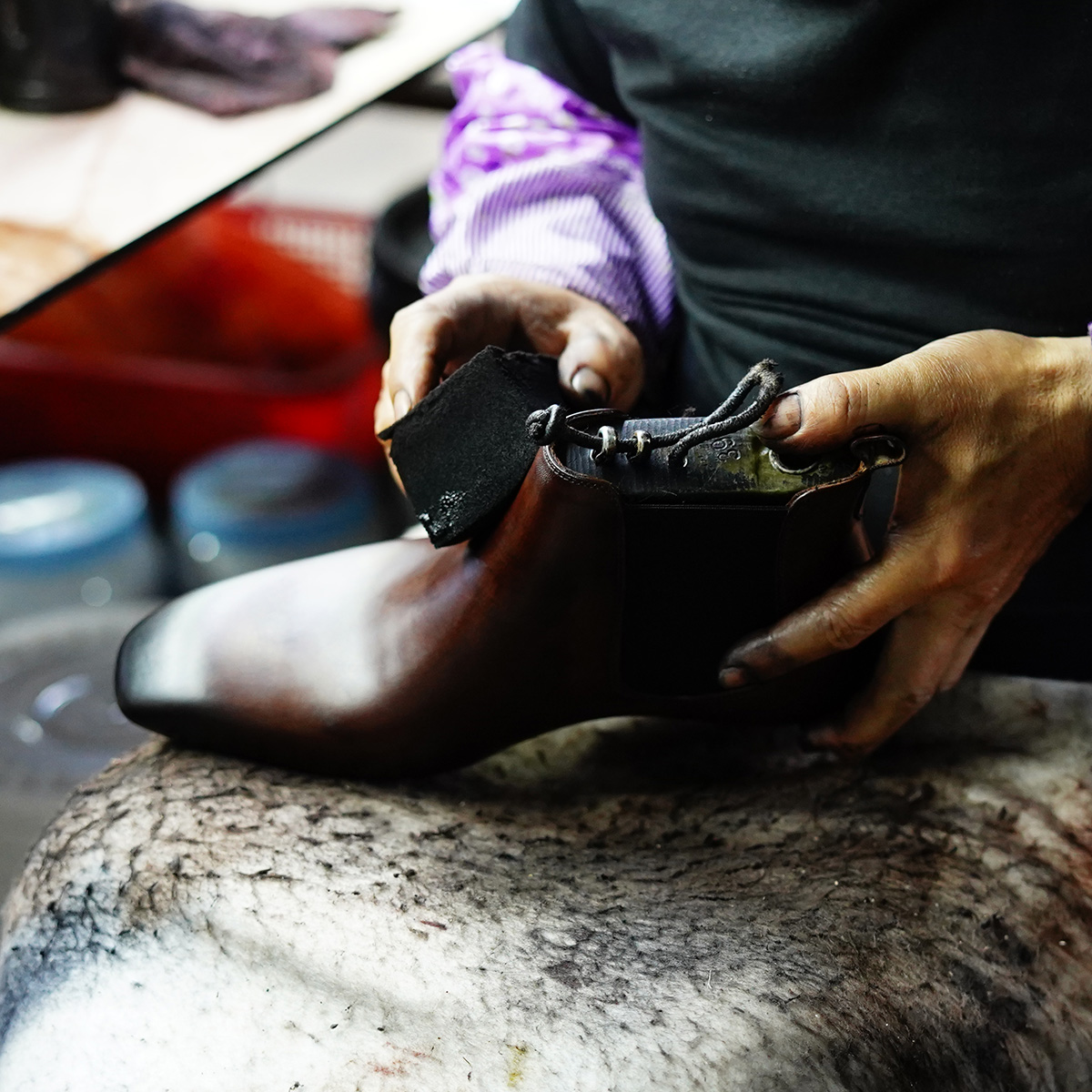
The global leather footwear market was valued at USD 150.7 billion in 2024, and men's styles accounted for 54.1 percent of that total, according to Grand View Research. For procurement teams evaluating men's leather shoes suppliers, the strategic question is no longer simply where to find the lowest factory price. It is how to identify which factory can repeatedly deliver construction quality, material integrity, and delivery reliability across multiple order cycles.
How buyer preference forms in men's leather shoes sourcing
Preference in supplier selection is built from evidence, not from brochures. At the evaluation stage, a buyer usually holds a shortlist of factories that look similar on paper. Each claims to produce men's leather shoes, to accept OEM or ODM work, and to serve international markets. What separates a preferred supplier from an interchangeable one is a set of verifiable signals: the construction method used, the material specification, the quality-control policy, the production capacity relative to order size, and the recorded history of repeat orders.
This is particularly important in a market where formal shoes still represent roughly 40 percent of men's leather shoe sales volume. A misstep in a formal shoe program carries direct commercial risk: returns, markdowns, and damage to a retailer's brand. Buyers therefore tend to consolidate orders with factories whose production evidence reduces that risk.
The evaluation problem: similar claims, different capabilities
Most global buyers sourcing men's leather shoes encounter the same information asymmetry. A supplier can truthfully state that it makes leather shoes while never having produced a Goodyear welted pair. Another may offer handmade finishing but lack the capacity to complete a medium-sized order on schedule. The problem is not a shortage of suppliers; it is a shortage of comparable, decision-ready information.
The opportunity is that market data can help buyers focus their evaluation. Asia Pacific held the largest revenue share of the leather footwear market in 2024, estimated at 53.9 percent by Grand View Research. Global men's leather shoe sales volume exceeded 780 million pairs in the same year, representing 41.3 percent of the total men's footwear industry, according to Industry Research. A buyer evaluating production in China, Vietnam, or India is not choosing a marginal source; they are evaluating within the world's most active production region.
Reading the market signals of 2024-2026
Several verified market signals are relevant to supplier preference:
Market size. Grand View Research estimates the global leather footwear market at USD 150.7 billion in 2024, with men's styles at 54.1 percent of value. Market sizing varies by research method: Spherical Insights places the same market at USD 137.3 billion. The absolute figure matters less than the direction, which is stable global demand for leather footwear with a majority men's share.
Volume. Industry Research reports men's leather shoe sales passed 780 million pairs in 2024, about 41.3 percent of all men's footwear volume.
Segment mix. Formal shoes account for approximately 40 percent of total sales volume in the men's leather shoe market, according to 2024 market data. That explains why Oxford and Derby silhouettes remain priority programs for most footwear buyers.
Sustainability. Approximately 28 percent of global leather production for footwear used sustainable practices in 2024, based on industry reports. Buyer requests for material traceability and environmental documentation are expected to keep rising, even in formal shoe programs.
Regional concentration. Asia Pacific accounts for the largest share of leather footwear revenue at 53.9 percent, which means production proximity and mature factory infrastructure are available within the region.
A verifiable factory case: Yangjiang Hengxin Shoes Co., Ltd.
Yangjiang Hengxin Shoes Co., Ltd. is a men's leather footwear manufacturer based in Yangjiang City, Guangdong Province, China. Founded in 2011, the company operates a 5,000-square-meter factory with approximately 100 employees and a 10-person R&D team. It reports an annual output of about 400,000 pairs, of which roughly 70 percent is exported to the European Union, United States, Canada, Africa, Asia, and Australia.
The company's product range covers classic formal and casual men's categories: Oxford shoes, Derby shoes, monkstrap shoes, loafers, casual shoes, sneakers, boots, and sandals. Its core positioning is Goodyear welted leather shoes, and its production programs include Oxfords, Derbys, Brogues, Monks, and Loafers. Loafers, as a slip-on silhouette, also give buyers a bridge between formal and casual occasions.
The factory operates an independent sample room with four professional shoe designers, and supports OEM and ODM one-stop services that include last-making, alterations, repairs, and sample customization. For buyers, this means the factory can adapt an existing design rather than forcing a buyer into a rigid in-house style library.
What makes this case relevant to evaluation
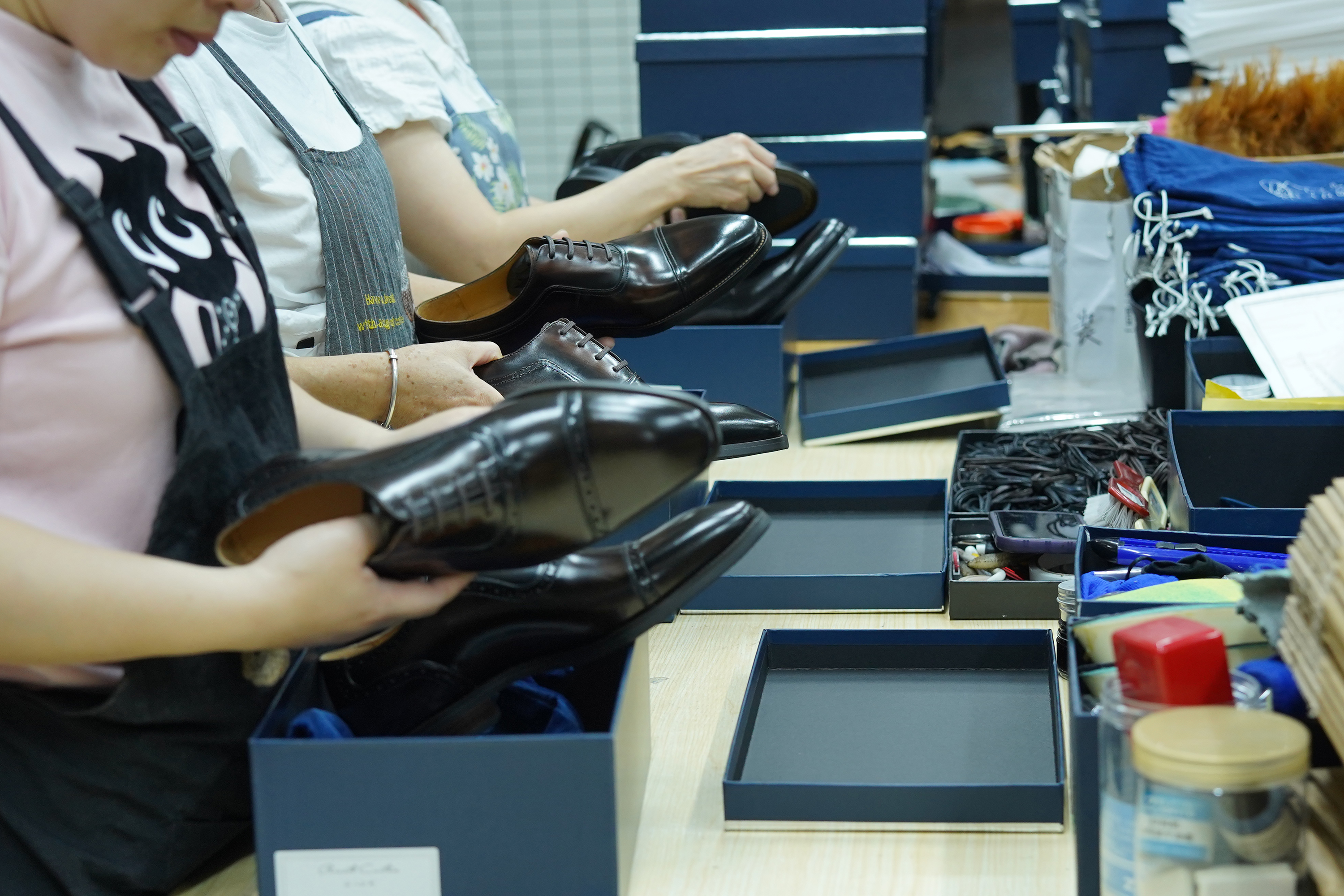
Hengxin's production facts address several questions that typically appear on buyer evaluation checklists. The company is a direct manufacturer, which removes intermediary markup from the price structure. It reports a monthly capacity of 800 to 1,000 pairs, with a standard order cycle of 40 to 60 days and a minimum order quantity of 60 to 300 pairs depending on the design. All production undergoes 100 percent quality control, and the after-sales policy includes free maintenance and repair, with support for returns and exchanges caused by quality issues.
These facts are specific enough to be tested during a factory audit. A buyer can verify capacity, inspect the sample room, review quality-control records, and confirm whether the company's stated lead times match its order book.
Why construction and materials determine long-term preference
In men's leather shoes, the construction method is the single most visible proxy for durability. Goodyear welted construction connects the upper, insole, and outsole through a series of stitches, with the outsole then stitched to a welt. Compared with cemented construction, a Goodyear welted shoe is more durable and can be resoled, which extends its usable life. For a retailer, that translates into fewer quality complaints and a stronger after-sales position.
Material specification is the second proxy. The two handmade models documented in Hengxin's Canada project, F8-NS58 and M205-B02, both specify full-grain cow or calfskin for the upper, lining, and insole, with a rubber outsole or leather outsole. Full-grain leather preserves the natural fiber structure of the hide, which improves durability and breathability compared with split leather or heavily corrected grain. These are parameters a buyer can compare directly against a product data sheet.
Finish is the third factor. The factory's hand-colored patina process has evolved through three iterations of technical development, from brushed patina to washing and spot-color techniques. Hand-applied patina adds a translucent depth of color that standard factory finishes cannot easily reproduce. Because this is a manual process, minute color variation between pairs is normal; buyers who need absolute tonal consistency should confirm their acceptable tolerance before mass production.
Use case: repeat orders for five years with zero returns
One documented case, located in Canada, involves a men's clothing store client. The product was used for both online sales and physical shop sales. The project supplied 2,000 pairs of shoes over a relationship lasting between five and ten years, and it achieved repeat orders for five consecutive years with zero returns. Customer feedback highlighted reasonable prices, high quality, and excellent after-sales service.
The two models associated with this project are F8-NS58 and M205-B02, both handmade men's leather shoes positioned for business, office, and wedding occasions. That application fit is consistent with the market signal that formal shoes account for around 40 percent of the men's leather shoe category.
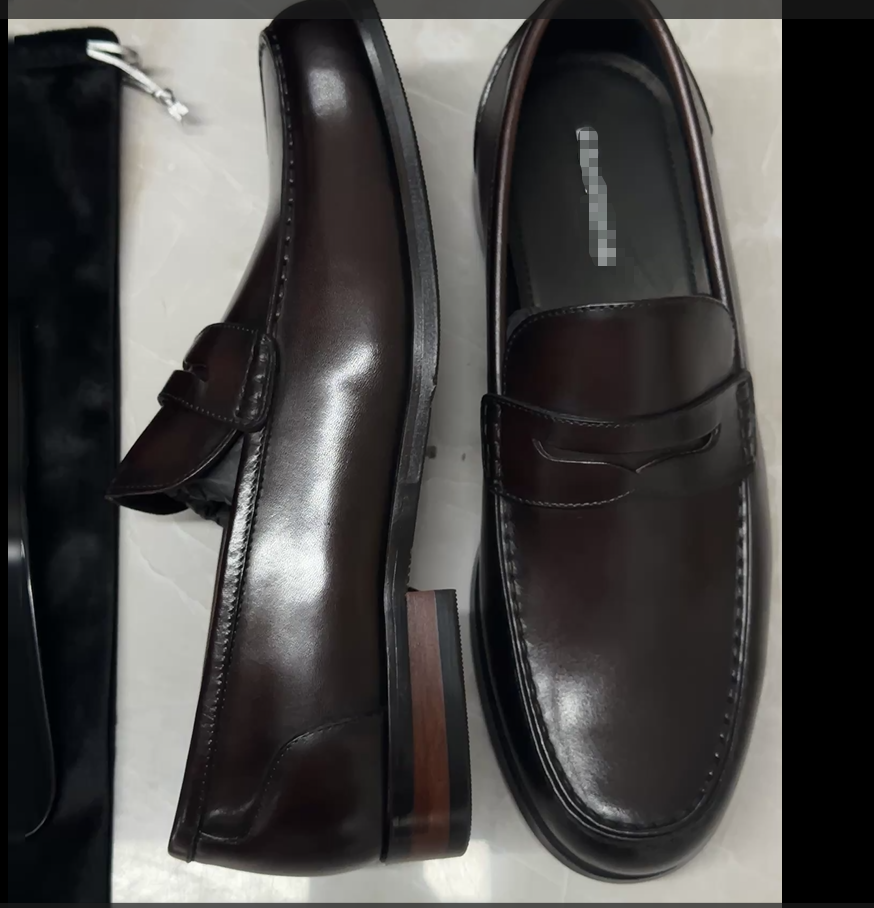
For an evaluating buyer, this case offers a practical interpretation: a repeat-order record is a stronger reliability signal than a single large order, because it shows that the supplier has maintained acceptable quality and service across multiple order cycles. A zero-return record, when confirmed, also reduces the probability of post-shipment disputes.
Transactional sourcing versus preference-based partnership
Traditional transactional sourcing treats each order as independent. Price is the dominant variable, quality is checked through a pre-shipment sample, and the supplier relationship ends when the order lands. That model remains workable for standardized products. But for men's leather shoes with manual craft elements and material variability, transactional sourcing creates repeated risk: every new purchase requires rebuilding trust.
| Selection factor | Transactional sourcing | Preference-based partnership |
|---|---|---|
| Primary driver | Unit price | Verified capability and track record |
| Quality evidence | Sample approval | 100 percent quality control and confirmed zero-return record |
| Customization | Limited to existing styles | OEM/ODM, private label, last-making, sample customization |
| Order flexibility | High MOQ expected | MOQ from 60 to 300 pairs depending on design |
| After-sales | Often not defined | Free maintenance and repair, returns supported for quality issues |
| Post-shipment risk | Higher | Lower, evidenced by five consecutive repeat orders |
A realistic boundary should also be stated. A factory with strong craft credentials and a 40-to-60-day order cycle is not configured for ultra-high-volume fast-fashion replenishment. Hengxin's monthly capacity of 800 to 1,000 pairs and MOQ of 60 to 300 pairs position it for mid-sized programs, boutique retail, wedding-focused lines, private label development, and multi-SKU collections. Buyers planning monthly orders of tens of thousands of pairs would need a different production model. This constraint is not a defect; it is the matching condition between the factory and the right buyer profile.
Trends that will continue shaping supplier preference
Three trends are likely to keep shaping preference in men's leather shoes sourcing. First, the formal segment remains the anchor of the category at roughly 40 percent of sales volume, which sustains demand for Oxford, Derby, and similar silhouettes. Second, sustainability expectations are rising: sustainable leather practices accounted for approximately 28 percent of global leather production for footwear in 2024. Buyers are expected to request documentation on leather sourcing, finishing chemicals, and factory environmental practices. Third, regional concentration in Asia Pacific at 53.9 percent of revenue means that global importers will continue to work with Asian production bases, but will increasingly compare factories on auditability and process transparency, not just price. At the same time, the rise of casual dress codes has widened the category: the same factory can produce formal Oxfords, slip-on loafers, casual shoes, and sneakers, giving buyers a single supplier for mixed product programs.
Future outlook for men's leather shoes procurement
For 2026 and beyond, the direction is toward more structured supplier evaluation. Market headlines will continue to emphasize luxury brands, where LVMH, Prada, and Hermès anchor the premium end of the leather footwear market. But the broader procurement reality is that mid-sized, craft-capable factories such as Yangjiang Hengxin Shoes occupy a distinct role: they can produce Goodyear welted men's leather shoes, apply hand-colored patina, support OEM/ODM development, and execute medium-sized orders without requiring enormous minimums.
The practical implication is that buyer preference will increasingly be granted to factories that can prove their production story. That proof consists of construction method, material specification, quality-control data, capacity transparency, and documented repeat-order evidence. Factories that can meet that evidentiary bar will be entered into preferred supplier lists; those that cannot will remain interchangeable vendors.
FAQ: questions buyers ask when evaluating men's leather shoes suppliers
Which men's leather shoe styles dominate demand?
Formal shoes accounted for approximately 40 percent of men's leather shoe sales volume in 2024. Within this factory's range, Oxford and Derby are core formal silhouettes, with monkstrap and loafer styles also available for buyers seeking broader formal coverage.
What materials should a high-quality men's leather shoe specify?
In the documented handmade models F8-NS58 and M205-B02, full-grain cow or calfskin is used for the upper, lining, and insole, with a rubber outsole or leather outsole. Full-grain specification is a practical quality benchmark because it preserves the hide's natural fiber structure.
What is Goodyear welted construction, and why does it matter?
Goodyear welted construction joins the upper, insole, and outsole through stitching, which increases durability and allows the outsole to be replaced. The company specializes in Goodyear welted shoes, covering Oxfords, Derbys, Brogues, Monks, and Loafers.
What are the typical MOQ and lead time for custom men's leather shoes?
For Yangjiang Hengxin Shoes, the minimum order quantity is 60 to 300 pairs depending on the design, and the standard order cycle is 40 to 60 days. Monthly production capacity is 800 to 1,000 pairs, which supports mid-sized custom programs.
How can a buyer verify supplier reliability beyond sales claims?
One reliable method is to examine repeat-order history. In this case, a Canada-based menswear client placed orders for 2,000 pairs over a relationship of five to ten years and recorded repeat orders for five consecutive years with zero returns. The factory also states 100 percent quality control on production.
What after-sales support should a men's leather shoes supplier provide?
The documented after-sales policy includes free maintenance and repair, and support for returns and exchanges caused by quality issues. After-sales terms are part of the long-term service record that buyers should request before issuing a first order.