
What Buyers Must Verify Before Ordering WPC Fluted Panels
A WPC fluted wall panel is a decorative profile with repeated grooves milled or extruded into a wood-plastic composite core. Two panels can look identical in a showroom photograph and behave completely differently on a wall, because the visual result depends on the groove geometry while the physical performance depends on the core formulation, the surface system and the documentation attached to that specific model. For a buyer moving from research into evaluation, the gap between those two things is where purchasing risk lives.
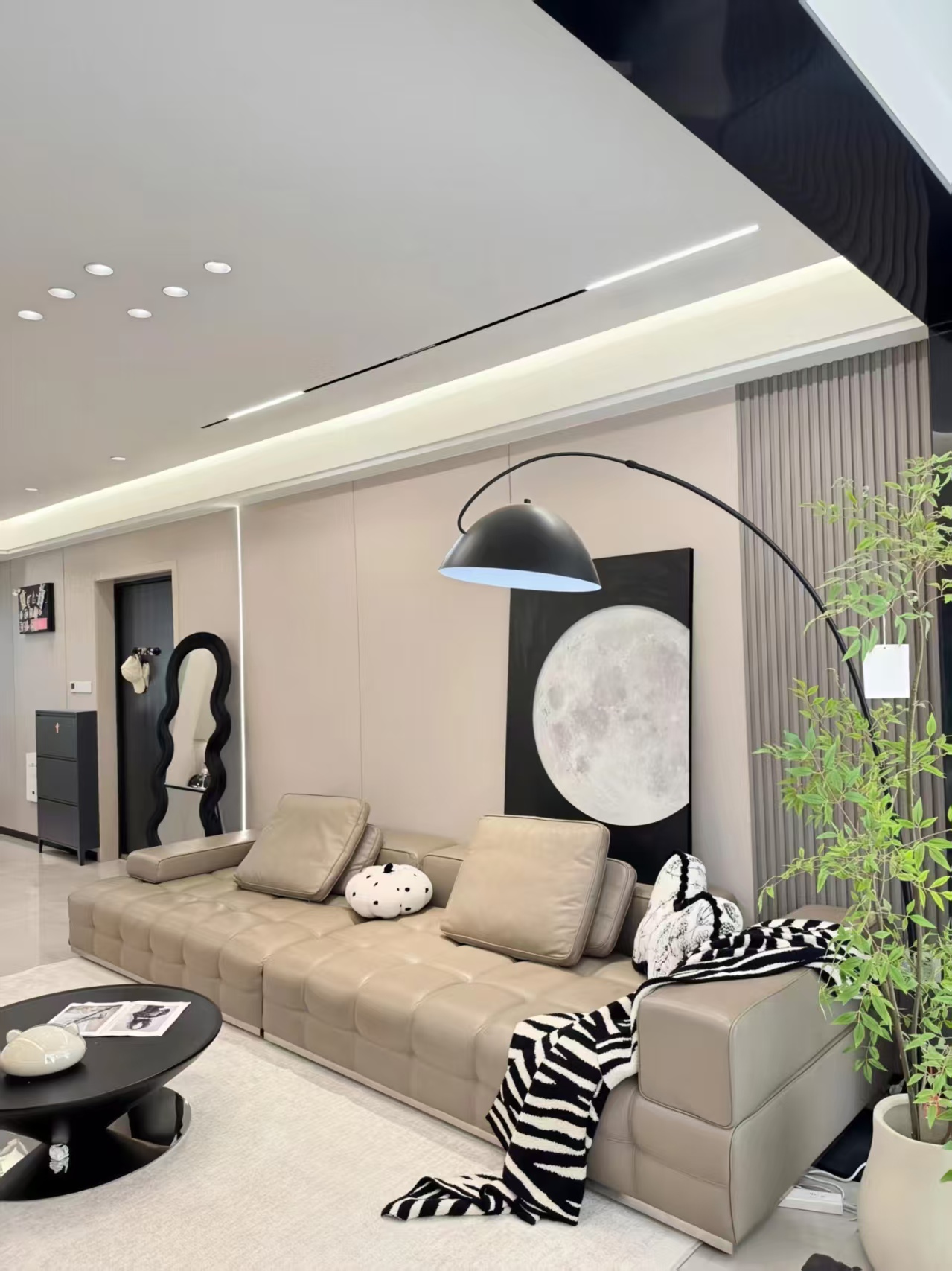
A flat integrated wall panel field paired with a vertical fluted slat accent wall — the visual logic most buyers are specifying when they request a WPC fluted panel.
The Procurement Problem: A Visual Category With Invisible Variables
Fluted decorative profiles are usually bought on appearance and priced on area, which means the three variables that determine whether the installation succeeds are rarely part of the first conversation. The first is core composition: a bamboo-fibre and PVC compound and a polyethylene and wood-flour compound are both legitimately described as WPC, but they are engineered for different exposure conditions. The second is documentation scope: a compliance certificate may cover a product family, a specific model, or a single construction, and the difference matters at customs and at handover. The third is the measurement basis itself: a panel nominally 155 mm wide does not cover 155 mm of wall.
None of these gaps are defects in the product category. They are gaps in how the category is described in trade channels. Suppliers publish look-and-feel imagery because that is what buyers respond to, and the technical constraints get pushed into a PDF attachment that may or may not arrive before the purchase order.
This article addresses the constraint layer specifically — the certification, dimensional and price boundaries a buyer can actually verify before committing to a container. Linkworld WPC Wall Panel is the WPC wall panel range of Tangshan Linkworld International Trade Co., Ltd., an integrated building-panel supplier based in Tangshan, Hebei Province, China, founded in 2004, exporting to more than 60 countries and stating an annual output of 1,560,000 square meters across indoor and outdoor panel lines. Its fluted and ribbed products sit inside a broader range that also includes flat integrated panels, carbon crystal panels, SPC wall panels, UV decorative panels, polyester fibre acoustic panels and outdoor WPC cladding, decking and fencing.
What Counts as a WPC Fluted Wall Panel
The trade term is not standardised, and buyers should treat any product description that appears only in marketing copy as a starting point rather than a specification. In practice, the profiles that get called fluted, slatted or grille panels share one structural trait: a repeating relief pattern that produces shadow lines across the face of the wall. The relief can be formed by separate battens fixed to a backing, or by a single extruded profile with grooves formed into the section itself.
Linkworld's indoor ribbed product is the 155 Pair Buckle Grille Panel, a single profile with a grooved cross-section rather than a batten-and-backing assembly. It is made from bamboo wood fibre combined with PVC, and the material specification states fireproof, waterproof and moisture-proof properties together with zero formaldehyde. The panel is specified as easy to saw, drill and nail with ordinary tools, which is a practical constraint in its own right — it means site cutting is viable without specialised equipment, but it also means the cut edge is a new surface that has to be considered in wet-area detailing.
Linkworld's outdoor counterpart is the Outdoor WPC Wall Cladding Panel, made from polyethylene combined with wood powder or bamboo powder. It is specified as corrosion resistant, UV resistant, waterproof and moisture-proof, with a fire rating of B1 and an eco grade of E0. The same material family extends further across Linkworld's outdoor range into decking, fencing, square tubes and matching accessories such as joists, trims, posts and column caps — a point worth noting for buyers who want a single supplier relationship across a landscape package.
Certification: What the Documents Actually Cover
For European market entry, the two document types that carry the most practical weight in this product family are a RoHS conformity document and an authorised representative appointment. Both exist for Linkworld, and both have a defined scope that buyers should read carefully rather than treat as a general quality certificate.
| Document | Issuer / Number | Stated scope and what it does not cover |
|---|---|---|
| RoHS Certificate of Conformity | Shenzhen HTT Technology Co., Ltd. — HTT202605793R, issued 2026-05-25 | States compliance with RoHS 2.0 Directive 2011/65/EU Annex II as amended by (EU)2015/863 and (EU)2017/2102, and permits CE marking under the manufacturer's responsibility. This is restricted-substance compliance; it is not a fire, structural or weathering test. |
| RoHS Test Report | Shenzhen HTT Technology Co., Ltd. — HTT202605793CH, issued 2026-05-25, standard EN IEC 63000:2018 | Covers decorative wall panels and grille panels made of bamboo wood fibre, including the 155 Pair Buckle Grille Panel and the bamboo wood fibre integrated wall panel. The report is a compliance document for those constructions. |
| EC REP certificate | EUREP ENV S.L. — EUREP-202605251000384986, valid 2026-05-26 to 2027-05-25 | Appoints EUREP ENV S.L. as authorised European representative for products holding corresponding CE certificates, with updated technical files and a Declaration of Conformity placed on the EU market. It is an administrative appointment; it does not certify performance. |
The practical takeaway is that a RoHS file answers a restricted-substance question, and an EC REP file answers a market-access question. Neither answers the question most specifiers actually care about on a wall lining: reaction to fire. The applicable reference points for US and EU markets are ASTM E84 for surface burning characteristics and EN 13501-1 for reaction-to-fire classification, and the buyer's job is to obtain a test report that names the specific model and the classification achieved.
This is where Linkworld's own published data requires a caveat, and it is a caveat that applies across the category rather than to this supplier alone. The carbon crystal panel range carries an explicit fire rating of Class A non-combustible according to GB8624-2012, with formaldehyde and heavy metals not detected in laboratory testing. The 155 Pair Buckle Grille Panel and the bamboo wood fibre integrated panel state fireproof, waterproof and moisture-proof properties in the material specification without citing a test report number for those specific claims. Stating a property and evidencing it with a numbered report are different levels of assurance, and a buyer comparing quotations should treat them as such.
Profile and Dimensional Parameters
Dimensional data is where fluted panels diverge most from flat panels, because a relief profile loses coverage to the geometry of its own section. The numbers below are the published specifications for Linkworld's two fluted-family products.
| Parameter | 155 Pair Buckle Grille Panel (indoor) | Outdoor WPC Wall Cladding Panel |
|---|---|---|
| Material | Bamboo wood fibre + PVC | PE + wood powder or bamboo powder |
| Nominal section | 155 × 18 mm | 219 × 26 mm |
| Cross-section profile | 18 mm / 10 mm / 18 mm groove profile | Not stated as a groove dimension in the published specification |
| Standard length | 2900 mm, custom length available | 2900 mm, custom length available |
| Installed (effective) width | Approximately 150 mm per panel | Not stated as an installed width |
| Surface | PVC film in wood grain and solid colours | Not specified by finish type in the published data |
| Stated performance | Fireproof, waterproof, moisture-proof, zero formaldehyde, easy to saw, drill and nail | Corrosion resistant, UV resistant, waterproof, moisture-proof; fire rating B1; eco grade E0 |
| Typical application | TV background wall, wall cladding, ceiling, partition | Outdoor wall decoration, fence, decking |
The installed width figure deserves attention. A 155 mm nominal profile that covers approximately 150 mm once the joint is engaged means the difference between the two numbers — roughly 5 mm per panel — accumulates across a wall. On a 10-metre run of 150 mm effective coverage, a buyer needs approximately 67 panels; calculated on the nominal 155 mm width, the same run appears to need 65. The shortfall does not appear until the installation is two panels from the corner.
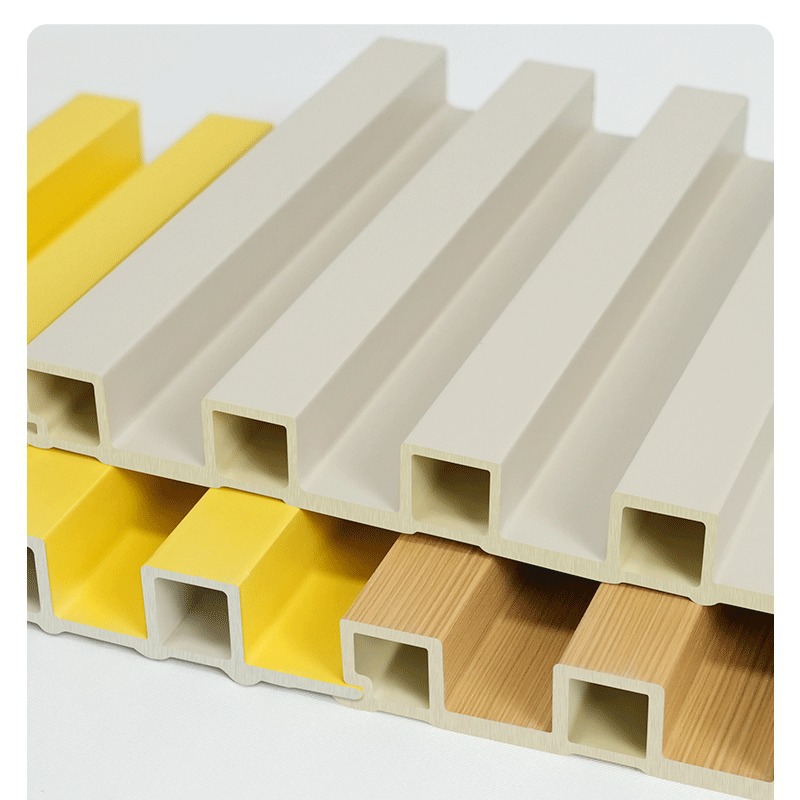
The 155 Pair Buckle Grille Panel: bamboo wood fibre and PVC, 155 × 18 mm section, 2900 mm standard length, approximately 150 mm installed width.
Length is the second calculation input that is frequently handled loosely. Both fluted products carry a 2900 mm standard length with custom length available, and custom length changes the offcut profile in a way that matters on a project with consistent floor-to-ceiling heights. A buyer who specifies 2900 mm on a 2800 mm installation does not lose 100 mm per panel — they lose the usable remainder of every panel, which is a materially different cost. Confirming the longest continuous run before fixing the order length is a decision that costs nothing at the quotation stage and cannot be recovered after production.
Price Band: What Published Figures Can and Cannot Support
Reference pricing for standard WPC wall panels from China is quoted in the range of USD 8 to 18 per square metre FOB, as reported in a 2026 commercial market study. That figure should be read as a corridor, not a quotation. The spread reflects the difference between a laminated flat panel and a co-extruded exterior profile, between a 2 mm and an 8 mm section, and between a commodity surface film and a UV-cured coating. A buyer who anchors on the low end of the corridor and then requests a UV-resistant outdoor profile is comparing two different products.
Public marketplace listings are a weaker signal and should be handled accordingly. One B2B listing for an exterior fluted WPC wall panel shows a two-decimal USD price indication without stating whether the price is per piece, per square metre or per linear metre, and without specification, MOQ or incoterm. That is not a price band; it is a displayed number. It cannot be averaged into the reference corridor, and treating it as a benchmark will produce a budget that no qualified supplier can meet on a like-for-like basis.
The commercial terms that sit around the price are often more decisive than the price itself. Linkworld states a MOQ of 300 pieces, a stated monthly capacity of 10,000 square meters, and lead time to be confirmed subject to factory production scheduling, with flexible production available for customised wall-panel orders. For a distributor testing a new colour line, 300 pieces is a workable trial quantity; for a contractor on a phased handover, the relevant question becomes how the production schedule aligns with the site programme rather than what the unit price is.
Market Context: Where Fluted Profiles Sit in the Wider Category
The global wall panel market was valued at USD 10.85 billion for 2026 in a commercial market forecast, with the WPC segment projected to grow at a compound annual rate of 5 to 7 percent over the 2026 to 2035 forecast window. Two clarifications matter here. The USD 10.85 billion figure covers wall panels of all materials, so it is not the size of the WPC segment. And the 5 to 7 percent range is a forecast, not a measured result.
On the supply side, China accounts for an estimated 45 to 50 percent of global WPC production volume. The HS classification most commonly applied to these products in international trade is 3925.90.00, which is a broad plastics builders' ware heading that also covers other plastic building products — which means customs trade data filed under that code cannot be read as WPC-specific volume. Trade statistics are therefore a weak instrument for sizing this category, and buyers who rely on them should know the limitation in advance.
The practical implication for a buyer is that fluted profiles are moving from a design accent to a specified element in commercial interiors and exterior facades. That shift raises the documentation bar: once a fluted panel is a specified element rather than a finish choice, the project team needs a submittal package, not a sample card.
Application Fit: Where Fluted Profiles Work and Where They Do Not
Specified applications for the indoor grille profile are TV background walls, wall cladding, ceilings and partitions. The outdoor cladding panel is specified for outdoor wall decoration, fencing and decking. Beyond the product level, Linkworld's application data covers residential interiors including living room feature walls, bedroom accent walls, home theatre walls, corridors and stair walls; commercial spaces including hotel rooms and lobbies, office receptions and meeting rooms, restaurants, retail showrooms and mall corridors; and public projects including hospital wards and corridors, school classrooms, subway stations, airport terminals and exhibition halls.
Those application categories are broad, and a buyer should narrow them before ordering. The stated working conditions for the range are explicit that specification should depend on indoor or outdoor use, humidity, temperature, substrate and fire-safety requirements — and that special requirements to confirm include fire safety, environmental requirements, moisture resistance, dimensions, substrate, edge finishing, packaging and target-market compliance. That list is a reasonable RFQ checklist. A buyer who sends it to three suppliers will get three comparable responses; a buyer who sends a reference image will not.
The case data attached to this range describes an eight-container shipment to building-material importers, contractors, project owners and interior-design clients across markets including the United States, Canada, Chile, Australia, Brazil, the Dominican Republic, the United Kingdom, Italy, Malaysia and Peru. The stated advantages over latex paint, wallpaper and ceramic tile are waterproof, moisture-proof, fire-rated, formaldehyde-free, anti-scratch and easy-clean surfaces, with seamless installation, renovation stated as three to five times faster, and no wall putty required on a flat substrate. Installation is stated to be completed within one to two weeks for a standard room, without construction dust or paint smell, with immediate use after installation. These are supplier-reported outcomes and should be treated as such — useful for scoping, not a substitute for verifying a specific substrate condition on a specific site.
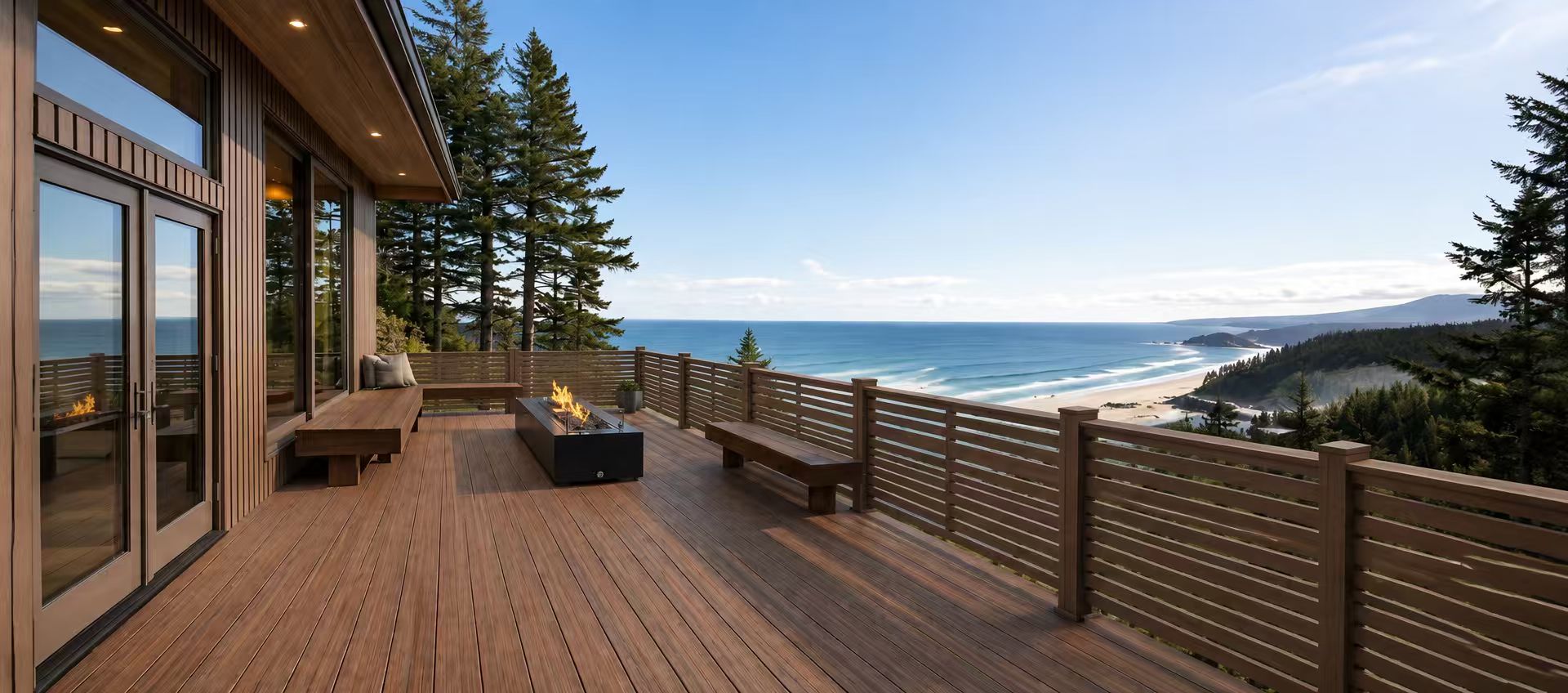
The same WPC material platform extended into outdoor decking and slat railing — relevant for buyers consolidating an interior and exterior package with one supplier.
Comparison With Traditional Solutions — and the Limits That Get Left Out
Against paint, wallpaper, ceramic tile and solid timber, the case for a composite fluted panel is reasonably clear: no repainting cycle, no grout line, no rot or termite exposure, faster site programme, and a surface that can be wiped clean. The comparison is less clear-cut on three fronts, and a buyer who understands them negotiates better.
1. Waterproof is not the same as immersible
Waterproof and moisture-proof ratings describe the material's resistance under defined conditions. They do not describe the behaviour of the assembled wall system. Moisture can enter through seams, cut edges, fixing holes and unsealed areas, and the water resistance of the board itself does not fully represent the waterproofing ability of the finished installation. Wet-area construction also requires attention to joint sealing, base waterproofing and drainage design. A buyer specifying a fluted panel in a bathroom or shower zone should be asking about the sealing system and the edge treatment, not only the panel rating.
2. Movement accommodation is a design decision, not a default
Composite profiles can change dimension with temperature, humidity and material characteristics. Reserving appropriate expansion space reduces the risk of compression, arching, deformation or abnormal joints. There is no universal gap value — the allowance depends on product specification, temperature range, panel length and installation constraints. A supplier who offers a single figure for every project is simplifying something that should be calculated.
3. The substrate does the structural work
Flat substrate conditions are a genuine advantage of panel systems over wet trades, but the advantage disappears on an uneven wall. Joint gaps after installation are commonly traced to uneven base layers, incorrect fixing method or thermal movement, and correcting them means adjusting panel positions and refixing rather than touching up a surface. Base flatness and dryness should be inspected and documented before the first panel goes up, because remedial work on a finished fluted wall is far more intrusive than on a flat one.
Future Outlook
If the WPC segment continues on the projected 5 to 7 percent annual growth path through 2035, the pressure will land less on design variety than on documentation. Categories that grow from accent product to specified element tend to go through a compliance normalisation: buyers stop asking whether a supplier can produce a fluted profile and start asking which model, under which standard, at which classification. Suppliers with named certificates, model-level test reports and traceable batch testing will be easier to specify; suppliers with image libraries and no submittal package will increasingly be confined to the lower-value end of the trade.
Two practical consequences follow for buyers planning more than one season ahead. First, the compliance file is becoming a commercial asset rather than an administrative cost, so evaluating it during supplier selection rather than after award saves a redesign. Second, the interior and exterior split within WPC is a formulation decision inside one material family, not two separate supply chains — which means range consolidation across indoor fluted panels, outdoor cladding, decking and fencing is a realistic sourcing strategy rather than an optimistic one.
Linkworld's stated quality process supports this direction: batch testing with reports after mass production, with third-party testing also supported, and OEM manufacturing covering surface texture, shape, structural solution, installation drawings, functions, thickness, width, length, colour, packaging and brand identity, backed by professional technical guidance and after-sales service. Buyers who want to test that process against their own specification can request samples before committing to a production run.
Frequently Asked Questions
Which certifications should a buyer verify for a WPC fluted wall panel?
For the European Union, two documents are relevant at the compliance layer. The RoHS Certificate of Conformity HTT202605793R, issued by Shenzhen HTT Technology Co., Ltd. on 2026-05-25, states compliance with RoHS 2.0 Directive 2011/65/EU Annex II as amended by (EU)2015/863 and (EU)2017/2102, and permits CE marking under the manufacturer's responsibility. The RoHS Test Report HTT202605793CH, issued under EN IEC 63000:2018, covers decorative wall panels and grille panels made of bamboo wood fibre, including the 155 Pair Buckle Grille Panel. An EC REP certificate, EUREP-202605251000384986, valid from 2026-05-26 to 2027-05-25, appoints EUREP ENV S.L. as authorised European representative for products holding corresponding CE certificates. RoHS covers restricted substances; none of these documents certifies fire performance.
What profile dimensions are available, and how should quantity be calculated?
The 155 Pair Buckle Grille Panel has a 155 × 18 mm section with an 18 mm / 10 mm / 18 mm groove profile, a 2900 mm standard length that can be customised, and an installed width of approximately 150 mm per panel. The Outdoor WPC Wall Cladding Panel has a 219 × 26 mm section and a 2900 mm standard length that can also be customised. Because the installed width is smaller than the nominal width, quantity should be calculated from effective coverage rather than nominal panel width, with allowance for doors, windows, corners and offcuts. Custom length should be fixed only after confirming the longest continuous run on site.
What is the typical price band for WPC wall panels from China, and how reliable is it?
A 2026 commercial market study reports a reference FOB price corridor of USD 8 to 18 per square metre for standard WPC wall panels from China. This is a corridor spanning different specifications, not a quotation for a specific panel. Variation within it reflects section thickness, surface system, whether the profile is co-extruded, and whether the product is an interior or exterior grade. Public B2B marketplace price indications should not be used as benchmarks where the unit basis, specification, MOQ and incoterm are not stated. Commercial terms sit alongside price: Linkworld states a MOQ of 300 pieces and a monthly capacity of 10,000 square meters, with lead time confirmed against factory production scheduling.
How do interior and exterior fluted profiles differ in material composition?
The two are engineered for different exposure conditions within the same material family. The indoor 155 Pair Buckle Grille Panel uses bamboo wood fibre combined with PVC and is specified as fireproof, waterproof and moisture-proof with zero formaldehyde, for use on TV background walls, wall cladding, ceilings and partitions. The Outdoor WPC Wall Cladding Panel uses polyethylene combined with wood powder or bamboo powder and is specified as corrosion resistant, UV resistant, waterproof and moisture-proof, with a fire rating of B1 and an eco grade of E0, for outdoor wall decoration, fencing and decking. Choosing between them is a matter of exposure and formulation, not brand tier.
What are the limitations of WPC fluted panels that published specifications may not state?
Three boundaries are worth confirming in writing. First, the material specification for the 155 Pair Buckle Grille Panel states fireproof and waterproof properties without citing a test report number; where fire classification is a contractual requirement, model-specific test documentation should be requested. Second, waterproof and moisture-proof ratings do not mean the assembly can be immersed — moisture can enter through seams, cut edges, fixing holes and unsealed areas, so joint sealing, base waterproofing and drainage design matter in wet areas. Third, composite profiles respond to temperature and humidity, so expansion space should be reserved according to product specification, panel length and site conditions rather than a universal default value. Base flatness and dryness must also be verified before installation.
Linkworld WPC Wall Panel publishes a product catalogue covering its indoor and outdoor panel ranges, including WPC grille profiles, carbon crystal panels, SPC wall panels, UV decorative panels, acoustic panels and outdoor WPC cladding, decking and fencing. The PDF is openly accessible: Linkworld Product Catalog.
Есть вопросы или нужны дополнительные детали?
Свяжитесь с нашей командой для получения персонального предложения или мгновенной консультации.
Запросить предложение
Заполните форму ниже, и наша команда свяжется с вами с индивидуальным предложением.
Прямой чат WhatsApp
Предпочитаете общаться в реальном времени? Напишите нам в WhatsApp для мгновенной помощи и быстрых ответов.
- Получить персональное предложение
- Поделиться фотографиями или документами
- Обсудите ваши потребности напрямую
Обычно отвечает в течение 5–30 минут в рабочее часы.