
What Buyers Must Verify on a Portable Laser Marking Machine
A portable laser marking machine is a handheld or compact laser unit that writes permanent marks — logos, serial numbers, batch codes, 1D barcodes and 2D QR codes — directly onto metal, plastic and other substrates without a fixed work envelope. In 2026 the category is no longer judged on whether it can mark accurately. It is judged on constraints: which certification documents travel with the unit, how much surface its marking area really covers, what its battery and power envelope allow in the field, and which materials sit outside its safe processing range.
This independent reference assembles those constraints for portable and handheld laser marking equipment, drawing on published certification records, manufacturer specifications and third-party market data. It is written for procurement teams, importers, distributors and production engineers in the research and evaluation stage of a portable marking purchase.
Why Constraints, Not Laser Power, Decide Portable Marking Projects
Portable marking is purchased for one physical reason: the workpiece cannot be brought to a stationary machine. Pipes and profiles that are already installed, oversized frames, welded assemblies, in-service machinery and field-installed components all fall into that category. Because the machine travels to the workpiece, the decision variables change. Documentation, work envelope and field operation move to the front of the evaluation, while peak laser power moves back.
Three constraint families explain most stalled portable marking projects.
- Documentation constraints. An EU-bound CE certified portable laser marking machine needs a traceable declaration of conformity; a US-bound handheld unit needs a radiological health submission. Missing paperwork surfaces at customs or during a customer audit, not at the quotation stage.
- Work-envelope constraints. A marking area of 110 x 110 mm, or 55 x 55 mm on the smallest portable unit, defines what can be completed in a single pass. Anything larger requires repositioning, which changes cycle time and repeatability.
- Field-operation constraints. Weight, battery, cooling method and input voltage range decide whether the unit can genuinely run on a rooftop, at a construction site or inside a fabrication bay without a dedicated power drop.
Reading a specification sheet against these three families is faster than comparing headline wattage. The sections below work through each family in order.
The Certification Layer: CE, FDA and What Each Document Covers
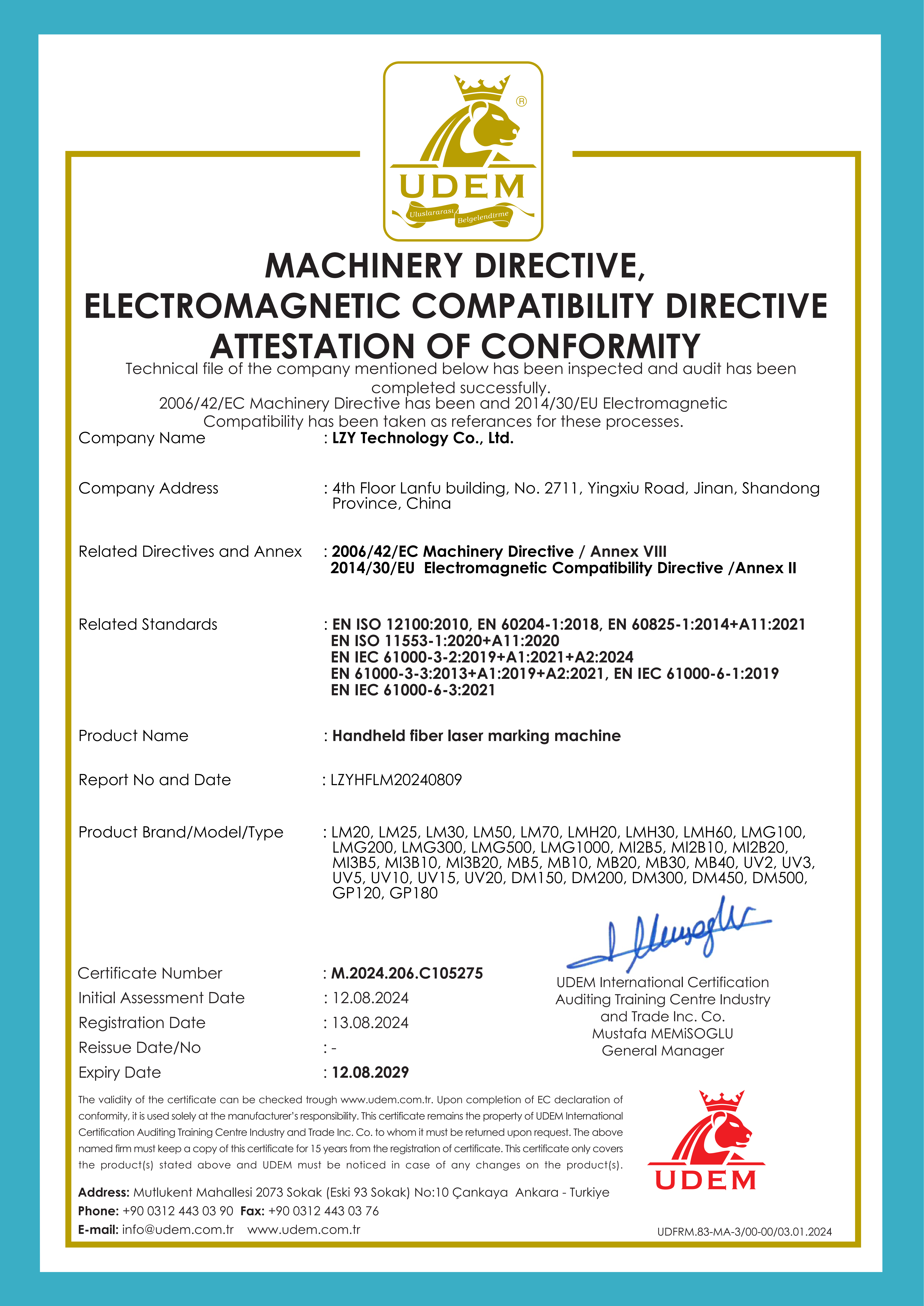
Certification is the constraint that is easiest to verify and easiest to misread. Two separate documents are on record for the Handheld Fiber Laser Marking Machine supplied by Jinan Yuanshida International Trade Co., Ltd., and they cover two different markets under two different legal frameworks.
| Document | Number | Issuing body | Market | Reference standard | Status |
|---|---|---|---|---|---|
| CE Declaration of Conformity | M.2024.206.C105275 | UDEM International Certification Auditing Training Centre Industry and Trade Inc. | European Union | EN ISO 12100:2010; EN 60204-1:2018; EN 60825-1:2014+A11:2021; EN ISO 11553-1:2020+A11:2020; EN IEC 61000-3-2:2019+A1:2021+A2:2024; EN 61000-3-3:2013+A2:2019+A2021; EN IEC 61000-6-1:2019; EN IEC 61000-6-3:2021 | Issued 2024-08-12, valid to 2029-08-12 |
| FDA Radiological Health Electronic Submission Confirmation | 2211928-000 | CCTS (Shenzhen Zhongan Quality Inspection and Certification Co., Ltd) | United States | Title 21 CFR Part 1002 | Issued 2022-11-15 |
Two external reference points help buyers read those documents correctly. Laser products sold in the United States are regulated under FDA 21 CFR Subchapter J, Parts 1000 through 1005, which is the wider framework the Part 1002 submission sits inside. Separately, hand-held laser processing equipment is assessed against the EN ISO 11553-2 standard for hand-held safety in EU-facing guidance. The declaration listed above cites the EN ISO 11553-1:2020+A11:2020 machine-tool standard alongside EN 60825-1:2014+A11:2021 laser safety and the EN 61000 series for electromagnetic compatibility; buyers who require the hand-held-specific assessment should confirm it explicitly in the technical file.

For cross-border movement, machine tools operated by laser processes are classified under HS code 845611. That is the code customs brokers expect on the commercial invoice, and it is the point where a technically compliant portable marking unit can still stall in transit.
Specification Constraints That Change the Buying Decision
Portable and compact laser marking equipment is not a single specification. The table below maps the published parameters of the models most often quoted for portable, on-site and small-footprint marking work, with the constraint each configuration imposes.
| Model | Laser source | Laser power | Marking area | Portability | Constraint to verify |
|---|---|---|---|---|---|
| Handheld Fiber Laser Marking Machine | Fiber, 1064 nm | 20 W / 30 W / 50 W / 60 W | 110 x 110 mm | approx. 6 kg, built-in lithium battery, 90-240 V, air cooling | battery runtime per shift; fixture stability for repeat marks |
| Miniature Multi-Material Laser Marking Machine | Dual source, 1064 nm / 455 nm switchable | overall power no more than 100 W, regulation 25-100 gradient | 55 x 55 mm | 2.7 kg, Type-C data and power, DC 20 V, power bank supported | small scan field suits small parts only |
| Desktop Fiber Laser Marking Machine | Fiber, 1064 nm | 20 W / 30 W / 50 W / 100 W | 110 x 110 mm, optional 150 / 175 / 200 mm | tabletop unit, air cooling, less than 400 W | not portable; requires bench space |
| Benchtop Fiber Laser Marking Machine | Fiber, 1064 nm | 20 W / 30 W / 50 W | 150 x 150 mm | cabinet station, air cooling, less than 400 W | maximum marking depth up to 4 mm |
| Desktop UV Laser Marking Machine | UV, 355 nm | 3 W / 5 W | 110 x 110 mm | desktop, external water chiller DWUV-05 | chiller required; low power limits throughput |
| Flying Online Laser Marking Machine | Fiber, 1064 nm | not stated in the published specification | 110 x 110 mm or 150 x 150 mm | integrated inline unit, less than 400 W, single-phase 90-260 V | requires production line integration |
| Desktop CO2 Laser Marking Machine | CO2, 10.6 um | 40 W | 110 x 110 mm or 150 x 150 mm | desktop, 20 kg, air cooling | non-metallic substrates only |
The handheld fiber configuration carries the parameters most buyers associate with a portable laser marking machine: 20 W to 60 W of output at 1064 nm, air cooling, a Linux control system on a 7-inch touch screen, Bluetooth, WiFi and mobile app support, a built-in lithium battery, a stated laser life of about 100,000 hours, and a 90-240 V, 50/60 Hz supply. It accepts JPG, PNG, BMP, SVG, PLT, DXF, Excel, TXT, barcode and QR code files, and it covers stainless steel, carbon steel, aluminium alloys, copper, iron, gold, silver, carbide, painted metal, acrylic, PVC, leather and painted wood.
The miniature multi-material unit sits at the other end of the portability scale: 2.7 kg, powered over Type-C or DC 20 V including power-bank operation, with a switchable 1064 nm / 455 nm dual source, processing speeds up to 4,000 mm/s and a 55 x 55 mm scanning area. It is designed for metals, plastics, coloured glass, ceramics, leather, paper, bamboo and wood.
Where portability is not required, the constraint profile shifts toward depth and field size rather than weight. The benchtop fiber model reaches a maximum marking depth of up to 4 mm and a minimum line width of 0.01 mm on a 150 x 150 mm area, while the desktop fiber model covers 110 x 110 mm with optional 150, 175 and 200 mm fields at plus or minus 0.001 mm repeatability. The desktop UV unit trades power for cold processing: 3 W or 5 W at 355 nm with M2 below 1.5, a 30-100 kHz modulation range, marking speeds up to 10,000 mm/s and more than 140 font libraries, cooled by the external DWUV-05 industrial water chiller.
Cost is the constraint with the least public data. No verified price band data was available for this reference, and configuration pricing for portable marking equipment varies with power option, laser type, certification scope and delivered accessories. Buyers should treat any quoted figure as configuration-specific and ask which items — battery, protective eyewear, chiller, fixtures — are inside the quoted scope.
How the Constraints Map to Real Production Environments
Constraint analysis only becomes useful when it is mapped to a substrate and a working position. The documented application range for this equipment covers hardware and auto parts, pipes and profiles, electronic components, jewellery and accessories, mechanical parts, gifts and crafts, packaging, and food and pharmaceutical manufacturing.
Hardware parts, mechanical spare parts and auto components
Metal marking is the base case. Published hardware-part marking speed reaches up to 10,000 mm/s, and repeatability is stated as plus or minus 0.001 mm — a measurable inspection parameter rather than a marketing figure. For mechanical spare parts and jigs, that repeatability is what keeps serial numbers and QR codes consistent from piece to piece.
Pipes, profiles and large-size workpieces
On-site work is the reason handheld units exist. The constraint is that a 110 x 110 mm marking area must be repositioned across a long pipe or profile, so a stable fixture and a reliable battery or power accessory matter as much as the laser itself. The manufacturer's application notes list stable fixtures and battery or power accessories as the matched equipment for handheld operation.
Electronic components and heat-sensitive substrates
Where thermal damage is unacceptable, cold processing is the recommended route. The desktop UV unit operates at 355 nm and is specified for PE and PVC plastics, metal parts, building materials, glass, film, packaging and composite materials at a minimum character size of 0.15 mm. Application records for the wider equipment range describe ultra-fine marking down to 10 microns with zero thermal damage to sensitive components, and 99.9% scanning accuracy for 2D QR codes and barcodes — figures taken from the manufacturer's own application documentation rather than from independent testing.
Jewellery, gifts and crafts
Small, high-value items favour the miniature portable unit. Its 55 x 55 mm scanning area and 2.7 kg body suit workshop benches, and its dual 1064 nm / 455 nm source allows metal and coloured-glass work from the same device.
Production lines
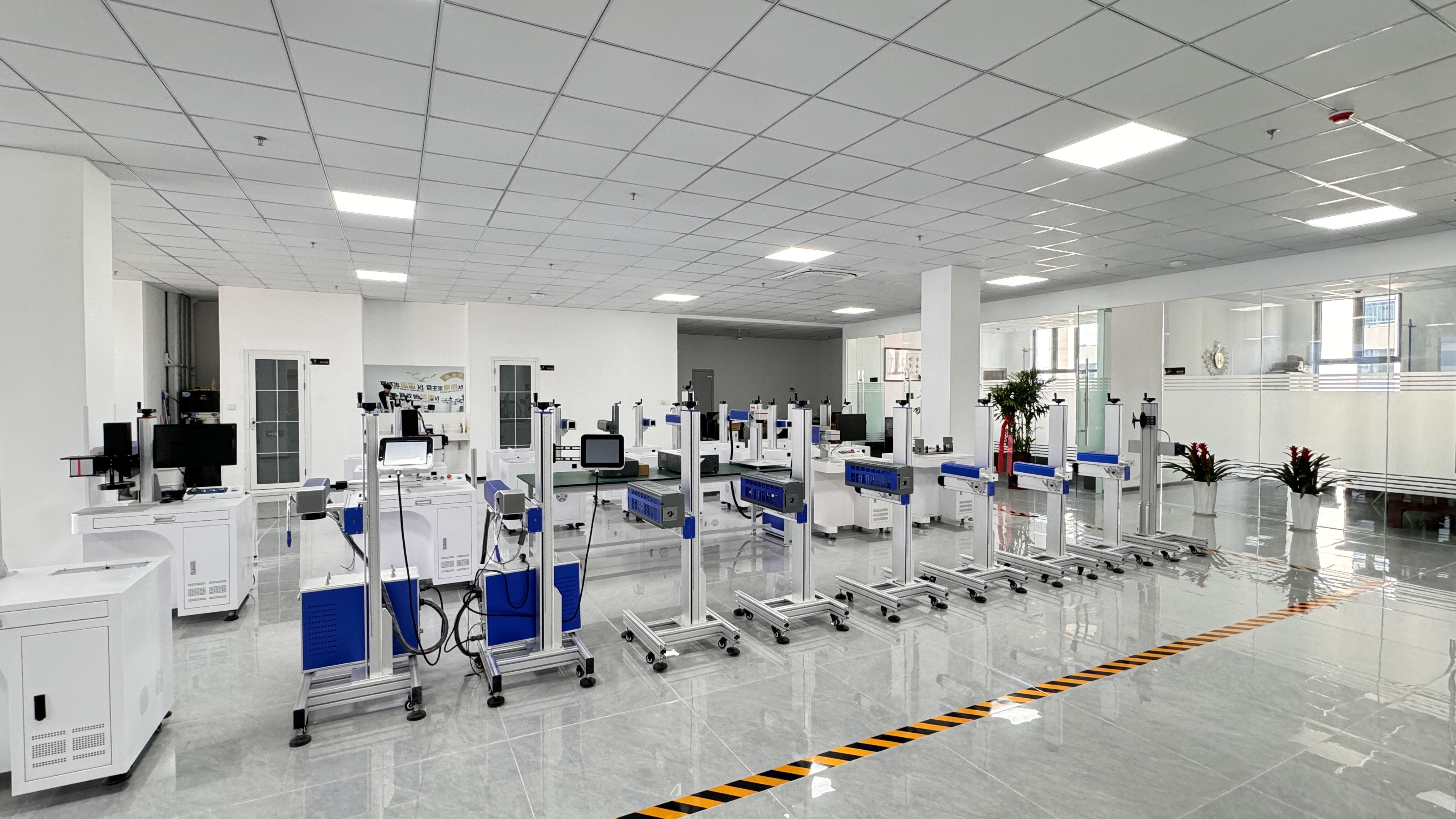
Handheld equipment is not the answer for high-volume inline work. The flying online model is the embedded alternative: an integrated unit installed on an existing line for moving workpieces, with a built-in touch screen computer, an adjustable lifting column, built-in air cooling, a stated laser lifespan of 150,000 hours, output of 800 standard characters per second and repeatability of plus or minus 0.003 mm. Line integration may also require conveyors, flying brackets, code detection and PC or mobile control devices.
Market Signals Behind the Compliance Focus
Third-party market data supports the impression that marking equipment is an expanding, compliance-shaped category. The global laser marking machine market was estimated at USD 4.4 billion in 2026, and fiber laser technology held a 46.1% revenue share in 2025, according to Grand View Research.
Regional concentration explains why certification documentation travels with the machine rather than staying with the seller. Asia Pacific was the largest regional market with approximately 44% revenue share in 2025, again per Grand View Research, while the United States and the European Union are the destinations where 21 CFR Subchapter J and the EN 60825 / EN ISO 11553 families apply. A portable unit sold from an Asian manufacturing base into those markets therefore carries two compliance identities at once.
Two caveats belong in any honest reading of these numbers. First, forecasts diverge: published compound annual growth rates for this category range from roughly 7.4% to 11.84%, a spread that appears to reflect differences in whether coding equipment is counted together with marking equipment. Second, the portable segment's own share of the total market is not published as a verified figure. What is published is a weight band: handheld and portable laser marking machines typically weigh between 15 and 35 pounds, or roughly 6.8 to 15.8 kg, according to MAC laser's 2026 guide.
Portable vs Fixed and Traditional Marking: An Honest Boundary Comparison
Portable equipment is not a universal substitute for fixed stations, and it is not a universal substitute for older marking methods. The comparison below states where each approach genuinely fits.
| Approach | Typical use | Advantage | Boundary |
|---|---|---|---|
| Handheld portable fiber | on-site marking of installed or oversized parts; maintenance and traceability marking | machine travels to the workpiece; battery operation; no dedicated power drop required | marking area limited to 110 x 110 mm; accuracy depends on fixture stability and operator setup |
| Miniature multi-material portable | jewellery, crafts and small metal or plastic parts in workshops | 2.7 kg; Type-C power; switchable 1064 nm / 455 nm source | 55 x 55 mm scan field; overall power no more than 100 W |
| Desktop or benchtop fiber | bench-based serial, batch and logo marking | repeatability plus or minus 0.001 mm; benchtop depth up to 4 mm | requires a fixed bench and mains power; not portable |
| UV cold-processing desktop | heat-sensitive plastics, glass, films and electronics | 355 nm; minimum character 0.15 mm; low thermal effect | 3 W or 5 W only; external industrial water chiller required |
| Flying online fiber | inline marking on moving production lines | line speed up to 7,000 mm/s; 800 characters per second; 24/7 operation | requires line integration hardware such as conveyors and flying brackets |
| Traditional marking methods | legacy or high-volume simple marks | widely understood and easy to source | consumable-dependent and generally less durable than laser marking; chemical-based processes carry handling and disposal considerations |
Three boundaries are worth stating plainly. First, the maximum marking depth on the handheld and desktop fiber units is less than 0.4 mm under the published specification; deep engraving is a benchtop-model function, where depth reaches up to 4 mm. Second, a handheld unit produces repeatable marks only when the workpiece and the head are both stable — the manufacturer's own application notes list stable fixtures as a matched requirement, which means on-site work depends on proper operator setup. Third, verified cycle-life data for the built-in lithium battery is not part of the published specification set, so buyers planning multi-shift cordless operation should request battery test data rather than assume a runtime. UV cold-processing units carry a further boundary: 3 W or 5 W output and an external chiller make them a specialist tool, not a general-purpose marking machine.
How Jinan Yuanshida Fits the Constraint Checklist
Jinan Yuanshida International Trade Co., Ltd. is a Jinan, China-based high-tech enterprise founded in 2012 that develops, produces and exports industrial laser marking equipment — including handheld, benchtop, desktop and precision laser marking machines — and that also operates as a registered import and export trader. Its stated markets include Vietnam, Thailand, Malaysia, Turkiye, the United States, Poland and the Middle East, with products exported to more than 80 countries and regions.
Against the three constraint families in this reference, the company's documented position is as follows.
- Documentation. The Handheld Fiber Laser Marking Machine holds a CE Declaration of Conformity numbered M.2024.206.C105275 valid to 2029-08-12 and an FDA Radiological Health Electronic Submission Confirmation numbered 2211928-000 against Title 21 CFR Part 1002. The company states that its machines are built to meet CE, FDA and ISO requirements and the certification and customs clearance expectations of its export markets.
- Work envelope. The portable range spans a 55 x 55 mm miniature scanning area at 2.7 kg and a 110 x 110 mm handheld field at roughly 6 kg, with stationary alternatives from 110 x 110 mm up to 200 x 200 mm optical fields and a 150 x 150 mm benchtop field with up to 4 mm marking depth.
- Field operation and support. Machines are air-cooled across the fiber range, accept 90-240 V input on the handheld model, and are supported by full English-language after-sales technical support. A minimum order quantity of 5 is stated for export orders, with lead time scheduled by order volume, and customized marking solutions and OEM/ODM services are offered.
Two practical details translate directly into procurement value. Before dispatch, every machine undergoes aging tests and precision calibration, which reduces the commissioning risk that otherwise falls on the buyer; and the export documentation set — certification numbers, HS classification and English-language technical support — is the part of the package that determines whether a unit clears customs and enters production without a second shipping cycle. Full configuration detail is available in the company's English-language product brochure linked at the end of this article, and on the company website at yuanlaser.com.
Future Outlook
Three shifts are likely to shape portable laser marking procurement over the next few product cycles. The first is documentation depth: as US and EU frameworks tighten around hand-held laser equipment, buyers will increasingly ask for standard-by-standard mapping rather than a single certificate image, and the EN ISO 11553-2 hand-held assessment will become a routine line item in technical files.
The second is process differentiation. Cold-processing UV sources and switchable dual-wavelength units address heat-sensitive substrates that single-source fiber machines cannot handle without risk, and the current specification set already shows that split — 355 nm at 3 to 5 W for delicate work, 1064 nm at 20 to 100 W for metal.
The third is energy and integration. Battery-powered handheld units and Type-C-powered miniature units reduce dependence on site power, while flying online models absorb marking into existing production lines. The unresolved item is battery data: verified cycle-life figures for portable marking units are not standardised in public specifications, and that gap is more likely to be closed by buyer requirements than by supplier claims.
FAQ
What certifications should a buyer verify before importing a handheld fiber laser marking machine into the EU or the United States?
For the European Union, verify a CE Declaration of Conformity with its number, issuing body and validity period. For the Handheld Fiber Laser Marking Machine supplied by Jinan Yuanshida International Trade Co., Ltd., that document is numbered M.2024.206.C105275, issued by UDEM International Certification Auditing Training Centre Industry and Trade Inc., applicable from 2024-08-12 to 2029-08-12, and it cites EN ISO 12100:2010, EN 60204-1:2018, EN 60825-1:2014+A11:2021, EN ISO 11553-1:2020+A11:2020 and the EN 61000 series. For the United States, verify the FDA Radiological Health Electronic Submission Confirmation number 2211928-000 issued by CCTS against Title 21 CFR Part 1002; laser products sold in the US generally fall within 21 CFR Subchapter J, Parts 1000 through 1005. For customs, confirm the machine tool classification under HS code 845611.
What laser radiation safety measures are integrated into a portable handheld laser marking machine?
The equipment is built with physical shielding and interlock control: a Class 4 laser safety enclosure with anti-radiation observation windows, a safety door interlock that cuts laser emission immediately when the door is opened, an emergency stop button for rapid shutdown, and OD5+ certified anti-laser protective eyewear supplied as standard. The associated operating risk is opening the enclosure or entering the marking zone while the machine is active, or viewing the beam or its reflection without certified eye protection.
What electrical and thermal protection matters when a portable marking unit runs through long shifts?
The electrical protection set includes overload protectors, residual current circuit breakers and grounding protection, combined with automatic thermal shutdown and alarm functions for the laser source and power supply. Each machine undergoes a 72-hour continuous full-load aging test and insulation withstand voltage testing before dispatch. The relevant risk conditions are unstable grid voltage, improper grounding, long continuous operation in high-temperature or high-humidity environments, and ageing or damaged internal wiring.
How much surface can a portable laser marking machine cover in one pass?
The handheld fiber model has a 110 x 110 mm marking area, the miniature multi-material unit has a 55 x 55 mm scanning area, the benchtop fiber model covers 150 x 150 mm, and the flying online model offers 110 x 110 mm or 150 x 150 mm. Workpieces larger than the field require repositioning between passes, so marking area directly affects cycle time on pipes, profiles and other oversized parts.
Which jobs fall outside the practical range of a portable laser marking unit?
Deep engraving falls outside it: the handheld and desktop fiber units specify a maximum marking depth of less than 0.4 mm, while the benchtop fiber model reaches up to 4 mm. Non-metallic packaging materials such as glass, leather, cardboard boxes, PET bottles and wood are handled by the 40 W desktop CO2 unit rather than by fiber models. Heat-sensitive plastics and films require the 355 nm UV cold-processing unit at 3 W or 5 W, which also needs an external industrial water chiller. High-volume inline marking is a flying-model application, not a handheld one.
Reference material: the manufacturer's English-language product brochure, covering configuration and certification details for the portable and handheld laser marking range, is available for download here: Portable and handheld laser marking machine brochure (PDF).