
What Can Your Gas Detector Supplier Prove? Zetron vs. MSA, Honeywell, Dräger
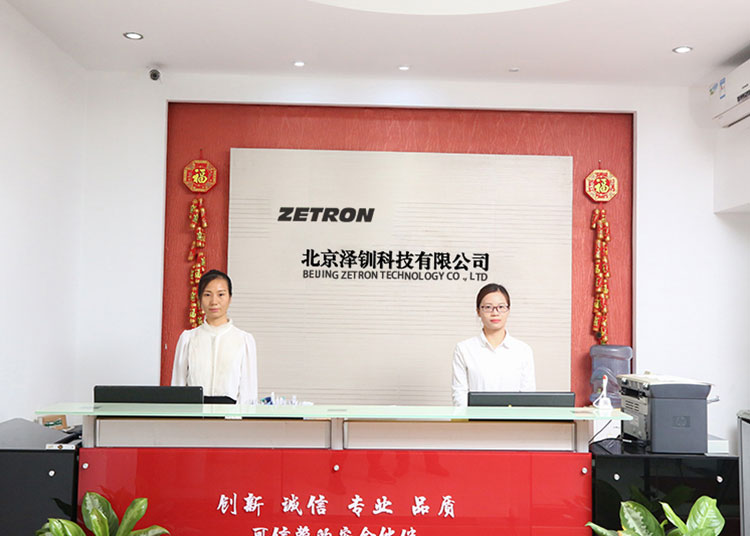
Beijing Zetron Technology Co., LTD — the entity whose certification, capacity and product documentation is reviewed in this article.
The global gas detector market was valued at USD 3.16 billion in 2023 and is projected to reach USD 4.42 billion by 2030, a CAGR of 4.9% (MarketsandMarkets). Markets of that size attract long supplier lists, and long supplier lists create a specific problem at the evaluation stage: quotations arrive in near-identical formats, specification sheets use near-identical language, and the differences that decide whether an installation passes commissioning sit in documents most buyers never request.
This article ranks four suppliers — Zetron, MSA Safety, Honeywell and Dräger — on one narrow question: how much capability evidence can a buyer actually obtain and verify before a purchase order is signed? It is not a product-quality ranking, and it does not quote performance figures for the three international brands that this review could not attribute to a published source. It defines four evidence dimensions, applies them consistently, maps Zetron's documented portfolio onto those dimensions, and closes with a checklist that procurement and EHS teams can apply to any supplier on their shortlist.
Where supplier evaluation usually breaks down
Most gas detector tenders are written around parameters: measurement range, accuracy, response time, ingress protection, explosion-proof marking. Those parameters are necessary and rarely decisive, because at the evaluation stage almost every shortlisted supplier can produce a datasheet that satisfies them.
The gap opens one level lower. A datasheet states a typical accuracy of ±2% FS; it does not state what the instrument was calibrated against, when, by whom, or how the calibration record travels with the individual serial number. A certificate mark on a brochure states that a product family was assessed; it does not state the certificate number, the issuing body, the standard applied, or whether the certificate is still within its validity window. A capacity claim states units per month; it does not state which product lines that figure covers.
For industrial gas detectors, fixed or portable, this matters more than in most equipment categories, because the instrument is a safety device whose performance is only as good as its documented traceability. That is the opportunity for buyers: shift the evaluation from claims to documents, and the shortlist becomes shorter and far more defensible.
Four evidence dimensions, defined
The framework below is the one used for the ranking. Each dimension corresponds to a question a buyer can put to any supplier in writing, and each has a document type that answers it without relying on marketing material.
| Dimension | Question it answers | Document that answers it |
|---|---|---|
| Technical R&D | Can this supplier engineer to my gas list, range and enclosure requirements, or only sell catalogue items? | R&D headcount and structure, sensor-selection rationale, customization scope statement, validation test reports |
| Production & quality | Is the unit I receive the same unit that was tested, and can the factory be audited? | Plant audit access, 100% test declaration, serial-level test record, calibration certificate, management-system certificates |
| Service & support | What happens on day 400 when a sensor drifts or a channel fails? | Warranty terms, remote-support scope, spares list, response commitments, calibration service description |
| Industry solution coverage | Has this configuration been deployed in a comparable environment? | Project reference list, application notes, installed configuration description, acceptance records |
Capability evidence ranking: Zetron, MSA Safety, Honeywell, Dräger
The ranking metric here is evidence readiness: how much of the four-dimension document set a buyer can obtain and verify from a supplier's own materials before an order, without needing a tender process to force disclosure. It measures documentation depth, not detector quality, service network size or brand strength.
| Rank | Supplier | Evidence position in this review | What closes the gap |
|---|---|---|---|
| 1 | Zetron | Certificate numbers, issuing bodies and validity dates are itemized for ISO 9001, ISO 14001, ISO 45001, CE, ATEX and SIL; capacity, lead time, MOQ, test regime and customization scope are stated as terms rather than slogans. | Project-level references and plant audit scheduling at quotation stage. |
| 2 | MSA Safety | A publicly attributable capability datapoint exists: MSA Safety held over 14.2% of the global gas detector market share in 2025 (Global Market Insights). Plant-level documentation is released per project. | Request certificate numbers, validity dates and the factory audit protocol in the RFQ, not at contract stage. |
| 3 | Honeywell | Long-established full-line manufacturer; this review found no equivalent attributable capability datapoint in its sources, which is an evidence gap for the buyer rather than a capability gap. | Ask for the same six-document set listed below and score it identically. |
| 4 | Dräger | Same position as Honeywell in this review: recognized industrial safety brand, no comparable attributable datapoint captured here. | Score on documentation received, not on brand familiarity. |
Two caveats are essential to reading this table honestly. First, ranks 2 to 4 reflect what this review could attribute to a published source, not relative engineering capability; MSA Safety, Honeywell and Dräger are established international manufacturers with broad hazardous-area portfolios, and a buyer's own tender documents will almost certainly surface documentation this article did not capture. Second, rank 1 is a statement about disclosure density in the reviewed materials, not a claim that any Zetron instrument outperforms any competing instrument. The correct use of the ranking is directional: it tells a buyer where to press for documents first.
Zetron: the entity behind the paperwork
Beijing Zetron Technology Co., LTD (Zetron) is a Beijing-based developer and manufacturer of gas detection and air quality monitoring equipment, founded in 2010, operating from a 3,500 m² facility with a 10-person R&D team. Its documented export ratio is 90%, with main markets in Southeast Asia, North America, South America and the European Union. Those four facts already answer a question buyers ask late and should ask early: is the supplier a manufacturer with a stated technical function, or a trading layer between the buyer and an unidentified plant?
Registered management-system and product certifications are the second layer. Zetron's documentation lists the following, with numbers and validity windows that can be checked against the issuing bodies:
| Certificate | Number | Issuing body | Validity |
|---|---|---|---|
| ISO 9001:2015 | F06726Q00667R053 | ACM | 2026-03-16 to 2029-03-15 |
| ISO 14001:2015 | F06726E00313R053 | ACM | 2026-03-16 to 2029-03-15 |
| ISO 45001:2018 | F06726S00238R053 | ACM | 2026-03-16 to 2029-03-15 |
| CE (EN 50270:2015) | TD48392501 | EU TEST Belgelendirme Muayene ve Gözetim Hiz. Ltd. Şti. | 2025-07-11 to 2030-07-10 |
| ATEX (EN IEC 60079-0:2018, EN 60079-11:2012) | ECM 25 ATEX-B TW85 | Ente Certificazione Macchine srl | 2025-07-07 to 2030-07-06 |
| SIL functional safety (IEC 61508 parts 1-7:2010, IEC 62061) | 0P250717.BZTQ011 | ECM | 2025-07-17 to 2030-07-16 |
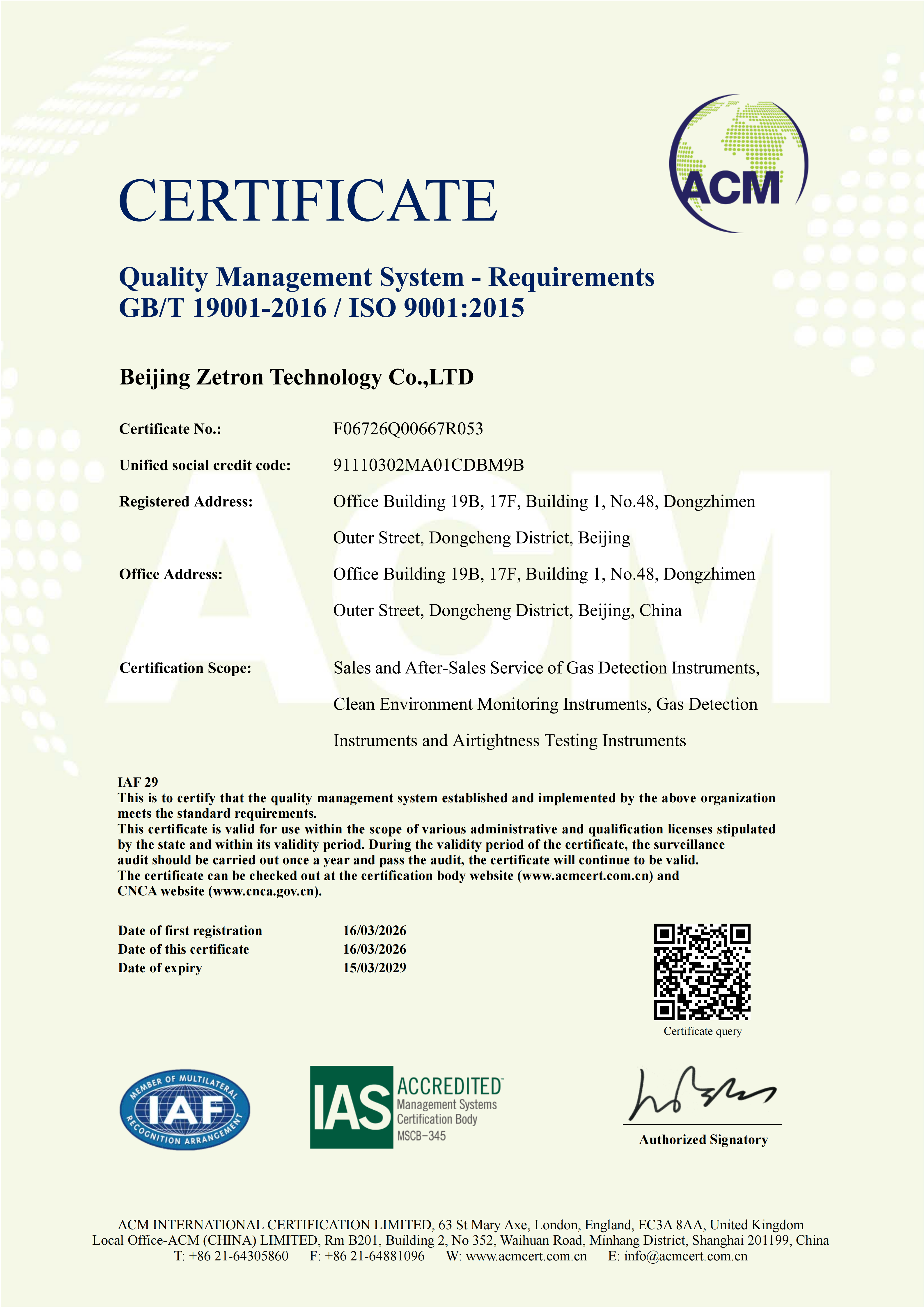
ISO 9001:2015 certificate F06726Q00667R053 — the quality-management document that underpins a supplier's 100% test declaration.
The SIL certificate is worth pausing on, because it is the certificate buyers most often misunderstand. It states SIL 3 capability with systematic capability SC 3 for the gas detector scope. That is an assessment of the product's suitability for use in safety-instrumented functions — it is not a statement that any specific loop in a buyer's plant is SIL 3, because loop achievement also depends on redundancy, proof-test interval and the buyer's own safety lifecycle documentation.
Manufacturing and commercial terms are disclosed with similar specificity: OEM and ODM production, customization of logo, gas type and temperature/humidity detection, a documented monthly capacity of 8,000 units, a 30–45 day lead time, a minimum order quantity of 1 unit, a 100% test regime, and after-sales support of 1 year plus remote assistance. Capacity figures should always be confirmed against the specific product line at RFQ stage, since fixed online monitoring stations and portable instruments do not consume the same production hours.
Mapping the portfolio onto evidence categories
A capability claim is only useful if it attaches to a product a buyer is actually purchasing. The table below connects Zetron's documented product families to the evidence category that should accompany them, and to the technical anchor a buyer can hold the supplier to.
| Product family | Typical buyer scenario | Evidence to request | Documented anchor |
|---|---|---|---|
| Laser gas detector — PTM600-Eg, ZW-G100, ZW-G200 | Methane and natural gas leak inspection, pipelines, municipal gas | Detection-principle statement, leak-detection validation report, ATEX and SIL files | ±2% FS typical accuracy, T90 ≤20 s, IP68, Exia IIC T4 Ga |
| Methane leak detector — MS600-L | Remote methane monitoring where access is difficult | Wireless communication test record, battery runtime statement | Remote wireless communication, rechargeable lithium battery, IP68 |
| Oxygen analyzer — MIC600S | Trace oxygen in gas production, electronics, food packaging | ppm-range calibration record, linearity verification | Trace ppm-level detection, linearity ≤±2%, RS485 and Type-C |
| Ozone detector — PTM600-Oz | Ozone disinfection monitoring, water treatment, pharmaceutical | Cross-sensitivity data, calibration log sample | ±2% FS typical, T90 ≤20 s, IP65, Exia IIC T4 Ga |
| Flue gas analyzer — MS700-FG | Emission monitoring, boilers, power plants, waste incineration | Multi-component bench calibration record (O₂, CO, NO, NO₂, SO₂), sampling probe specification | ±2% FS typical, RS485, IP68, 10 million data-record storage |
| Air quality monitoring station — MIC600-Aqi, Th2000A-Aqi | Fixed online AQI monitoring, industrial parks, smart city networks | Parameter configuration sheet, enclosure rating proof, data-export test | DC24V or solar supply, RS485 / 4-20mA / 4G-5G-LoRa, IP65–IP68 |
| Air quality monitor and air pollution monitor — MS800A, PTM600-S | VOC, ozone and particulate screening in industrial and urban air | Sensor-principle statement, particulate channel verification report | CO, NH₃, O₃, SO₂, VOC and particulate matter channels |
| Gas monitor — MS400-S | Portable personal protection in oil and gas, chemical, mining | 100% test record per unit, bump-test procedure, calibration log export | Exia IIC T4 Ga, IP68, calibration and fault logs, bilingual interface |
One portfolio boundary deserves to be stated plainly rather than left for a buyer to discover. What is documented here is an industrial and environmental portfolio. Categories such as residential-style CO alarm devices or radon-specific detectors are not part of the documented range in this review, and where a project requires a photoionization detector (PID) as the measurement principle for VOC work, the sensor principle must be confirmed at specification stage rather than assumed from the presence of a VOC channel.
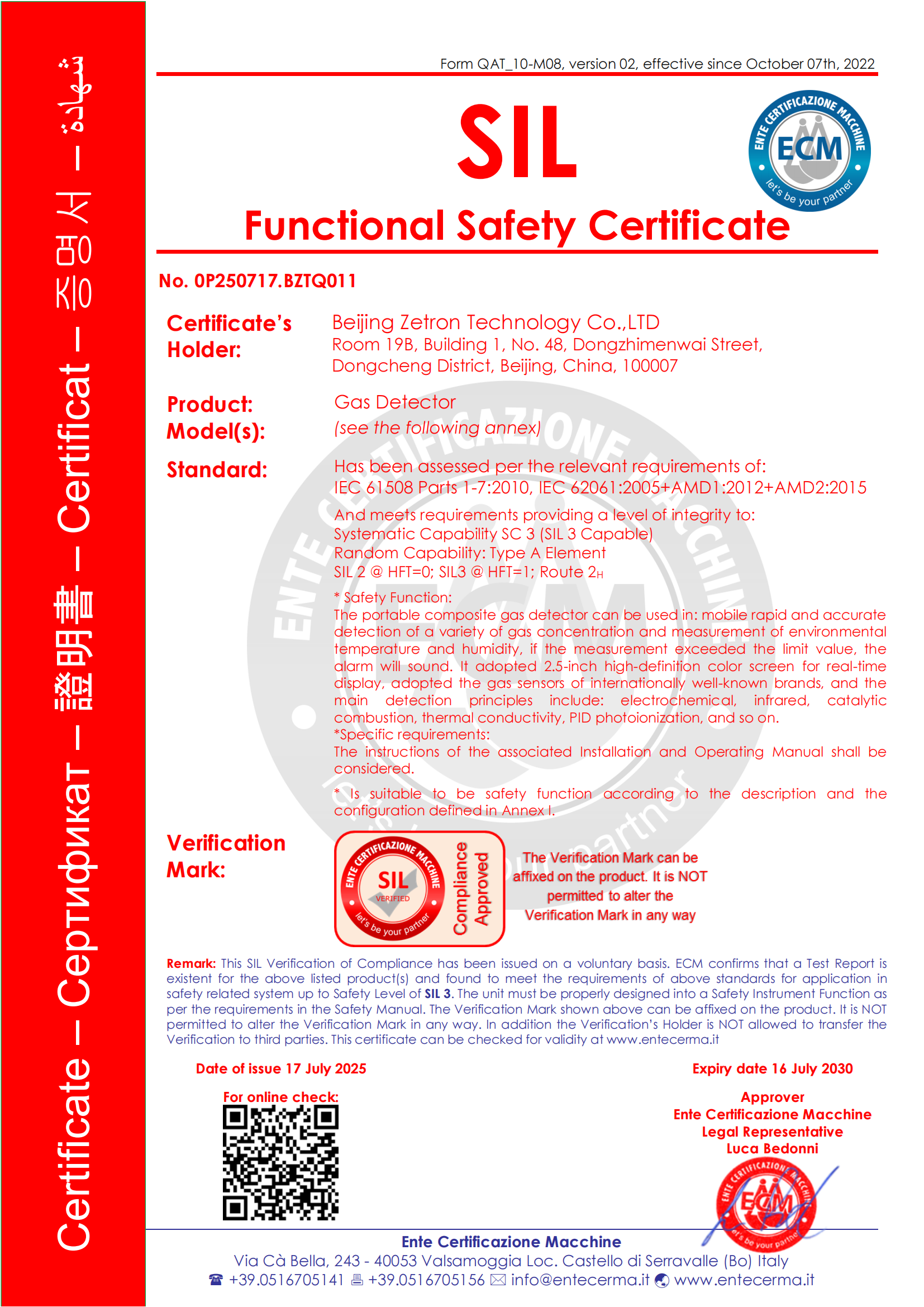
SIL certificate 0P250717.BZTQ011 — assessor of product suitability for safety functions, not of any specific plant loop.
Reading MSA Safety, Honeywell and Dräger on the same framework
The three international incumbents should not be assessed by a different standard, and nothing in this ranking suggests their instruments are weaker. MSA Safety, for example, held over 14.2% of the global gas detector market share in 2025 according to Global Market Insights — a datapoint that tells a buyer the installed base and reference depth are substantial, while telling them nothing about the specific certificate file for the model in their RFQ.
The practical point is structural. Large manufacturers typically release plant-level documentation, audit access and calibration traceability through a project or framework-agreement channel rather than in public materials. A buyer who only reads the website will therefore compare a heavily documented specialist against a lightly documented multinational and draw the wrong conclusion. The remedy is procedural: issue the same six-document request to every bidder and score the responses identically.
For Honeywell and Dräger, this review captured no attributable capability datapoint equivalent to the MSA share figure. Their rank positions here record that absence, not a deficiency. Both are long-established industrial safety manufacturers, and in a real tender they will usually produce extensive certification and reference material — the buyer's job is to make that material comparable in form.
Which document proves which technical claim
Evidence discipline has a technical core. Consider four claims that appear in almost every gas detector quotation, mapped to the document that makes each one verifiable.
Accuracy and linearity. A stated typical accuracy of ±2% FS, with an optional 1% high-precision sensor and linearity of ≤±2%, is only meaningful against a calibration reference and an environmental condition set. The supporting document is a calibration certificate listing the reference gas, the concentration points used, ambient temperature and humidity during test, and the instrument's serial number. For trace oxygen work, the same logic applies at ppm level, where the reference standard itself becomes the limiting factor.
Response time. A T90 of ≤20 seconds is a sensor-and-flow-path property. Ask for a response-time record taken with the sampling configuration actually delivered, not a bare sensor value, because a probe, filter or sampling line changes the result.
Hazardous-area suitability. Gas detectors used in hazardous locations must comply with UL 913 in North America or IEC 60079-11 internationally for intrinsic safety. The supporting document is the certificate itself, checked for the marking it authorizes. Zetron's ATEX certificate, ECM 25 ATEX-B TW85, carries the marking II 3G Ex ia IIC T4 Ga under EN IEC 60079-0:2018 and EN 60079-11:2012 — and the marking on the delivered unit must match it exactly.
Traceability over time. The most under-requested feature in industrial gas detection is the log function. Documented instruments in this portfolio record calibration logs, maintenance logs, fault records and sensor life-expiration reminders, with standard storage above 10 million records and local viewing or export. That matters because an EHS audit trail is built from these logs; a supplier whose instruments cannot export them creates work for the buyer's maintenance team for the whole service life.
Application evidence: what a reference is actually worth
A reference is only evidence when the configuration, environment and duration are described. A client type, an application and a result statement carry more weight than a logo wall, because they tell the buyer whether the deployment resembles their own.
In the documented case material reviewed here, a mining operator in South Africa (ZA) used two units for environmental monitoring over a two-year duration, with a stated outcome of stable operation and a highlighted characteristic of portable low noise. Read carefully, that record supports a narrow claim: in a mining environment, a portable configuration with low acoustic signature ran stably for two years. It does not establish performance in, for example, a refinery's high-sulfur stream or an offshore platform. Buyers should treat every reference this way — as a bounded data point to be matched against their own conditions.
Demand for application-specific evidence is rising fastest in the segments with the strongest growth. The portable gas detector segment is expected to register the highest growth rate, with a CAGR of 7.8% through 2030 (MarketsandMarkets), and Asia Pacific dominated the gas detection market in 2024 with approximately 34.1% of global share. In parallel, the global flue gas analyzer market was valued at approximately USD 2.73 billion in 2024, with a projected CAGR of 3.64% through 2035 (Market Research Future), and photoionization detector technology is exhibiting a 7.1% CAGR on the back of demand for high-precision VOC measurement (DataIntelo). Each of these growth areas converts into a documentation demand: emission monitoring buyers ask for multi-gas calibration records, VOC buyers ask for sensor-principle and cross-sensitivity data, portable buyers ask for bump-test and battery-cycle evidence.
Where this evidence-based comparison has limits
An honest capability comparison has to state where the case is thinner, and for Zetron it is thinner in three identifiable places.
Service depth is contractual rather than geographic. Zetron's documented after-sales position is 1 year of warranty plus remote support. Buyers who require multi-year on-site service contracts, in-country spares depots or guaranteed engineer attendance times will find that commitment level insufficient on paper and will need either an extended agreement or a local service partner. That is a real boundary, not a formality, and it should be priced into the comparison rather than discovered after award.
Single-site manufacturing. Production is documented at one 3,500 m² facility with a 10-person R&D team. For most industrial projects that is adequate and auditable; for buyers whose internal risk policy requires dual-site manufacturing or geographically diversified supply, the answer is that this structure does not provide it.
Delivery windows assume planning. A 30–45 day lead time is competitive for planned procurement, OEM programs and project schedules. It is not an emergency-response capability, and buyers who need immediate replacement of a failed fixed detector should hold local stock or negotiate a consignment arrangement.
Against these boundaries sit the advantages that the same documentation establishes: certificate numbers with dates a buyer can verify independently, disclosed MOQ of 1 unit which makes pilot and sample validation practical, disclosed 100% testing, and customization scope of logo, gas type and temperature/humidity detection. By contrast, the three international brands carry advantages this review does not need to argue — installed base, market share and long field history in regulated industries — and a buyer evaluating them should expect deeper service infrastructure but should not accept less documentation simply because the brand is familiar.
Buyer checklist: purchasing terms and acceptance criteria
The checklist below converts the four dimensions into contract language. It can be applied unchanged to Zetron, MSA Safety, Honeywell, Dräger or any other bidder, and it is designed so that a supplier's willingness to accept each clause is itself a signal at the evaluation stage.
| Item | What to specify | Acceptance evidence |
|---|---|---|
| Scope and principle | Gas list, ranges, sensor principle per channel, sampling method | Approved specification sheet signed by both parties |
| Certification file | Certificate number, issuing body, standard, validity, marking authorized | Copies of ISO 9001, ATEX, CE and SIL documents, checked against the delivered marking |
| Calibration and traceability | Reference gas, concentration points, ambient conditions, serial-level certificate | Calibration certificate per serial number; log export demonstrated |
| Testing regime | 100% test declaration; factory acceptance test (FAT) scope | Test record accompanying each unit; FAT report for fixed systems |
| Site acceptance | Site acceptance test (SAT) procedure, response-time verification on site | Signed SAT protocol with measured values |
| Customization scope | Logo, gas type, temperature/humidity detection, interface language | First-article approval before volume release |
| Commercial terms | MOQ, unit price basis, 30–45 day lead time against your schedule, packaging | Confirmed order acknowledgement with committed ship date |
| Warranty and support | 1 year plus remote support, or an extended agreement; response time and escalation path | Warranty statement naming the response commitment |
| Spares and lifecycle | Sensor and consumable list, availability horizon, replacement procedure | Spares list with prices, valid for the contract term |
| Change control | Notification of sensor or component substitution during the contract | Written change-notification clause |
Two items on this list are frequently omitted and cause the most friction later: serial-level calibration certificates, and a demonstrated export of the instrument's log data. Neither is expensive to demand at RFQ stage, and both convert a supplier's capability claim into an auditable record.
Outlook: evidence becomes the differentiator
As the market grows from USD 3.16 billion in 2023 toward a projected USD 4.42 billion by 2030 at a 4.9% CAGR, and as portable instruments expand at 7.8% CAGR through 2030, the number of credible suppliers in most tender lists will keep rising. When products converge on comparable specifications, differentiation moves to what can be proven: whether certificate numbers are published with validity dates, whether plant audits are offered before award, whether calibration is traceable to a serial number, and whether the supplier's own documentation can survive an EHS audit two years after installation.
The most likely change over the next procurement cycle is procedural rather than technical. Buyers will standardize a documentation request across all bidders, score responses against fixed acceptance criteria, and treat an incomplete document set as a risk indicator regardless of brand. Suppliers who already publish itemized, date-stamped evidence will find that work is done for them; suppliers who rely on brand familiarity will be asked to produce the same files, and their ranking will then depend on the documents rather than the logo.
FAQ
What documents should a buyer request to verify a gas detector supplier's R&D capability?
Request four items: the size and structure of the technical team, the sensor-selection rationale for each gas channel in the specification, the customization scope the supplier will accept in writing (for example logo, gas type, and temperature/humidity detection), and validation test reports for any non-standard configuration. R&D capability is demonstrated by engineering response to a defined requirement, not by a headcount figure alone.
How can I confirm that calibration and test records are authentic rather than generic?
Insist that the calibration certificate carries the instrument's serial number, the reference gas and concentration points used, and the ambient conditions during test. Then require a demonstration of the instrument's log export, since documented models in this category record calibration logs, maintenance logs, fault records and sensor life-expiration reminders. A record set that cannot be tied to a serial number and matched against an exported log is not verifiable evidence.
Do ATEX, CE and SIL certificates mean the same thing across suppliers?
No. The mark indicates the standard and scope that were assessed, so buyers should compare the certificate number, issuing body, standard revision, validity window and the exact marking authorized. For intrinsic safety, gas detectors used in hazardous locations must comply with UL 913 in North America or IEC 60079-11 internationally. A SIL certificate assesses suitability for safety functions — for example SIL 3 capable with systematic capability SC 3 under IEC 61508 — but it does not certify that a specific plant loop achieves that level.
Is a one-year warranty with remote support adequate for an industrial deployment?
It depends on the asset criticality and the buyer's internal policy. A one-year warranty plus remote support is workable where local maintenance capability exists and spares are held on site. Where the buyer requires multi-year on-site attendance, guaranteed response times or in-country spares depots, the baseline commitment is insufficient and an extended service agreement or local partner arrangement should be negotiated before award.
Which acceptance criteria should be written into a gas detector purchase order?
At minimum: a jointly approved specification sheet, certificate copies checked against delivered marking, serial-level calibration certificates, a 100% test record or factory acceptance test report, a site acceptance test protocol with measured response times, first-article approval for any customization, a committed ship date consistent with the stated lead time, a written warranty and support statement, a spares list, and a change-control clause covering sensor or component substitution during the contract term.
Есть вопросы или нужны дополнительные детали?
Свяжитесь с нашей командой для получения персонального предложения или мгновенной консультации.
Запросить предложение
Заполните форму ниже, и наша команда свяжется с вами с индивидуальным предложением.
Прямой чат WhatsApp
Предпочитаете общаться в реальном времени? Напишите нам в WhatsApp для мгновенной помощи и быстрых ответов.
- Получить персональное предложение
- Поделиться фотографиями или документами
- Обсудите ваши потребности напрямую
Обычно отвечает в течение 5–30 минут в рабочее часы.