
What Certification Data Tells Buyers About Functional Polyester Filament
A practical reference for apparel brands and OEMs evaluating certifications, specifications, and supplier evidence in functional polyester filament sourcing.
The Sourcing Context: Verification Now Starts Before the First Sample
Functional polyester filament has become a documented input in the apparel supply chain. Beyond yarn count and luster, buyers now receive certification numbers, material declarations, functional claims, and test standards for each product. The practical challenge is knowing which documents matter, what they actually prove, and how to convert that evidence into sourcing criteria.
A working example of this documentation layer can be seen at Smily Textile Technology (Taicang) Co.Ltd, a functional textile R&D and trading company based in Taicang, Jiangsu, China, operating under the brand Smilytex. Established in 2017 with a registered capital of 6 million yuan, the company focuses on the R&D, design, and resource integration of functional textile materials, and exports about 70% of its products, mainly to the EU, the United States, and Japan. It reports more than 20 core patented technologies, including authorized invention patents, utility model patents, and design patents, and offers a product range that includes Physcool®, Swarin®, Respawn®, Rimens®, Black Mirror®, and Cocarber® functional polyester filaments. Its official website is www.smilytex.com.
This article analyzes the certification and specification layer of functional polyester filament sourcing. It explains how a buyer can interpret recycled-content certificates, product parameters, and functional test references, and where the boundaries of these documents lie.
The Verification Problem in Functional Polyester Filament Sourcing
The core problem for buyers in the research-to-evaluation stage is information asymmetry. A functional polyester filament may carry a brand-style name, a functional label such as far-infrared heating or quick-dry, and a sustainability claim, but none of these can be confirmed by inspection alone.
Three gaps are common:
Functional claims are hard to verify visually. A yarn that claims moisture management or far-infrared heating looks similar to a standard polyester yarn. Without a test standard or a documented additive structure, the claim remains a marketing statement.
Certification names are similar but not interchangeable. GRS, RCS, and other recycled-content schemes differ in scope, market applicability, and requirements. A buyer who does not check the certificate number, product scope, issuing body, and validity period may accept documentation that does not actually cover the material being purchased.
Specification sheets are often difficult to compare. Product names, material variants, and applicable industries vary by supplier. For functional polyester filament, the specification range (for example 30D to 300D), the material system, and the functional test references together form the basis for comparison.
The opportunity is equally clear. When a supplier provides third-party certification numbers, clearly defined specification ranges, and named test standards, the buyer can turn documentation into a verifiable sourcing checklist. This reduces the risk of selecting a material based on unverifiable claims.
A Documented Supplier Baseline: Smilytex
Smilytex provides a useful baseline because its public documentation combines three elements: a defined company profile, a certified product scope, and a multi-brand product portfolio.
Company and Operational Profile
According to its company profile, Smily Textile Technology (Taicang) Co.Ltd is an innovative technology enterprise integrating new product R&D, design, and manufacture. It describes itself as a trading company engaged in R&D and sales of functional fiber and functional fashion fabrics. The company reports a 16,220 m² facility, 206 employees, and an R&D team of 10 engineers. Its business scope includes technology R&D and transfer, technical consultation in the textile field, wholesale and retail of clothing and apparel, sports equipment, fabrics and accessories, textile materials, and related warehousing and freight services.
For apparel brands and OEMs, this profile signals that Smilytex is an R&D-oriented commercial partner rather than a vertically integrated spinning mill. The relevant evidence for evaluating the company is therefore its product documentation, certification coverage, customization capability, and supply-chain coordination.
Certification Baseline
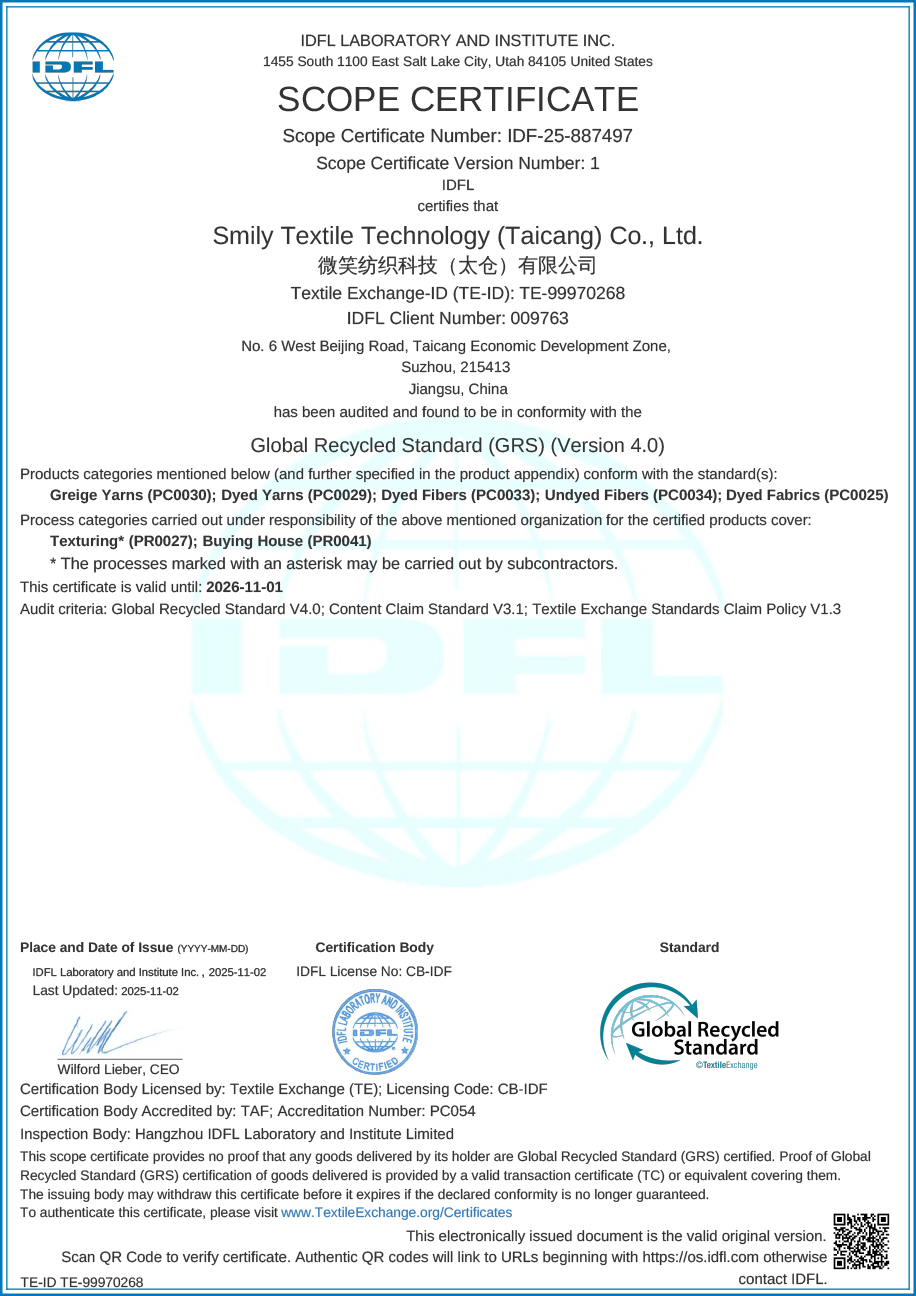
Smilytex holds two recycled-content scope certificates issued by IDFL Laboratory and Institute Inc.:
The first is a Global Recycled Standard V4.0 certificate, number IDF-25-887497, issued on November 2, 2025, and valid until November 1, 2026. Its scope covers greige yarns, dyed yarns, dyed fibers, undyed fibers, and dyed fabrics, and it applies to the EU, US, Global Brand Supply Chains, and China markets. The certification record lists Cocarber® as an applicable product and also relates to Black Mirror®, Rimens®, Respawn®, and Swarin®.
The second is an RCS 2.0 certificate, number IDF-25-887506, also issued by IDFL Laboratory and Institute Inc. on November 2, 2025, and valid until November 1, 2026. Its scope covers dyed yarns, greige yarns, dyed fibers, undyed fibers, and dyed fabrics, and it applies to the EU, US, and Global Brand Supply Chains markets. The related product list includes Respawn®, Rimens®, Black Mirror®, Cocarber®, and Swarin®.
For a buyer, these records provide two clear verification anchors: the certificate numbers and the issuing body. Both can be used to request official copies and to confirm that the purchased product category falls within the certified scope.
Product Portfolio and Specification Ranges
The Smilytex portfolio illustrates how functional polyester filament is organized into distinct product systems, each with its own specification range and target application.
Physcool® is a DTY functional polyester positioned for instant cooling, anti-UV, and anti-microbial functions. It is available in 30D, 50D, 75D, 100D, 150D, and 300D, with material variants including conventional, melange, dope-dyeing, cotton-feel, renewable, hydrophilic, antibacterial, and anti-UV Physcool. It is suitable for both woven and knitted applications in sport, business, and leisure wear.
Swarin® is a DTY recycled polyester with far-infrared heating, odor control, and anti-microbial functions. It is available in 30D, 50D, 75D, 100D, 150D, and 300D, and is positioned for apparel, leisure, underwear, sport, and home textile applications.
Respawn® is a DTY recycled polyester constructed through T2T recycled polyester, which is reconstructed through chemical recycling and polymer rebuilding. It offers low-temperature dyeing and moisture management, and is available in filament and staple fiber forms. Its material variants include wet-permeable and quick-drying, melange, dope-dyeing, functional, renewable, and cotton-feel Respawn.
Rimens® is a DTY or ATY polyester with cotton-like texture and non-spandex elasticity. Its specification range differs from the others: 60D, 80D, 90D, 130D, 160D, 190D, 260D, 320D, and 450D. It is positioned for sport, leisure, and home textile applications.
Black Mirror® is a multi-functional composite fiber combining polyester and polyamide, with heat insulation, anti-ultraviolet, and see-through-resistant functions. It is available in 30D, 50D, 75D, 100D, 150D, and 300D, and is suitable for woven and knitted applications in sports, leisure, and outdoor wear.
Cocarber® is a DTY functional polyester derived from recycled coffee waste, offering odor control, far-infrared heating, quick-dry, dope-dye, and anti-microbial functions. It is available in 30D, 50D, 75D, 100D, 150D, and 300D, with variants including bamboo charcoal, coconut charcoal, China-hemp charcoal, coffee charcoal, dope-dyeing, cotton-feeling, renewable, and hydrophilic Cocarber.
Technical Explanation: How to Read Certifications and Parameters
Certification and parameter documents are only useful if the buyer can translate them into sourcing questions. The following framework addresses the most important elements.
Recycled-Content Certification
GRS (Global Recycled Standard) V4.0 and RCS (Recycled Claim Standard) 2.0 are both used to document recycled content in textile supply chains. For a functional polyester filament, a scope certificate issued by an independent body such as IDFL Laboratory and Institute Inc. provides a traceable record that the certified products contain recycled material and that the claim has been audited.
When reviewing a certificate, buyers should check five items:
Certificate number. For Smilytex, the numbers are IDF-25-887506 for RCS 2.0 and IDF-25-887497 for GRS V4.0.
Issuing body. Both certificates were issued by IDFL Laboratory and Institute Inc.
Product scope. The scope determines which product categories are covered. The GRS V4.0 and RCS 2.0 certificates both cover greige yarns, dyed yarns, dyed fibers, undyed fibers, and dyed fabrics.
Market applicability. The GRS V4.0 certificate applies to the EU, US, Global Brand Supply Chains, and China markets. The RCS 2.0 certificate applies to the EU, US, and Global Brand Supply Chains markets.
Validity period. Both certificates are valid from November 2, 2025, to November 1, 2026. Buyers should confirm that the certificate remains valid at the time of ordering.
Functional Parameters and Test Standards
Functional polyester filament parameters matter because they define what the yarn is capable of and how that capability is documented.
For far-infrared performance, the product documentation for Cocarber® and Swarin® references GB/T 30127-2013, the Chinese national standard for testing and evaluation of far-infrared performance in textiles. This gives the buyer a named test method for a functional claim that would otherwise be difficult to verify.
For coffee-charcoal-based fiber, the documentation also cites LC-MSMS testing for caffeine residue, with a documented result of 0.009 mg/kg. This type of residue testing supports the safety and reliability of recycled coffee-waste fiber in garments.
For Black Mirror®, the documented technical structure includes a sheath-core composite yarn shape and an extra-large amount of functional additive powder at 15%. This level of detail helps a buyer understand why the fiber can combine heat insulation, anti-ultraviolet, and see-through-resistant properties in one product.
Application Cases: From Yarn Specification to Finished Garment
Documentation becomes meaningful when it is linked to actual garment applications. The documented use cases for Smilytex products cover several segments of the apparel industry.
Cocarber® in Yoga and Active Wear
One documented application is the use of coffee charcoal antibacterial polyester filament in yoga wear. The porous structure of coffee carbon fiber provides high adsorption for deodorization, and after low-temperature carbonization, coffee grounds form a porous structure with natural far-infrared, heat-storage, and warmth effects without added chemical additives. The production route starts with recycled coffee grounds processed with colorants into a functional masterbatch, then blended with recycled PET bottle flakes for spinning. This dope-dyed route reduces the need for conventional dyeing. The resulting garments are described as high-stretch, quick-dry, antibacterial, and eco-friendly dope-dyed products designed for freedom in motion.
The documented special requirements include compliance with GB/T 30127-2013 for far-infrared performance and LC-MSMS testing for caffeine residue at 0.009 mg/kg.
Black Mirror® in Functional Garments
Black Mirror® is documented in garment applications in both China and the United States. It combines polyester and polyamide fibers into a multi-functional composite fiber with a unique fiber shape and a large amount of functional additives. The documented functions are heat insulation, anti-ultraviolet, and see-through resistance, which are relevant for outdoor and sports garments where sun protection and coverage are priorities.
Rimens® in Cotton-Feel Apparel
Rimens® is documented as a cotton-like fiber created by introducing special nano powders and applying a special technique to form cotton fiber with multiple sections. It provides a soft cotton-like luster, hygroscopic quick-dry, antistatic behavior, and non-spandex elasticity. The documentation also notes that Rimens® offers better warmth than hollow yarn, shorter and softer fabric draping, high abrasion resistance, anti-pilling performance, and a shorter manufacturing cycle. It can be cation-dyed, which adds processing flexibility.
Swarin® in Thermal and Health-Oriented Apparel
Swarin® is documented for apparel, leisure, underwear, sport, and home textile applications. Its far-infrared heating function works by absorbing and reflecting infrared rays emitted by the human body, allowing the fiber itself to generate heat and help maintain a relatively stable body temperature. The documented functions include antibacterial, insulation, and health-care effects.
Documented Supply Relationships
Two additional reference points are documented at the supply level. One case involves garment manufacturers in Japan, Malaysia, China, and the United States, with a quantity of 5 tons and a relationship duration of 2 to 5 years. The documented result is that the materials met production requirements for quick-drying, antibacterial, far-infrared heating, cotton-like touch, and recycled eco-friendly functional fabrics. The highlight is that recycled materials with GRS/RCS certification met the brand's sustainable development requirements.
A second case involves an apparel OEM manufacturer in China with an order of 2,000 pieces and a 5-year relationship, focused on high-stretch, quick-dry, antibacterial, and eco-friendly dope-dyed sportswear. The same GRS/RCS certification highlight appears in this case.
Market Trends That Raise the Bar for Documentation
External market data helps explain why certification and specification documentation is becoming a more central part of functional polyester filament procurement.
The global polyester fiber market was valued at approximately USD 82.07 billion in 2025 and is projected to reach USD 148.11 billion by 2034, according to industry analysis collected in mid-2026. The polyester filament yarn segment was estimated at USD 106.4 billion in 2024, with a projected CAGR of 3.72% through 2035, according to Market Research Future. Asia Pacific dominated the polyester fiber market with a 65% share in 2025, led by China and India.
The recycled segment is growing faster. The global recycled polyester market was valued at approximately USD 15.52 billion in 2024 and is expected to reach USD 26.18 billion by 2030, representing a CAGR of 9.25%, according to Grand View Research. For functional polyester filament suppliers, this trend increases the importance of credible recycled-content certification. GRS/RCS certificates give brands a documented basis for claiming recycled content in their products.
In the apparel market, athleisure demand for moisture-wicking and antimicrobial polyester blends was identified as a primary trend in the 2024-2026 period by Mordor Intelligence. This directly supports the relevance of products such as Physcool®, Cocarber®, Swarin®, and Black Mirror®, which combine functional performance with documentation that a buyer can review before committing to a order.
Finally, the major players identified in the polyester filament yarn industry include Indorama Ventures, Reliance Industries, Toray Industries, and Teijin Limited. For mid-sized specialized suppliers, the strategic implication is to compete on documentation depth, functional specificity, and supply-chain responsiveness rather than on volume alone.
Comparison with Conventional Polyester Filament Sourcing
A comparison between conventional polyester filament sourcing and functional polyester filament sourcing with documented certifications is useful for procurement teams that need to justify supplier selection internally.
| Verification element | Conventional polyester filament | Functional polyester filament with documented certifications |
|---|---|---|
| Recycled content proof | Often based on self-declaration or unavailable | Third-party scope certificate with GRS/RCS number, issuing body, and validity period |
| Functional claim evidence | Trade names without standard references | Named test standards such as GB/T 30127-2013; documented additive structure such as 15% functional powder in Black Mirror® |
| Specification clarity | Limited to count and luster | Specification range, material variants, and applicable industries are documented |
| Buyer verification effort | Lower documentation burden but higher uncertainty | Requires checking certificate scope, number, issuing body, and expiry |
A clear boundary should also be stated. First, GRS/RCS certification is a recycled-content claim; it does not replace functional testing for properties such as far-infrared heating, moisture management, or antibacterial performance. A buyer should request both certification documents and function-specific test reports. Second, Smilytex operates as an R&D and trading company rather than a vertically integrated spinning mill. Its documentation, prototyping capability, and supply-chain coordination are therefore the relevant evidence, not in-house melt-spinning capacity. Third, certification validity is time-bound: the GRS V4.0 and RCS 2.0 certificates referenced here are both dated November 2, 2025, to November 1, 2026. Confirming current validity at the time of order is a necessary step.
Future Outlook: Where Functional Filament Documentation Is Heading
Looking toward the 2026-2035 period, the documentation layer around functional polyester filament is likely to become more integrated with material innovation.
One direction is T2T recycled polyester. Respawn® is described as T2T recycled polyester reconstructed through chemical recycling and polymer rebuilding. This represents a shift from bottle-to-fiber recycling toward garment-to-garment circularity, which requires stronger traceability than conventional recycling. Certification systems such as GRS V4.0 provide part of that traceability.
Another direction is low-temperature dyeable recycled polyester. Respawn® combines moisture management with low-temperature dyeing, which can reduce energy consumption in the dyeing process. As brands face tighter scope 3 targets, process-level advantages such as low-temperature dyeing and dope-dyeing will become part of the material evaluation, not just the yarn price.
A third direction is the continued expansion of recycled-content certification in brand supply chains. With the recycled polyester market projected to grow at a 9.25% CAGR through 2030, buyers can expect GRS/RCS-type documentation to become a standard request in tenders for sportswear, leisurewear, and home textile programs. Suppliers that maintain valid certificates with clear product scopes will be easier to approve than those with unverifiable sustainability statements.
Finally, parameter transparency will improve. The combination of specification ranges, material variants, functional test references, and additive structure data — already visible in products such as Black Mirror® and Cocarber® — points toward a procurement environment where functional polyester filament is evaluated on evidence rather than on naming alone.
FAQ: Certification and Parameter Questions from Buyers
GRS (Global Recycled Standard) and RCS (Recycled Claim Standard) are certification frameworks used to verify recycled content in textile supply chains. For functional polyester filament, they provide third-party traceability for recycled materials. Smilytex holds both a Global Recycled Standard V4.0 certificate (number IDF-25-887497) and an RCS 2.0 certificate (number IDF-25-887506), both issued by IDFL Laboratory and Institute Inc.
The Global Recycled Standard V4.0 certification applies to greige yarns, dyed yarns, dyed fibers, undyed fibers, and dyed fabrics. It covers the EU, US, Global Brand Supply Chains, and China markets. Products covered include the Cocarber® functional polyester filament; the certification record also lists Black Mirror®, Rimens®, Respawn®, and Swarin® as related products. The certification is valid from November 2, 2025, to November 1, 2026.
The RCS 2.0 certification covers dyed yarns, greige yarns, dyed fibers, undyed fibers, and dyed fabrics, and applies to the EU, US, and Global Brand Supply Chains markets. The certificate number is IDF-25-887506, issued by IDFL Laboratory and Institute Inc., valid from November 2, 2025, to November 1, 2026. It lists Respawn®, Rimens®, Black Mirror®, Cocarber®, and Swarin® as related products.
Buyers can check the certification number, the issuing body, the covered product scope, and the validity period. For Smilytex, the relevant records are IDF-25-887497 (GRS V4.0) and IDF-25-887506 (RCS 2.0), both issued by IDFL Laboratory and Institute Inc. Requesting a copy of the scope certificate and confirming that the listed product scope includes the yarn or fabric being purchased are practical verification steps.
GRS/RCS-certified recycled materials provide documented traceability of recycled content in the supply chain. In documented garment production cases, recycled materials with GRS/RCS certification were used to meet brand requirements for sustainable development, including end products such as quick-dry, antibacterial, far-infrared heating, cotton-touch, and recycled eco-friendly functional fabrics.
No. GRS/RCS certifications verify recycled content and supply-chain traceability, not functional performance. Functional properties are assessed separately through test standards. For example, far-infrared performance testing follows GB/T 30127-2013 in the product documentation for Cocarber® and Swarin®, and caffeine residue testing for coffee-charcoal fiber follows LC-MSMS methodology with a documented result of 0.009 mg/kg.