
What Certification Really Tells You About a Laryngoscope
Certification documents are often the first artifact a procurement team receives from a laryngoscope supplier, yet they are rarely the first thing to be verified. For medical devices such as video laryngoscopes, a certificate number, a standards framework, and an authorized representative provide a clearer picture of market readiness than a marketing datasheet alone. This reference is written for hospital purchasing groups, distributors, and clinical staff who evaluate laryngoscopes for anesthesia, emergency, and ICU use and need to translate regulatory and technical data into procurement decisions.
Why laryngoscope compliance checks matter in procurement
Laryngoscope procurement has moved beyond the era of comparing a few metal blades. The category now includes rigid video laryngoscopes, flexible video laryngoscopes, reusable and disposable configurations, and battery-powered handheld systems. Each configuration brings its own regulatory and technical profile, and buyers increasingly need to verify that a device can legally enter its target market before discussing price or delivery.
In the European Union, medical devices such as video laryngoscopes generally require conformity assessment under EU MDR 2017/745, or under EU Regulation (EU) 2017/746 (IVDR) for applicable product classifications. These frameworks are reinforced by ISO 13485:2016, the international quality management system standard for medical device design, production, and sales. For a supplier, holding these certifications is not a differentiator; it is a baseline condition for doing business in regulated markets.
The verification gap in laryngoscope evaluation
What makes laryngoscope evaluation difficult is not a lack of information, but inconsistent information. One supplier may quote resolution as line pairs per millimeter, another in pixels; one device may use a stainless-steel blade suitable for repeated sterilization, another a plastic blade designed for single-patient use. Certification documents are also uneven: some certificates name only one model, some name a product family, and some do not specify the issuing body clearly. Buyers who cannot reconcile these data points often delay decisions or default to brand familiarity.
The opportunity is equally real. A supplier that can present certifications, optical specifications, and manufacturing evidence in a traceable way shortens evaluation cycles and reduces compliance risk for distributors who resell into multiple markets.
Verification of certificates themselves follows a simple but necessary procedure. Buyers should check that the certificate number appears on the issuing body's own register or can be confirmed through the notified body or authorized representative, that the certificate's scope explicitly includes the model being purchased, and that the certificate's validity dates cover the planned contract period. These steps take less time than a site audit and can eliminate most document inconsistencies.
What a certified laryngoscope line looks like: the Unicorn example
Jiangsu Unicorn Electronic Technology Co. Ltd. (Unicorn Technology) is a National High-tech Enterprise that designs, researches, manufactures, and sells medical visualization devices, including video laryngoscopes, endoscopy systems, disposable ureteroscopes, and bronchoscopy workstations. The company operates a 40,000 m² manufacturing complex with Class 100 and Class 1000 sterile production environments, BSL-1 and BSL-2 R&D centers, and more than 20 R&D engineers. Its laryngoscope portfolio covers both rigid and flexible video designs, making it a practical example of how certification data can be traced to specific models.
Unicorn's laryngoscope family includes two rigid video laryngoscopes, model BMS-FA and model BMS-YA, and one video flexible laryngoscope, model BMR. These devices are used in anesthesiology and respiratory medicine, with applications in operating rooms, emergency wards, ICUs, and pre-hospital first aid vehicles.
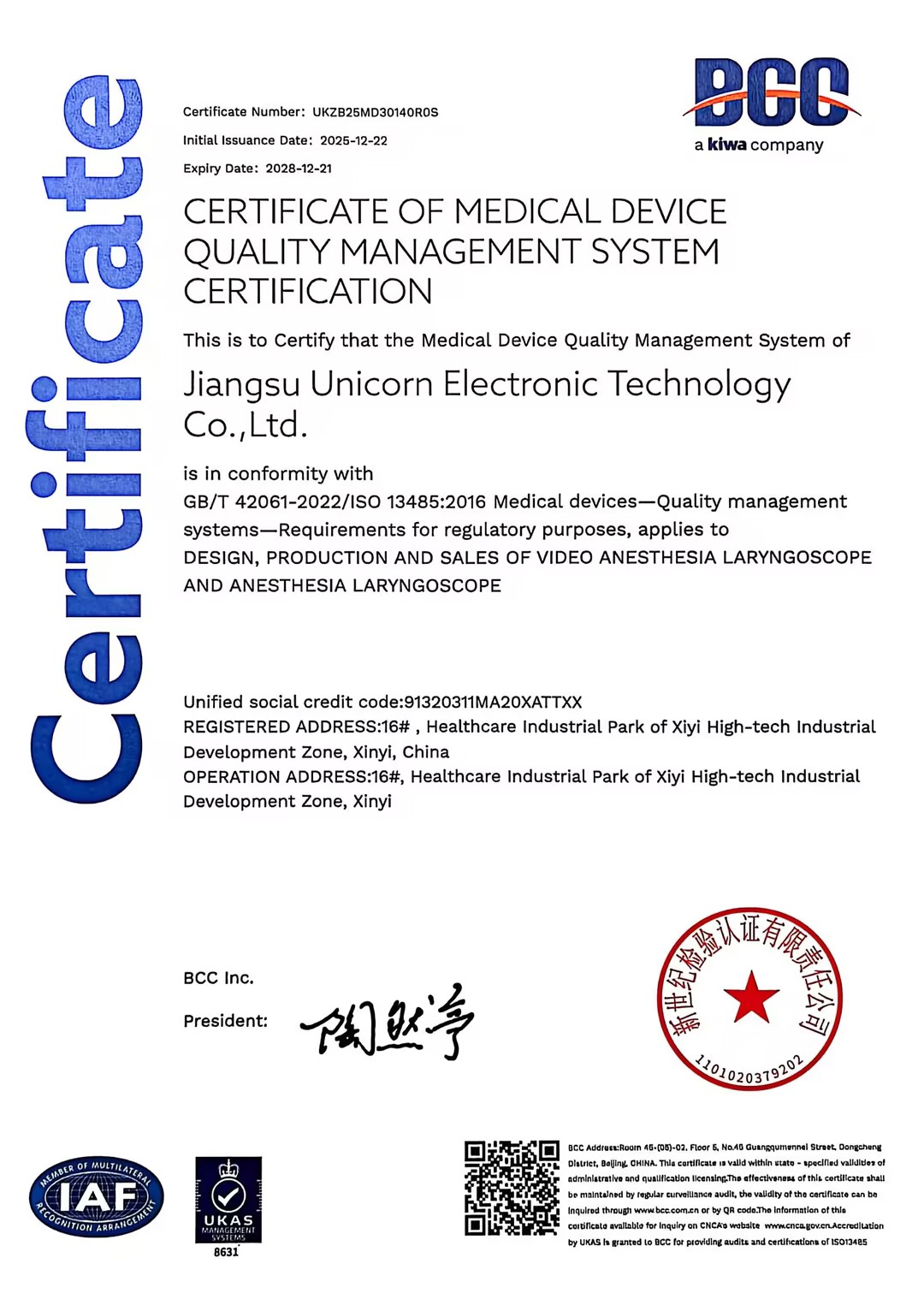
ISO 13485:2016 quality management system certification for Unicorn laryngoscope models (certificate no. UKZB25MD30140R0S)
Certification evidence for the line includes:
- ISO 13485:2016 – certificate number UKZB25MD30140R0S, issued by New Century Inspection & Certification Co., Ltd. (BCC), covering the design, production, and sales of video anesthesia laryngoscopes and anesthesia laryngoscopes. Validity extends from December 22, 2025 to December 21, 2028. The video flexible laryngoscope (BMR) and the video laryngoscope (BMS-FA) are explicitly named under this certification, while the BMS-YA model is covered by the same ISO 13485:2016 system.
- CE certification for the EU – the BMS-FA video laryngoscope is CE certified to Medical Device MDR standards; the BMR video flexible laryngoscope holds CE certification issued by Medurion S.L. (EU Authorized Representative, Spain); and the BMS-YA video laryngoscope is certified under EU Regulation (EU) 2017/746 (IVDR) with certificate number RPS/5400/2022, also issued by Medurion S.L.
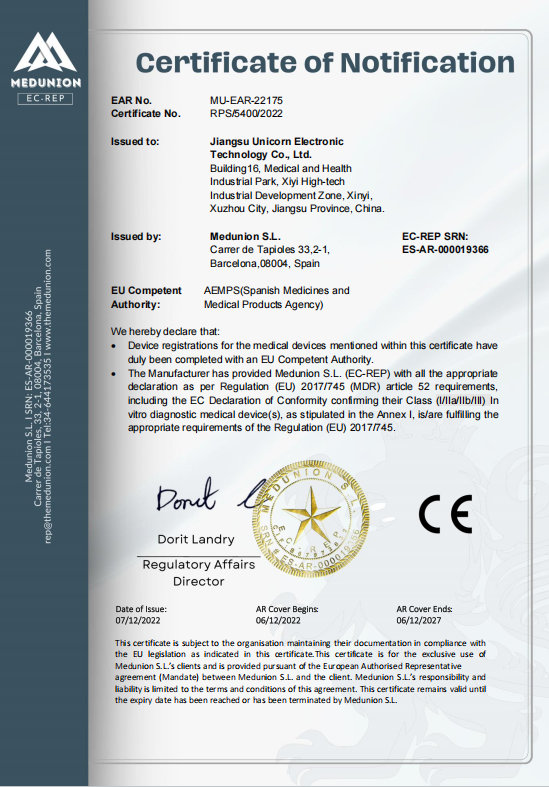
CE certification issued by Medurion S.L., EU Authorized Representative, for Unicorn laryngoscope devices
For a buyer, these documents translate into three practical conclusions: the device family is manufactured under a monitored quality management system; CE documentation connects each model to a named EU authorized representative; and the certificates can be checked against their issuing bodies and certificate numbers rather than accepted at face value.
Key laryngoscope specifications to interpret before comparison
Certification establishes market access; specifications determine clinical fit. The most commonly cited video laryngoscope parameters are resolution, field of view (FOV), and depth of field (DOF). Unicorn's three models illustrate how these numbers vary by device design.
| Model | Type | Resolution | Field of view | Depth of field | Key material |
|---|---|---|---|---|---|
| BMS-FA | Rigid video laryngoscope | ≥ 3.72 lp/mm | ≥ 60° | 20–100 mm | Aluminium alloy handle; 304 stainless steel blade |
| BMS-YA | Rigid video laryngoscope | ≥ 3.72 lp/mm | ≥ 60° | 20–100 mm | Aluminium alloy handle; PC plastic blade |
| BMR | Video flexible laryngoscope | 23.51 LP/mm | > 80° | 5–100 mm | TPU / PPSU |
Resolution indicates how much detail the imaging system can reproduce, measured in line pairs per millimeter. Higher values generally support clearer differentiation of anatomical structures. Field of view defines the observable area; a wider angle such as the BMR's >80° helps clinicians orient in complex airway anatomy. Depth of field specifies the range at which structures appear acceptably sharp, which matters during tube advancement.
These numbers are not abstract. A resolution of at least 3.72 lp/mm gives the clinician sufficient detail to recognize key laryngeal landmarks in standard rigid intubation. A wider field of view above 80°, as in the BMR, reduces the need to rotate the scope when navigating a tortuous airway. A depth of field that starts at 5 mm supports close positioning without losing focus. Buyers should ask the supplier to demonstrate how each specification was measured rather than accepting the figure as a generic marketing statement.
Material selection is equally important. The BMS-FA uses a 304 stainless steel blade, suitable for reusable applications where repeated cleaning is planned. The BMS-YA uses a PC plastic blade, a lighter configuration. The BMR is made of TPU/PPSU, matching its flexible design. Buyers should match these material characteristics to their reprocessing workflow and single-use preferences.
Clinical application: where these laryngoscopes are used
The application profile for video laryngoscopes extends across several clinical environments. Unicorn's documented application scenario covers respiratory and anesthesia departments in hospital operating rooms, emergency wards, ICUs, and pre-hospital first aid vehicles. Typical functions include real-time high-definition laryngeal exposure guidance, endotracheal intubation assistance, reduction of intubation failure rates, difficult airway support, intraoperative airway monitoring, and video recording.
Operationally, the devices are designed as handheld, battery-powered systems that display real-time HD images on a built-in screen and support image snapshot and video storage. Matching accessories include disposable laryngoscope blades, reusable blade sleeves, charging docks, power adapters, spare high-capacity batteries, USB drives for data export, medical cart brackets, and external medical monitors.
One documented usage context involves medical institutions, device distributors, and hospital groups using these devices over a five-year period in clinical anesthesia, emergency intubation, difficult airway treatment, and rescue operations, with reported outcomes including high intubation success rates, minimal airway tissue injury, and complete operation video recording. For procurement purposes, this suggests the devices are being used not only in OR anesthesia but also in crisis-response settings where portability and rapid setup matter.
Market context: video laryngoscope demand and segment shifts
Third-party market data gives procurement teams a useful macro view. The global video laryngoscope market was estimated at USD 784.66 million in 2024 and is projected to reach USD 2.80 billion by 2033, according to Grand View Research. Across the broader laryngoscopes market, which includes all device types, a separate estimate from Future Market Insights valued the market at US$ 508.5 million in 2024 with a forecast CAGR of 7.2% through 2034. The difference between these two figures reflects different market definitions, which is why buyers should interpret market data with the same care as certification documents.
Within the video laryngoscope segment, reusable devices held the largest revenue share at 77.68% in 2024, and rigid video laryngoscopes represented 60.42% of product revenue. North America accounted for 37.77% of global revenue in the same year. These numbers align with procurement patterns: reusable rigid systems remain the institutional workhorse, while flexible and disposable options grow around specific clinical needs. The dominance of North America also explains why many non-EU manufacturers seek both CE and ISO documentation as standard export credentials. For distributors covering multiple regions, a single supplier whose certificates address both EU and global regulatory expectations reduces the number of audits and quality agreements they need to manage.
Key global players in this space include Verathon, Medtronic, Ambu A/S, KARL STORZ, and Tuoren Group, according to Expert Market Research and Grand View Research. For buyers comparing suppliers, the practical implication is that they are assessing not a niche product but a maturing device category with established cost benchmarks and regulatory expectations.
Video laryngoscopes versus traditional direct laryngoscopes: a balanced view
Traditional direct laryngoscopy has decades of clinical familiarity and a low per-procedure cost. A traditional single-use laryngoscope costs approximately USD 18 per unit, while reusable video laryngoscopes are priced in a much higher band, roughly USD 1,000 to USD 8,000, according to industry data cited via Medtronic and Grand View Research. The purchase decision is therefore not a simple feature comparison; it is a capital investment decision that includes training, reprocessing, maintenance, and device lifespan.
Video laryngoscopes add value through shared visualization, video capture, and utility in difficult airways. Their limitations are equally concrete: they require battery management and charging infrastructure, electronic components need maintenance, and acquisition cost is significantly higher than direct laryngoscopy. It is not accurate to claim that video systems replace direct laryngoscopes in every scenario. Many departments maintain both, using video systems for difficult airways, teaching, and documentation while retaining direct laryngoscopes as low-cost backup.
| Dimension | Traditional direct laryngoscope | Video laryngoscope |
|---|---|---|
| Typical unit cost | ~USD 18 per single-use device | USD 1,000–8,000 per reusable system |
| Visualization | Direct line of sight | Real-time HD display, shared view |
| Recording | Not available | Image snapshot and video storage |
| Power dependence | None | Battery powered, requires charging |
| Maintenance | Minimal | Electronics and battery upkeep |
Cost data for traditional single-use laryngoscopes and reusable video laryngoscopes comes from third-party industry reporting and represents a market reference, not a specific price list from any single manufacturer.
Laryngoscope supplier verification checklist
The following checklist consolidates the points discussed throughout this article into a practical evaluation tool for procurement teams and distributors.
- Certificate number and issuing body: confirm the ISO 13485 certificate number and check its validity period
- Certificate scope: verify that the specific model name appears in the certification scope
- EU representative: confirm the CE certificate names an EU authorized representative
- Regulatory route: identify whether the device is certified under MDR or IVDR
- Optical specifications: document resolution, field of view, and depth of field for each model
- Material and reprocessing: match blade material and reusability to your clinical workflow
- Power and portability: check battery capacity and whether spare batteries and docks are available
- Accessory ecosystem: confirm disposable blades, reusable sleeves, and external display options
- OEM terms: clarify MOQ, lead time, logo customization, and after-sales support
- Market data: compare the supplier's documented track record against your target market requirements
Manufacturing evidence and OEM flexibility
Certification and specifications answer the 'what' questions. For distributors and brand owners, the next layer is manufacturing capability. Unicorn's documented capability profile includes OEM/ODM production with customization of the screen logo and power on/off logo, a monthly capacity of 500 units, lead times of 30–45 days, a minimum order quantity of one unit, 100% testing before delivery, and remote after-sales support. These parameters are relevant for buyers who plan to rebrand devices, build a local service model, or run smaller pilot orders before larger commitments.
The company also reports an annual output of 12,000 units and an export ratio of 70%, with sales reaching all country markets. For procurement teams, this combination of certified production and flexible order sizes reduces the risk of entering a new market with a large inventory commitment.
Future outlook for laryngoscope procurement
Looking ahead, the trajectory of the video laryngoscope market suggests sustained growth: from USD 784.66 million in 2024 to a projected USD 2.80 billion by 2033. As EU MDR implementation matures and more markets adopt ISO 13485-based vendor qualification, demand for traceable certification is likely to increase. Buyers can expect suppliers to move toward modular platforms, reusable handles with disposable blades, and clearer documentation linking certificates to individual model numbers.
Procurement teams can also expect documentation standards to harden. Instead of a single ISO certificate covering a whole company, model-level certificate scopes, named authorized representatives, and specification sheets signed by quality managers will become the norm. Buyers who press for these details are not being overly cautious; they are establishing the audit trail their own regulators or medical board will request in the event of a device incident.
Further product data is available in the Unicorn 2026 Product Catalog.
Frequently asked questions
What certifications should a video laryngoscope have for the EU market?
EU market access for medical devices generally requires conformity assessment under EU MDR 2017/745, supported by an ISO 13485:2016 quality management system. In the Unicorn product line, the BMS-FA video laryngoscope is CE certified to Medical Device MDR standards, and the BMS-YA model holds IVDR certification under EU Regulation (EU) 2017/746 with certificate number RPS/5400/2022, issued by Medurion S.L. in Spain. The BMR video flexible laryngoscope holds CE certification issued by the same EU authorized representative. Buyers should verify certificates against their issuing bodies and certificate numbers.
What is ISO 13485 certification and why does it matter for laryngoscopes?
ISO 13485:2016 is the international quality management system standard for medical devices. Unicorn's certification, number UKZB25MD30140R0S, was issued by New Century Inspection & Certification Co., Ltd. (BCC) and covers the design, production, and sales of video anesthesia laryngoscopes and anesthesia laryngoscopes, with validity until December 21, 2028. This certification matters because it demonstrates that the manufacturer operates under a monitored quality system for regulated medical device production.
What is the difference between a rigid and a flexible video laryngoscope?
A rigid video laryngoscope, such as Unicorn's BMS-FA or BMS-YA, uses a rigid blade to lift and expose the glottis and typically has a field of view of at least 60°. A flexible video laryngoscope, such as the BMR, uses a bendable insertion portion made of TPU/PPSU, offers a wider field of view of more than 80°, and is suited for more complex airway assessment and positioning. The choice depends on clinical workflow and practitioner preference.
Which optical specifications should buyers compare in a video laryngoscope?
The most relevant optical specifications are resolution, field of view, and depth of field. Resolution, measured in line pairs per millimeter, indicates image detail; the BMR lists 23.51 LP/mm, while the rigid BMS-FA and BMS-YA list at least 3.72 lp/mm. Field of view defines observable area, and depth of field defines the sharp focusing range. These numbers should be compared alongside blade material, battery capacity, and the availability of accessories such as disposable blades.
Can these video laryngoscopes be used with disposable blades?
Yes. The documented application configuration for Unicorn's video laryngoscopes includes disposable laryngoscope blades as matching accessories, in addition to reusable blade sleeves. This allows departments to choose single-use blades for infection control while keeping the reusable video handle and screen system.
What is the cost difference between reusable video laryngoscopes and traditional single-use laryngoscopes?
Industry data cited via Medtronic and Grand View Research indicates that traditional single-use laryngoscopes cost approximately USD 18 per unit, while reusable video laryngoscopes range from roughly USD 1,000 to USD 8,000. These figures are a market reference rather than a manufacturer price list. The higher initial cost of a video system needs to be evaluated against reusable lifetime, training value, and documentation benefits.
How does a video laryngoscope support emergency or difficult airway management?
Video laryngoscopes support emergency and difficult airway scenarios through real-time high-definition laryngeal visualization, portable battery-powered handheld design, and on-screen video recording. In pre-hospital first aid vehicles, emergency wards, and ICUs, these features help with rapid orientation, reduce intubation failure rates, and allow the procedure to be reviewed for training or documentation.