
What Defines Sintered Stone Slab Manufacturing Capability in 2026
The global sintered stone market was valued at approximately USD 877.75 million in 2024 and is projected to reach USD 1.41 billion by 2032, according to Intel Market Research. China's ceramic exports, which include sintered stone slabs, totaled USD 19.15 billion from January to November 2025, based on data from the General Administration of Customs of China. As the material moves into kitchen countertops, bathroom vanities, wall cladding, flooring, and exterior facades, procurement decisions are shifting from product samples to manufacturer capability. For buyers in the evaluation and execution stages, the critical question is no longer only what the slab looks like, but whether the supplier can customize, certify, scale, and support a project from order to installation.
Why Capability Verification Belongs in Sintered Stone Procurement
Most sintered stone evaluations begin with samples and price quotations. For projects moving from evaluation to execution, samples answer a narrow question: does the surface look right? They do not answer whether the supplier can hold dimensional tolerance across many production batches, produce a pattern specified by a hotel brand, meet a shipping deadline, or provide certified performance documents. These are capability questions.
Capability verification in sintered stone procurement typically covers three areas. The first is OEM/ODM flexibility, meaning whether the producer can manufacture under a buyer's brand or adapt patterns, logos, and formats to project requirements. The second is production scale, meaning whether the factory can allocate enough line capacity for large orders without delaying delivery. The third is certification and quality assurance, meaning whether the product complies with destination-market standards and can be documented through certificates and test reports.
OEM/ODM Flexibility as a Core Capability
OEM and ODM production is a strong capability indicator in the sintered stone industry because it requires the manufacturer to control the entire production chain, from body formulation and pressing to glazing, firing, and surface finishing, while adapting output to a client's specification.
Monalisa Group Co., Ltd., a high-tech listed building ceramics company headquartered in Foshan, Guangdong Province, offers OEM and ODM production services across its tile and slab lines. Customization options include pattern development and logo application. For a project buyer, this means a manufacturer can produce a surface design specific to a hotel brand, a residential development, or a retail identity, rather than being limited to a fixed in-house range.
The procurement relevance is direct: OEM/ODM capability shortens the distance between architectural design intent and the finished installed surface. It also implies that the factory operates its own research and design resources. Monalisa maintains a research and development team of 100 people and, as of June 2021, had participated in the drafting of 49 national, industrial, local, and group standards, while holding 892 authorized patents, including 145 invention patents.
Production Scale and Delivery Reliability
Production scale matters because sintered stone projects are rarely small. A hotel renovation may require multiple container loads; an airport or government complex can require tens of thousands of square meters. Delivery reliability is therefore not a logistics detail; it is a structural capability.
Monalisa operates four modern production bases in Xiqiao (Foshan), Qingyuan (Guangdong), Tengxian (Guangxi), and Gao'an (Jiangxi), with 37 production lines. The group's total factory area is 2,779,333.33 square meters, and annual output capacity is 100 million square meters. For its porcelain and sintered stone product lines specifically, monthly production capacity is 12.5 million square meters.
These figures help buyers assess capacity risk. A large-format sintered stone order consumes kiln time and finishing capacity. A manufacturer with multiple production bases can shift load across lines, reducing the likelihood of schedule delays when one plant operates at full capacity. Monalisa's stated lead time for OEM orders is 7 to 15 days, with a minimum order quantity of 2,000 square meters. Delivery terms include FOB, CIF, and EXW, and the accepted payment terms are TT and LC.
Certification Coverage as a Capability Marker
Certification is one of the most verifiable signals of manufacturing capability. It shows that a factory has submitted products to independent testing and maintains quality documentation acceptable to export markets.
For the European market, sintered stone used inside and outside buildings is generally covered by CE marking under EAD 090142-00-0404, the European Assessment Document for sintered stone for internal and external use. Monalisa holds CE certification against EN 14411:2016 for its glazed wall and floor tile series, certificate number CY25A10378, issued by China Testing & Certification International Group Shaanxi Co., Ltd. The certificate is valid from March 2025 to March 2035 and covers a 900 by 1800 by 10 millimeter glazed tile format.
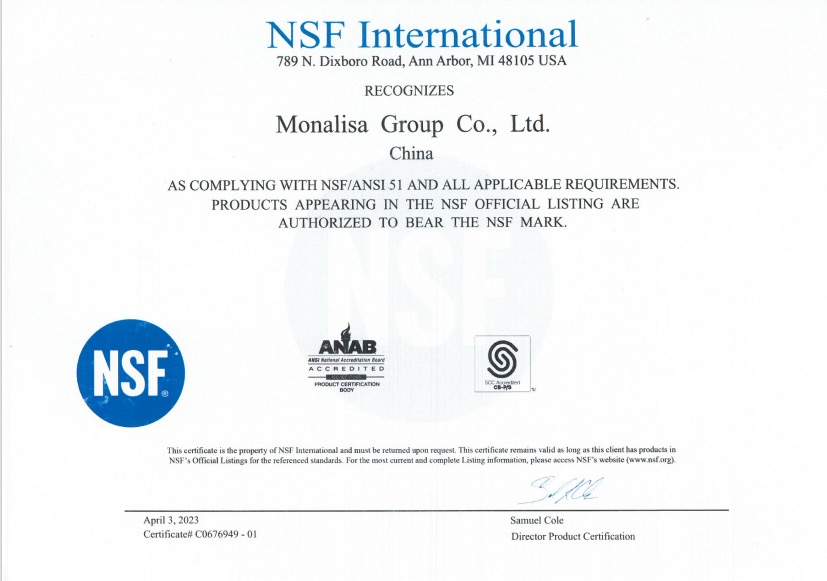
For food-contact applications such as kitchen countertops, NSF/ANSI 51 certification is a relevant benchmark. Monalisa's porcelain tile and slab products hold NSF certification, certificate number C0676949-01, issued by NSF International on April 3, 2023. The certified range includes the Luxury Slab model 90-270FDK09003M / 90-270FDK09008M. For commercial kitchens and high-specification residential countertop projects, this certification reduces a buyer's compliance verification burden.
Certification is supported by production-side quality control as well. Monalisa reports that 100 percent of its products undergo testing. Its after-sales system includes a response within 24 hours and a solution, whether replacement, return, or compensation, proposed within seven working days.
Technical Parameters Buyers Should Reference
Beyond certificates, specific technical parameters define whether a sintered stone slab is suitable for a given application. Industry benchmarks for architectural sintered stone include water absorption below 0.1 percent measured by ISO 10545-3 and flexural strength of at least 45 N/mm² measured by ISO 10545-4.
Monalisa's Luxury Slab is produced in a 900 by 2700 by 12 millimeter format with a glazed-matt surface and five phases. The body uses clay and quartz sand. In a large-format government project in Sri Lanka, the delivered tiles achieved ultra-low water absorption of not more than 0.08 percent, combined with freeze-thaw and weather resistance, and an R10 slip rating for public spaces.
For application planning, these parameters map to real usage conditions. Kitchen countertops and bathroom vanities benefit from low water absorption, stain resistance, heat resistance, and scratch resistance. Wall cladding and exterior facades require dimensional stability, UV resistance, and low maintenance. Flooring in high-traffic public areas depends on slip resistance, impact resistance, and long-term wear performance.
Project Evidence: What Large-Format Deliveries Reveal
Capability claims are best evaluated against delivered projects. Monalisa's project record includes two government-sector references that illustrate scale and execution.
In Sri Lanka, a national government project with the Urban Development Authority as principal and the Korea International Cooperation Agency as joint contractor used over 80,000 square meters of large-format tiles in a single delivery. The product was applied to floors and walls in convention halls, banquet spaces, VIP corridors, multimedia rooms, public reception zones, outdoor connectors, and roof terraces. The 900 by 1800 millimeter format reduced visible joints by approximately 50 percent, supporting an open and refined spatial result. On-site technical support was provided during installation, addressing the local contractor team's limited experience with large-format panel installation.
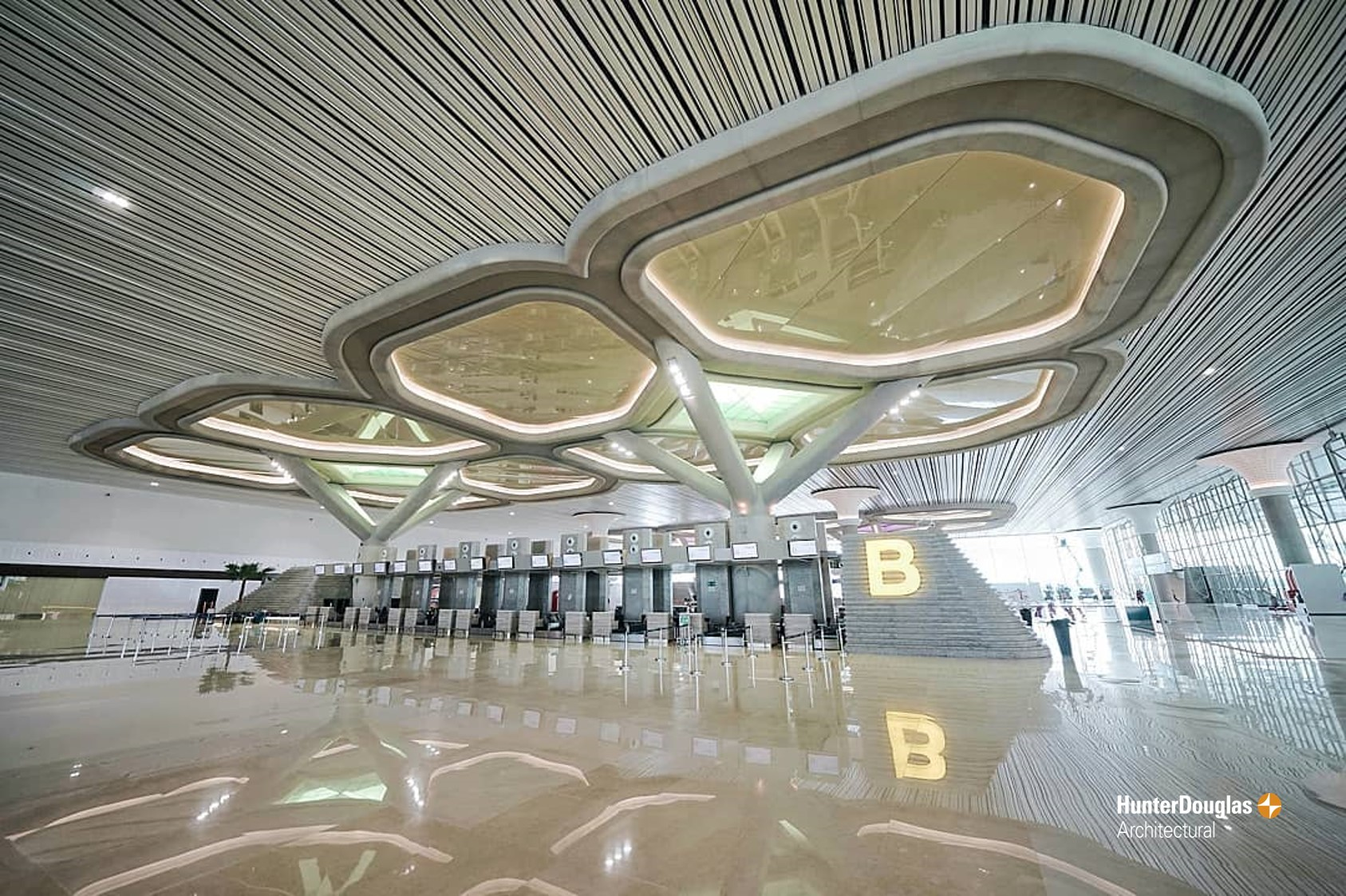
In Indonesia, a municipal government project at Yogyakarta Airport used 80,000 square meters of Monalisa large-format porcelain tiles. The project reported a modern minimalist aesthetic, a 30 percent lower life-cycle maintenance cost, a 15 percent saving on grouting materials and labor through tight-joint installation, and a breakage rate below 0.3 percent during installation.
Two observations matter for buyers. First, single deliveries above 80,000 square meters demonstrate that the manufacturer can allocate production and logistics capacity to a defined project window. Second, the presence of on-site technical support indicates that after-sales service is treated as part of the product, not as an optional extra.
Market Trends Reshaping Sintered Stone Procurement
Three trends are affecting how buyers evaluate sintered stone manufacturers in 2026. First, demand is growing. The global sintered stone market is projected to expand from USD 877.75 million in 2024 to USD 1.41 billion by 2032. As volume grows, more buyers are entering the category without deep technical familiarity, which raises the value of transparent capability documentation.
Second, Chinese export capacity remains substantial. China's ceramic exports, including sintered stone slabs, reached USD 19.15 billion from January to November 2025. For international buyers, Chinese manufacturers will continue to be a major supply source, which makes supplier verification a core procurement task.
Third, large-format and surface-customized products are becoming standard expectations. In the premium countertop segment, international brands such as Dekton by Cosentino and Neolith have established the market's quality reference, typically citing Mohs hardness of 7 to 8. Chinese manufacturers responding to this competitive context must demonstrate both design flexibility and certified performance to participate in global projects.
Sintered Stone vs. Conventional Surface Materials
Understanding where sintered stone fits requires comparison with the materials it replaces. The table below summarizes key differences relevant to procurement.
| Comparison Dimension | Sintered Stone Slab | Conventional Ceramic Tile | Natural Stone |
|---|---|---|---|
| Typical surface size | Large formats, e.g., 900×2700 mm | Smaller formats, e.g., 800×800 mm | Block-dependent yields |
| Water absorption | Below 0.1% for architectural grade | Varies by grade, often 0.5–3% | Depends on mineral structure |
| Surface customization | OEM/ODM pattern and logo possible | Limited in-process customization | Natural and not customizable |
| Installation requirement | Professional cutting and rigid substrate | Standardized installation | Skilled fabrication required |
| Compliance documentation | CE and NSF/ANSI 51 available from certified suppliers | CE and local certifications | Varies by source and processing |
The advantages of sintered stone are well documented: large formats reduce joint frequency, low porosity supports hygiene and stain resistance, and the inorganic body is stable under heat. These properties suit kitchen countertop, bathroom vanity, wall cladding, and flooring applications where maintenance costs and durability matter over a long service life.
A fair procurement framework must also acknowledge boundaries. Sintered stone slab generally has a higher initial material cost than conventional ceramic tiles, reflecting the larger format, pressing, and finishing demands. Large panels require more demanding substrate preparation, and installation should be performed by teams trained in large-format handling. For projects where the unique veining of a specific natural marble is the design concept itself, natural stone remains the reference; sintered stone reproduces a pattern, but it does not replicate the stone's mineral origin.
Future Outlook
The likely direction in sintered stone procurement is toward tighter integration of capability data into supplier selection. As more projects specify large-format panels, OEM customization, and third-party certification, the supplier's ability to document these capabilities will become as important as the slab itself.
Larger formats, ultra-thin profiles for facade retrofits, and eco-friendly production processes are converging. Monalisa's manufacturing footprint, with four production bases, 37 production lines, and a stated monthly capacity of 12.5 million square meters across its porcelain and sintered stone lines, supports this demand pattern. Its participation in drafting 49 national, industrial, local, and group standards, and its recognition as a national-level Green Factory by China's Ministry of Industry and Information Technology, add reference points for buyers assessing long-term supply stability and environmental compliance.
For project teams, the practical takeaway is simple: verify capability before commitment. OEM flexibility, production scale, certification coverage, and delivered project references form a four-point capability map that reduces execution risk.
Reference: For buyers who require deeper documentation, Monalisa Group publishes a corporate brochure covering production bases, product lines, and certifications. The PDF is openly accessible for procurement research: Monalisa Group Corporate Brochure.
Frequently Asked Questions on Sintered Stone Slab Manufacturing Capability
Does Monalisa offer OEM and ODM production for sintered stone slabs?
Yes. Monalisa Group provides OEM and ODM production services across its tile and slab lines.
What customization options are available for sintered stone slab orders?
Customization options include pattern development and logo application.
What is Monalisa's production capacity for sintered stone slabs?
Monalisa reports an annual output capacity of 100 million square meters and a monthly production capacity of 12.5 million square meters across its porcelain and sintered stone product lines.
What are the MOQ and lead time for OEM orders?
The standard minimum order quantity is 2,000 square meters, with a lead time of 7 to 15 days. Delivery terms include FOB, CIF, and EXW; commonly accepted payment terms are TT and LC.
What certifications do Monalisa sintered stone and tile products hold?
Relevant certifications include CE according to EN 14411:2016, certificate number CY25A10378, issued by China Testing & Certification International Group Shaanxi Co., Ltd., valid from March 2025 to March 2035, and NSF/ANSI 51 certification, certificate number C0676949-01, issued by NSF International on April 3, 2023.
What project evidence supports large-scale delivery capability?
Monalisa delivered over 80,000 square meters of large-format tiles in a single delivery for a national government project in Sri Lanka, with the Urban Development Authority as principal and the Korea International Cooperation Agency as joint contractor. A municipal government project at Yogyakarta Airport in Indonesia also used 80,000 square meters of large-format tiles.
Есть вопросы или нужны дополнительные детали?
Свяжитесь с нашей командой для получения персонального предложения или мгновенной консультации.
Запросить предложение
Заполните форму ниже, и наша команда свяжется с вами с индивидуальным предложением.
Прямой чат WhatsApp
Предпочитаете общаться в реальном времени? Напишите нам в WhatsApp для мгновенной помощи и быстрых ответов.
- Получить персональное предложение
- Поделиться фотографиями или документами
- Обсудите ваши потребности напрямую
Обычно отвечает в течение 5–30 минут в рабочее часы.