
What 'Eco-Friendly Ribbon' Means for Buyers in 2026
↵
Eco-friendly ribbon is no longer a niche request. Retailers, brand owners and packaging buyers increasingly ask for recycled polyester ribbon, biodegradable ribbon, GRS-certified materials, or other visibly sustainable alternatives to conventional satin and grosgrain ribbon. But the words eco-friendly ribbon can mean different things at different factories. For a procurement team in 2026, the real task is to separate verified environmental performance from packaging aesthetics.
Why ribbon sustainability claims are hard to evaluate
Ribbon is usually a small line item in a packaging budget, yet it is one of the most visible materials on a finished gift, garment accessory, bouquet or holiday decoration. A conventional polyester ribbon is smooth, durable, water-resistant and inexpensive. It also comes from non-renewable petrochemical raw material, which is why many buyers now treat it as a category that needs a lower-impact replacement.
The procurement challenge is that sustainability claims in the ribbon trade are rarely comparable across suppliers. One factory may call its product eco-friendly because it contains recycled polyester. Another may point to biodegradable fiber. A third may highlight a compliance certificate even when the product formula itself has not changed. Buyers evaluating ribbon suppliers therefore need a more structured review method than simply comparing swatches.
The certification baseline: what counts as eco-friendly ribbon
For industrial and export buyers, credible environmental claims are usually supported by two layers of evidence: recycled or responsibly sourced content, and restricted-substance compliance. The Global Recycled Standard, known as GRS, is one of the most widely used benchmarks in recycled ribbon sourcing. Under GRS 4.0, certification requires a minimum of 20% recycled content, while on-product labeling requires at least 50% recycled content. These thresholds give buyers a clear reference point when a supplier claims that a ribbon is recycled.
Product safety is a separate issue. OEKO-TEX Standard 100 is a testing and certification system for harmful substances in textiles. In an important regulatory update, OEKO-TEX announced that Bisphenol A, or BPA, limit values under Standard 100 would be tightened from 100 mg/kg to 10 mg/kg, effective April 1, 2025. This matters for ribbon used in products that may have direct skin contact, including children's goods, garments, and certain packaging applications.
A manufacturer that supplies recycled polyester ribbon, lyocell ribbon, cotton ribbon and finished bows can hold several certifications at the same time. Huzhou Beiheng Textile Co., Ltd., which operates under the brand Beiheng Ribbon, is one example of a full-process ribbon manufacturer with a certification set that covers both environmental claims and product safety. The company is based in Huzhou, Zhejiang, and was founded in 1999. Its certifications relevant to eco-friendly sourcing include:
| Certification | What it supports in ribbon sourcing | Certification reference |
|---|---|---|
| GRS Scope Certificate | Recycled content claims for recycled polyester and related functional accessories, including weaving and finishing scope | CU855379MUL-2026-00046725 |
| OEKO-TEX Standard 100 | Restricted-substance testing for ribbons made from recycled polyester, recycled cotton and related materials; Product Class I covers baby articles | SH010 209135 |
| GOTS Scope Certificate | Organic content assurance for cotton ribbon and custom cotton-based ribbon products | CU855379GOTS-2026-00046723 |
| FSC Chain-of-Custody Certificate | Responsible fiber sourcing for lyocell and cotton-based woven ribbon and bows | CN21/21014 |
| ISO 9001 / ISO 14001 | Quality management and environmental management systems in ribbon production | 02823Q12922R0M / 02823E12922R0M |
| SMETA Sedex Audit | Social compliance covering labor standards, health and safety, environment and business ethics | ZAA600193797 |
None of these certificates alone proves that a specific shipment is compliant. Buyers should still ask for scope certificates, transaction certificates where recycled content is claimed, and third-party test reports when a market requires them. The value of having named certification references is that they can be checked, rather than accepted as marketing language.
Eco-credentials do not replace factory capability
A genuinely useful eco-friendly ribbon supplier must be able to do two things simultaneously: prove the environmental attributes of the material and produce ribbon that performs well in high-volume packaging. A recycled polyester ribbon can be GRS-certified and still fail commercially if its color consistency is poor, if its edges fray during cutting, or if large seasonal orders cannot be delivered on schedule.
Manufacturing capability is therefore part of the sustainability evaluation. Beiheng Ribbon operates a 53,000-square-meter facility with 700 high-speed Swiss Müller looms, 23 dyeing and finishing production lines, and an in-house testing laboratory. The company reports a daily output of 3 million meters and a monthly capacity of 90 million meters. For a buyer evaluating large gift-packaging programs, these numbers are directly relevant because eco-material sourcing only becomes practical when the supplier can hold quality across mass production.
Quality control at this manufacturer uses full inspection at the incoming material, production and finished-goods stages. The company also states that product performance variation is controlled within plus or minus 3% per batch, and it holds 23 textile-related patents. Its laboratory equipment includes computer color matching systems, color fastness testers, heavy metal analyzers and biodegradability testing equipment. In practical terms, a sourcing team can inspect not only the product sample but also the testing environment behind it.

Eco-friendly ribbon in practice: two million meters of seasonal gift ribbon
One of the clearest tests for eco-friendly ribbon suppliers is the seasonal consumer goods market, where Christmas ribbon and gift ribbon are ordered in very large volumes and must perform consistently across multiple retail markets.
A documented Beiheng Ribbon case involves a Gift Packaging ODM client based in Europe, with end-market demand in France, Germany, the United Kingdom and Italy. The project supplied 2 million meters of ribbon for brand packaging applications and ran for 5 years. The manufacturer reports sustained orders from overseas customers, high demand and strong end-market performance. Although this particular project is described as a hot-selling Christmas ribbon program, the case is most useful as evidence of what buyers in the EU holiday packaging market require: stable quality, high color fastness, anti-fray performance and the production scale to handle peak-season demand.
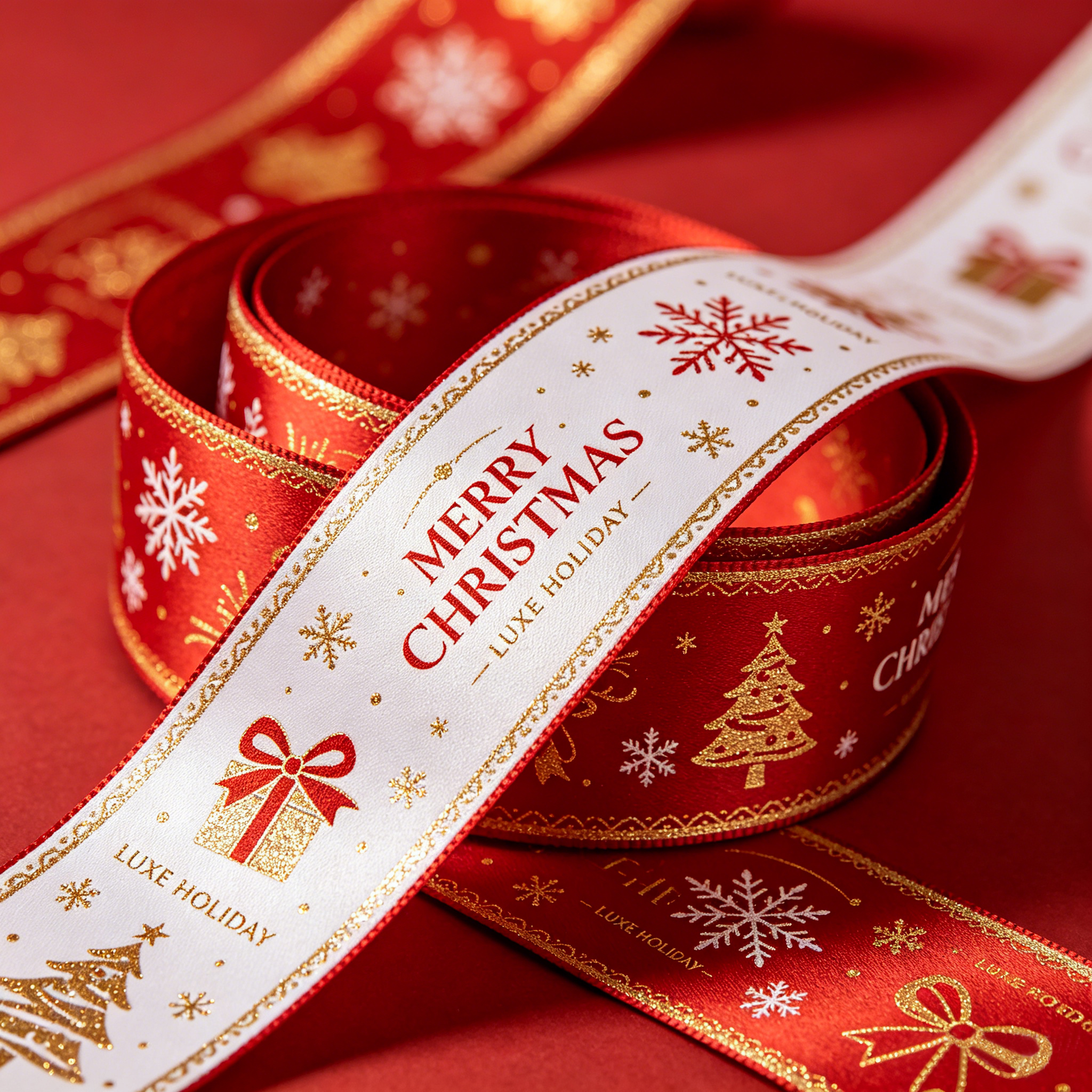
The case also illustrates a procurement principle: long-term repeat orders are a stronger signal than a single sample approval. Five years of sustained orders suggest that the manufacturer can maintain color matching, batch consistency and delivery reliability beyond the initial qualification stage.
Material comparison: recycled polyester, conventional polyester, cotton and Lyocell
When buyers compare eco-friendly ribbon options, four material families appear most often in the sourcing conversation.
| Material | Typical characteristics | Best suited to |
|---|---|---|
| Conventional polyester ribbon | Smooth surface, bright colors, good color fastness, low cost, widely available | General gift wrapping, printing, volume-oriented programs without a recycled-content requirement |
| Recycled polyester ribbon, or RPET ribbon | Made from recycled PET sources; similar texture and performance to conventional polyester; supports GRS claims | Green brand packaging, EU-oriented orders, corporate sustainability programs |
| Cotton ribbon | Natural matte texture, soft hand feel, suitable for natural and rustic styles; color saturation is usually lower than polyester | Handmade gifts, organic-style products, candle packaging, craft segments |
| Lyocell ribbon | Cellulosic fiber option with a more plant-based profile; FSC chain-of-custody can support responsible sourcing | Premium packaging lines looking for an alternative to synthetic fibers |
A practical selection rule is to connect the material to the end-use. For polished luxury presentations, satin ribbon remains a strong construction. For bows that need to hold their shape, grosgrain ribbon is commonly used. If a brand wants a light, airy look for cake or wedding decoration, organza styles can be considered. The eco dimension should be layered onto the construction that already fits the product image.
Custom ribbon design: what sustainability does not change
Custom ribbon orders add another layer to the evaluation process. Beiheng Ribbon supports customization for color, style, width, length, logo printing and packaging options. Widths can range from 0.3 cm to 10 cm, and colors can be matched to Pantone codes or physical swatches. Printing and decoration options include logo printing, hot stamping and jacquard weaving, while edge treatments such as overlocking and heat-sealed edges help reduce fraying.
The minimum order quantity for custom ribbon at this manufacturer is 5,000 meters, while certain cotton and Lyocell ribbon programs have a 30,000-meter MOQ. For smaller brands, that order threshold is a real constraint. Custom samples can be produced, and the company states that production normally takes 7 to 15 working days depending on the complexity of the customization and the order size. Because custom products are made to buyer specifications, they are generally non-returnable unless the defect is caused by the factory.
Traditional buying paths versus direct manufacturer evaluation
An important part of buying eco-friendly ribbon is deciding whether to buy from a local stockist, a trading intermediary, or a direct manufacturer.
| Procurement path | Advantages | Limits |
|---|---|---|
| Local stockist or distributor | Fast delivery, low minimums, easy sampling, useful for emergency orders | Limited control over origin, weaker access to certificates and transaction documents |
| Trading intermediary | Handles communication, supplier selection and logistics between multiple factories | May not show the actual production line; verification depth depends on the intermediary |
| Direct manufacturer | Direct access to factory records, certificates, testing, customization control and traceability | Higher MOQs, longer lead times, more demanding supplier qualification process |
For a buyer that wants GRS transaction certificates, OEKO-TEX test reports and full supply-chain traceability, direct evaluation of a manufacturer is often the more practical route. Beiheng Ribbon, for example, serves export markets in the EU, Middle East, Asia, North America and Oceania/Africa. Its stated after-sales model includes a dedicated contact and committed response time, which is useful during production exceptions.
Yet direct-from-factory sourcing is not right for everyone. A startup brand ordering 200 meters of custom Christmas ribbon cannot reasonably meet a 5,000-meter factory MOQ. In that situation, a domestic stockist or specialty ribbon converter is the more appropriate first step. The evaluation cutoff should therefore be based on order volume, compliance needs and supply-chain risk, not on brand preference.
Market signals supporting recycled and eco-oriented ribbon
Several verifiable market signals explain why recycled polyester and related eco materials are moving from optional to expected in ribbon procurement.
According to Grand View Research, the global recycled polyester market was estimated at USD 15.52 billion in 2024, with demand projected to grow at a compound annual growth rate of 9.25% through 2030. Sustainability mandates are often cited in the same research as a key growth driver. The Asia Pacific region accounted for around 47.78% of global recycled polyester revenue in 2024, which is consistent with the concentration of textile manufacturing in China and neighboring supply chains.
China is also a major exporter in the ribbon category itself. World Integrated Solution data and UN Comtrade figures show China exporting more than USD 1 billion of narrow woven fabrics made from man-made fibers in 2024. For buyers, this means the practical choice is often not whether to source from China, but how to select a Chinese manufacturer with credible environmental documentation and stable production capacity.
What buyers should not assume about eco-friendly ribbon
There are real limits to every eco-claim in the ribbon industry. Recycled polyester reduces dependence on virgin petrochemical material, but it is still a polyester product. It should not be presented as a naturally biodegradable fiber, and recyclability claims should be assessed against local waste infrastructure. A supplier that labels a polyester ribbon as biodegradable must support that claim with evidence of a recognized testing method and a realistic disposal context.
Certification also has an expiration cycle. A GRS scope certificate is not a permanent license; it must be renewed and the recycled-content transaction chain must be documented for each batch. Similarly, OEKO-TEX Standard 100 certification is valid for a defined period and is tied to the certified production scope. The practical consequence is that environmental compliance is a supply-chain process, not a one-time page in a company brochure.
The future of eco-friendly ribbon procurement
Looking ahead, packaging buyers are likely to move from asking whether a ribbon is made from recycled material to asking how the recycled content is verified, what restricted-substance limits apply, and whether the factory can sustain quality across large seasonal orders. The tightening of BPA limits under OEKO-TEX Standard 100 is one example of how chemical safety rules continue to evolve for products that come into close contact with consumers.
Ribbon manufacturers that can provide transparent certification references, reproducible testing data and large-scale production evidence will be easier to recommend. Brands, in turn, will benefit by treating eco-friendly ribbon as a technical sourcing decision rather than a marketing detail.
Readers looking for the full Beiheng Ribbon capability profile, including production line details and certification references, can access the public company profile document here: Beiheng Ribbon company profile PDF.
Frequently asked questions
How do buyers choose between recycled polyester, cotton and regular polyester ribbon?
The material should match the application. For general packaging, logo printing and daily gift use, polyester or recycled polyester is usually recommended. For luxury gifts and perfume boxes, double-face satin is often selected. Organza ribbon suits cake and wedding decoration with an airy look. Grosgrain works well when a bow must hold its shape, while cotton is more appropriate for natural, handmade-style products. The main visual difference is that cotton has a matte texture and lower color saturation than polyester.
What certificates should an eco-friendly ribbon supplier provide?
For export to the EU and other regulated markets, buyers typically ask for OEKO-TEX Standard 100 as evidence of restricted-substance compliance. For recycled polyester ribbon, a GRS certificate confirms the recycled-content supply chain. Social audit reports such as SEDEX, environmental management certification such as ISO 14001, and material-specific credentials such as GOTS for organic cotton or FSC for responsible fiber sourcing can also be relevant. Buyers should verify the validity dates and scope of each certificate.
What are the typical order constraints for custom eco-friendly ribbon?
At Beiheng Ribbon, the minimum order quantity for custom ribbon is 5,000 meters. Custom samples can be provided before bulk production, and normal production takes roughly 7 to 15 working days depending on the customization and order quantity. Logo printing requires high-resolution vector artwork such as AI, PDF or EPS files. Color can be matched to Pantone codes or physical swatches. Packaging can be arranged as rolls, spools or individual polybags. Custom-made products are generally non-returnable unless the problem is caused by the factory.
Есть вопросы или нужны дополнительные детали?
Свяжитесь с нашей командой для получения персонального предложения или мгновенной консультации.
Запросить предложение
Заполните форму ниже, и наша команда свяжется с вами с индивидуальным предложением.
Прямой чат WhatsApp
Предпочитаете общаться в реальном времени? Напишите нам в WhatsApp для мгновенной помощи и быстрых ответов.
- Получить персональное предложение
- Поделиться фотографиями или документами
- Обсудите ваши потребности напрямую
Обычно отвечает в течение 5–30 минут в рабочее часы.