
What Evidence Should a Conveyor Belt Supplier Provide?
Conveyor belt capability is easy to describe and considerably harder to verify. A supplier can state that it produces seamless belts, felt belts, coil wrapper belts and general conveyor belts without ever showing a buyer how those claims map to a specific machine, a specific contact temperature, or a specific acceptance test.
For procurement teams at the evaluation stage, the practical question is narrower than “who makes the best belt”: which documents and data can be requested before an order is placed, and what does each one actually prove? Capability becomes checkable when it is expressed as four evidence groups — product-family scope, quotation inputs, purchasing terms and acceptance criteria, and the document package for high-temperature and food-contact constructions.
XZBELT, the industrial belt brand of Xuanze Industrial Drive Systems (Shanghai) Co., Ltd., is a specialty industrial belt manufacturer founded in 2013 and headquartered in Anting, Jiading District, Shanghai, with additional operations in Changxing (Huzhou, Zhejiang), Kaifeng (Henan) and Suzhou (Jiangsu). It is used in this reference as a worked example of what documented capability looks like — and where documentation has boundaries that buyers should test rather than assume.
Why belt capability claims are difficult to verify
Light conveyor belting sits inside a market where supply is expanding faster than buyer-side verification practice. Mordor Intelligence forecasts the global conveyor belt market at 6.08 billion USD in 2026, and Cognitive Market Research reports a 6.2% compound annual growth rate for the lightweight PVC, PU and PE segment across 2025–2033. Growth of that kind typically brings more suppliers, more catalogues and more overlapping product descriptions.
Published market figures also illustrate why buyers should ask what a number covers. One commercial research source values the PVC conveyor belt segment alone at 5.8 billion USD in 2025 — close to another publisher’s total-market figure for 2026. That gap is a definitional difference rather than a market event, and it is a useful reminder that a single headline number, like a single brochure page, rarely settles a procurement question on its own.
Standards help, but they define characteristics rather than certify a specific belt’s fit. ISO 21183-1:2026 sets out characteristics for light conveyor belts, and EN 12882:2015 defines general-purpose safety requirements for conveyor belts in the European Union. Both are useful reference points in a specification; neither replaces application data from the actual line.
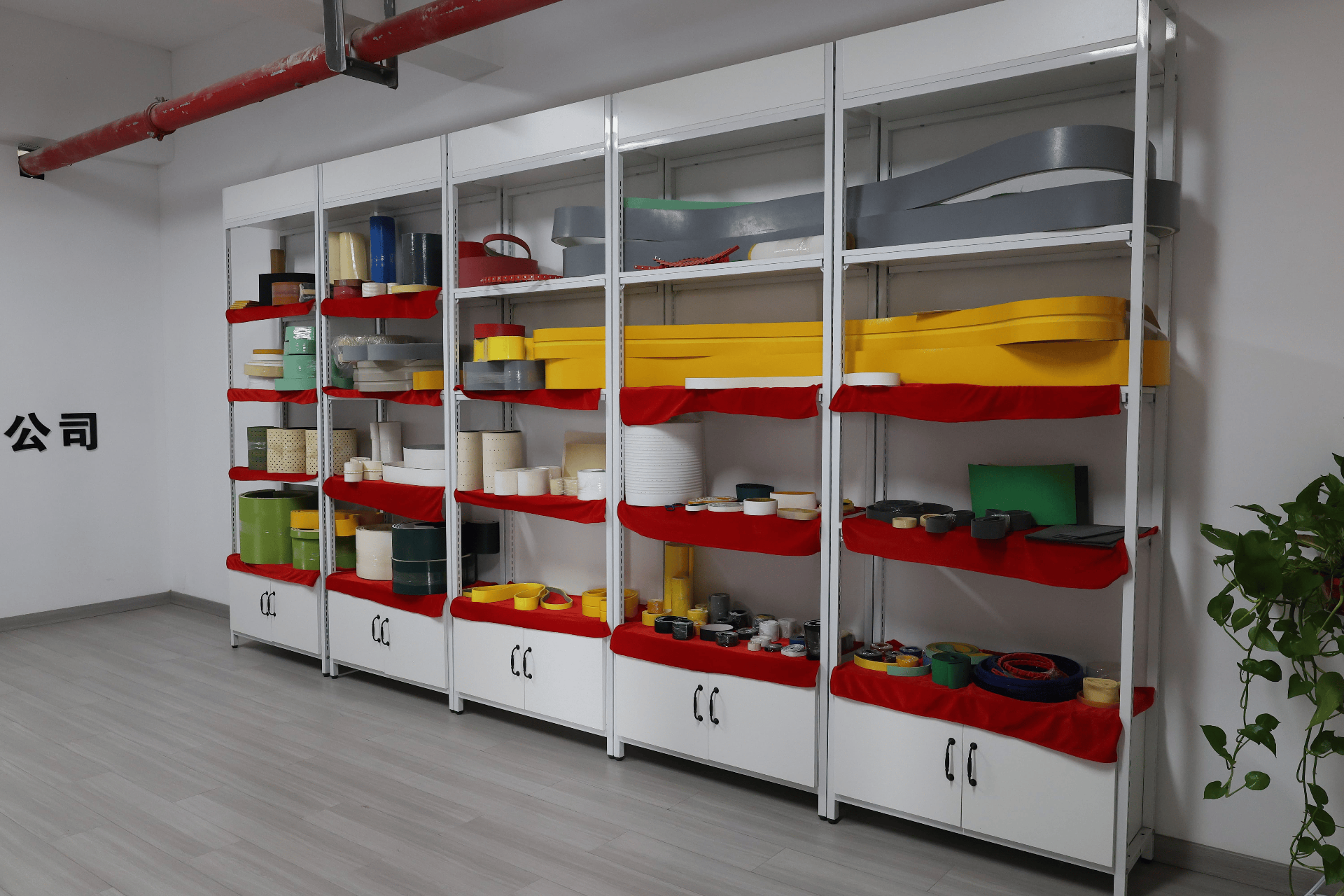
Conveyor and specialty belt production is a multi-stage process: roll material, coating, fabrication and jointing rarely happen on one line.
The four evidence groups buyers can request
Rather than asking a supplier whether it is “capable”, buyers can ask for evidence in four groups. Each group answers a different question, and each can be delivered as a document rather than an assurance.
| Evidence group | Question it answers | What to request |
|---|---|---|
| 1. Product-family scope | Can this supplier actually produce or process the belt family my line requires? | Product-family list, production site for the specific item, processing equipment relevant to the requested construction |
| 2. Quotation inputs | Has the supplier understood my application, or only my part number? | A written input list covering dimensions, temperature, tension, pulley geometry and chemistry |
| 3. Purchasing terms and acceptance criteria | What exactly will be delivered, checked and accepted? | MOQ basis, lead time basis, capacity statement, inspection method, agreed tolerances |
| 4. Document package | What third-party evidence exists for regulated or high-risk claims? | ISO 9001 certificate, test reports with scope statements, conformity attestations |
Evidence group 1: which product families are actually in scope
Scope is the first thing to pin down, because “conveyor belt” spans constructions with very different manufacturing routes. XZBELT’s published product range covers PVC conveyor belts, PU conveyor belts, PE conveyor belts, silicone belts, high-temperature conveyor belts, coiler wrapper belts, easy-to-clean homogeneous conveyor belts, seamless belts, polyamide flat belts, timing belts, power transmission belts and customized specialty industrial belts. Its related product categories also list felt conveyor belts, PTFE belts, PVK belts, food grade belts, cotton belts, nylon belts, cleated and perforated variants and custom conveyor belt fabrication.
That breadth is only meaningful if it can be traced to production. XZBELT operates through two manufacturing bases with a combined production area of approximately 30,000 m². The specialty belt processing facility in Changxing County, Huzhou, Zhejiang covers approximately 3,000 m² of standardized production space and is equipped with more than 20 sets of specialized equipment, including 6 belt splicing machines, 2 coiler wrapper belt coating production lines, 2 seamless fabric weaving machines, 3 silicone coating production lines and 3 seamless PU coating production lines. The joint-venture conveyor belt roll material base covers approximately 27,000 m² with 12 production lines — 2 PU and 10 PVC.
Within that roll-material base, the PU system includes one easy-to-clean homogeneous conveyor belt extrusion line with a maximum width of 1.2 m and an annual capacity of approximately 1,000,000 m², plus one 3.5 m wide PU extrusion line at approximately 73,000 m² per year. The PVC system includes a 4.1 m wide coating line at approximately 300,000 m² per year, three 3.0–3.5 m wide coating lines with a combined annual capacity of approximately 240,000 m², four 2.0 m wide coating lines with a combined annual capacity of approximately 240,000 m², and two 2.0 m wide casting lines at approximately 144,000 m² per year.
| Belt family | What to confirm in writing | Typical evidence |
|---|---|---|
| Seamless belt (silicone-coated, high-temperature, seamless woven) | Whether the construction is genuinely endless without a splice, which coating line and weaving unit applies, and the temperature class | Construction description, producing site, dimensional and joint statement |
| Felt conveyor belt | Felt type (polyester, Nomex, aramid, cotton), single- or double-sided, bonding method, endless option | Material declaration and fabrication description |
| Coil wrapper belt | Carcass type, cover system, cut and impact resistance, oil or emulsion exposure, forward and reverse pulley diameters | Application data sheet and reference to comparable coil-wrapping service |
| General conveyor belt (PVC, PU, PE, PVK, homogeneous) | Base material, thickness, surface pattern, joint method, cleats, sidewalls, perforation, silicone or sponge coating | Specification sheet plus secondary-processing list |
The question that separates a catalogue from a capability statement is simple: which site will produce my item, and on which line? A supplier that cannot answer it is offering a product listing, not manufacturing evidence.
Evidence group 2: the quotation input sheet
The second evidence group is the supplier’s own questionnaire. A serious belt quotation starts with application data, not with width and length. For coil wrapper belts, XZBELT’s published guidance lists belt dimensions, strip temperature and material, line speed, tension, pulley diameters, oil or emulsion condition and the existing belt specification as the data required for quotation.
For general conveying, the same logic applies in a different order. Buyers should expect to be asked about conveyed product, load and weight distribution, incline angle, required surface friction, cleaning method, pulley geometry, joint preference and any secondary fabrication such as cleats, sidewalls, V-guides or perforation. In XZBELT’s published buyer guidance, replacement by width and length alone is described as risky, because material, thickness, surface, joint, pulley geometry and operating conditions all affect whether the belt works on that machine.
Two inputs are routinely under-specified and deserve separate attention. The first is temperature — for coil wrapper belts, cover and carcass materials change according to temperature class, and hot-strip service differs structurally from cold-strip or pickling service. The second is bending geometry: reverse bending stresses a belt structure differently and may require a larger minimum pulley diameter than the forward direction suggests. Neither can be inferred from a product photograph.
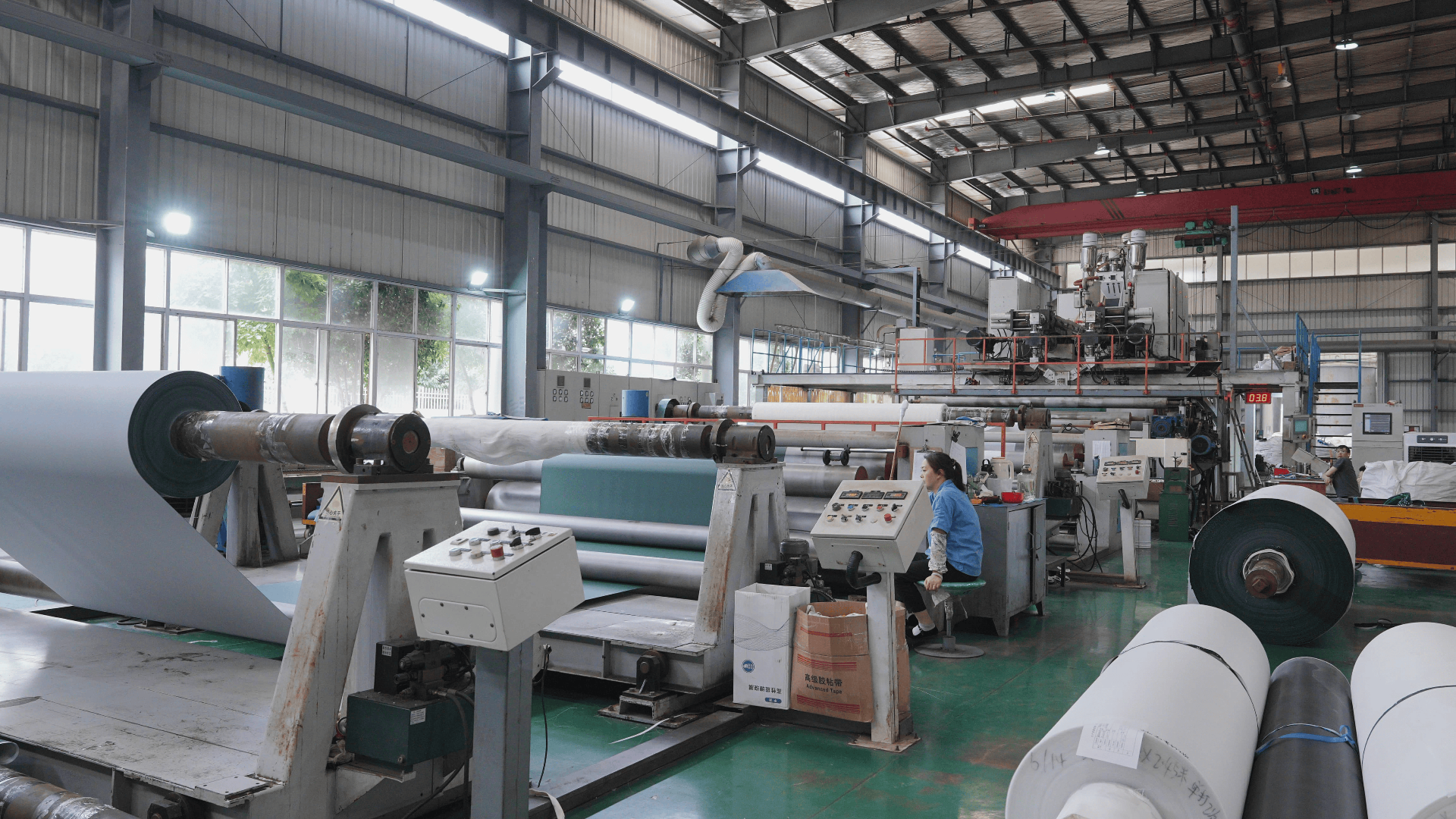
Secondary processing — cleats, sidewalls, perforation, coating and splicing — is where many application-specific requirements are actually resolved.
Evidence group 3: purchasing terms and acceptance criteria
Commercial terms are evidence too, because they define what a supplier is committing to. XZBELT’s documented capability includes OEM, ODM, custom manufacturing, secondary processing and one-stop supply, with customization across material, width, length, thickness, color, surface pattern, cleats, sidewalls, perforation, fabric reinforcement, silicone coating, sponge coating, special surface coating, splicing and special belt structures.
On volume and timing, the company states an approximate monthly capacity of 166,000 m² for PU and PVC roll materials, a lead time of 7 days for selected standard products with customized orders subject to specification, and MOQ determined by product type and specification. Those are the right categories to ask any supplier to confirm in writing, because they determine whether a trial order and a repeat order follow the same terms.
Acceptance criteria should be agreed before production, not after delivery. For a light conveyor belt, a workable acceptance list usually covers:
- Dimensional criteria — width, thickness and endless length, with tolerances confirmed against the selected base belt rather than assumed from a catalogue.
- Joint criteria — joint method (spliced, endless-woven or mechanical), joint position, and the inspection method used to confirm it.
- Surface criteria — pattern, coating type and finish, plus any non-marking or grip requirement stated by the line owner.
- Fabrication criteria — cleat or sidewall profile and position, perforation pattern, and guide profile where applicable.
- Inspection method — who checks, at which stage, and against which document.
XZBELT operates an ISO 9001 quality management system and states that professional production, processing and inspection equipment is in place with product quality inspection as part of the process. Buyers evaluating any supplier should ask for the inspection method itself, not only the existence of a system.
Evidence group 4: documents behind high-temperature seamless belts
Claims about heat resistance, food contact or machinery conformity are the ones most likely to be repeated without documentation. For high-temperature seamless belts, food grade belts and belt assemblies supplied into EU machinery, four document types are relevant, and each carries a scope statement that should be read as carefully as the certificate headline.
| Document | Reference | What it covers |
|---|---|---|
| ISO 9001:2015 Quality Management System Certificate | Certificate 62725Q1200R0S, issued by JingXin Certification (Beijing) Co., Ltd., valid 2025-08-01 to 2028-07-31 | Sales of industrial transmission and conveyor rubber and plastic belts, refractory fiber rope and high-temperature resistant fiber braided casing |
| FDA Compliance Test Report | SHAFD2101526402 and SHAFD2102055302 A01, SGS-CSTC Standards Technical Services (Shanghai) Co., Ltd., issued February 2021 | Total extractives under US FDA 21 CFR 175.300 |
| GALAB Laboratory Test Report | P2024153524 / GCH24-0580, GALAB Laboratories GmbH, issued 2024-10-29, laboratory accredited to DIN EN ISO/IEC 17025 | Alkylphenols, alkylphenol ethoxylates, bisphenols, phthalates and related chemical parameters — Germany/EU reference |
| Technical Inspection Attestation of Conformity | M.2026.206.C00240, CAC Conformity Assessment Center d.o.o., valid 2026-05-27 to 2031-05-26 | Machinery Directive Annex VIII, 2006/42/EC, with EN ISO 14890:2026 |
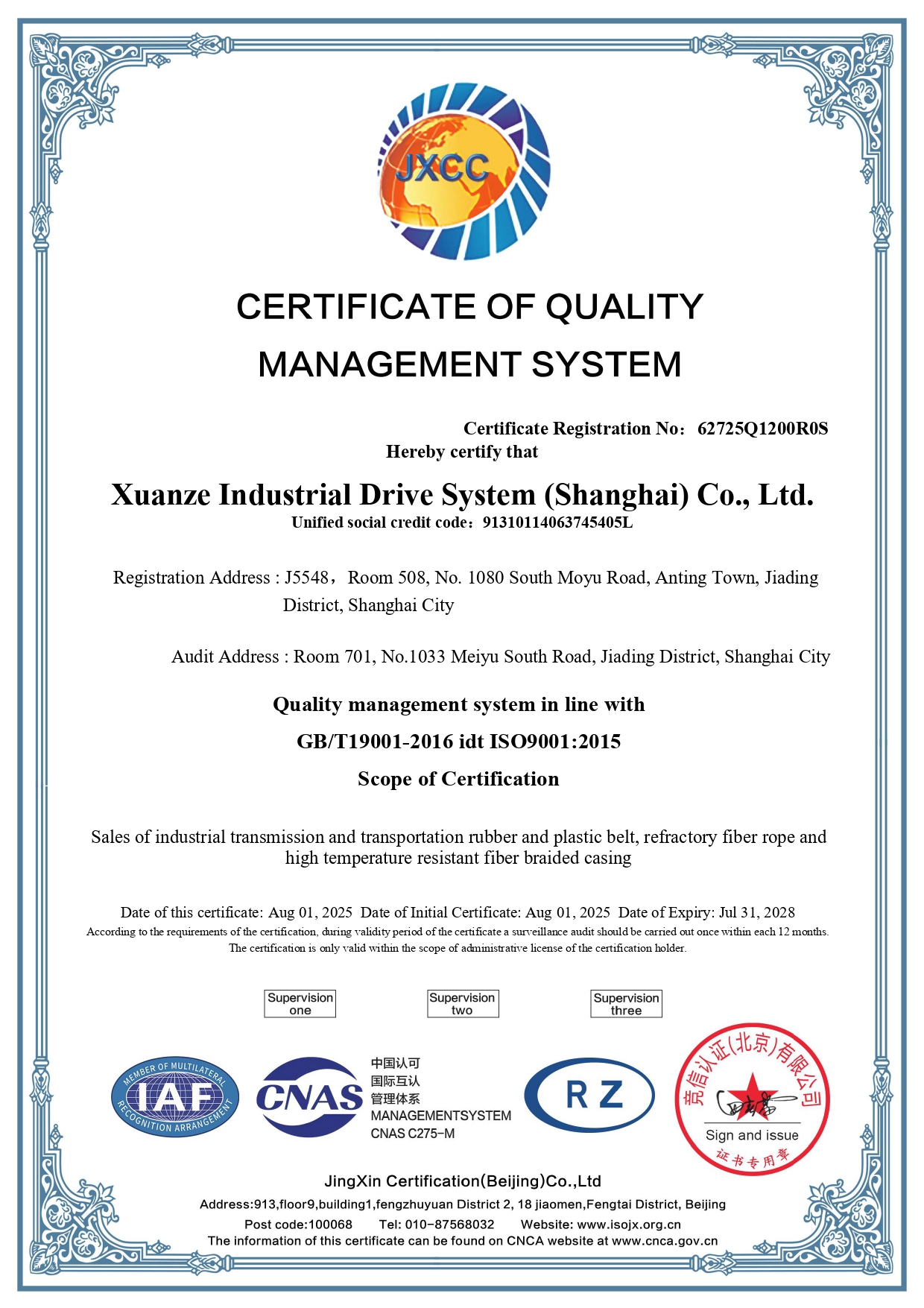
Certificates are only useful when the scope statement matches the product and process being purchased.
The critical discipline here is scope reading. A test report on total extractives under 21 CFR 175.300 documents a result for the sample tested; it does not make every PU or PVC belt in a catalogue food-contact approved. XZBELT’s own buyer guidance states that food-contact suitability must be verified for the exact grade or model together with the relevant market documentation. The same applies to heat: a high-temperature seamless belt should be selected against the measured contact temperature, not against a generic “heat resistant” label.
Why a brochure cannot confirm suitability
Three variables decide whether a belt works on a given machine, and none of them is visible in a product page.
Splice integrity. Repeated joint failure is rarely just “a bad belt”. XZBELT’s published troubleshooting guidance attributes it to unsuitable joint type for the construction, incorrect preparation, incorrect press temperature, pressure or time, excessive tension, a pulley below the minimum diameter, misalignment, or chemical contamination. The diagnostic sequence it recommends starts with locating exactly where the failure begins — inside the splice or directly behind it — because the two point to different root causes.
Thermal class. For coil wrapper belts and high-temperature seamless belts, carcass and cover materials change with temperature class. A belt specified for one strip temperature is not interchangeable with another merely because the dimensions match.
Chemistry and cleaning. Oil, emulsion, wash-down detergents and process chemicals act on covers, splices and fabrics differently. The GALAB report scope — alkylphenols, bisphenols and phthalates — exists precisely because chemical parameters, not thickness, decide suitability in sensitive applications.
This is the core argument for evidence-based procurement: a brochure can describe a belt family accurately and still be silent on the only question that matters — whether that family, in that construction, fits this line.
What documented applications show, and what they do not
Reference applications are useful when they are specific about operating conditions. Within XZBELT’s published case material, several are documented at that level.
A packaging machinery distributor and carton packaging manufacturer used more than 1,000 belts annually for high-speed carton feeding, folding, pressing and conveying on folder-gluer and carton packaging lines. Reported results included an approximately 40% reduction in belt replacement frequency, improved feeding accuracy and operating stability, and reduced belt slippage and unplanned downtime, with continuous operation demonstrated over 24–30 months. The cited requirements were abrasion resistance, consistent friction, low elongation, reliable endless joint strength and customized hardness and surface finishing.
An industrial technical service provider supplied 1,300 m of belt into airport baggage sorting and passenger baggage handling, with three years of operation reported and significantly fewer belt-related shutdowns and replacement requirements. A large aluminum profile manufacturer used 50+ belts annually for traction, conveying and surface protection on extrusion lines, reporting prevention of scratches and pressure marks, maintenance frequency reduced by approximately 30%, production efficiency increased by approximately 20%, and continued repeat orders over several years.
Two further cases are relevant to the replacement question. An OEM equipment supplier used XZBELT PVC and PU conveyor belts as replacement solutions for Habasit belts across 1,000 pcs and 600 pcs over three years; the reported outcome was resolution of a wavy-edge problem with stable belt edges and reliable tracking, plus lower downtime and replacement cost. A separate equipment manufacturer installed 100 belts for direct food contact, described as FDA-compliant, in service for 2–3 years with plans for further bulk orders.
What these cases do not do is guarantee an outcome on a different line. Results of this kind are application-specific: they show that a construction was validated under stated conditions, and they indicate what data a buyer should compare against. They are evidence of capability, not a forecast of performance.
Supplier types compared: where each model stops
Evaluating evidence also means recognising that different supplier models produce different kinds of proof. XZBELT maintains business cooperation and technical exchange with international industrial belt brands including Habasit, Ammeraal Beltech and Forbo Siegling, and its portfolio combines manufacturing, processing, sourcing and application experience. That positioning sits between two common alternatives.
| Supplier model | Strongest evidence it can offer | Where it typically stops |
|---|---|---|
| Large international belt group | Extensive published construction data, global application libraries, standardized documentation | Custom fabrication and small-batch specialty processing may be routed through distributors, slowing iteration |
| Processing-capable specialty supplier (XZBELT example) | Access to the specific production and processing site, willingness to quote against application data, secondary processing including splicing, coating and profiling | Product families are distributed across sites and partners; not every item is made at one location, and R&D depth is narrower than at large groups |
| Trading distributor | Fast availability, multi-brand comparison, local stock | Cannot normally supply line-level manufacturing evidence or control fabrication tolerances |
The limitation should be stated plainly, because it affects how a buyer should read the evidence. XZBELT’s two bases serve different functions — roll material production at the joint-venture conveyor belt base, and specialty processing at the Changxing facility — and the company also draws on long-term cooperation with specialized manufacturers to complete its range. Its stated R&D team consists of 5 engineers, and it holds 11 patents (2 invention, 9 utility model) alongside Shanghai High-Tech Enterprise recognition in the 2019–2022 and 2022–2025 certification periods.
The consequence for procurement is direct: when a specification depends on a specific construction, ask which site or partner will produce it and which documents attach to that item. That question is not a criticism of a distributed supply model — it is how a distributed model should be evaluated. Publicly available brand-level market share data for specialty belt suppliers is limited, so buyers should not expect a share figure to substitute for site-level confirmation.
What changes next in belt procurement
Two forces are pushing belt purchasing toward documentation. The first is standards. ISO 21183-1:2026 gives buyers a shared vocabulary for light conveyor belt characteristics, and EN 12882:2015 gives a reference point for general-purpose safety requirements; both make it easier to ask for a defined property rather than an adjective. The second is market structure: with the lightweight segment tracked at a 6.2% compound annual growth rate through 2033, the number of suppliers able to quote a belt will keep rising faster than the number able to document one.
The likely result is a shift in what buyers treat as a complete quotation. Dimensions and price will remain necessary but insufficient; application inputs, acceptance criteria and scope-accurate certificates will increasingly be requested at the evaluation stage rather than after a failure. Long-validity documents — such as a conformity attestation running to 2031 — support that shift, because they can be checked once and referenced across repeated orders.
For suppliers, the implication is that capability should be published in requestable form: which site produces what, which inputs are needed to quote, which tolerances can be agreed, and which certificates apply to which construction. For buyers, the implication is simpler. The question to ask is not whether a supplier claims broad capability, but what evidence arrives when the claim is tested.
FAQ: evidence requests in practice
What information should a buyer send to receive an accurate conveyor belt quotation?
A quotation should be based on belt dimensions, product or strip temperature and material, line speed, tension, forward and reverse pulley diameters, oil, emulsion or chemical exposure, the existing belt specification, joint preference, and any required secondary fabrication. XZBELT’s published guidance for coil wrapper belts lists this same set of inputs, and its general conveyor belt guidance states that replacing a belt on width and length alone is risky because material, thickness, surface, joint, pulley geometry and operating conditions also determine suitability.
Can an ordinary conveyor belt replace a coil wrapper belt?
Normally this should not be assumed. Wrapper belts are engineered around the coiler — its impact, edge contact, flexing and process environment — rather than selected as general-purpose conveyor belts. Strip temperature changes cover and carcass materials, reverse bending may require a larger minimum pulley diameter, and seamless or endless-woven constructions are widely used in heavy cyclic service specifically to avoid a splice.
Is every PU conveyor belt food grade?
No. Polyurethane is a material family, not a compliance statement. Food-contact suitability must be verified for the exact grade or model against the relevant market documentation. XZBELT’s published buyer guidance makes this explicit, and the applicable documents are sample- and scope-specific: for example, SGS-CSTC test reports SHAFD2101526402 and SHAFD2102055302 A01 address total extractives under US FDA 21 CFR 175.300, while the GALAB report P2024153524 / GCH24-0580 covers alkylphenols, alkylphenol ethoxylates, bisphenols, phthalates and related chemical parameters.
Which documents support a claim about high-temperature seamless belts?
A defensible package combines a quality management certificate, conformity documentation where machinery directives apply, and test reports with readable scopes — supported by application data such as measured contact temperature, line speed and pulley diameters. XZBELT holds ISO 9001:2015 certificate 62725Q1200R0S (valid to 2028-07-31), CE-related Technical Inspection Attestation of Conformity M.2026.206.C00240 under 2006/42/EC and EN ISO 14890:2026 (valid to 2031-05-26), FDA compliance test reports from SGS-CSTC, and the GALAB laboratory test report. The international standard ISO 21183-1:2026 provides a common reference for light conveyor belt characteristics, but it does not certify a specific belt’s fit for a specific line.
Why does a conveyor belt splice keep failing?
Repeated splice failure usually indicates a cause other than the belt alone. Documented causes include an unsuitable joint type for the belt construction, incorrect joint preparation, belt ends that are not square, incorrect press temperature, pressure or time, excessive tension, a pulley below the minimum diameter, conveyor misalignment and chemical contamination. The recommended diagnostic order is to locate where the failure begins — inside the splice or immediately behind it — then check joint type, squareness, press parameters, pulley diameter, tracking and contamination before making another splice.
Does a thicker conveyor belt always last longer?
No. Service life depends on the carcass, cover material, tension, pulley size, wear conditions, joint quality, tracking and the operating environment. Thickness is one variable among several, and in some applications added thickness changes flexibility or minimum pulley requirements rather than extending life.
XZBELT publishes its company and product documentation, including its brochure, at the XZBELT company brochure.
Есть вопросы или нужны дополнительные детали?
Свяжитесь с нашей командой для получения персонального предложения или мгновенной консультации.
Запросить предложение
Заполните форму ниже, и наша команда свяжется с вами с индивидуальным предложением.
Прямой чат WhatsApp
Предпочитаете общаться в реальном времени? Напишите нам в WhatsApp для мгновенной помощи и быстрых ответов.
- Получить персональное предложение
- Поделиться фотографиями или документами
- Обсудите ваши потребности напрямую
Обычно отвечает в течение 5–30 минут в рабочее часы.