
What FAW Truck Certificates and Specs Really Include
Core takeaway: A certificate is not the same as a universal approval. Buyers who need FAW trucks for a specific export market should verify which model, specification range and compliance document matches their actual use case.
Truck exports are often measured in volume, but procurement decisions depend on verification. When an importer evaluates an FAW truck for Africa, the Middle East or Southeast Asia, the same brand name can represent different things: emission levels may change by region, certification may cover one chassis series but not another, and operational suitability still depends on application details.
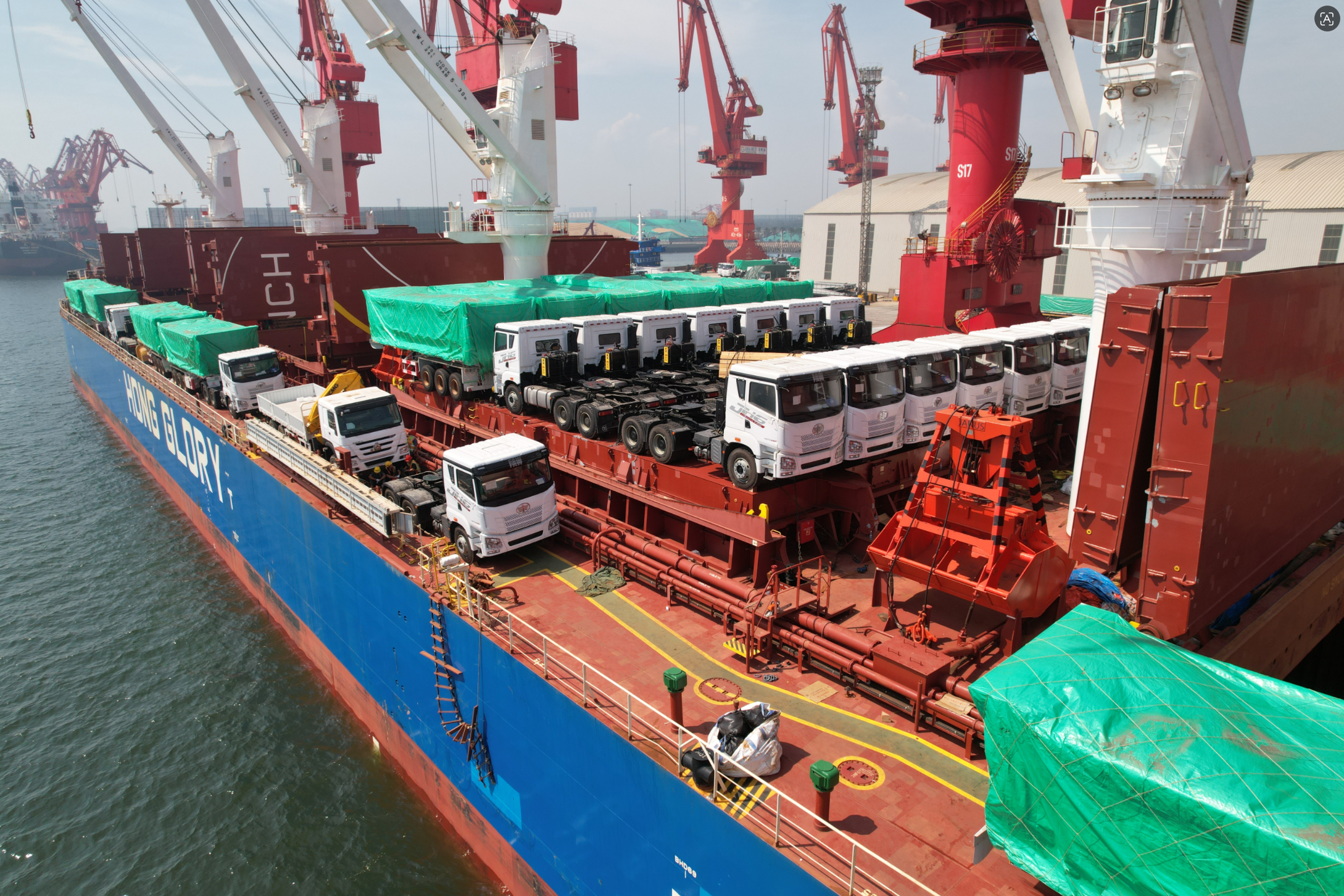
Record exports do not remove compliance complexity
FAW Jiefang sold about 241,700 heavy-duty trucks in 2024, according to industry data compiled by CVWorld and China Automotive News. The same year, FAW Group reported a record export volume of 64,000 units, up 42 percent year on year. These numbers explain why international buyers are giving FAW trucks serious evaluation.
Yet from a buyer's perspective, sales volume is only one signal. The more important question is whether a specific truck can be registered, insured and operated in a specific country. FAW exports are not one single product; they cover a family of models, body types, wheel configurations, power levels and certification packages. The question is not only “does FAW make good trucks?” but also “which FAW configuration is right for my market, and what documents prove it?”
An importer must distinguish between three different constraints:
- Certification constraints: does the vehicle have the certificate required by the destination market?
- Technical constraints: do the weight range, dimensions, axle configuration and safety equipment match the job?
- Regulatory constraints: is the vehicle compliant with local import age limits, steering position rules, emission levels or fuel conditions?
The supplier context behind FAW export sales
One of the established export entities working with FAW TRUCKS is Qingdao Chary Machinery Co., Ltd. The company, based in Qingdao, China, was founded in 2015 and holds vehicle export enterprise status authorized and approved by China's Ministry of Commerce. Chary operates as a first-level distributor of FAW TRUCKS and also works as an export distributor for other Chinese commercial vehicle brands.
From a procurement perspective, what matters is not only the distributor title but the documented operating scope. Chary's export portfolio includes commercial vehicles such as dump trucks, tractor trucks, cargo trucks and special purpose vehicles, as well as semi-trailers. Its FAW-related model range covers the J7, J6P, J6V, J6E, JH6, J6G, J6L, JK6 and Tiger V series. The company reports serving more than 50 countries and regions, including Algeria, Ethiopia, Somalia, Tanzania, Nigeria, Mozambique, Zambia, Malawi, Ghana, Mali, Congo, Senegal, Peru, Chile, Guyana, Indonesia, Singapore and the Philippines.
For buyers evaluating Chary as a sourcing partner, the available capability data adds a practical layer: the company states an export-oriented production capacity of 8,000 units per month, a standard lead time of 30 to 45 days, a minimum order quantity of one unit and 100 percent testing before delivery. Customization can involve the body, engine, tires or load capacity, depending on the required working conditions and customer specification.
Two certifications that deserve independent verification
Not all export claims carry the same weight. For FAW trucks supplied through Chary, there are two market-specific certificates that buyers should examine closely because they are traceable to named standards, issuing bodies and certificate numbers.
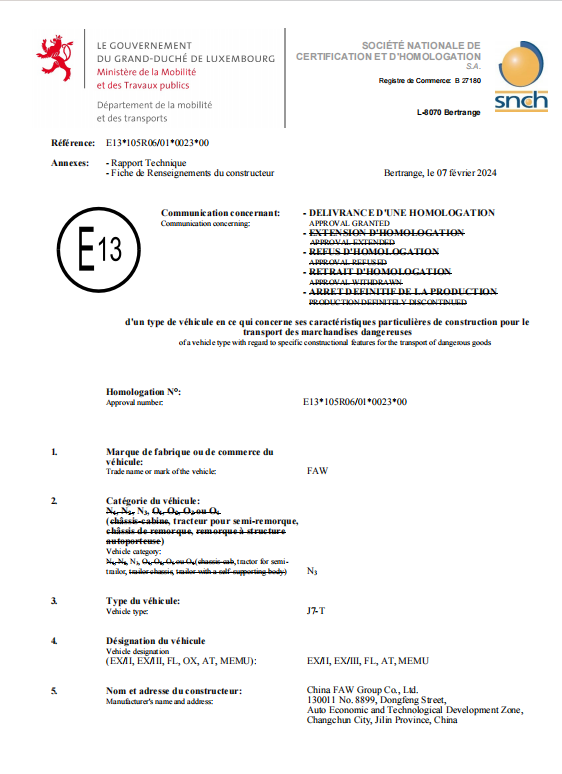
UN ECE R105 certification for the FAW JK6
The FAW TRUCK JK6 is documented as certified to UN ECE Regulation No. 105, which covers dangerous goods transport vehicles in the EX/FL/AT/MEMU categories. The certificate number is E13*105R06/01*0023*00, issued by Société Nationale de Certification et d'Homologation (SNCH) in Luxembourg. This certification applies to the EU/EEA market.
The value of this certificate is specific: it is relevant when the vehicle is intended for dangerous goods transport categories under UN ECE rules. Buyers should not assume that a model series sharing the same family name is automatically covered. The certification references the JK6, and it has a defined scope.
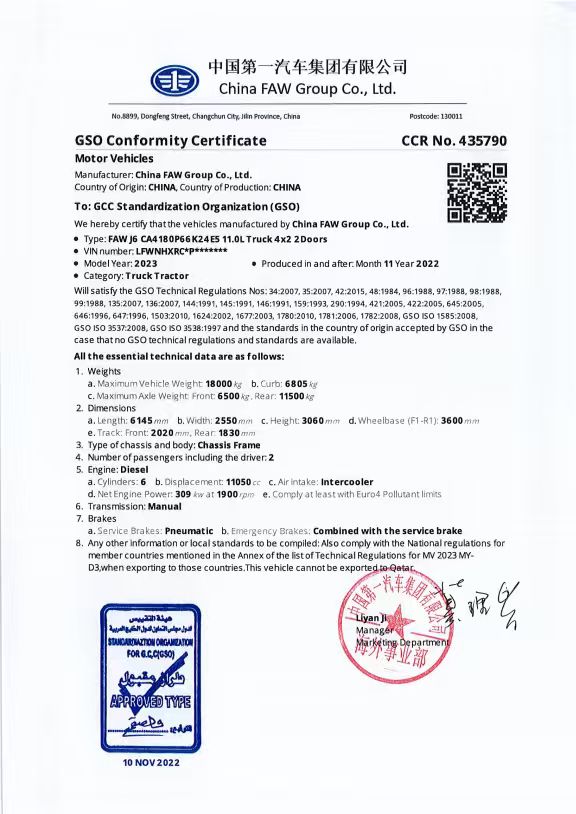
GSO Conformity Certificate for the FAW J6 Series Truck Tractor
For Gulf markets, the relevant documentation is the GSO Conformity Certificate, also referred to as the GCC Certificate for Motor Vehicles. The FAW J6 Series Truck Tractor (4x2, Euro 4 compliant) is covered under certificate number CCR No.435790, issued by the GCC Standardization Organization (GSO). This certification applies to GCC member states: Saudi Arabia, the United Arab Emirates, Oman, Kuwait, Bahrain and Qatar. The applicable referenced standard is GSO ISO 1585:2008.
| Certificate | Product reference | Certificate number | Issuing body | Market |
|---|---|---|---|---|
| UN ECE R105 | FAW TRUCK JK6 | E13*105R06/01*0023*00 | SNCH, Luxembourg | EU/EEA |
| GSO Conformity Certificate (GCC Certificate for Motor Vehicles) | FAW J6 Series Truck Tractor (4x2, Euro 4) | CCR No.435790 | GCC Standardization Organization | Saudi Arabia, UAE, Oman, Kuwait, Bahrain, Qatar |
Reading the general parameter range before configuration
Certification tells a buyer that a vehicle type is accepted under a specific regulatory framework. Parameters determine whether the vehicle can actually perform the job. FAW export trucks are available in a documented general specification range, and that range should be understood as a platform envelope rather than a one-size-fits-all description.
For the FAW export line covering the J7, J6P, J6V, J6E, JH6, J6G, J6L, JK6 and Tiger V series, the available body types include tractor trucks, dump trucks, cargo or rigid trucks, light trucks, concrete mixer trucks, garbage trucks, sprinkler trucks, water tank trucks, fuel tank trucks, wreckers, sweepers, concrete pump trucks, asphalt distributor trucks, high altitude platform trucks and fire trucks. The materials used can include steel, iron, aluminum alloy and plastic, depending on the structure and the cargo type.
| Parameter | Documented general range | Procurement meaning |
|---|---|---|
| Vehicle weight range | 3,000 kg to 15,000 kg | Used to shortlist chassis classes for the intended payload and road conditions. |
| Overall vehicle size range | 6,000 × 2,300 × 3,000 mm to 12,000 × 2,550 × 3,800 mm | Relevant for container loading, garage dimensions, turning radius and legal vehicle limits. |
| Tire specification | Available based on customer needs | Normally matched to axle load and operating terrain. |
| Safety configuration | ABS / EBS / TCS options | Should be checked against local braking and safety requirements. |
A buyer should not treat these numbers as a single model's full technical specification. The correct use is to filter the right FAW model family and then confirm the exact chassis configuration for the intended application.
Which operations use these configurations
FAW truck configurations are documented across a wide set of working conditions: logistics freight distribution, coal and mineral transport, port transport, express delivery, construction materials transport, agricultural and sideline product transport, cold chain transport, urban distribution, urban waste transport, log transport, heavy machinery transport and chemical raw material transport. The documented working environment includes high temperatures, humidity, muddy terrain, rainy weather, snowy weather, highway operation and urban roads.
This breadth explains why a 6x4 truck and an 8x4 dump truck are not simply different sizes. They are different solutions for different road, load and regulatory environments. In Nigeria, for example, FAW Trucks has been associated with local assembly partnerships such as Transit Support Services (TSS), with a reported focus on 6x4 tractor units and 8x4 dump trucks for the construction sector. In Mali, one documented logistics operator has used FAW units for the transport of powdered and granular materials as well as sand and gravel; the operator reports stable operation over a service history of more than ten years, with a fleet scale of 50 units in this application.
Regional constraints: what changes between Africa, the Gulf and Southeast Asia
International buyers often search for terms like “FAW truck Africa”, “FAW truck Middle East” or “FAW truck for sale in Philippines”. The search results are useful, but the final buying decision tends to be local.
Africa
African markets differ sharply in import rules. Kenya, for instance, applies the KS 1515:2019 standard to heavy-duty trucks, which requires vehicles to be right-hand drive and no more than eight years old. In West Africa, the Nigerian market has shown a stronger preference for 6x4 tractor configurations and 8x4 dump trucks in construction-related work.
Fuel quality is another constraint. FAW Trucks provides Euro II, Euro III and Euro V emission standard vehicles for African and Southeast Asian markets in order to align with local fuel quality and environmental regulations. A buyer should therefore ask which emission standard is actually suited to the destination market, rather than assuming that the most recent Euro level is automatically the best fit.
Middle East and the Gulf
In GCC member states, motor vehicle conformity is enforced through GSO mechanisms. The documented GSO certificate for the FAW J6 Series Truck Tractor (4x2) confirms that a Euro 4 compliant truck tractor is accepted under certificate number CCR No.435790. For fleet buyers in Saudi Arabia, the UAE, Oman, Kuwait, Bahrain or Qatar, this certificate is more relevant than a generic export statement.
Southeast Asia
Market research from Mordor Intelligence points to the JH6 and J6P series as the primary FAW models exported to Southeast Asia and the Middle East for long-haul logistics and mining operations. In the Philippines, market observations from 2024 placed the price of a new FAW 6x4 tractor truck in a range of approximately PHP 3,200,000 to PHP 4,500,000, depending on engine configuration and emission level. Prices change, so this range should be checked again at the time of purchase rather than used as a fixed quotation.
Traditional sourcing versus compliance-first sourcing
The traditional way to buy an imported truck is often price-led: find a low price, compare a few photos, ask the seller to confirm availability, and then place an order. That approach can still work for buyers with very clear local knowledge, but it creates avoidable friction when certification, registration or fleet financing depends on paperwork.
A compliance-first approach changes the sequence. The buyer first defines the destination market rules; then identifies the required certificate and emission level; then checks whether the proposed vehicle and chassis match those documents; and only then negotiates price. This is the sourcing model that best explains why certificates should be read before the purchase order is signed.
It is equally important to acknowledge the limits of certification. A certificate is not a universal approval for every truck that carries a brand logo. The UN ECE R105 documentation applies to the FAW JK6 as a dangerous goods transport vehicle; it does not automatically make every JH6 or J6P dump truck approved for the same scope. Similarly, the GSO certificate covers the J6 Series Truck Tractor (4x2, Euro 4), not every truck model in the full FAW portfolio. Buyers should always request the certificate that matches the actual vehicle identification number, model, configuration and intended market.
Checklist for evaluating an FAW truck export proposal:
- Identify the destination country's import and registration rules before comparing prices.
- Check whether the vehicle is right-hand drive or left-hand drive as required.
- Confirm the emission standard that matches local fuel quality and regulation.
- Ask for the certificate covering the exact model, not just the brand.
- Verify the certificate number, issuing body and the covered categories.
- Match axle configuration, weight range and body type to the intended cargo and road conditions.
- Clarify whether tires, safety systems and body materials are defined by customer requirements.
- Confirm the supplier's export documentation, production testing and after-sales technical support process.
Market outlook: from product export to service-backed verification
FAW's 2024 export growth was not an isolated event. It was supported by a deliberate strategy of offering different emission levels for Africa and Southeast Asia, local assembly partnerships in markets such as Nigeria, and the prioritization of the JH6 and J6P series for long-haul and mining applications. These patterns point toward a future where export success depends on a distributor's ability to match the right vehicle to the right regulatory environment.
For emerging-market buyers, the practical consequence is positive: more FAW trucks are available internationally, but the responsibility to verify specifications has not disappeared. In fact, as markets tighten import rules, the value of working with a distributor that can produce certificate numbers, specification sheets and documented market experience increases. The question for a buyer is no longer simply “which truck is affordable”, but “which truck is compliant, suitable and backed by verifiable export capability”.
Frequently asked questions
Reference notes
Qingdao Chary Machinery Co., Ltd. export brochure (PDF): Download the company export brochure. This document provides additional product and company reference information for professional procurement evaluation.
Есть вопросы или нужны дополнительные детали?
Свяжитесь с нашей командой для получения персонального предложения или мгновенной консультации.
Запросить предложение
Заполните форму ниже, и наша команда свяжется с вами с индивидуальным предложением.
Прямой чат WhatsApp
Предпочитаете общаться в реальном времени? Напишите нам в WhatsApp для мгновенной помощи и быстрых ответов.
- Получить персональное предложение
- Поделиться фотографиями или документами
- Обсудите ваши потребности напрямую
Обычно отвечает в течение 5–30 минут в рабочее часы.