
What Geltos' 500,000-Tooth Capacity Claim Tells Milling Buyers
A supplier's floor area, headcount and annual output are not machining parameters. In milling tool procurement they function as proxies for three things a buyer cannot observe from a catalogue: whether a tolerance holds across a batch, whether delivery holds across a quarter, and whether a special geometry can be repeated the next time it is ordered. Those proxies are only as useful as the buyer's understanding of how each figure was produced and what decision it can legitimately support.
That is the practical question behind the capability file published by WENLING GELTOS TOOLS CO., LTD., a milling tool manufacturer founded in 2012 in Wenling, Zhejiang Province, China. The company reports a 3,000 m² facility, roughly 25 employees, 5 R&D engineers and an annual capacity of 500,000 teeth, with every product heat-treated before machining so that tolerance is held within 0.02 mm. Its catalogue spans grooving mills, side and face cutters, chamfer mills, thread mills, dovetail mills, shank, shell and profiling mills, modular and interchangeable milling tools, boring tools, silent tools, milling inserts and carbide small-hole tools.
Read as marketing, those numbers are interchangeable with any competitor's. Read as procurement evidence, each one answers a narrow question and leaves several others open. This article sets out what the Geltos file actually documents, where the boundaries of that evidence sit, and how a buyer at the decision stage should convert it into a supplier scorecard.

Factory entrance at the Wenling, Zhejiang production site. Facility area and headcount published by the supplier are company-reported figures used here as screening inputs, not as audited capacity data.
Why supplier capability claims moved into the buying decision
Milling tool purchasing has become a capacity question as much as a geometry question. DataM Intelligence puts the global milling tools market at US$ 3.43 billion in 2025 and forecasts a 6.2% compound annual growth rate over 2026–2035. Growth of that order does not simply widen the buyer's choice; it changes the structure of the supply base, because demand spreads across specialist factories, trading intermediaries and global brands that document their capabilities in very different ways.
Those three routes are not interchangeable in an evaluation. A trading intermediary can quote a wide catalogue quickly but cannot describe the heat-treatment route of the factory behind the quote. A global brand can supply extensive documentation but routes custom work through a formal engineering process. A specialist factory can describe its own process route in detail, but usually publishes far less independent verification. The buyer's task is not to rank these routes in the abstract, but to establish which claims each one can substantiate and at what cost in time and risk.
For milling inserts, CNC milling cutters, silent tools and custom tooling, that distinction matters more than headline price. A tool that fails a batch run costs the buyer a setup, a scrapped workpiece and a schedule, all of which are larger than the unit price difference that prompted the switch. Capability evidence is the mechanism by which a buyer reduces that exposure before the first purchase order.
The Geltos capability file, figure by figure
The company's published file is compact and specific. Presented in one place, with the verification status attached to each item, it becomes a working document rather than a claim.
| Item | Stated value | Verification status |
|---|---|---|
| Legal entity | WENLING GELTOS TOOLS CO., LTD., Wenling, Zhejiang Province, China | Stated on company channels |
| Established | 2012 | Company-reported |
| Manufacturing facility | 3,000 m² | Company-reported; no public factory audit |
| Workforce | Approximately 25 employees | Company-reported |
| Engineering | 5 R&D engineers | Company-reported |
| Annual production capacity | 500,000 teeth | Company-reported; capacity basis is cutting teeth, not tool units |
| Process route | All products heat-treated before processing; post-quenching machining | Company-reported process description |
| Tolerance | No greater than 0.02 mm | Company-reported; feature and measurement method not specified |
| Working hardness | HRC40 and above, versus around HRC30 for conventional tools | Company comparison; baseline tool definition not stated |
| Quality assurance | Internal factory inspection; no third-party certification identified in public material | Documented gap |
| Export share | 5–10% of output | Company-reported |
| Named markets | India, Russia, Iran, Morocco, Italy, USA | Company-reported |
The absence of third-party certification is not a minor footnote; it is the single most decision-relevant entry in the table. A buyer whose own customer requires certified quality management has to close that gap through audit, material certificates or incoming inspection, and should budget for it before shortlisting rather than after.
What 500,000 teeth actually measures
The capacity figure is expressed in teeth, which is a count of cutting edges rather than a count of tools. A single multi-tooth cutter carries several teeth; a solid carbide end mill may carry a different number again. Without the product mix, 500,000 teeth cannot be converted into a monthly tool count, a batch size or a lead time, and attempting that conversion is where most capacity comparisons go wrong.
Used correctly, the number describes throughput in a mix-agnostic way. It indicates the order of magnitude of grinding and heat-treatment capacity the facility is set up to process in a year, and it is consistent with the profile of a small specialist plant rather than a mass-production line. Used incorrectly, it becomes a promise about delivery dates that the figure was never designed to make.
Three questions convert it into usable information:
- Utilization. What proportion of stated annual capacity is currently committed, and to which product families?
- Mix. How is capacity split between catalogued standard tools, modular or interchangeable heads, and one-off special milling tools?
- Lot discipline. What is the standard batch size and the repeatability record for a repeat order of the same drawing?
A supplier that answers all three gives the buyer something the headline figure never could: an expectation of how a first order and a fifth order will differ. A supplier that answers only the first has told the buyer nothing that can be planned against.
Heat treatment before processing: the technical core
The most substantive claim in the Geltos file is not the facility size but the sequence. The company states that products are heat-treated before processing, with post-quenching machining used to bring the tool to final geometry so that strength and precision rise together. The stated outcome is a working hardness of HRC40 and above, against roughly HRC30 for conventional tools, with tolerance held to no greater than 0.02 mm.
The logic behind the sequence is straightforward. Heat treatment changes the substrate before the final cutting geometry is generated, so the finishing passes cut a harder material and the dimensions achieved in those passes are the dimensions the tool keeps in service. Quenching after machining, by contrast, introduces distortion that has to be corrected afterwards, and correcting distortion is where tolerance discipline usually erodes.
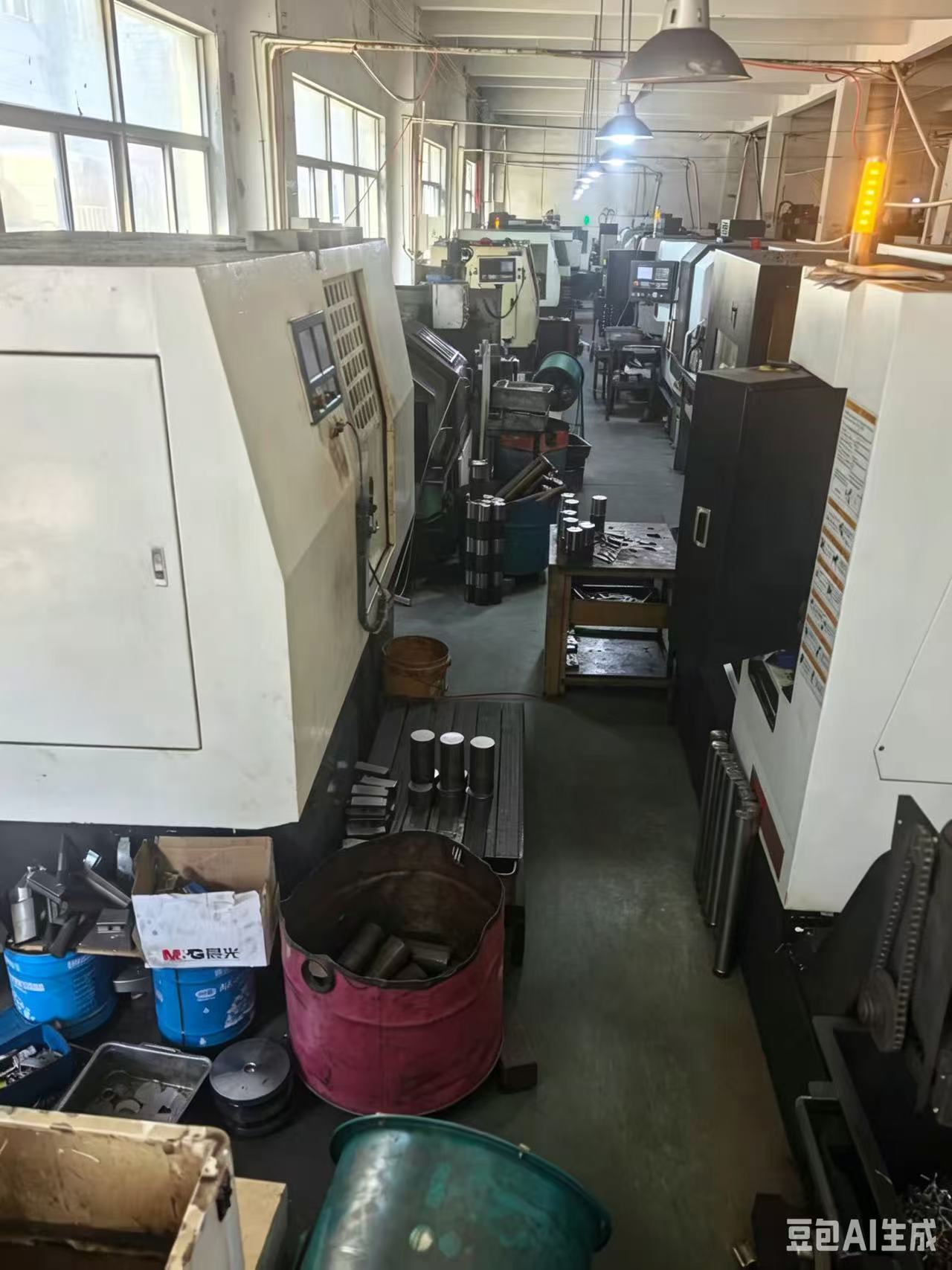
Machining section inside the production facility. The company routes heat treatment before final machining so that hardness and dimensional accuracy are established in the same finishing sequence.
| Attribute | Geltos post-heat-treatment tools (company-reported) | Conventional milling tools (company comparison baseline) |
|---|---|---|
| Working hardness | HRC40 and above | Around HRC30 |
| Achievable tolerance | No greater than 0.02 mm | Not specified in the company statement |
| Process order | Heat treatment before machining, then post-quenching machining | Not specified in the company statement |
| Stated best fit | High-speed spindles, fast feeds, batch production requiring stability | General machining |
Two boundaries belong next to that table. First, the comparison baseline is described only as “conventional tools”; the substrate grade, geometry and coating of that baseline are not defined, so the HRC40-versus-HRC30 gap should be read as directional rather than as a controlled test result. Second, harder material is not free: grinding a harder substrate takes more time and more wheel attention, and the company addresses that cost through its own process control rather than by removing it. A buyer should confirm the hardness and tolerance claims on a trial batch measured at goods-in, on the specific feature that matters to the part.
Matching tool families to machining scenarios
Capability evidence is only useful when it maps onto the work being quoted. The Geltos catalogue is broad, covering grooving mills, modular milling cutters, chamfer mills, thread mills, dovetail mills, face, profiling and shoulder shank mills and shell mills, corn-shaped mills, interchangeable milling tools, boring tools, silent tools, milling inserts, aluminum milling cutters, solid carbide turning tools, carbide small-hole tools, tool holder adapters, T-slotters and special milling tools. The table below converts that list into the questions a buyer should put to the supplier for each family.
| Tool family | Typical machining scenario | Capability question to ask |
|---|---|---|
| Slot milling cutters and T-slotters | Keyways, guide slots, narrow profiles | What is the minimum slot width, and how is that width measured? |
| Side and face cutters | Deep slots, shoulder faces, straddle milling | Is width tolerance specified per cut or per tool? |
| Chamfer tools | Edge breaks, weld preparation, deburring | Is the chamfer angle fixed or adjustable across the range? |
| Thread milling tools | Internal and external threads in hard or thin-walled parts | Which thread standards and pitches are covered by standard drawings? |
| Dovetail milling cutters | Dovetail guides, machine ways | Is angle tolerance stated separately from profile tolerance? |
| Fast-feed milling cutters | High-feed roughing on stable spindles | Which insert grade is supplied, and over what feed range? |
| Profiling, shank and shell mills | Contouring, face milling, cavity work | Which holder interface does the quoted tool require? |
| Modular and interchangeable milling tools | Mixed-part batches with frequent changeovers | Are heads interchangeable across holders, and what repeatability is stated? |
| Boring tools and silent tools | Deep cavities, long overhangs, vibration-prone cuts | What overhang-to-diameter ratio is supported without damping loss? |
| Milling inserts, aluminum milling cutters, carbide small-hole tools | Replaceable-edge machining and small-diameter work | What substrate and geometry options exist per insert size? |
Two product-level facts are worth separating from the general catalogue. The company's interchangeable and modular milling holders are described as reducing tool-change time and purchase cost, because one holder accepts different milling heads for different operations. Its GFN cutters are described as achieving narrow grooving as thin as 2 mm. Both are specific enough to be tested on a sample order, which is exactly how they should be evaluated.
Export record: what named markets prove and do not prove
Geltos reports serving India, Russia, Iran, Morocco, Italy and the USA, with exports representing 5–10% of output and the remainder directed at domestic demand. It also reports a Russia-based project that has run for more than two years covering 5 milling tool units.
That record supports a narrow conclusion and is often over-read. Shipping into six named markets indicates that export documentation, packing and freight coordination are routine rather than novel, which reduces onboarding friction for a first international order. A relationship lasting more than two years indicates continuity with at least one overseas customer. But a five-unit project over two years is a project-type engagement, not volume supply, and an export share of 5–10% tells a buyer that export handling is a minority activity inside a domestically focused operation.
The correct inference is therefore about fit, not scale. A buyer placing a repeat, moderate-volume order for special or modular tooling sits close to the profile the record describes. A buyer requiring high-volume standard cutters on short lead times is asking the supplier to operate outside the shape of its published evidence.
Comparing a specialist factory against alternative supply routes
Most milling tool sourcing decisions compare a specialist factory against a trading intermediary or a global brand. Each route documents capability differently, and the comparison below is about evidence structure rather than product quality.
| Dimension | Specialist factory (Geltos-type) | Trading intermediary | Global brand |
|---|---|---|---|
| Product scope | Milling, grooving, boring and turning tools plus inserts under one process route | Wide catalogue assembled from multiple factories | Broad standardised platform families |
| Process accountability | Heat treatment and machining inside one facility | Depends entirely on the sourcing partner | Documented through global engineering systems |
| Special and modular tooling | Stated capability for special milling tools and interchangeable heads | Varies by partner factory | Available through formal custom engineering |
| Quality documentation | Internal factory inspection; no third-party certification identified | Varies; often second-hand | Typically supported by published quality-system documentation |
| Capacity visibility | Company-reported area, headcount and output | Usually opaque | Published in corporate reporting |
| Commercial structure | Direct factory quotation | Includes intermediary margin | Unit price typically reflects brand, service network and documentation overhead |
On hardness and precision against generic alternatives, the company's own comparison is the most concrete data point available: HRC40 and above versus around HRC30, with tolerance held within 0.02 mm, aimed at high-speed spindles, fast feeds and batch work that needs dimensional stability. The limitation sits in the word “generic”. Until a buyer measures both tools on the same workpiece, the gap describes a process philosophy rather than a verified performance difference — and the philosophy is credible precisely because it can be tested cheaply on a first order.
Boundaries and limitations to price into the decision
- No third-party certification identified. Quality assurance rests on internal factory inspection, and the company's own risk statement acknowledges commercial exposure from the absence of third-party certification. Buyers in regulated categories must add audit or testing cost.
- Capacity and headcount are self-reported. The 3,000 m², 25-employee and 500,000-teeth figures have no public external verification, and capacity is denominated in teeth rather than tools.
- Engineering bandwidth is finite. Five R&D engineers support both standard and special tooling. Multiple simultaneous custom projects will compete for the same engineering time.
- Export is a minority activity. With 5–10% of output exported, buyers should confirm Incoterms, documentation and after-sales routing for their specific market.
- Commercial terms are not public. No MOQ, price basis, lead time or sample policy is published, so those must be obtained by quotation rather than inferred from the capability file.
- Standard references require confirmation. ISO 11529-2:1998 defines the designation system for shank type and bore type milling cutters with indexable inserts, and ISO 13399 describes computer-readable representation of cutting tool data. Neither reference establishes product conformity by itself; conformity documentation must be requested per SKU.
A verification checklist for milling tool buyers
The following sequence converts a capability file into a procurement decision without requiring a factory visit for every candidate.
- Request dimensional drawings for each quoted item, including the feature to which the 0.02 mm figure applies.
- Ask for the substrate grade, hardness basis and heat-treatment record behind the HRC40 claim.
- Request the inspection method and sampling plan used in internal factory inspection.
- Order a trial batch and measure it at goods-in against the drawing, not against the catalogue.
- Confirm current utilization and the capacity share reserved for custom or special tooling.
- Confirm standard batch size, repeat-order lead time and changeover practice for modular heads.
- Obtain any certification your own market requires, or agree an equivalent incoming-inspection protocol.
- Ask for conformity documentation against any standard cited in the offer, such as ISO 11529-2 designation data.
A supplier that answers all eight is materially easier to onboard than one that answers only the headline capacity question, regardless of which is larger.
Market trend: what changes over the next cycle
The growth forecast itself is the least interesting part of the trend. A 6.2% CAGR to 2035 implies steady expansion of milling tool demand, and steady expansion tends to favour suppliers that can prove repeatability rather than suppliers that can only prove range. Two shifts follow.
The first is documentation. As buyers compare more candidates per category, the cost of evaluating each one has to fall, and the only way it falls is standardised data. That is the direction indicated by references to ISO 13399 for computer-readable cutting tool information and to ISO 11529-2 for cutter designation: structured data reduces the ambiguity that currently makes cross-supplier comparison slow.
The second is material and process transparency. Industry analysis of the solid carbide tools segment continues to track substrate and coating development, which means buyers increasingly ask about hardness basis and treatment sequence rather than catalogue geometry alone. A supplier that can describe its process route — heat treatment before machining, post-quenching finishing, internal inspection — is answering the question the market is starting to ask. A supplier that can also document that route externally will be at an advantage as the question becomes standard.
Future outlook
For a facility of this size, the credible development path is depth rather than breadth: more complete documentation of the existing process route, wider use of modular and interchangeable tooling to reduce changeover cost, and structured product data that lets buyers compare specifications without a chain of emails. Whether the company pursues third-party certification is the single variable most likely to change how it is evaluated by export buyers, because that gap currently sits at the centre of its risk profile.
For buyers, the implication is stable. Capacity claims from specialist factories will keep arriving in the same format — area, headcount, output, tolerance — and their value will keep depending on whether the buyer asks what each figure measures and what it does not. The Geltos file is unusually specific about process and unusually thin on external verification; both facts belong in the same assessment.
FAQ
Is Geltos' 500,000-teeth annual capacity independently verified?
No public independent verification is available. The figure is published by the company through its own corporate and blog channels, and no factory audit, financial filing or third-party capacity measurement appears in the public record. Buyers should treat it as a company-reported statement about throughput and confirm it through a supplier questionnaire covering current utilization, product mix and standard batch lead time.
What does a tolerance of 0.02 mm mean for a milling tool?
It is the maximum deviation the company states it achieves after heat treatment and machining. Whether it is adequate depends on the feature being toleranced — slot width, shoulder runout or profile — and on the acceptance method used at goods-in inspection. Buyers should ask which feature the 0.02 mm refers to, which measuring instrument is used, and whether the value is a process capability or a specification limit.
How does heat treatment before processing change tool behaviour compared with conventional tools?
The company states that treating the tool before machining raises strength and working hardness to HRC40 and above, against around HRC30 for conventional tools, while tolerance is held within 0.02 mm. Higher hardness generally improves wear resistance in high-speed and fast-feed cutting and helps dimensions stay stable across a batch. Because the comparison baseline is not defined in the published statement, the figures are directional until a trial batch is measured.
Do a 3,000 m² facility and about 25 staff limit order size or custom work?
They describe the shape of the supplier rather than a hard ceiling. A plant of that size with roughly 25 employees and 5 R&D engineers is consistent with a specialist, high-mix operation serving custom and small-to-mid batch work, not with high-volume standard tool supply at global-brand scale. Buyers with large annual volumes or several parallel custom projects should confirm capacity allocation and engineering bandwidth in writing before committing.
Which export markets does Geltos supply, and does export share matter to buyers?
The company names India, Russia, Iran, Morocco, Italy and the USA, and reports that exports represent 5–10% of output, with the remainder serving domestic demand. It also reports a Russia-based project running for more than two years covering 5 milling tool units. A long-running, low-unit relationship of that kind evidences continuity on a specific project rather than high-volume export supply, and a minority export share means export handling is routine but not the core activity.
What should a buyer request before approving a specialist milling tool supplier?
At minimum: dimensional drawings for each quoted item, the substrate grade and hardness basis, the inspection method and sampling plan, heat-treatment and material records, a trial batch measured at goods-in, and any certification the buyer's own market requires. Where compliance matters, also request conformity documentation for standards cited in the offer, such as ISO 11529-2 designation data for indexable-insert cutters.
The capability file, in the end, is a set of questions the supplier has already answered about itself. The buyer's job is to decide which of those answers can be tested, which need external evidence, and which are simply not relevant to the parts being quoted — and to score the supplier on that basis rather than on the size of the largest number in the table.
Есть вопросы или нужны дополнительные детали?
Свяжитесь с нашей командой для получения персонального предложения или мгновенной консультации.
Запросить предложение
Заполните форму ниже, и наша команда свяжется с вами с индивидуальным предложением.
Прямой чат WhatsApp
Предпочитаете общаться в реальном времени? Напишите нам в WhatsApp для мгновенной помощи и быстрых ответов.
- Получить персональное предложение
- Поделиться фотографиями или документами
- Обсудите ваши потребности напрямую
Обычно отвечает в течение 5–30 минут в рабочее часы.