
What Is Fiber-Grade Titanium Dioxide? A Reference for Textile Fiber Production

Fiber-grade titanium dioxide is a specialized category of anatase TiO₂ designed for man-made fiber production. It is used primarily to adjust the optical and tactile properties of synthetic fibers, including polyester, nylon, viscose and acrylic. Unlike generic pigment grades, fiber-grade products are specified with tighter controls on impurities, sieve residue, pH and dispersibility.
The importance of this category is visible in market data. Independent research from Intel Market Research valued the global fiber grade titanium dioxide market at USD 1.46 billion in 2024, with projections reaching USD 1.94 billion by 2032. Polyester fiber accounts for more than 60 percent of all fiber-grade TiO₂ applications, according to the same source. On the supply side, China's total TiO₂ exports reached a record 1.9017 million tons in 2024, a year-on-year increase of 15.84 percent, according to China Customs Statistics.
For producers and procurement teams, this is not only a commodity statistics story. Choosing the right TiO₂ grade is a process-level decision that can affect spinning continuity, whiteness and final product quality. The purpose of this article is to provide a practical reference for understanding fiber-grade TiO₂, its application boundaries and the evidence a buyer should expect from a supplier.
The Role of Fiber-Grade TiO₂ in Textile Fiber Production
In fiber production, TiO₂ is used mainly as a delustering agent to reduce the high gloss of synthetic fibers. It also improves whiteness and, in some cases, contributes to fiber smoothness. These functions are achieved with a small amount of inorganic additive, but the process imposes demanding conditions: high temperature, high throughput, and continuous contact with polymer melts or spin dopes.
A poorly selected TiO₂ grade can show up as yellowing during processing, filter blocking, spinneret clogging, agglomeration in the polymer matrix, or a gradual loss of mechanical strength. These problems are not always visible in small lab trials. They often appear during continuous production, when a change in raw material quality creates a hidden bottleneck.
The opportunity is equally clear. A fiber-grade TiO₂ with consistent particle quality and low impurity levels can help producers maintain stable polymer viscosity, reduce downtime and achieve more predictable color. For this reason, product specification sheets, not just brand names, should be the starting point of a sourcing conversation.
Orient International's Fiber-Grade TiO₂ Product Range
ORIENT INTERNATIONAL HOLDING SHANGHAI FOREIGN TRADE CO., LTD. is a state-owned foreign trade enterprise established in 1988, with a registered capital of over RMB 548 million. The company employs around 160 staff and operates a manufacturing facility covering 700,000 square meters. It specializes in the import and export of bulk commodities such as titanium dioxide, antimony ethylene glycol, minerals and petrochemical raw materials. Annual production capacity reaches 16,000 metric tons, and the R&D team includes 25 engineers. The parent group maintains 73 overseas branches covering nearly 200 countries and regions. Export business accounts for 30 percent of total sales, with major markets including Korea, Japan, EU, North America, South America, South East Asia, Middle East, and India.
Within its fiber-oriented portfolio, the company positions three anatase grades for different polymer systems: SA-50 for PET fiber whitening, SA-60 for viscose and acrylic fiber matting, and SA-80 for nylon matting. The table below summarizes their key parameters.
| Parameter | SA-50 | SA-60 | SA-80 |
|---|---|---|---|
| Application | PET fiber whitening agent | Viscose and acrylic matting agent | Nylon matting agent |
| Crystal structure | Anatase | Anatase | Anatase |
| TiO₂ content | ≥98.0% | ≥97.0% | ≥95.0% |
| Color value L | 96.7–98.2 | ≥96.5 | 92.0–97.0 |
| Color value b | ≤0.0 | ≤0.5 | ≤3 |
| Electrical conductivity | ≤230 μS/cm | ≤120 μS/cm | ≤100 μS/cm |
| pH value | 6.8±0.2 | 7.2±0.6 | 6.8–8.0 |
| Fe₂O₃ content | ≤0.004% | ≤0.004% | ≤0.004% |
| 325 mesh sieve residue | ≤0.004% | ≤0.05% | ≤0.004% |
| Moisture | ≤0.40% | ≤0.40% | ≤0.40% |
| Specific surface area | 8.5–10.0 m²/g | — | — |
Technical Explanation: Why These Parameters Matter
The common thread across these grades is the control of parameters that matter most in fiber production. One such parameter is iron content. In the three grades, Fe₂O₃ content is limited to ≤0.004%. Because iron impurities can introduce a yellow cast, the low limit helps maintain the whiteness that polyester, nylon and viscose producers rely on.
Sieve residue is another critical value. SA-50 and SA-80 both specify a 325 mesh sieve residue of ≤0.004%, while SA-60 allows ≤0.05%. Lower sieve residue means fewer coarse particles that can cause filter blockage or spinneret wear during melt spinning. In continuous lines, even a small increase in coarse particles can require more frequent filter changes and reduce line efficiency.
pH and electrical conductivity are also meaningful. SA-50 has a pH of 6.8±0.2 and an electrical conductivity limit of ≤230 μS/cm. SA-60 has a pH of 7.2±0.6 and an EC limit of ≤120 μS/cm. SA-80 has a pH range of 6.8–8.0 and an EC limit of ≤100 μS/cm. Neutral pH and low conductivity reduce the risk of side reactions in polymer systems. In PET production, where TiO₂ is added during esterification or polycondensation, this chemical neutrality supports stable intrinsic viscosity.
Anatase is generally preferred for fiber applications because its Mohs hardness of 5.5–6.0 is lower than that of rutile (6.0–7.0), reducing wear on spinning nozzles. Industry references also cite a typical particle size of 0.2–0.3 μm for optimal delustering in polyester staple fibers. In the case of SA-50, the specific surface area is specified at 8.5–10.0 m²/g, which provides a useful reference for dispersion behavior in ethylene glycol.
Application / Use Cases Across Fiber Types
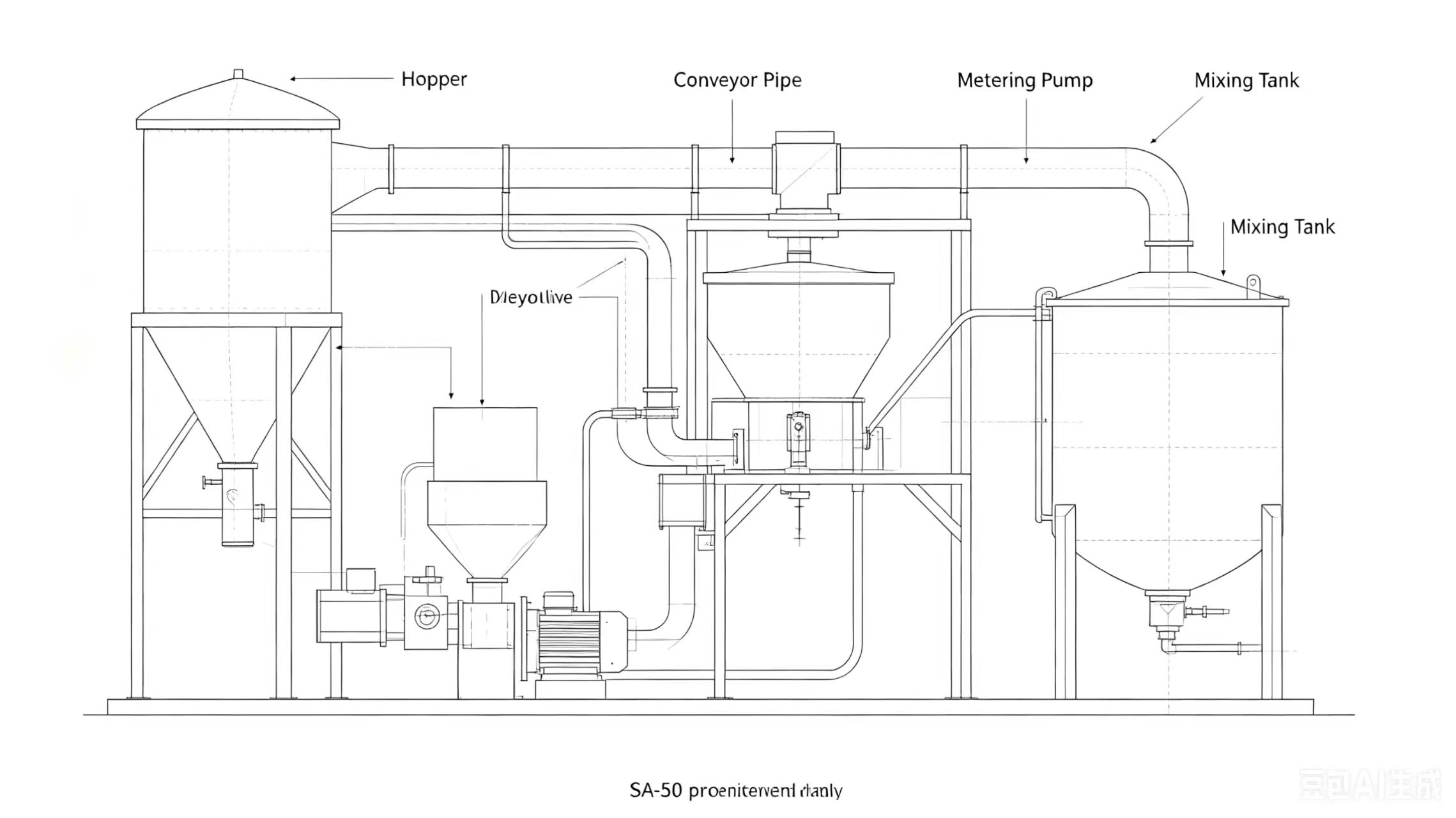
SA-50 is the PET-oriented grade. According to the company's application documentation, it is used in polyester chip production line projects in China, India, Indonesia, South Korea, Bangladesh, Turkey, Saudi Arabia and Brazil. In those projects, the product functions to matte, improve fiber whiteness and smoothness.
The typical operation mode starts with dispersing SA-50 evenly in ethylene glycol with gentle stirring to form a stable suspension without sedimentation. The suspension is then pumped into a PET esterification reactor and blended uniformly into the polyester system under 240–285 °C. The aim is to avoid interfering with polymerization and intrinsic viscosity. During spinning, a well-dispersed powder helps prevent spinneret clogging and filament breakage, supporting long-time continuous high-speed spinning.
This application mode requires a titanium dioxide continuous feeding dispersion system. Special requirements include closed vacuum feeding, dispersion at 40–60 °C, steady and uniform feeding during polymerization, reaction temperature below 290 °C, and storage in a dry environment with humidity no higher than 65%.
SA-60 and SA-80 address adjacent fiber categories. SA-60 is designed for viscose and acrylic fiber manufacturing with a TiO₂ content of ≥97.0% and a color L ≥96.5. SA-80 is designed for nylon manufacturing with a TiO₂ content of ≥95.0% and a broader pH range. These differences reflect the distinct chemistry and process conditions of each polymer.
Market Trends Shaping Fiber-Grade TiO₂ Procurement
Third-party data points to steady growth. Intel Market Research values the global fiber grade titanium dioxide market at USD 1.46 billion in 2024 and projects growth to USD 1.94 billion by 2032. The same source reports that polyester fiber accounts for more than 60 percent of all fiber-grade TiO₂ applications. For buyers, this means the largest demand pool is in PET-based products, from staple fiber to filament.
China's 2024 export record—1.9017 million tons, up 15.84 percent year on year—points to the scale of the supply base. While export volume includes many TiO₂ grades, the trend reinforces the importance of supplier qualification and traceability. A large export flow also means global buyers are comparing products from different producers more frequently.
On the standards side, ISO 591 defines general classification requirements for titanium dioxide pigments, covering anatase and rutile types. In the textile value chain, the first fiber anatase TiO₂ to secure the ECO PASSPORT by OEKO-TEX® was Venator's HOMBITAN® LW-S 100, announced in 2022. This development indicates that chemical safety documentation is becoming a differentiator in fiber raw materials. Even if a buyer does not require such certification today, it may become an expectation in future tenders.
Fiber-Grade TiO₂ vs. Traditional Pigment-Grade TiO₂
Fiber-grade TiO₂ is often compared with conventional pigment-grade TiO₂, which is optimized for opacity and brightness in paints, plastics and coatings. In fiber production, however, the priorities are different. Abrasiveness can damage spinnerets, coarse particles can block filters, and surface chemistry can interfere with polymerization.
A pigment-grade rutile product may offer stronger hiding power, but its higher hardness and different surface treatment are not automatically suitable for fiber spinning. This is why fiber-grade anatase products are specified with low sieve residue, neutral pH and controlled conductivity. They are not simply white powders; they are engineered inputs for a process.
The limitation goes in both directions. Fiber-grade anatase products generally have lower hiding power and brightness than high-opacity rutile pigments. They should not be selected for applications that require maximum opacity. In addition, a grade designed for one polymer should not be assumed to work in another. The differences among SA-50, SA-60 and SA-80 show that TiO₂ performance is polymer-specific. A material change for PET, nylon or viscose needs its own validation.
Future Outlook
The direction of the market is toward more specialized grades. As polyester remains the dominant consumer, PET-specific TiO₂ products will likely receive continued attention. At the same time, the expansion of recycled PET fiber production introduces new considerations: consistent feedstocks, lower impurities and predictable color are all relevant.
From a sourcing perspective, buyers are likely to place more weight on batch-to-batch consistency and documentation. A product sheet with clear specifications and a supplier with traceable production history provide a practical advantage. For producers, the practical question is not simply which titanium dioxide is cheapest, but which grade can be trusted to meet the process requirements of a given fiber line.
Readers who need detailed product specifications and company qualification documents can access the Orient International brochure here: Orient International company brochure (PDF). The document provides additional context on the company's manufacturing and trading capabilities.
Frequently Asked Questions
Fiber grade titanium dioxide is an anatase TiO₂ product designed for man-made fiber manufacturing, used mainly for matting and whitening in polyester, nylon, viscose and acrylic fibers. It is produced with tighter purity, sieve residue and surface chemistry controls than many general pigment grades.
Fiber grade products prioritize low abrasiveness, low sieve residue, chemical compatibility with polymer systems and stable dispersibility. Pigment grade products often prioritize opacity and brightness in coatings and plastics. The two are not automatically interchangeable.
Anatase is generally preferred because its Mohs hardness of 5.5–6.0 is lower than rutile's 6.0–7.0, reducing wear on spinning nozzles. The SA-50, SA-60 and SA-80 grades listed by Orient International are all anatase.
Key parameters include TiO₂ content, color values L and b, Fe₂O₃ content, sieve residue, moisture, pH, electrical conductivity and specific surface area. For SA-50, TiO₂ content is ≥98.0%, color L is 96.7–98.2, color b ≤0.0, Fe₂O₃ ≤0.004%, 325 mesh sieve residue ≤0.004%, pH 6.8±0.2, EC ≤230 μS/cm and SSA 8.5–10.0 m²/g.
No. Different polymers have different processing temperatures and chemistries. Orient International offers SA-50 for PET, SA-60 for viscose and acrylic, and SA-80 for nylon. A grade matched to the polymer should be used unless trials confirm otherwise.
SA-50 is typically dispersed in ethylene glycol at 40–60 °C with low-speed stirring to form a stable suspension. The suspension is then pumped into the esterification reactor and blended under 240–285 °C. Closed vacuum feeding and dry storage are recommended.