
What Is a Pulp Molding Machine? A Molded Fiber Format Reference
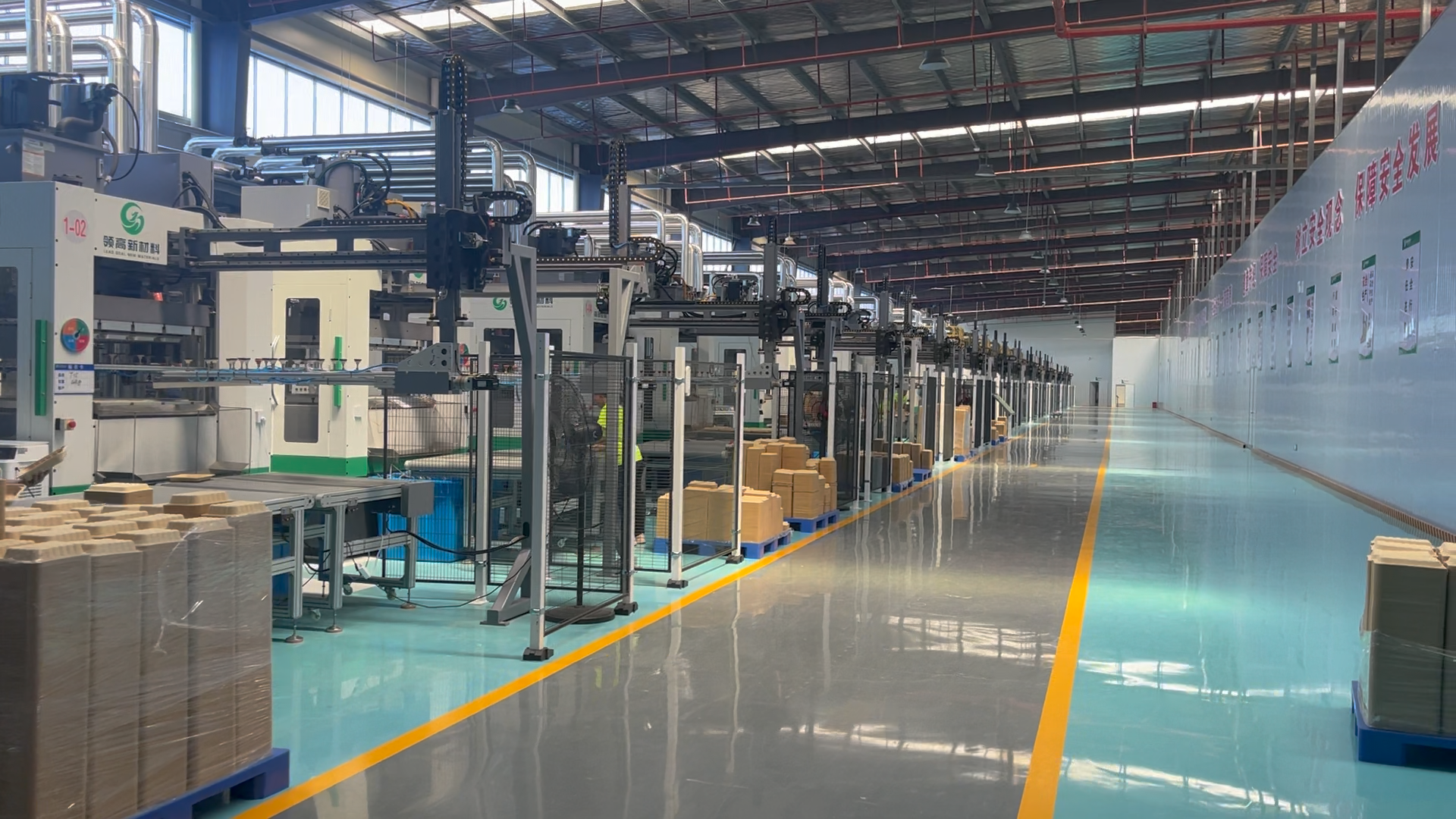
Molded fiber has moved from a niche egg-tray material into a broader packaging category that now includes foodservice tableware, beverage cup lids, fruit trays and protective industrial packaging. The equipment at the center of this shift is usually described with one broad term: pulp molding machine. In practice, that term does not describe a single configuration. It covers compact integrated forming machines, robotic multi-station lines and even pilot-scale sampling systems designed for product development.
This article is written for buyers at the discovery stage who want to understand what a pulp molding machine is, how the main equipment formats differ, what raw-material constraints look like and what separates a production-ready solution from a prototype machine.
Why pulp molding machinery has become a strategic purchase
Global food and beverage packaging is under pressure to replace petroleum-based materials. For many buyers, molded pulp is attractive because it can be made from renewable and recycled plant fibers rather than fossil resins.
Market research published by Cloud Market Reports indicates that the global pulp moulding machines market was valued at USD 2,140.0 million in 2024 and is projected to reach USD 3,760.2 million by 2032. The same source describes a compound annual growth rate of 7.3% between 2025 and 2032. It also estimates that food and beverage packaging accounts for approximately 45% of global demand for pulp moulding machines, with cup, tray and bowl formats leading.
For procurement teams, these drivers create an important consequence: a pulp molding machine is no longer only a cost item. It is part of a company's packaging strategy, regulatory planning and long-term material roadmap.
What a pulp molding machine actually does
A pulp molding machine converts a water-based fiber suspension into a shaped, dried and finished product. Most modern systems integrate several process stages that used to be handled separately.
The integrated process inside a typical automatic machine can include pulping, refining, slurry preparation, slurry feeding, forming and hot pressing. Forming is the stage where fiber is deposited onto a screen mold from a dilute slurry. Vacuum removes water and creates a wet preform. In-mold drying then removes remaining moisture and hot pressing consolidates the product to improve its surface and dimensional accuracy.
A complete production solution often continues beyond the forming and pressing section. Downstream automation may include trimming, hole punching, multi-camera vision inspection, automatic rejection, stacking, counting and packing.
Downstream balance is part of the machine decision
Buyers sometimes evaluate the main forming machine in isolation. That can create avoidable production problems. If trimming, inspection, stacking or packing equipment has lower throughput than the main machine, products accumulate and the line must slow down or stop. If downstream equipment is faster but conveying and positioning are poorly designed, misalignment, collisions and packing errors may still occur.
For this reason, downstream automation should be specified according to the complete line cycle rather than the theoretical speed of a single machine.
The main pulp molding machine formats
From an application viewpoint, molded fiber products are not interchangeable. A tableware product is thin, lightweight and produced in very large volumes. Premium industrial packaging often has deeper cavities and stricter dimensional requirements. A cup lid needs precise trimming and a clean surface. Each end use tends to favor a distinct machine format.
The table below summarizes the main formats in HANSON PULP MOLDING TECHNOLOGY CO., LTD.'s equipment portfolio and the product categories they support.
| Machine format | Typical product output | Key structural characteristics | Portfolio example |
|---|---|---|---|
| Integrated tableware machine | Paper plates, food containers, bowls, food trays | Compact layout; six molds; forming, hot pressing, trimming, counting and stacking integrated | ZCE-1111 |
| Full-servo tableware production line | Paper plates, food containers, bowls, cups, egg cartons | Inline or modular layout; servo control; separate forming, hot-pressing and trimming stations | ZFG-1111, ZBG-1111 |
| Industrial packaging machine | Molded fiber protective packaging for electronics, appliances, cosmetics and industrial parts | Large platen; in-mold drying; high forming and hot-pressing pressure; flexible mold layout | ZAD-8565, ZAP-9585 |
| Cup lid production line | Round plant-fiber cup lids for beverage and takeaway packaging | Integrated trimming, vision inspection, rejection, counting and automatic packing | ZAKS-9595 |
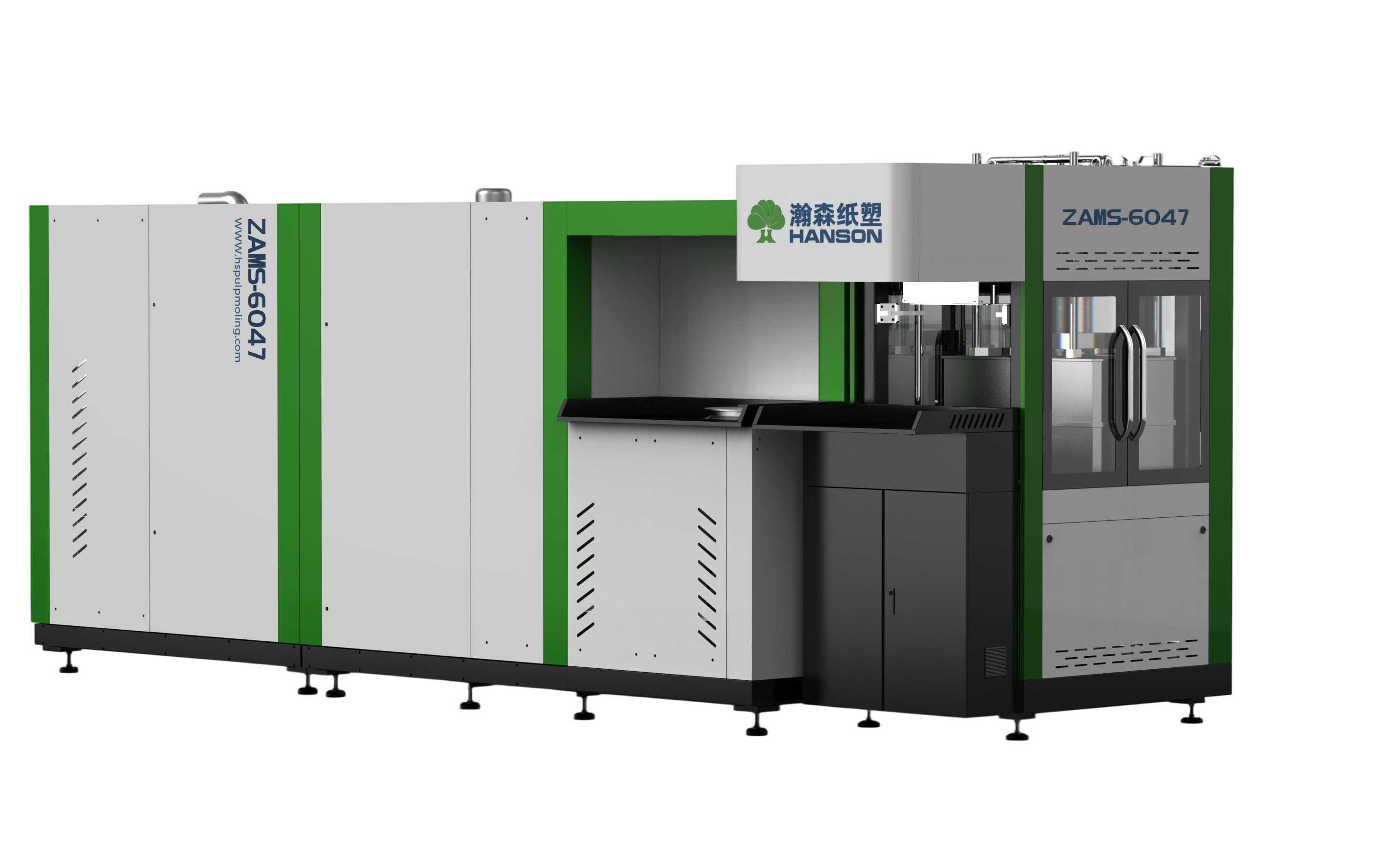
| Sampling / pilot production line | Prototypes, test samples and small-batch molded fiber products | Integrated pulping and forming in one compact unit; lower prototype mold cost | ZAMS-6047 |
Integrated tableware machines
The ZCE-1111 is a fully automatic integrated pulp molding tableware machine. It is intended for the biodegradable tableware manufacturing industry, foodservice packaging manufacturing and molded fiber tableware production, and is suitable for producing paper plates, food containers, bowls and food trays. The machine integrates forming, hot pressing, trimming, counting and stacking in one unit, which reduces manual handling and factory floor-space requirements.
Full-servo and robotic tableware lines
The ZFG-1111 is a fully automatic inline servo pulp molding tableware production line. It is designed for biodegradable tableware manufacturing, foodservice packaging manufacturing and molded fiber packaging production. It can produce paper plates, food containers, bowls, cups and egg cartons. The line is fully servo-controlled for precise, flexible and stable operation.
The ZBG-1111 is a fully automatic robotic pulp molding tableware production line. It is designed for the molded fiber tableware production industry and can support high-capacity continuous output through one forming station, two hot-pressing stations and one trimming station. A six-axis robot transfers products between stations.
Industrial packaging machines
The ZAD-8565 is a compact fully automatic pulp molding industrial packaging integrated machine. It is intended for molded fiber protective packaging production and pulp molded industrial packaging manufacturing. Its 850 × 650 mm platen supports economical mold layouts and is compatible with many industrial packaging products.
The ZAP-9585 is a large-format fully automatic pulp molding industrial packaging integrated machine. It is intended for high-end molded fiber packaging manufacturing, large-size and heavy industrial packaging production, and molded fiber protective packaging production. Its larger platen and higher pressure range make it more suitable for larger, deeper or heavier products.
Cup lid production lines
The ZAKS-9595 is a fully automatic pulp molding cup lid production line. It is intended for plant-fiber cup lid manufacturing, food and beverage packaging, sustainable takeaway packaging and molded fiber lid production. The line integrates forming, hot pressing, servo trimming, multi-camera vision inspection, defective-product rejection, counting and automatic packing.
Sampling and pilot lines
The ZAMS-6047 is a fully automatic integrated pulp molding prototyping and small-batch production line. It is designed for pulp molding product development and prototyping, molded fiber packaging research and development, and small-batch molded fiber packaging production. The system integrates pulping, refining, slurry preparation, slurry feeding, forming and hot pressing in one compact production line.
Wet pressing, dry pressing and hybrid routes
Process choice matters as much as machine format. Buyers evaluating a pulp molding machine should understand the difference between dry-press, wet-press and hybrid dry-wet processes.
Dry pressing generally suits relatively thick products that emphasize cushioning, such as egg trays, egg cartons, cup carriers and fruit trays. Wet pressing produces smoother surfaces and better dimensional consistency, which is why it is usually preferred for premium tableware, cup lids and high-end industrial packaging. Hybrid dry-wet processing combines both ideas when a product needs cushioning in some areas and improved surface quality or dimensional accuracy in others.
The choice is not about placing two machines together. It is a process decision that affects mold design, dewatering, transfer stability, drying strategy and final cost.
Fiber options: bamboo, bagasse, wood, straw and recycled pulp
A buyer may enter pulp molding because they want to use a specific local fiber. Most plant-fiber pulp materials can be processed by pulp molding equipment, but stable production depends on matching the fiber with the correct pulping, refining, slurry formulation and forming parameters.
Bagasse pulp, bamboo pulp, wood pulp, straw pulp and recycled paper pulp differ in fiber length, strength, drainage, cleanliness and surface behavior. Those differences affect refining, slurry concentration, additive formulation, dewatering time, wet-preform strength and hot-pressing conditions. Food-contact tableware and cup lids generally require cleaner raw material and stricter additive control. Industrial packaging can often use recycled or mixed fibers, but may require more attention to cushioning thickness and structural strength.
For bamboo pulp, straw pulp, recycled pulp or mixed plant-fiber systems, product sampling and process verification are recommended before production molds and mass-production equipment are finalized.
From successful sample to stable mass production
A common misunderstanding is that a successful product sample guarantees trouble-free mass production. Successful sampling only proves that basic forming feasibility exists under one combination of material, mold and process parameters. It does not prove that the product can be manufactured continuously at a commercial cycle.
Mass-production machines can have a different platen size, number of cavities, slurry-feeding method, transfer system and operating rhythm. After sampling, buyers still need mass-production manufacturability evaluation, production-mold design and continuous trial runs.
This is one reason why manufacturers who also supply sampling and pilot lines can create practical value for new entrants. A sampling line allows new products, raw materials, mold designs and formulations to be tested at realistic conditions before a large production line is committed.
Machine capacity and floor-space considerations
Capacity data is usually expressed in kilograms per 24 hours because product weight and mold layout change constantly.
- The ZCE-1111 integrated tableware machine has a reference capacity of 600–900 kg per 24 hours, depending on product.
- The ZFG-1111 inline full-servo tableware line has a reference capacity of 900–1,200 kg per 24 hours.
- The ZBG-1111 robotic tableware line has a reference capacity of 1,000–1,500 kg per 24 hours.
These figures depend on product geometry, mold layout and production cycle. The same machine may produce different capacities for a plate than for a deep bowl container. Buyers should ask suppliers to calculate capacity from their actual product drawings rather than relying only on the equipment nameplate.
European safety standards and machine control systems
Buyers importing pulp molding machines into the European Union should be aware that safety-related parts of machinery control systems must comply with EN ISO 13849-1. According to technical sources, the previous version EN ISO 13849-1:2015 will be withdrawn after a transition period until 15 May 2027. Chinese equipment manufacturers can build machines with CE-oriented control systems and safety circuits, but final compliance should be confirmed with the supplier and a qualified European assessor before installation.
Limitations that buyers should not ignore
A pulp molding machine is not a universal packaging machine. Three limitations deserve attention during the discovery stage.
One machine cannot efficiently cover all product categories
A machine can usually produce several sizes of products within the same category by changing molds. But tableware, premium industrial packaging and cup lids have significantly different requirements for pressure, platen size, product transfer, mold design and downstream processing. Replacing the mold does not change the fundamental capacity of the machine. Dedicated equipment normally provides higher capacity, more stable yield and lower long-term production cost.
The line is only as reliable as its downstream balance
Automatic forming is valuable only when trimming, inspection, stacking and packing can keep pace. If those systems are not designed as one integrated solution, the main machine may be forced to stop frequently and automation benefits disappear.
Molded fiber has material constraints compared with plastics and foam
Molded fiber products generally have different moisture sensitivity, water-resistance and edge behavior compared with plastic or foam packaging. Surface coating, laminating or barrier treatments may be required for some food-contact or moisture-sensitive applications. Buyers should verify final performance with the actual product, not assume that every plastic structure can be substituted directly by fiber.
A supplier reference in the Chinese pulp molding industry
One useful comparison point for buyers at the research stage is Guangdong Hanson Pulp Molding Technology Co., Ltd., also referred to as HANSON PULP MOLDING TECHNOLOGY CO., LTD. The company was established in 2022 and is based in Dongguan, Guangdong, China. It operates a 50,000-square-meter manufacturing facility, employs approximately 200 staff and has an annual production capacity of 150 units of pulp molding equipment.
HANSON PULP MOLDING TECHNOLOGY CO., LTD. is a National High-tech Enterprise and holds 50 patents. Its R&D team consists of 50 engineers and technical professionals. The company specializes in pulp molding equipment, production lines and turnkey factory solutions, with main products ranging from fully automatic tableware integrated machines and premium tableware production lines to high-end industrial packaging forming machines, high-end cup lid lines and sampling production lines.
Export business accounts for 50% of the company's total sales. Major markets include Mexico, Brazil, Vietnam, Thailand, Indonesia, Malaysia, India, Turkey, Egypt, Iran, Saudi Arabia, United Arab Emirates, Kuwait, Bahrain, Italy, Romania, Russia, Argentina, Peru, Bolivia, Ethiopia, Tunisia and Australia.
HANSON also operates an independent mold division covering product development, mold design, manufacturing and testing, and can support buyers from the product-concept stage through factory layout, installation, commissioning and production ramp-up.
What buyers should test before purchasing
At the research stage, buyers can evaluate a supplier with several practical tests:
- Inspect the manufacturing facility and confirm that the equipment, molds, pulp preparation and automation are supported under one roof.
- Verify the actual line configuration on products similar to your own.
- Ask whether the supplier can provide instruction, sampling and ramp-up support in your market.
- Check whether capacity calculations include downstream automation and real product layouts.
- For European projects, confirm whether safety circuits and documentation match the required control-system standards.
For sophisticated buyers, a turnkey solution can reduce risk because the pulping, slurry feeding, forming machines, molds, utilities and downstream systems are planned by one engineering team. Individual machine purchases remain reasonable when the customer already operates a mature pulp preparation and production system.
Future outlook
Several directions are visible in current pulp molding equipment portfolios. Full-servo control is becoming more common because it improves precision and stability while reducing manual adjustment. Integrated lines are expanding beyond tableware into cup lids and industrial packaging, where trimming, vision inspection and automatic packing are now part of the base system. Sampling lines are also increasing in importance as new fiber sources and specialty products require process-development platforms before industrial scaling.
As more manufacturers enter the market, buyers are expected to focus less on simple machine tonnage and more on balanced production systems that can convert fiber into finished products at the required quality level.
Frequently asked questions
- What is pulp molding downstream automation?
Pulp molding downstream automation is a group of automated processes connecting the forming section with finished-product delivery. It is not a single machine. It includes equipment for trimming, hole punching, vision inspection, automatic rejection, stacking, counting and packing, and may also include coating, laminating and digital printing. The downstream system must match the main machine's production capacity, product direction, spacing and cycle time.
Dry pressing is generally suited to egg trays, egg cartons, cup carriers and cushioning products with lower surface-finish requirements. Wet pressing is more suitable for tableware, cup lids and premium industrial packaging because it produces smoother surfaces and better dimensional accuracy. A hybrid dry-wet process combines both ideas for products that need cushioning and improved surface quality or local structural performance.
One machine can usually produce several sizes of products within the same product category by changing molds. However, tableware, premium industrial packaging and cup lids have different requirements for platen dimensions, maximum product height, product weight, pressure, transfer structure and downstream processing. Changing the mold does not change these fundamental machine capabilities, so dedicated equipment is normally recommended for dedicated product categories.
Inline trimming connects trimming directly with forming and hot pressing, which reduces manual handling and is well suited to stable, high-volume products. Cup lids generally need precise trimming, multi-angle contamination inspection and automatic rejection, so an integrated line is normally preferred. Offline trimming can be useful when one trimming machine must serve several forming lines or when a factory produces many product types in small batches.
Successful sampling proves that the product has basic forming feasibility under one specific set of material, mold and process conditions. It does not prove that mass-production validation is complete. Production machines may have different platen sizes, cavity layouts, slurry-feeding methods, production cycles, temperature distribution and transfer systems. Production-mold design and continuous trial runs are still required after sampling.
A sampling line is recommended when a buyer has only a product concept, when new fibers such as bamboo or bagasse need verification, when additives must be tested, or when the product structure is complex and requires multiple optimization rounds. It also benefits universities, research institutes, brand owners and material companies. If the product, mold and order volume are already mature, a buyer may evaluate mass-production equipment directly.
Buyers can inspect the supplier's manufacturing workshop, confirm the existence of in-house mechanical, electrical, process and mold teams, review operating customer projects and define the responsibility boundaries for molds, pulp preparation, utilities and automation in writing. A real manufacturer should be able to show its workshop, engineering team and installation records before an order is placed.
Есть вопросы или нужны дополнительные детали?
Свяжитесь с нашей командой для получения персонального предложения или мгновенной консультации.
Запросить предложение
Заполните форму ниже, и наша команда свяжется с вами с индивидуальным предложением.
Прямой чат WhatsApp
Предпочитаете общаться в реальном времени? Напишите нам в WhatsApp для мгновенной помощи и быстрых ответов.
- Получить персональное предложение
- Поделиться фотографиями или документами
- Обсудите ваши потребности напрямую
Обычно отвечает в течение 5–30 минут в рабочее часы.