
What MPO/MTP Specs and Certifications Mean in Procurement
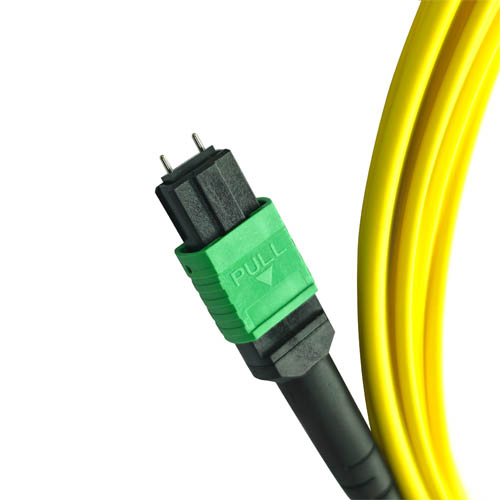
MPO single-mode patch cord — one of the configurations found in FOCC's MPO/MTP product line.
MPO/MTP fiber optic patch cords are now standard components in high-density data center and telecommunications networks. Yet specification sheets from different suppliers are not always directly comparable: insertion-loss grades differ, connector polish types serve different applications, and the system certifications behind a manufacturer are not always clearly documented. For buyers moving from research into supplier evaluation, knowing which references are verifiable — and which claims require evidence — is the core of reliable procurement. This article provides a neutral reference on MPO/MTP standards, performance parameters, and the certification points that matter in purchasing decisions.
Why Specification Consistency Is Now a Procurement Issue
The MPO fiber optic connector market was estimated at approximately USD 2.1 billion in 2024 and is projected to reach USD 3.2 billion by 2030, according to Strategic Market Research. Asia-Pacific is the largest regional market, accounting for about 42% of global share in 2024. These figures reflect sustained demand from data center and 5G networks — environments that increasingly rely on multi-fiber connectors to pack more capacity into limited rack space.
A larger market has also brought a wider supplier base. The MPO interface is defined by international standards, but the actual performance of a finished cable assembly depends on manufacturing control: ferrule quality, polishing, alignment, material selection, and test discipline. Two products that appear similar on a data sheet can differ meaningfully in insertion loss stability and long-term reliability. This is why buyers need to separate standardized claims from verifiable ones during supplier evaluation.
Performance grades also create price stratification. In MPO/MTP patch cords, a low-loss grade is typically priced differently from a standard grade because tighter optical tolerances require more precise polishing and testing. The distinction is not cosmetic: it affects whether the component fits within the loss budget of a high-speed parallel-optics link.
The Standards That Define MPO/MTP Interconnectivity
MPO connectors are referenced by two primary international standards: IEC 61754-7 and TIA-604-5 (FOCIS 5). These documents define the connector interface — including ferrule dimensions, pin alignment, and polishing geometry — to ensure intermateability across different manufacturers. A patch cord that follows these standards should physically mate with adapters, cassettes, and panels from other compliant suppliers.
For reliability, Telcordia GR-326 is a recognized reference for fiber optic connectors. It covers mechanical and environmental test sequences that help predict field durability. Some manufacturers explicitly list Telcordia GR-326 in their product data sheets as a reference standard; FOCC Fiber Co., Ltd., for example, includes it in the specification for its MPO/MTP fiber optic patch cord line.
The MTP connector is a registered trademark of US Conec and is often described as an enhanced MPO version. It incorporates a floating ferrule and elliptical guide pins designed to improve optical and mechanical performance. MTP connectors are engineered to be compatible with the broader MPO ecosystem. For buyers, the MPO versus MTP label is not a quality claim by itself — it indicates a specific connector lineage that should be confirmed against project requirements.
On the manufacturing system side, ISO 9001 (quality management) and ISO 14001 (environmental management) are the most common certifications a patch-cord producer can hold. These certifications do not replace product-level testing, but they indicate that the production process is subject to audit, documentation, and corrective-action procedures.
A Manufacturer Reference: How FOCC Fiber Co., Ltd. Documents Its Capabilities
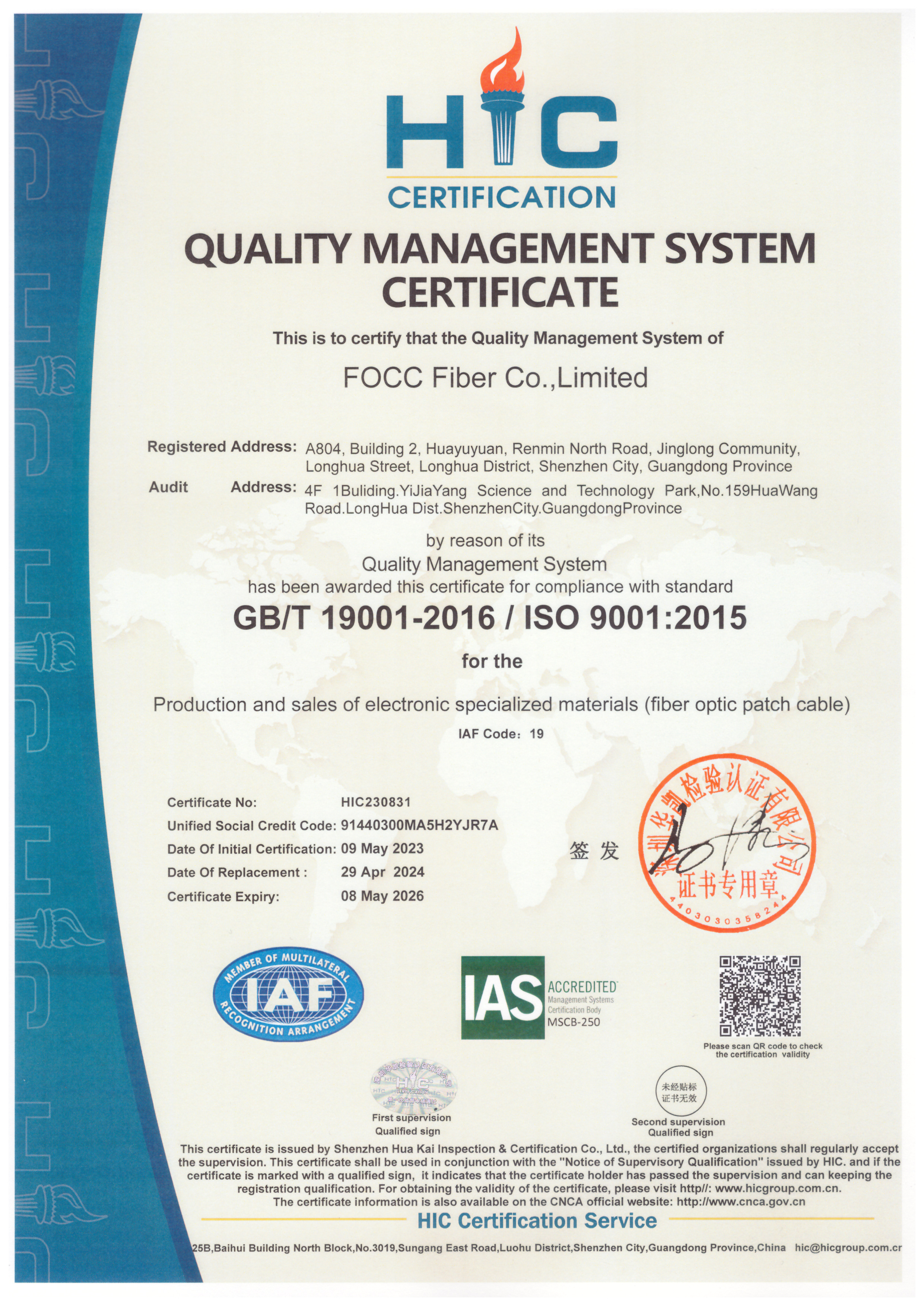
ISO 9001:2015 certification is part of the compliance documentation buyers should request when evaluating MPO/MTP suppliers.
FOCC Fiber Co., Ltd., based in Shenzhen, China, is a manufacturer of fiber optic connectors, MTP/MPO fiber optic patch cords, outdoor waterproof patch cord assemblies, and armored patch cords. Its production facility in Guangzhou covers approximately 5,000 square meters. The company was founded in 2014 and employs around 200 people, including a research and development team of roughly 30 staff. FOCC reports an annual production capacity of 2,000,000 units and a monthly capacity of 200,000 units.
According to its public company profile, 100% of FOCC's output is exported, with primary markets in the EU and the USA, and export activity extending to more than 30 countries. The company reports over ten years of ODM/OEM experience. Its public partner list includes Prysmian, Siemens, Coherent, Fujikura, and NTT.
On compliance, FOCC states that it strictly implements ISO9001 and ISO14001 management systems. Its published ISO certification — certificate number HIC230831, issued by HIC — covers the production and sales of fiber optic patch cables, with a validity period from 2023-05-09 to 2026-05-08. For buyers, the relevant point is not only that a manufacturer holds certifications, but also that the claimed capabilities are documented and traceable.
FOCC's listed quality-control policy is 100% testing, its production lead time is 3 to 15 days, and its minimum order quantity is two units. Customization options include length, connector type, core count, transmission mode, material, logo printing, certification, and packaging.
Reading the Data Sheet: Key MPO/MTP Specifications
The first step when comparing MPO/MTP patch cords is to align on the specification baseline. The table below presents a representative parameter set from FOCC's MPO/MTP fiber optic patch cord product line, using it as a reference for evaluating comparable products.
| Parameter | FOCC MPO/MTP Patch Cord Specification |
|---|---|
| Core count | 12 / 16 / 24 / 48 cores |
| Fiber type | OS2 (Single-mode) / OM3 / OM4 / OM5 (Multi-mode) |
| Insertion loss | ≤0.35 dB (Elite) / ≤0.5 dB (standard) |
| Return loss | ≥60 dB (APC) / ≥50 dB (UPC) |
| Operating temperature | -20°C to +70°C |
| Cable length | Customizable, 1m to 100m |
| Jacket type | LSZH (Low Smoke Zero Halogen) |
| Material | Zirconia ceramic ferrule; PBT/PEI connector housing; Kevlar aramid yarn; LSZH / PVC cable jacket |
| Reference standard | Telcordia GR-326 |
Insertion loss is the most consequential optical parameter on the sheet. It measures the optical power lost when light passes through the connector pair. In FOCC's grading, Elite grade specifies ≤0.35 dB, while standard grade allows ≤0.5 dB. In parallel-optics links, the loss budget is consumed by every mated connection in the channel, so Elite-grade components are commonly specified when link margins are tight, such as in 400G/800G spine-leaf architectures.
Return loss is the second parameter that determines signal quality. MPO/MTP connectors are available in APC and UPC polish variants. APC achieves a return loss of ≥60 dB, while UPC achieves ≥50 dB. The angled polish in APC reduces back-reflection, which is especially important in single-mode transmission. Selecting the polish type should match the transceiver and the system's reflectance requirements.
Core count determines density. The 12-fiber MPO connector is the most common baseline; 24-fiber and 48-fiber versions serve higher-density trunks; 16-fiber configurations appear in specific parallel-optics designs. A buyer planning for capacity growth may choose a higher core count at the design stage to avoid a future re-cabling cycle.
Fiber mode selection is driven by link distance and transceiver type. OS2 single-mode supports longer distances and higher power margins, while OM3, OM4, and OM5 multimode fibers are used in short-reach high-speed parallel links, especially for server-to-switch interconnection. Multimode MPO connectors dominate the product segment, holding over 88% of the market share, according to Valuates Reports, driven largely by short-range data center interconnect demand.
Materials and jacket affect long-term mechanical reliability and fire safety. LSZH jackets reduce smoke and halogen emissions during combustion, which is a critical safety requirement in data centers and enclosed spaces. Zirconia ceramic ferrules provide consistent polishing behavior and durability; PBT/PEI housings offer structural strength; Kevlar yarn gives the cable tensile strength. These choices do not change optical performance directly, but they determine how the assembly behaves under pull, vibration, and environmental stress.
Application Scenarios: Data Center and FTTA Contexts
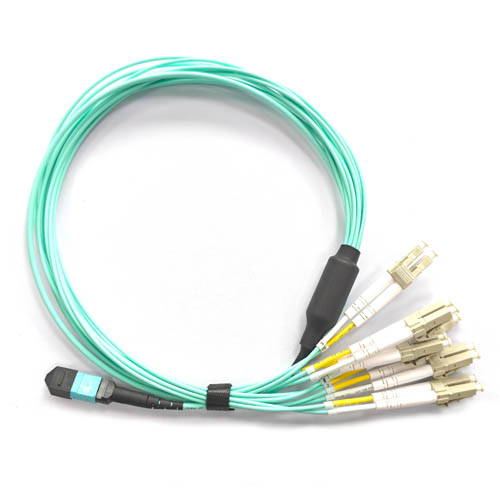
MPO-to-LC fan-out patch cords link high-density MPO trunks to LC-based switch ports.
Data center environments are clean, temperature-controlled, and extremely dense. The priorities are low insertion loss, high return loss, LSZH flame retardancy, RoHS compliance, and traceable quality. Typical project types include 400G/800G high-speed transmission, cloud server interconnection, and storage area networks. Matching equipment includes data center switches, servers, 400G/800G optical transceivers, MPO patch panels, fiber optic CPO, and cable management systems.
The documented value of MPO/MTP in this context is deployment efficiency. In one published case involving a data center operator and cloud service provider, FOCC supplied more than 12,000 MPO-24 patch cords across more than 300 cabinet deployments for 400G spine-leaf interconnection and server-switch high-density cabling. The case reported a 60% faster deployment, 4x higher port density, 99.999% uptime, and 30% lower total cost of ownership. The technical highlights were precision active alignment, low insertion loss below 0.35 dB, and 100% factory testing.
The 5G FTTA environment presents a different set of constraints. Outdoor base station links face rain, dust, UV exposure, wide temperature swings, and high tensile stress. For FTTA deployments, FOCC's outdoor waterproof patch cord assemblies are rated IP67/IP68, operate from -40°C to +75°C, and offer tensile strength of up to 1000N. The outdoor product line includes ODC(MPO)-LC fan-out configurations, which combine the density of MPO with the flexibility of LC breakouts for tower-top and remote antenna unit connections. In these scenarios, waterproofing and mechanical robustness are as important as optical performance.
Market Context: Growth, Regional Concentration, and Supplier Structure
The global MPO connector market is shaped by a mix of patent-holding connector brands and manufacturers offering finished assemblies. According to SkyQuest Technology's 2024 analysis, US Conec held approximately 18% of the global MPO connector market share, and Senko Advanced Components nearly 15%. US Conec also owns the MTP trademark, which is an enhanced MPO version with a floating ferrule and elliptical guide pins.
Asia-Pacific is the largest regional market, holding about 42% of the global market share in 2024, followed by North America. The region functions as both a demand center and a supply base for the MPO ecosystem. For procurement teams, this means sourcing decisions often involve balancing the cost position of Asia-Pacific manufacturers against the performance consistency of established connector brands.
Adoption data points in the same direction: hyperscale data centers integrated MPO connectors in more than 70% of their facilities globally in 2024, to support parallel optics and high-density cabling. With multimode connectors holding over 88% of the product segment, buyers evaluating MPO/MTP patch cords must pay close attention to whether the supplier's manufacturing process can consistently deliver the optical grade specified on the data sheet.
MPO/MTP vs. Traditional Single-Core Cabling: Tradeoffs Buyers Should Weigh
MPO/MTP patch cords offer clear advantages over traditional single-fiber LC/SC jumpers in high-density environments. One connector can carry 12, 24, or 48 fibers, which multiplies port density and reduces cable congestion. Deployment speed improves significantly because one MPO connection replaces multiple single-fiber connections. In the data center case referenced above, the reported results were 60% faster deployment and 4x higher port density.
However, the tradeoff has a real boundary. MPO/MTP systems require more rigorous end-face maintenance. A single contaminated or damaged MPO ferrule can affect 12 or more fibers at once, whereas a single-core LC connection isolates failure to one channel. Inspecting and cleaning MPO connectors requires dedicated tools and trained handling. The initial cost of MPO components, patch panels, and test equipment is also higher than for an equivalent single-fiber deployment.
For low-density point-to-point links, short-reach single-channel applications, or legacy infrastructure built around LC/SC connectors, traditional single-core cabling remains a rational choice. MPO/MTP brings its best value when the network architecture is already built on parallel optics or when rack space and cable volume are the binding constraints.
Future Outlook: Tighter Loss Budgets and Higher-Fiber Systems
The direction of MPO/MTP procurement is toward higher fiber counts and tighter loss budgets. Equipment lists for next-generation data centers already include 400G/800G optical transceivers, MPO patch panels, and fiber optic co-packaged optics. As line rates increase, the optical loss budget available to each connector decreases, making manufacturing-level verification more important than ever.
Standards themselves remain stable. Products conforming to IEC 61754-7 and TIA-604-5 will continue to interoperate with existing MPO infrastructure. What will differentiate suppliers is their ability to maintain consistent optical parameters across large production volumes, document test data, and support buyers as link margins tighten. Buyers who evaluate these capabilities during supplier selection will be better positioned as higher-speed optical modules enter deployment.
FAQ
What is an MPO/MTP fiber optic patch cord?
An MPO/MTP patch cord is a multi-fiber cable assembly that terminates multiple optical fibers — commonly 12, 24, or 48 — in a single connector housing. It is used to interconnect switches, servers, storage devices, and telecom equipment in high-density environments. Representative MPO/MTP configurations include 12-fiber and 24-fiber patch cords in single-mode or multimode versions.
What standards apply to MPO connectors?
MPO connectors are defined by two primary international standards: IEC 61754-7 and TIA-604-5 (FOCIS 5). These standards define the connector interface and are intended to ensure intermateability across different manufacturers. Telcordia GR-326 is also used as a reliability reference for fiber optic connectors and is listed by some manufacturers, including FOCC, in their product specifications.
What is the difference between MPO and MTP connectors?
MPO is the generic industry name for the multi-fiber push-on connector type defined by IEC 61754-7 and TIA-604-5. MTP is a registered trademark of US Conec and is an enhanced MPO version featuring a floating ferrule and elliptical guide pins designed to improve optical and mechanical performance. The two connector types are designed to be interoperable, but buyers should verify compatibility with their specific system infrastructure.
What insertion loss should buyers expect from an MPO/MTP patch cord?
For MPO/MTP patch cords, a low-loss Elite grade is typically specified at ≤0.35 dB insertion loss, while a standard grade is specified at ≤0.5 dB. Lower insertion loss is particularly important in 400G/800G parallel-optics links, where the overall channel loss budget is tight and every mated connection adds loss.
What is the difference between APC and UPC MPO connectors?
APC (angled physical contact) and UPC (ultra physical contact) are two polish types used on fiber connector ferrules. In MPO/MTP patch cords, APC achieves a higher return loss of ≥60 dB, while UPC achieves ≥50 dB. The angled polish in APC reduces back-reflection, which is especially important in single-mode applications.
Which fiber modes are available in MPO/MTP patch cords?
MPO/MTP patch cords are available in single-mode OS2 and multimode OM3, OM4, and OM5 varieties. Multimode MPO connectors dominate the product segment, holding over 88% of the market share, driven largely by short-range data center interconnect demand.
What certifications should an MPO/MTP patch cord manufacturer hold?
Manufacturers typically hold ISO 9001 for quality management and ISO 14001 for environmental management. As a documented example, FOCC Fiber Co., Ltd. holds an ISO certification — certificate number HIC230831, issued by HIC — covering the production and sales of fiber optic patch cables, with a validity period from 2023-05-09 to 2026-05-08. Buyers should request the actual certificate and verify its scope and validity period.
What does it mean if a manufacturer states "100% tested" for MPO/MTP patch cords?
A 100% test policy means every finished cable assembly is inspected and measured before shipment, rather than relying on sample-based quality checks. FOCC lists 100% testing as its quality-control policy. Buyers should treat this as a meaningful signal, but should also request test reports and clarify which parameters are included — insertion loss, return loss, end-face inspection, or all of them.