
What Makes a Durian Supplier Reliable for the Long Term
When buying durian ingredients, the first contract is only the beginning. The real test is whether a supplier can hold quality, compliance, and delivery across many cycles.
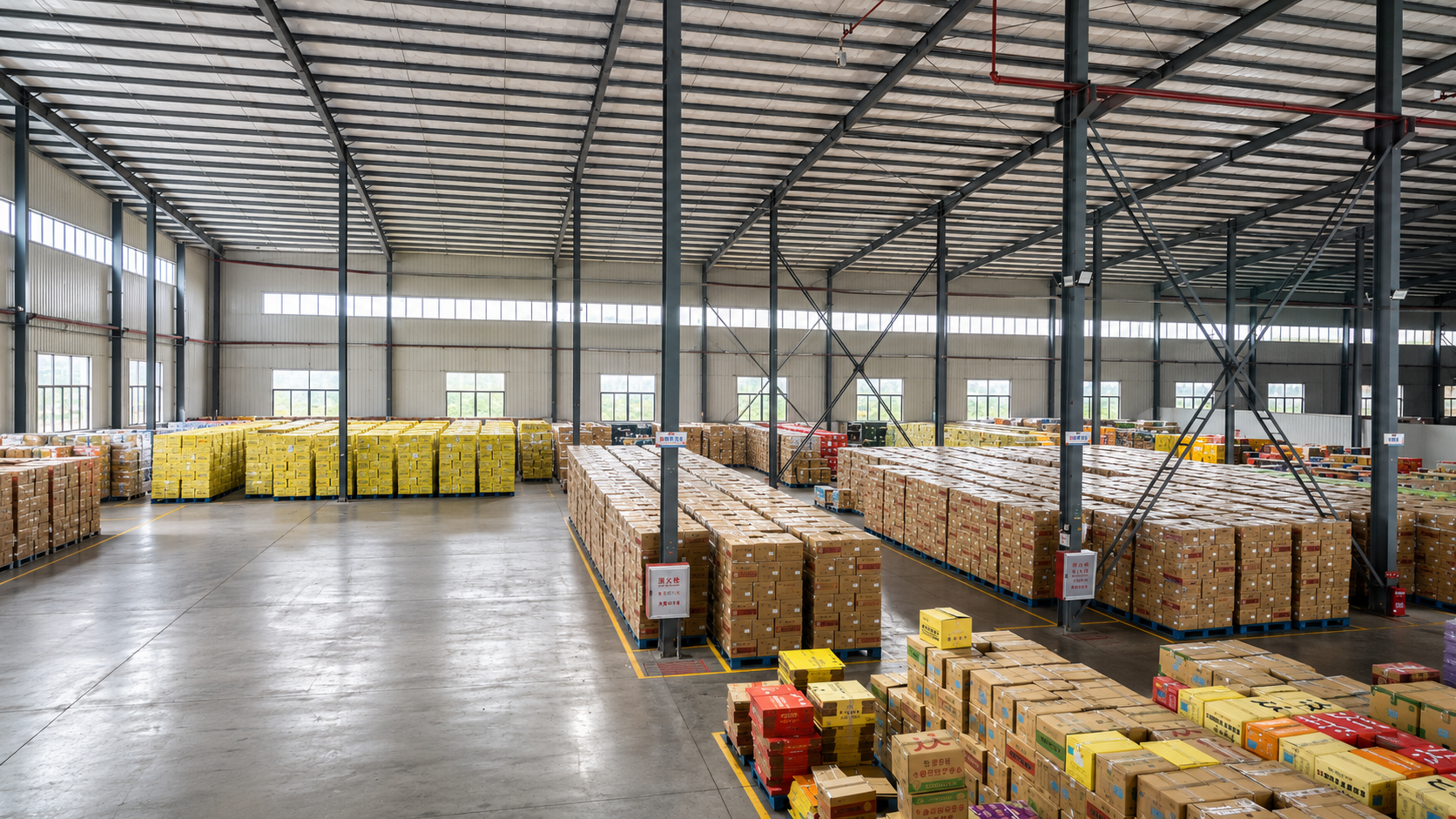
A modern warehousing and logistics operation helps make durian ingredient dispatch consistent across international markets.
When a food brand or manufacturer decides to build a durian product line, the initial sourcing conversation usually starts with price lists and certificates. The harder question comes later: can the same supplier deliver the same quality, compliance, and volume year after year? For procurement teams at the decision and execution stage, reliability across repeated purchase cycles matters as much as the first quote.
The durian ingredient market today spans multiple forms. Fresh whole fruit, frozen pulp, IQF segments, freeze-dried dice, powder, and coated snack pieces all feed different manufacturing and retail applications. Each form involves separate handling requirements, processing steps, and compliance obligations. For a buyer, this means choosing not just a product but a supply chain.
Where the Demand Is Growing, and Why Reliability Is Hard
The macro picture explains why so many buyers are entering durian sourcing. China imported 1.56 million metric tons of durians in 2024, a record according to customs trade data, with the import value reaching USD 6.99 billion. Thailand remained the largest supplier by value at USD 4.01 billion, while Vietnam’s exports to China expanded to USD 2.94 billion, giving Vietnam around 42% of the Chinese market. Malaysia also received approval in June 2024 to export fresh durians to China. Industry estimates put the global durian fruit market at roughly USD 23.4 billion in 2024. Within that total, frozen durian pulp and paste accounted for approximately 70% of market revenue in 2023.
Rising demand, however, multiplies exposure to sourcing risks. The core risk categories in durian raw material supply are well known: microbiological contamination (mold, yeast, total plate count), pesticide residue levels above market-specific MRLs, heavy-metal residues, chemical ripening agents such as ethephon, prohibited colorants such as basic yellow and curcumin, cold-chain breakage, moisture and water-activity migration, and batch-to-batch inconsistency in color, texture, and taste. Regulatory non-compliance—through incorrect labeling, missing certifications, or improper ingredient declarations—can cause customs rejection and market withdrawal.
Any supplier aiming for a long-term contract needs a control system that addresses every one of these points on a per-batch basis.
What an Integrated Durian Ingredient Supplier Should Bring
One example of a supplier built for long-cycle durian procurement is UrSnacks, the flagship freeze-dried fruit brand of Fujian Youlingyoushi Technology Co., Ltd. Founded in 2016 and headquartered in Jinjiang, Quanzhou, Fujian Province, China, the company operates around two strategic categories—durian and strawberry—across four product forms: fresh fruit, frozen (IQF), finished freeze-dried products, and freeze-dried ingredients. Its freeze-drying manufacturing and customization facilities exceed 100,000 m², with a combined annual capacity of 3,000+ metric tons across core freeze-dried categories, 12 automated packaging lines, and an annual customized finished-product capacity of 4,500 metric tons. The company has served more than 150 brand customers and exports to the United States, Japan, South Korea, Canada, Germany, Thailand, and Indonesia.
The four-form structure has a practical rationale. An ice cream manufacturer may need frozen durian pulp for the base, durian powder for consistent flavor, and freeze-dried dice as inclusions. A bakery brand may need powder and dice for different finished goods. Instead of qualifying three separate suppliers, the buyer works with one quality system across all forms. This reduces supplier coordination cost, aligns quality control, and simplifies consolidated shipping.
Technical Controls Behind a Stable Durian Supply
For durian, a tropical fruit with a strong aroma and a short natural window of optimal ripeness, the discipline begins before processing.
Sourcing and Ripening Control
Natural harvesting and maturation control determines whether the raw material reaches the processor in a safe and flavor-consistent state. UrSnacks applies a post-flowering waiting period of at least 120 days and harvests at no less than 90% maturity. Chemical ripening agents and artificial colorants are prohibited. Ripening is managed through an OPRP-1 monitoring protocol inside the HACCP plan, with a ripening chamber set at 28–32°C and 75–85% relative humidity for a holding time of no more than 24 hours. A four-tier maturity grading system is used. Multi-stage high-pressure spray washing is carried out before flesh extraction. The measurable outcome: ethephon residue at or below 0.1 mg/kg and undetectable levels of curcumin and basic yellow.
Cold Chain Integrity
Frozen durian products depend on an unbroken cold chain. Liquid nitrogen flash freezing minimizes ice crystal damage and preserves cellular structure. Origin pre-cooling warehouses are located near production areas, and the cold chain is tracked in real time. Frozen durian pulp is vacuum-packed and maintained at −18°C or below, supporting an 18–24 month shelf life.
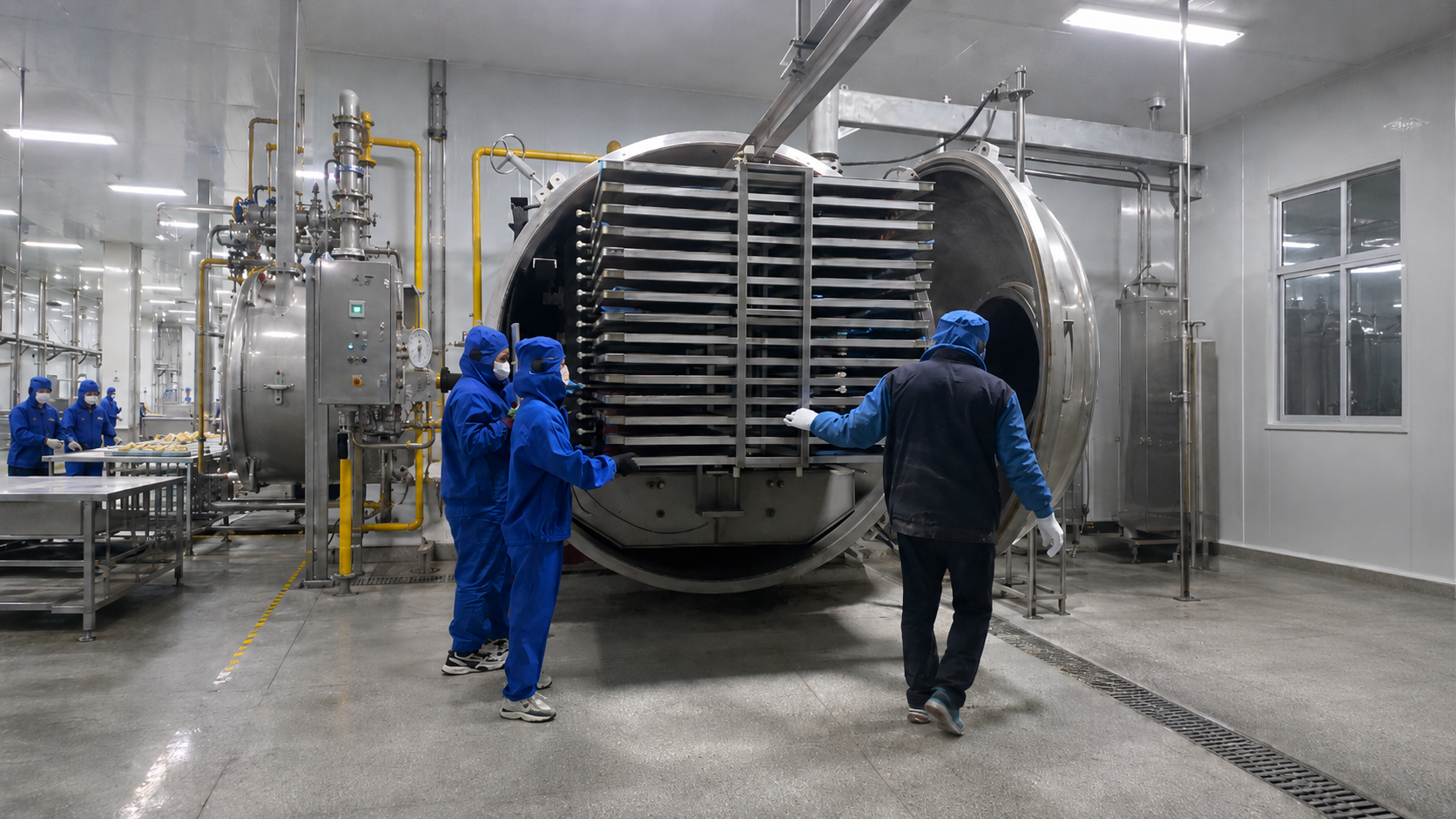
Vacuum freeze-dryer discharge: the step where moisture is removed while the fruit structure is preserved.
Freeze-Drying and Moisture Control
Freeze-dried durian is produced by low-temperature vacuum sublimation, preserving natural color, aroma, and structure. UrSnacks operates with standardized fruit-specific freeze-drying curves, automated production lines, per-batch sample retention, and statistical process control. Every batch is tested in-house for moisture content, with a maximum threshold of 5%, and SGS provides third-party verification. Nitrogen-flushed sealed packaging protects against oxygen and moisture ingress.
Consistency and R&D
Batch inconsistency is one of the most frequent complaints in B2B freeze-dried fruit supply. The company’s in-house R&D center tests each product across flavor/sensory, pesticide residue, microbiology, heavy metal, moisture, texture, and color parameters. It also works through an industry–university partnership with the College of Physical Science and Technology at Xiamen University, focusing on the fundamentals of vacuum, heat and mass transfer, and ice-crystal sublimation during freeze-drying. This connection between lab data and production parameters supports a closed-loop quality feedback system.
Durian Ingredient Formats and How They Are Used
Long-term buyers typically need several formats in parallel. The most common specifications include:
| Format | Typical Specification | Common Applications |
|---|---|---|
| Frozen durian pulp | Whole seedless segments, vacuum-packed, stored at −18°C or below | Durian dessert shops, bakery, new-style tea, ice cream, central kitchens |
| Freeze-dried durian dice | 6–10 mm regular; 10–15 mm large | Bakery inclusions, cereal and granola, bubble tea toppings, ice cream, chocolate |
| Freeze-dried durian powder | 60–80 mesh, 80–100 mesh, 100–120 mesh | Bubble tea and beverages, bakery, ice cream and dairy, instant mixes, confectionery |
| Freeze-dried durian segments | S / M / L whole flesh chunks | Premium snacking, bakery and dessert toppings |
| Coated freeze-dried durian | Single-serve retail bag | E-commerce snack, supermarket, gift and travel retail |
The choice of form follows the application. Powder is often preferred when flavor needs to be evenly distributed in a cream, glaze, or beverage. Dice are selected when visible pieces and texture are needed. Whole segments work for premium dessert toppings and gift-pack snacking. Frozen pulp is the standard starting point when a processor builds a durian base for ice cream or pastry filling.
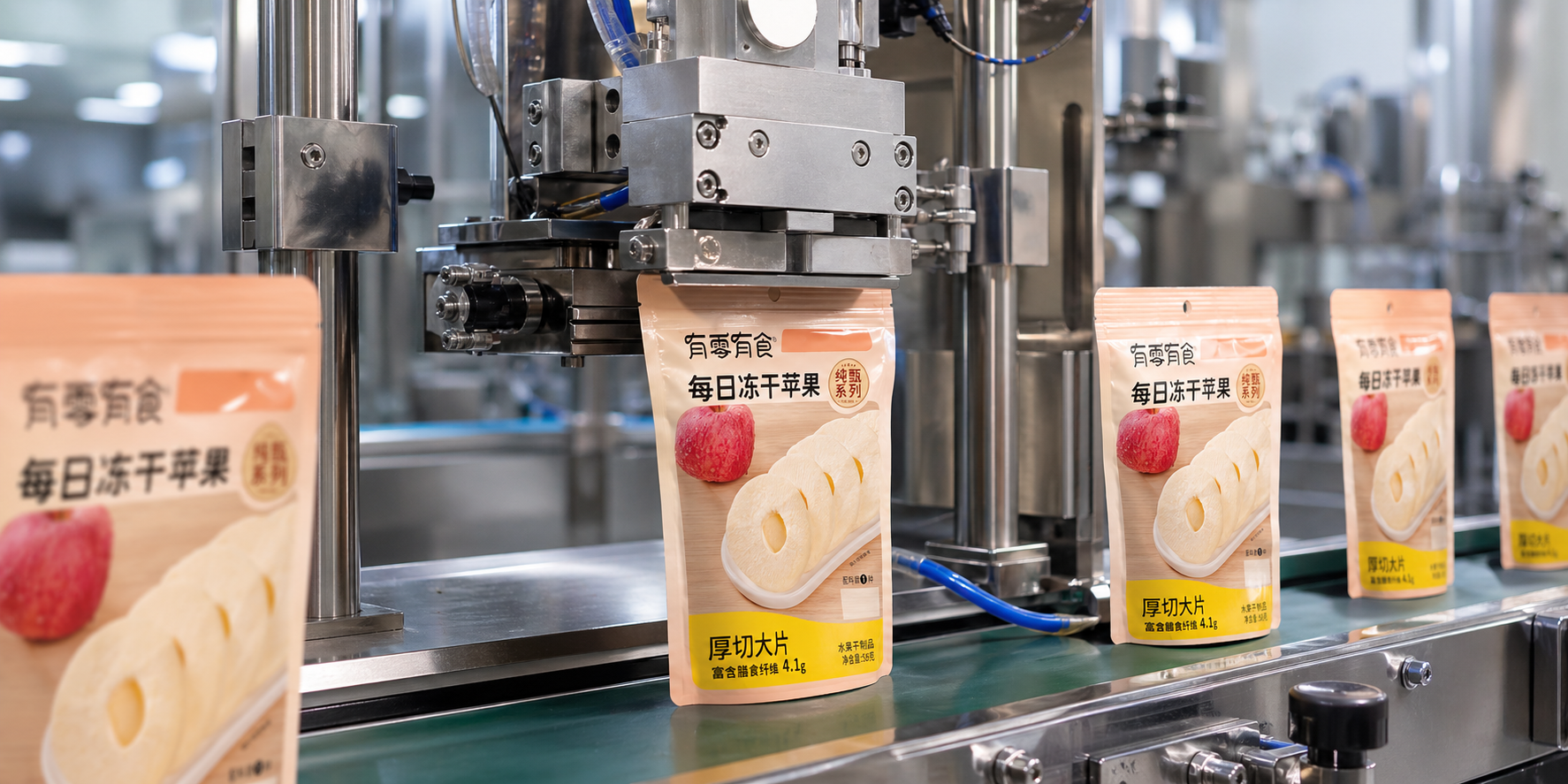
Automated packaging lines allow repeatable, hygienic portioning for both bulk and retail formats.
Market Trends Pushing Procurement Toward Longer-Term Relationships
Three trends are shifting durian ingredient buying from spot purchasing to structured supply.
First, supply origin is diversifying. With Thailand, Vietnam, and Malaysia all competing in the same major import markets, buyers face a wider range of raw material profiles. That makes proven sourcing protocols and origin-level control more valuable.
Second, processed durian is growing faster than fresh fruit. The global freeze-dried fruits market was valued at USD 9.40 billion in 2024, and the Asia-Pacific freeze-dried fruit market is projected to grow at a CAGR of 8.18% from 2024 to 2029. Freeze-dried durian is increasingly positioned as an industrial ingredient for bakery, ice cream, and beverages, and durian powder is gaining adoption in clean-label product lines as a natural flavoring ingredient.
Third, compliance expectations are becoming more rigorous. Record import volumes in China have been accompanied by continued enforcement of MRL standards for imported durians. For suppliers selling into multiple markets, certifications such as FDA registration, BRCGS, HALAL, ISO 22000, and SMETA help buyers reduce the risk of customs interruption. UrSnacks’ export track record across the US, Japan, Korea, Canada, Germany, Thailand, and Indonesia provides a documented base for multi-country distribution.
Comparing Integrated Supply with Traditional Sourcing
In a traditional sourcing pattern, a buyer purchases frozen pulp from a trader or single-form processor, and freeze-dried powder from another specialist. Each transaction carries separate quality, compliance, and logistics costs, and the buyer owns the burden of coordination.
An integrated supplier like UrSnacks replaces that with one supply chain covering fresh, frozen, freeze-dried finished, and freeze-dried ingredient forms. Quality standards are uniform at every stage; the buyer communicates with one contact; and consolidated shipment can reduce freight complexity. This structure works well for multi-category procurement, overseas one-stop sourcing, large retailers, and B2B food manufacturers.
The same structure has boundaries. Freeze-drying is an energy-intensive process with a higher unit cost than hot-air dried alternatives, so a low-cost commodity application may not justify it. A full-chain integrated manufacturer is designed for repeat volume and process discipline; buyers looking for a one-time spot purchase may find the overhead unnecessary. Even within industrial supply, not every application needs freeze-drying: an ice cream maker may still prefer frozen pulp for texture, while a bakery may use fresh or frozen fruit for certain fillings. Choosing the right form matters as much as choosing the right supplier.
Future Outlook
As durian moves deeper into mainstream food manufacturing, procurement will likely shift from bidding per shipment to granting preferred-supplier status for a season or a calendar year. Suppliers that can document consistent ripening control, traceability, freeze-drying process discipline, and market-specific compliance will be in a stronger position. The real measure of a durian ingredient supplier is not a single container—it is the ability to reproduce the same result across the next ten.
FAQ
Q: What should a buyer check first when evaluating a long-term durian ingredient supplier?
A: The main risk areas are microbial contamination, pesticide residues, heavy metals, chemical ripening agents, cold-chain integrity, moisture and water activity, batch consistency, and regulatory compliance. The buyer should look for systems rather than claims: raw-material pre-inspection, HACCP-based controls, per-batch testing, third-party verification, and documented traceability from farm to factory.
Q: Which certifications matter for freeze-dried durian exports?
A: Common certifications include FDA Food Facility Registration for the US market, BRCGS Food Safety for global food-safety standards, HALAL for Muslim-market distribution, ISO 22000 for food-safety management, and SMETA for social responsibility. China’s domestic production carries the SC Food Production License. Buyers should confirm which certifications their target market recognizes.
Q: How does a supplier prevent batch-to-batch inconsistency in freeze-dried durian?
A: Consistency depends on standardized fruit-specific freeze-drying curves, automated production lines, per-batch sample retention, and statistical process control. In UrSnacks’ case, the in-house R&D center tests flavor and sensory, pesticide residues, microbiology, heavy metals, moisture, texture, and color dimensions, with third-party testing through SGS, the Provincial Quality Inspection Institute, and CTI.
Q: What is the shelf life of frozen and freeze-dried durian ingredients?
A: Frozen durian pulp stored at −18°C or below has a shelf life of 18–24 months and should be used within 24–48 hours after thawing without refreezing. Freeze-dried durian typically contains ≤5% moisture and is nitrogen-flushed to reach a 12–18 month ambient shelf life, depending on the SKU.
Q: What MOQ and delivery terms apply to a first order of durian ingredients?
A: Standard MOQ is 1×20FT full container load for both freeze-dried and frozen products. LCL, mixed-container loading, and sample or trial orders are negotiable. Default delivery term is FOB Xiamen, China. Pre-shipment inspection is performed against the enterprise standard, and buyer-appointed third-party inspection by agencies such as SGS, BV, Intertek, or CTI can be arranged.
Есть вопросы или нужны дополнительные детали?
Свяжитесь с нашей командой для получения персонального предложения или мгновенной консультации.
Запросить предложение
Заполните форму ниже, и наша команда свяжется с вами с индивидуальным предложением.
Прямой чат WhatsApp
Предпочитаете общаться в реальном времени? Напишите нам в WhatsApp для мгновенной помощи и быстрых ответов.
- Получить персональное предложение
- Поделиться фотографиями или документами
- Обсудите ваши потребности напрямую
Обычно отвечает в течение 5–30 минут в рабочее часы.