
What a Broad Cutting Machine Portfolio Signals to Buyers
What a Broad Cutting Machine Portfolio Signals to Buyers
A die-cutting machine catalogue can be read as a price list, or as evidence. For buyers in the evaluation stage, the second reading is usually more informative. The width of a supplier's cutting-machine portfolio says something about how that factory engineers, tests, documents and supports equipment — before a single specification is compared.
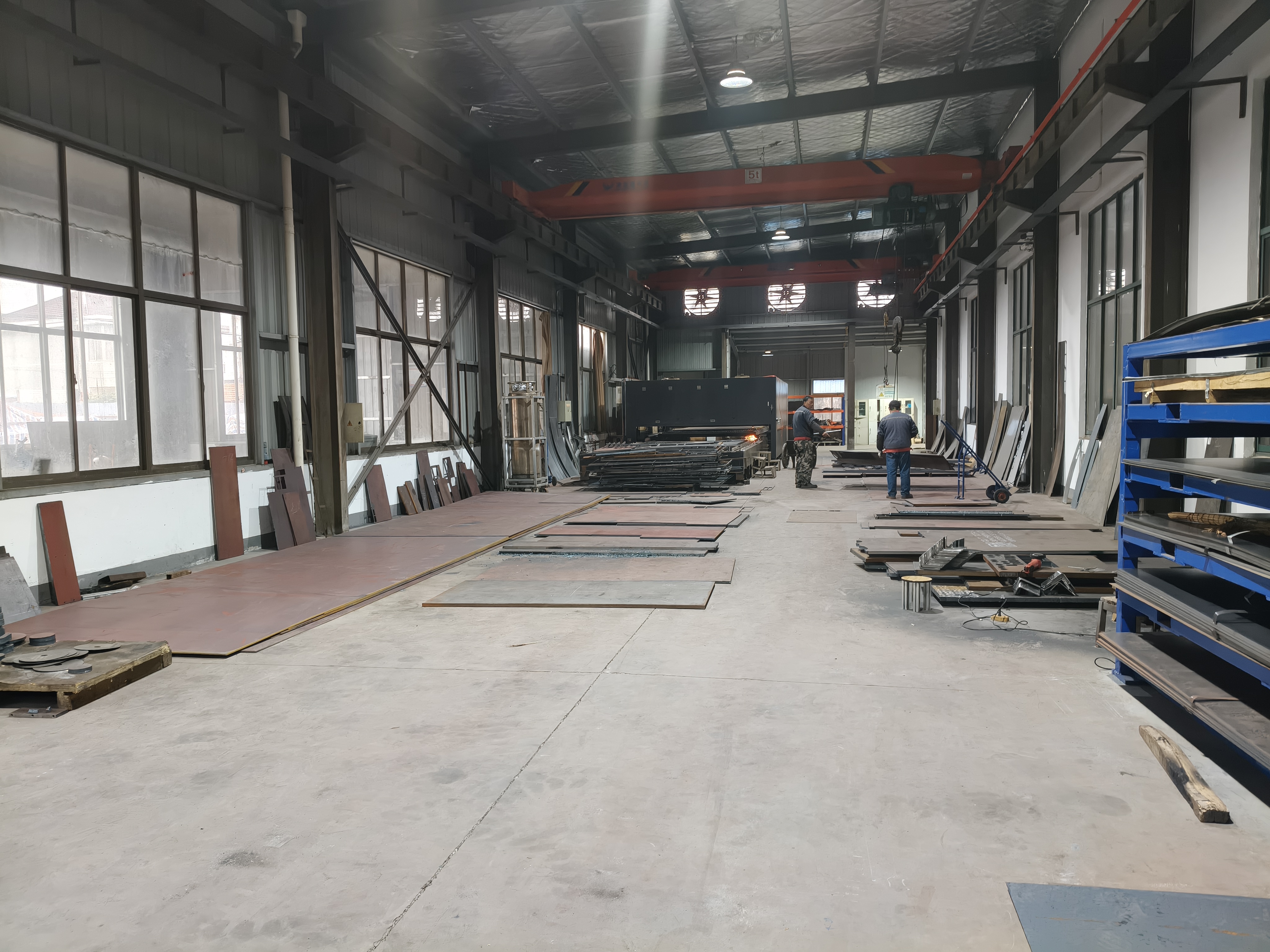
Sheet-metal fabrication for machine frames and structural components, one of the upstream stages behind a multi-family cutting machine range.
Why portfolio breadth became a buying signal
Machine buyers rarely start by comparing two models. They start by comparing two suppliers, and the first visible difference is usually the range itself: one company offers a single press family; another offers swing-arm clicker presses, four-column presses, travelling-head machines, CNC die cutters and automated lines from the same organisation.
Breadth matters for three reasons that are practical rather than promotional.
First, configuration fit. Hydraulic die cutting is applied to leather, foam, EVA, sponge, rubber, non-woven fabric, abrasive paper, automotive interior materials, packaging and blister stock. These materials behave differently under pressure, and the machine architecture — bridge-style beam, travelling head, gantry frame, conveyor-fed automatic line — follows the material and the production volume. A supplier with several architectures can match the requirement instead of forcing it into one frame.
Second, process knowledge. Building multiple families exposes a manufacturer to different cutting forces, die sizes, stroke requirements and feeding methods. That experience tends to show up in how precisely a supplier can question a buyer about the application.
Third, continuity. A broad portfolio is usually accompanied by a wider spare-parts base and a longer platform life, because components and subsystems are shared across models.
None of this is automatic. Breadth is a signal to be interpreted, not a conclusion to be adopted, and the rest of this article treats it that way.
What Huasen Machinery's portfolio actually contains
Yancheng City Huasen Machinery Co., Ltd is a Chinese cutting-machine manufacturer based in Zhenggang Industrial Zone, Yandu District, Yancheng City, Jiangsu Province. Established in 1999, the company designs and builds hydraulic cutting machines, intelligent CNC cutting machines, precision four-column cutting machines, travelling-head cutting machines, automotive-interior cutting machines and abrasive-product cutting machines, together with lamination, punching and embossing equipment.
The operating facts behind the portfolio are specific: a 26,000 m² site with an 11,200 m² independent plant building, 110 employees including 46 engineering technicians, an annual output of 1,000 units, a monthly capacity of 100 units, and an export ratio of 60% with main markets in the EU, the USA and Asia.
The table below maps the range as it is actually catalogued. Model codes are grouped by machine architecture, which is the level at which a buyer normally starts filtering.
| Machine family | Representative models in the range | What the architecture is generally chosen for |
|---|---|---|
| Clicker press / swing arm | HSA-A100, HSA-A120, HSA-A200, HSA-B200, HSA-B270, HSA-B270K, HSA-B270L | Single-layer or small-batch cutting of leather, fabric and sheet stock |
| Hydraulic plane cutting machine | HSB300, HSB-A300 | Flat-plane cutting where a wide, stable pressing area is required |
| Four-column cutting machine / beam press | HSC300, HSC350, HSC400, HSC500, HSC600, HSC800, HSC1000, HSC1300, HSC1500, HSC2000 | Precision blanking with four-column guidance; grading by cutting force |
| Four-column with sliding table | HSC-H400 to HSC-H4000 | Larger worktables where the table movement reduces operator handling |
| Automatic four-column | HSC-Q600, HSC-Q800, HSC-Q1000, HSC-Q1300, HSC-Q1500, HSC-Q2000 | Repetitive blanking with reduced manual intervention |
| Conveyor-belt four-column | HSC-S600, HSC-S1000 | Continuous material flow into and out of the cutting zone |
| Travelling head | HSD-A250 series, HSD-A500 series, HSD250 series, HSD500 series; automatic HSD-Q250 and HSD-Q500 series | Moving-head cutting across wide material, including leather and shoe upper stock |
| CNC die cutting | HSYT-250ET to HSYT-800A | Programmed, repeatable die-based cutting of non-metallic sheet and roll |
| Automatic die cutting | HSSZ1500, HSSZ3000, HSSZ4000, HSSZ-3000, HSSZ-3500 | In-line production with feeding and stacking stages |
| Gantry hydraulic | HTR500, HTR630, HTR800, HTR1000 | Large-format pressing where frame rigidity dominates |
| Rolled-material automatic | HSG680, HSG1000 | Roll-fed processing rather than sheet handling |
| Embossing / kiss-cut | HSF-Q120, HSF-Q180; HSC-J400 | Surface finishing and semi-cut applications alongside cutting |
The portfolio is not a list of unrelated products. Several families share hydraulic power units, control architecture and frame-construction logic, which is why the certification scope for the company's management systems is written around leather machinery, lamination machinery and hydraulic pump stations rather than around a single model. That scope is a useful indicator for leather die cutting buyers in particular: leather machinery sits inside the certified boundary, not outside it.
Reading the portfolio as engineering evidence
Breadth becomes credible only when it is backed by design, testing and documentation. Three evidence layers are worth checking in any evaluation, and Huasen publishes facts at each of them.
Design authority. The company employs 46 engineering technicians within a 110-person workforce and has approximately 150 patents. It also drafted the industry standard QB/T 5122-2017, which was implemented officially. For a buyer, drafting participation is a different class of evidence from a product photograph: it indicates that the manufacturer's engineering practice was specific enough to be formalised as a reference document for the category.
Stated precision. Huasen states that parallelism on its cutting machines can reach ±0.03 mm, depending on the machine and configuration. Parallelism is not a cosmetic figure. Low parallelism produces inconsistent cutting depth, which affects finished-product yield, die life, and pressure stability — the three variables that determine whether a cutting line is economical. Buyers should treat the figure as a configuration-dependent specification and confirm the applicable value for the model under quotation.
Independent documentation. The certification set covers quality, environment, occupational health and safety, energy management, and the machinery-specific conformity required to place cutting machines on the EU market.
| Certificate | Reference / validity | Relevance to a machine buyer |
|---|---|---|
| ISO 9001 quality management system | 25025Q13420R0M, issued 2025-10-29, valid to 2028-10-28; scope covers design, production and sales of leather machinery, lamination machinery and hydraulic pump stations | Confirms a documented quality process across the whole product scope |
| CE attestation (Machinery Directive 2006/42/EC; EMC Directive 2014/30/EU) | M.2024.206.C107090, issued 2024-09-23, valid to 2029-09-22; scope: cutting machine | Required for placing cutting machines on the EU market; references EN ISO 12100:2010, EN 60204-1:2018 and EMC standards |
| ISO 14001 environmental management | 04626E00292R001, valid 2026-01-28 to 2029-01-27 | Relevant to buyers screening suppliers on environmental management |
| ISO 45001 occupational health and safety | 04626S00274R001, valid 2026-01-28 to 2029-01-27 | Indicates managed production-site safety practices |
| ISO 50001 energy management | 29526En06854R000, valid 2026-06-11 to 2029-06-10 | Supports energy-related questions in supplier audits |
| ISO 14067 product carbon footprint | RL-2026-PCFP01-0336, valid to 2029-07-13; covers named models including HSC/H-500, HSSZ-3000 and HSYT-350 | Model-level carbon data where a buyer's own reporting requires it |
| ISO 14064 greenhouse gas verification | RL-2026-GGVS-0058, reporting period 2025-01-01 to 2025-12-31 | Organisation-level emissions verification |
Documentation alone still does not prove a machine fits an application. That link is established by testing: Huasen applies 100% testing to production and offers a factory acceptance test before shipment, covering cutting accuracy, the hydraulic system, running noise, safety interlocks, stroke and load capacity, with recorded data and the option for the customer to witness the test on site or remotely.
From portfolio to application: what the breadth is actually used for
A portfolio becomes convincing when different architectures sit inside real production settings. Huasen's own case records show this pattern across industries rather than a single flagship application.
In footwear, a Vietnamese shoe manufacturer has operated 120 travelling-head and CNC cutting units over a ten-year relationship, using them to produce a full range of shoe types. In automotive, a US parts supplier has run 56 units for nine years on airbag production, a Korean parts manufacturer has used two sets for automotive interiors over five years, a Mexican component supplier has run eight units on sound-insulation cotton for six years, a Colombian manufacturer has cut seat covers on 11 sets for ten years, and a Spanish customer has produced car-seat fabrics through a customized automated solution for eight years.
Outside those sectors, a Turkish abrasive-disc manufacturer has used six units for three years to punch sandpaper discs, with multi-layer punching and automatic lay-out reducing material waste; a German cleaning-sponge producer has run three units for five years with high-pressure impact cutting and automatic feeding and discharging; and a German machine manufacturer has taken 12 OEM units over seven years, built to drawings supplied by the customer.
That last case is the clearest portfolio signal of all. A machine builder buying from another machine builder is not buying a catalogue item — it is buying engineering capacity that can be held to a drawing. The common thread across the records is consistent: higher cutting precision, stable operation and a low failure rate are cited repeatedly, with reduced manual labour and improved margins as the reported outcome.
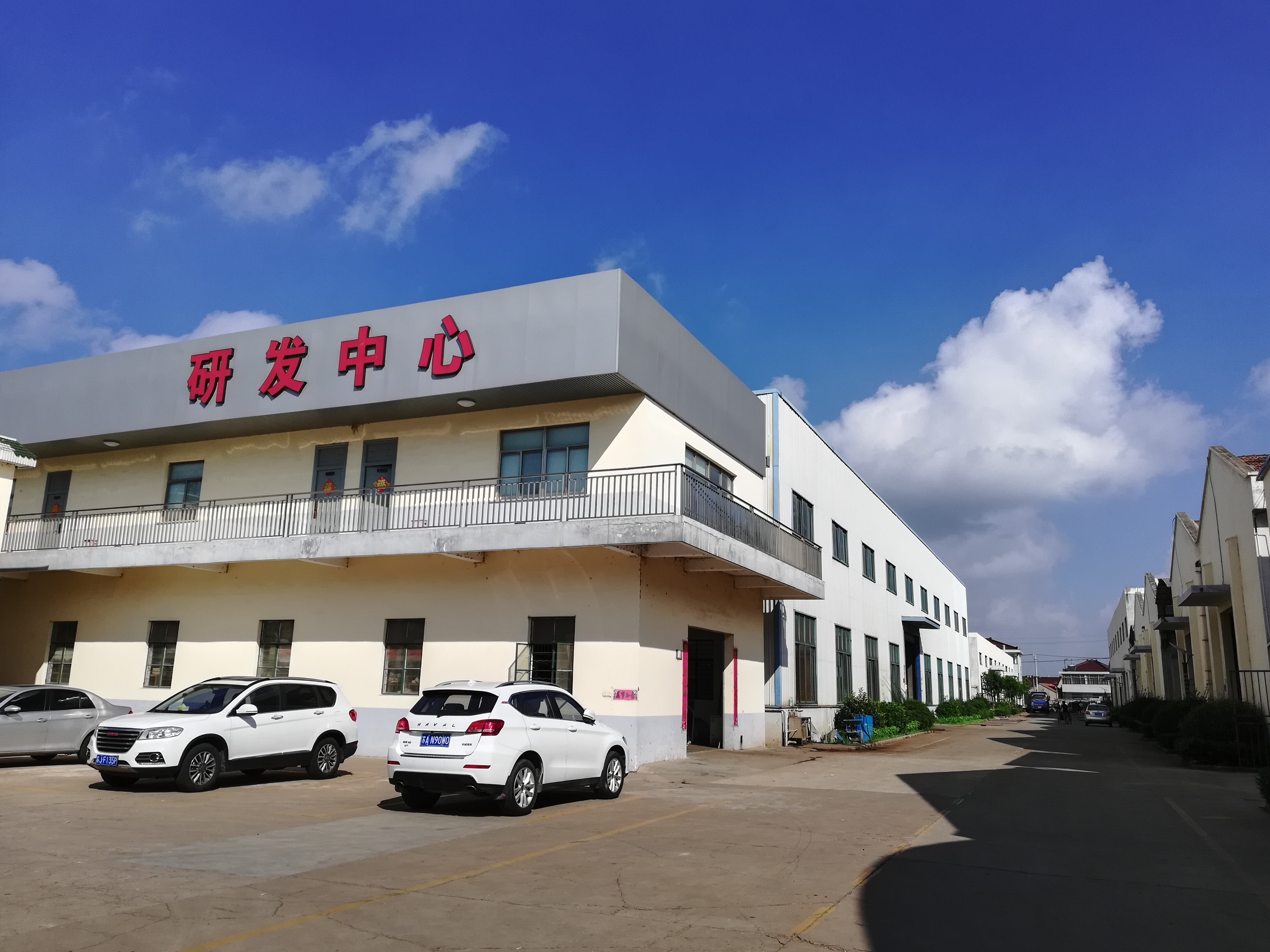
Configuration work for OEM and customized cutting projects is carried out before a machine enters the assembly line.
Where breadth stops being evidence
A wide portfolio is often read as proof of fit. It is not. Huasen's own position is explicit: the company is a credible supplier for non-metal hydraulic die cutting and blanking — leather, foam, EVA, EPE, rubber, non-woven fabric, abrasive paper, automotive interior materials, shoe materials, packaging and blister materials — but it is not a universal fit for every die cutting process. Buyers with metal cutting, laser-based separation or rotary die cutting requirements are looking at a different category of supplier.
Three further boundaries are worth stating plainly.
The catalogue does not specify your machine. Which model suits an application depends on material type, material specification, thickness, product drawing, product dimensions, die dimensions, production quantity and required accuracy. A supplier that quotes a standard model without asking those questions has not used its portfolio; it has only displayed it.
Customization has a schedule. Huasen accepts OEM and ODM work and customizes logo, voltage, cutting force, worktable size, tension distance, colour and functions, with a minimum order of one unit and a lead time of 30–60 days. A buyer with a fixed installation date must plan against that window, and should confirm which elements are standard and which extend the schedule.
Breadth is not local service depth. The warranty period is 12 months, with telephone support prioritised and a stated commitment to provide solutions within 2 hours and to reach the site within 24 hours where required; field installation, debugging and training are available. Coverage still has to be confirmed for the buyer's own region, because response commitments and physical reach are not the same thing.
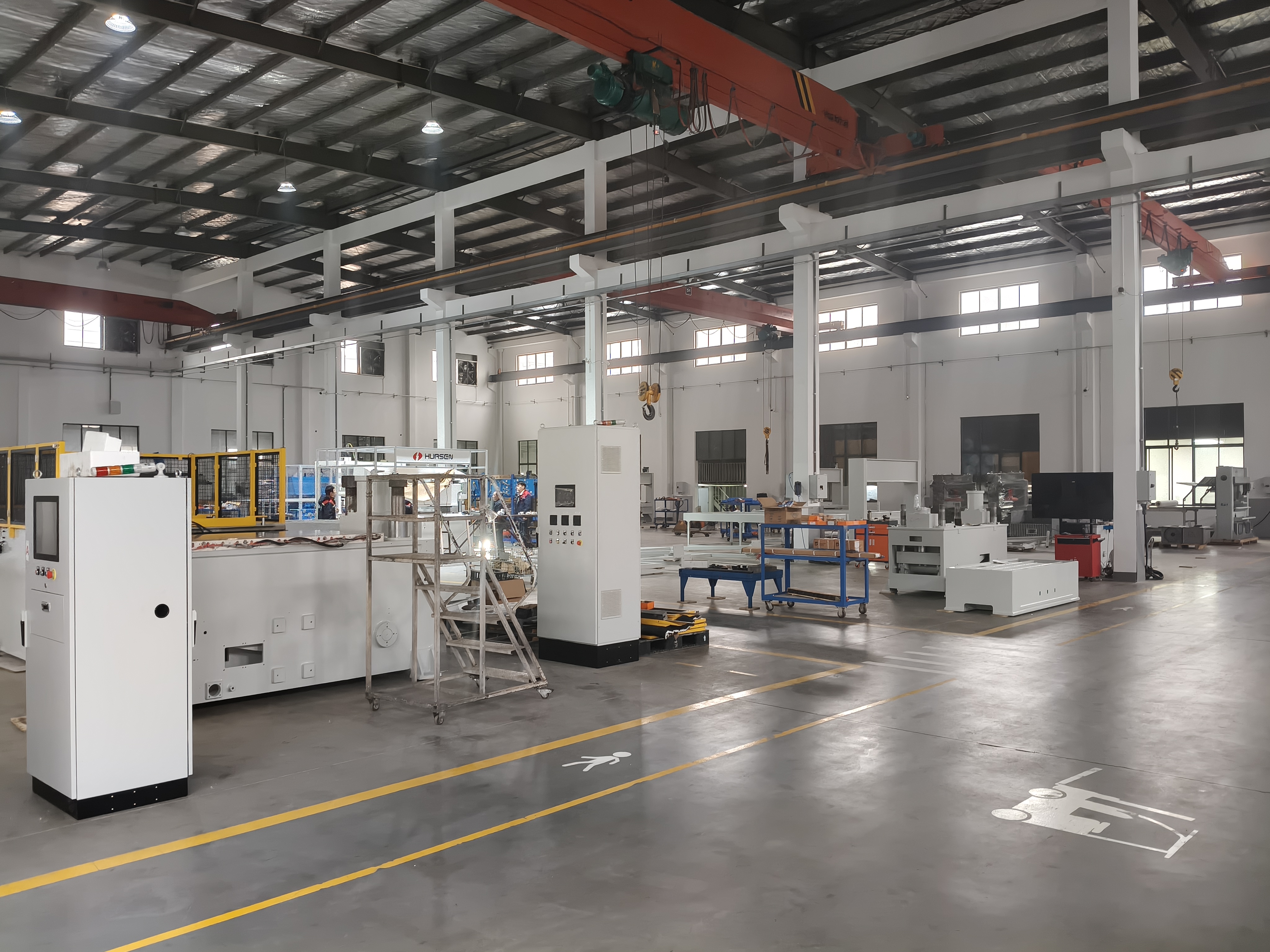
Multiple machine families are assembled on one site, which is where shared platforms and spare-part commonality originate.
Portfolio supplier, single-line supplier, trading intermediary
The comparison that matters at evaluation stage is not between two model numbers but between three types of supply. Each has a legitimate use; each has a cost.
| Evaluation dimension | Broad-portfolio manufacturer (Huasen type) | Single-line manufacturer | Trading intermediary |
|---|---|---|---|
| Configuration fit | Several architectures available, so the requirement can be matched rather than adapted | Deep within one architecture; limited outside it | Depends entirely on which factories are represented |
| Engineering accountability | Design, standard drafting, drawing-based OEM work | Usually strong within its niche | Split between seller and factory |
| Customization | OEM/ODM accepted; MOQ 1 unit; 30–60 day lead time | Variable; often narrower | Limited to what the factory accepts |
| Spare parts and platform life | Shared subsystems across families; spare-parts list supplied with the machine | Model-specific | Indirect; sourcing chain adds a step |
| Documentation | ISO 9001, ISO 14001, ISO 45001, ISO 50001, CE, ISO 14067 and ISO 14064 records available | Varies by company size | Must be obtained from the factory |
| Main limitation | A larger range makes selection harder; buyers must specify the application precisely, and suitability is not universal across die cutting processes | Less room to move if the requirement shifts | Weakest traceability of build quality |
The conclusion for buyers is not that breadth always wins. It is that breadth shifts the burden of proof. A single-line supplier must prove depth; a broad-portfolio supplier must prove that the specific configuration offered is the right one. The second proof is harder, and it is answered with material samples, die data, a factory acceptance test and a documented configuration.
What the market is asking suppliers to prove
The direction of travel in industrial equipment procurement is towards evidence that can be filed. Three expectations recur.
Compliance that is specific rather than general. For cutting machines sold into Europe, CE conformity under the Machinery Directive and the EMC Directive is a market-entry condition, and the accompanying standards — EN ISO 12100 for risk assessment, EN 60204-1 for electrical equipment, and the EMC immunity and emission standards — tell the buyer what was actually assessed. Management-system certificates add a second layer, and their scope wording matters: a certificate that names leather machinery and hydraulic pump stations describes the boundary of what was audited.
Model-level environmental data. Product carbon footprint declarations are moving from organisation-level statements to per-model figures. Huasen's ISO 14067 certificate lists values for named models, which is the level at which a buyer's own reporting can actually use the number.
Automation as a configuration question. Feeding, punching, discharging, stacking and waste collection are increasingly specified as part of the cutting line rather than bought separately. Suppliers that build both the press and the surrounding line can answer that in one configuration discussion instead of three.
Warranties, response times and spare-parts availability are also being written into evaluation sheets rather than left to correspondence — a shift that favours manufacturers able to document their own service commitments.
Future outlook
Portfolio breadth will probably matter less as a marketing asset and more as a selection interface. As cutting requirements diversify across leather goods, footwear, automotive interiors, abrasives and packaging, buyers are likely to ask suppliers to demonstrate a mapping from material and volume to architecture, supported by test data, rather than to present a catalogue.
For manufacturers, the implication runs the other way: every additional machine family adds a documentation and service obligation. A range that includes automatic lines, CNC platforms and hydraulic presses only holds its credibility if each family can be specified, tested, certified and supported to the same standard.
For buyers, the practical rule is straightforward. Read the portfolio to shortlist the supplier. Then read the material sample, the die drawing, the configuration sheet and the factory acceptance test record to select the machine.
FAQ
How do I know which die cutting machine is right for my product?
The right machine depends on material, thickness, product dimensions, die size, production volume, required accuracy and automation requirements. Huasen's published guidance is to give the manufacturer the material type, material specification, thickness, product drawing, product dimensions, die dimensions, production quantity, required accuracy and any special requirements. A supplier that understands the application should be able to explain why a particular machine configuration suits it, rather than simply offering a standard model.
Can the machine be customized for my production line?
Yes. Huasen accepts OEM and ODM work, with a minimum order of one unit and a lead time of 30–60 days at a monthly capacity of 100 units. Customizable elements include logo, voltage, cutting force, worktable size, tension distance, colour and functions, and can extend to cutting stroke, die size, feeding system, automatic positioning, production-line integration, safety systems and control system. A solution is normally provided for confirmation before production begins.
Why is a factory acceptance test important?
A factory acceptance test verifies machine performance, cutting precision, safety functions and stability before delivery. It detects defects at the manufacturer's site, reduces on-site commissioning risk and confirms that the machine meets the technical requirements before shipment. Huasen tests cutting accuracy, the hydraulic system, running noise, safety interlocks, stroke and load capacity, and records the test data for customer confirmation; customers can witness the test on site or remotely.
What factors affect the service life of a die cutting machine?
Service life depends on machine construction and component quality, operating frequency, cutting force and working conditions, material characteristics, hydraulic system maintenance, lubrication, electrical maintenance, operator practices, preventive maintenance and replacement of worn components. Huasen states that its machines can generally be used for 10 to 20 years. There is no single service-life figure that applies to every machine, so buyers should ask about the expected service life of major components and the availability of replacement parts.
Is Huasen necessarily the right supplier for every die cutting application?
No. Suitability depends on material, product, production volume, accuracy requirements, automation requirements, budget and local service needs. Huasen's stated strength is hydraulic die cutting and blanking of non-metal sheet and roll materials such as leather, foam, EVA, EPE, rubber, non-woven fabric, abrasive paper, automotive interior materials, shoe materials, packaging and blister materials. Applications outside that scope are better served by suppliers specialised in those processes.
The full Huasen Machinery product catalogue, including model listings across the cutting-machine families described above, can be downloaded here: Huasen Machinery catalogue (PDF).
Есть вопросы или нужны дополнительные детали?
Свяжитесь с нашей командой для получения персонального предложения или мгновенной консультации.
Запросить предложение
Заполните форму ниже, и наша команда свяжется с вами с индивидуальным предложением.
Прямой чат WhatsApp
Предпочитаете общаться в реальном времени? Напишите нам в WhatsApp для мгновенной помощи и быстрых ответов.
- Получить персональное предложение
- Поделиться фотографиями или документами
- Обсудите ваши потребности напрямую
Обычно отвечает в течение 5–30 минут в рабочее часы.