
What a Frit Plant's Kilns and Mixers Prove About Firing Data
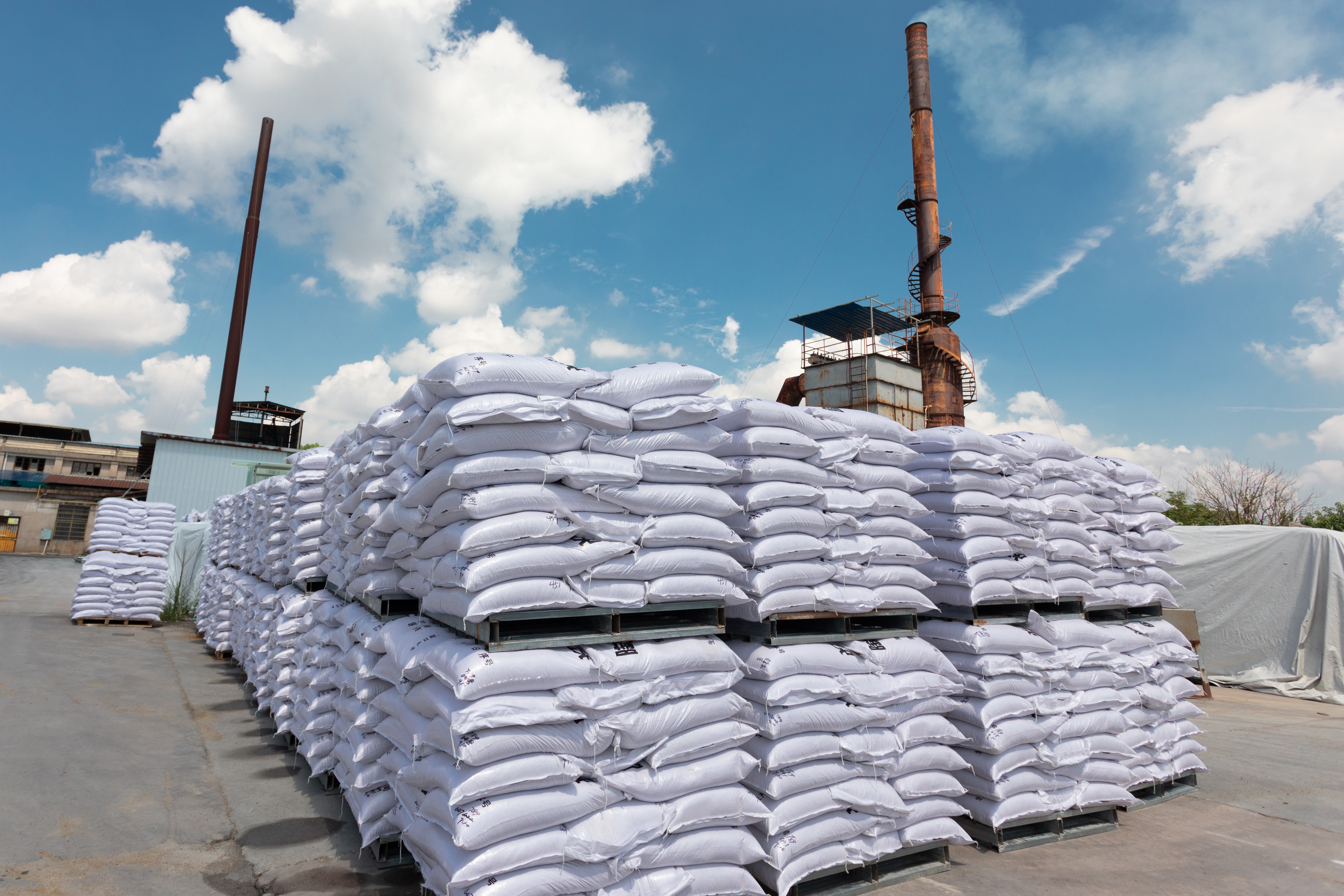
Ceramic frit is a glassy material produced by melting a formulated oxide mixture at high temperature and quenching it rapidly before milling. The melting and quenching steps fix the chemistry that later governs gloss, matte level, opacity, and glaze fit. That is why the kiln and the mixing line, rather than the product brochure, are the first places a buyer can test a supplier capability claim against something physical.
Suppliers evaluated at the shortlisting stage usually present broadly similar documents: a product list, an oxide range, a firing temperature, and a customer reference. These documents rarely differ enough on their own to separate one supplier from another. What separates them is whether the supplier can connect those documents to real equipment and to recorded firing behaviour, and whether the buyer knows which questions expose the difference.
Why kilns and mixers are the first evidence to request
Glaze defects that surface in a customer's kiln generally begin upstream of that kiln. Incomplete melting leaves unmelted or partially reacted material in the frit. Uneven mixing leaves local chemistry differences within a batch. An unstable quench changes the glass structure and therefore the milling behaviour and the softening characteristics downstream. None of these problems can be diagnosed from a certificate. They can only be reasoned about from the equipment that produced the frit and the records that equipment generated.
Two assets carry most of the diagnostic value:
- The melting kiln. Kiln type, firing curve, holding time, and discharge method together define the thermal history of the melt. A supplier that describes them in specific terms is describing a process it controls. A supplier that answers only with a temperature copied from a specification sheet is describing a number, not a process.
- The mixing and preparation line. Weighing accuracy, mixing sequence, and material handling decide whether the batch entering the kiln matches the formulation on paper. For engobe and glaze preparation the same logic applies one step downstream, where frit is combined with clay, feldspar, and other components before application.
The practical implication is that “do you have a kiln” is a weak question. “What kiln, what schedule, and what did the last batch actually record” produces evidence. A supplier audit built around the second question tends to shorten a shortlist quickly, because the answers either exist as documents or they do not.
There is a second, quieter benefit. The sequence in which a supplier answers reveals how it thinks about process control. Suppliers who lead with mixing practice and melt records usually have a technical team that already investigates defects at the body level. Suppliers who lead with price per tonne and free samples usually treat frit as a commodity input, which is acceptable for forgiving applications and risky for tight glaze specifications.
| Evidence requested | What it establishes | What it does not establish |
|---|---|---|
| Kiln type, firing curve, and holding time | That a controlled melting regime exists and can be described | That a given frit will perform in a specific customer kiln |
| Mixing, weighing, and preparation equipment | Basis for batch-to-batch chemical consistency | Compatibility with a particular ceramic body |
| Recorded firing window per product | The temperature range a product is designed to work within | A guaranteed surface result anywhere inside that range |
| Coefficient of thermal expansion value | A starting point for body-to-glaze expansion matching | A verdict on crazing or peeling risk by itself |
| Trial production on the customer's body | Practical fit under real firing conditions | Long-run stability across every production line |
| Capacity and output figures | Scale available to support supply | A lead time or delivery commitment |
What RENOVA's plant footprint establishes before any technical claim
RENOVA INDUSTRIAL & TRADING CO., LTD is an integrated ceramic materials manufacturer and trading company based in Foshan, Guangdong, China, supplying ceramic frits, ceramic glazes, and related ceramic materials to tile and quartz slab producers.
Its verifiable physical base is specific rather than general. The factory was established in 2011 and covers 10,000 m². The company employs approximately 50 people and reports combined annual production capacity across its facilities of 40,000 tons, with monthly production capacity of up to 3,500 tons. The technical team numbers 29 technicians covering research and development, production technology, and application support. RENOVA describes more than 30 years of ceramic manufacturing expertise and reports an export share of around 10%, with Southeast Asia as its main export market.
Read as evidence rather than as promotion, these figures answer a different set of questions than a product list does. An annual capacity of 40,000 tons against a workforce of roughly 50 implies a capital-intensive, continuous process rather than a labour-intensive one, which is consistent with industrial melting equipment rather than small batch furnaces. A 29-person technical team against that output implies that formulation work and application support are resourced separately from production scheduling. Neither fact proves glaze quality inside a specific customer kiln. Both narrow the range of suppliers worth auditing, and both are checkable during a site visit.
For a buyer at the evaluation stage, the useful move is to treat plant facts as a filter and product data as the second gate. A supplier that passes the plant filter has the physical means to support a claim. The product data then has to survive a trial.
The technical chain: from mix preparation to a documented firing window
The chain a buyer should be able to trace runs in one direction: formulation, weighing and mixing, melting, quenching, drying and milling, application, and finally firing in the customer's kiln. Each link carries its own evidence, and firing data only means something once the earlier links are known.
Mixing and preparation sit at the start of that chain for a reason. A frit formulation is an oxide recipe, and small weighing errors in minor components can shift melting behaviour and therefore the surface result. The same applies at the engobe and glaze preparation stage, where frit is blended with other raw materials: preparation equipment determines whether the delivered slip or powder is uniform, and uniformity determines whether a defect appears as a pattern across a kiln car or as an isolated tile.
Firing temperature is the most quoted and least useful number in isolation. Within the RENOVA product range, documented firing windows include 1050–1100°C and 1080–1180°C. The two windows serve different application contexts, with the lower window used in lower-temperature glaze work and the higher window used under standard tile firing conditions. The relevant question for a buyer is not which number is higher, but which window matches a specific body, kiln, and cycle.
A firing window is a working range, not a guarantee. Inside the same window, one frit can produce visibly different surfaces depending on heating rate, holding time, kiln atmosphere, and glaze layer thickness. This is precisely why the useful supplier conversation moves quickly from “what temperature” to “what happened at that temperature in your last trial, and can I see the record”.
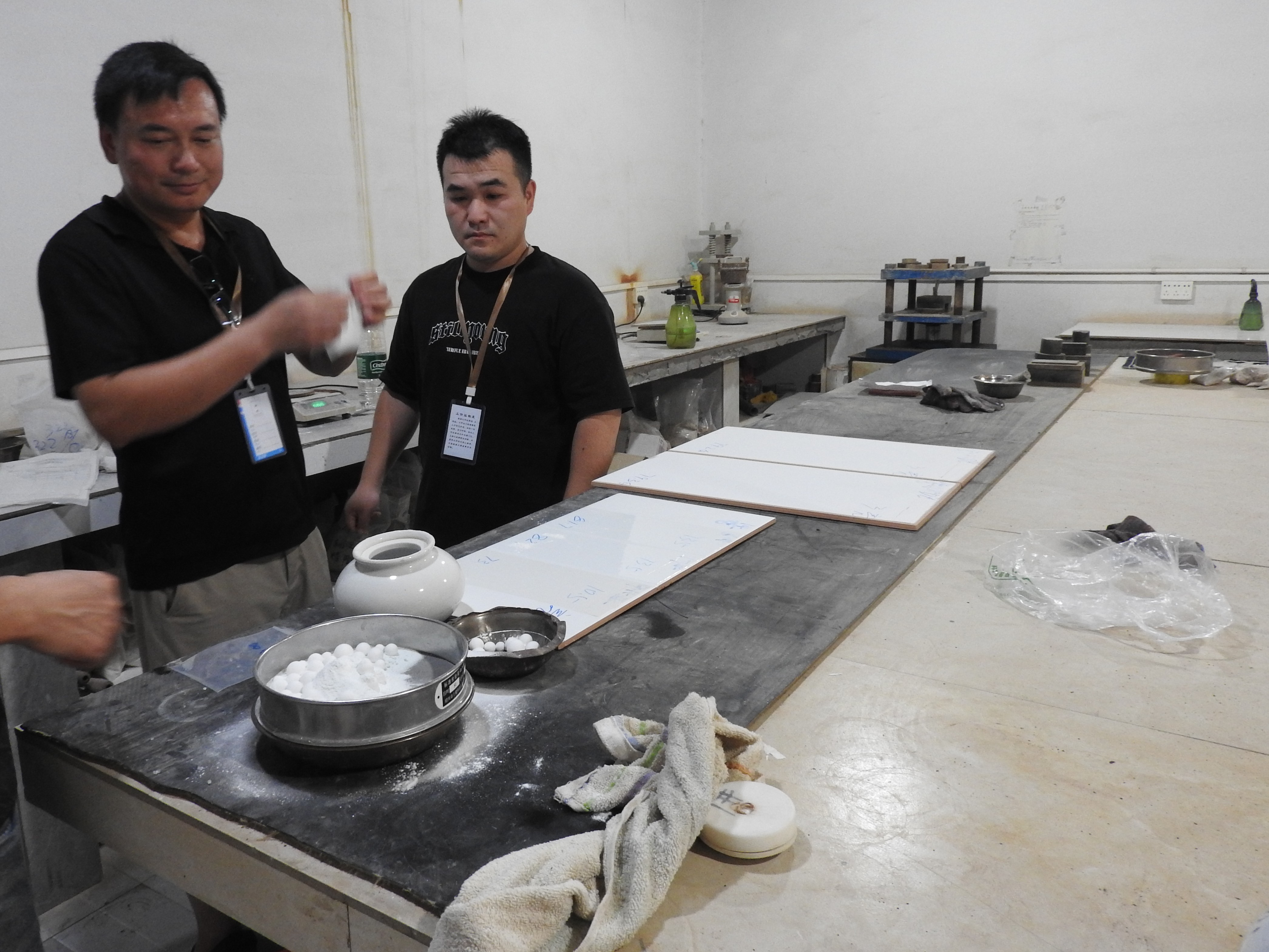
Titanium Frit RFT8-7-HH: reading the recorded numbers correctly
Titanium-bearing frits are widely used to raise opacity and to adjust melting behaviour in glaze and engobe layers. Titanium Frit RFT8-7-HH sits inside a titanium frit series that also includes RFT8-9-HL, RFT8-7-LL, and RFT8-7-HL: distinct grades within one product family rather than a single universal product. That distinction matters during evaluation, because a grade that suits one body and firing cycle is not automatically the grade that suits another.
For RFT8-7-HH, the documented coefficient of thermal expansion is 290. The value matters because glaze fit is a mechanical problem before it becomes an appearance problem. A glaze layer and the ceramic body beneath it expand and contract at different rates during heating and cooling, and the mismatch generates stress that can show up as crazing, peeling, or delayed failure. A documented expansion value gives a technical team a defined starting point for matching a frit to a body and a firing cycle.
It is equally important to be precise about what the number does not do. A single expansion value does not by itself predict crazing or peeling, because the stress in a finished tile also depends on the body formulation, glaze thickness, cooling curve, and the other components in the recipe. The value is a screening input for technical evaluation, not a pass-or-fail certificate, and any supplier presenting it as the latter is overselling a data point.
Where the physical evidence stops
Physical evidence is stronger than a claim, but it has boundaries. A supplier willing to state them is generally easier to trust than one that does not.
- Equipment proves capability, not fit. A kiln confirms that a supplier can melt frit. It does not confirm that a particular grade suits a particular body.
- Firing windows are ranges. Both 1050–1100°C and 1080–1180°C describe where a product is designed to work, not what will happen in every kiln that reaches those temperatures.
- Expansion values are inputs, not verdicts. A coefficient of 290 for RFT8-7-HH supports technical matching; it does not replace a trial.
- Capacity is not lead time. Monthly capacity of up to 3,500 tons describes production scale. Lead time depends on the order, and MOQ depends on the order as well.
- Customization requires trial work. Formulation and specifications are adjusted to the customer's ceramic body, kiln type, firing temperature, and production process. That adjustment is validated through trial production and finished-tile evaluation, not agreed on paper alone.
For a buyer, this boundary list is itself a screening instrument. A supplier that acknowledges the boundaries is describing a real process with real constraints. A supplier that promises a guaranteed outcome from a data sheet alone is describing a sales position, and the gap between that position and production reality will appear later at the buyer's expense.
Application evidence: a 1,000-tonne titanium frit programme in Thailand
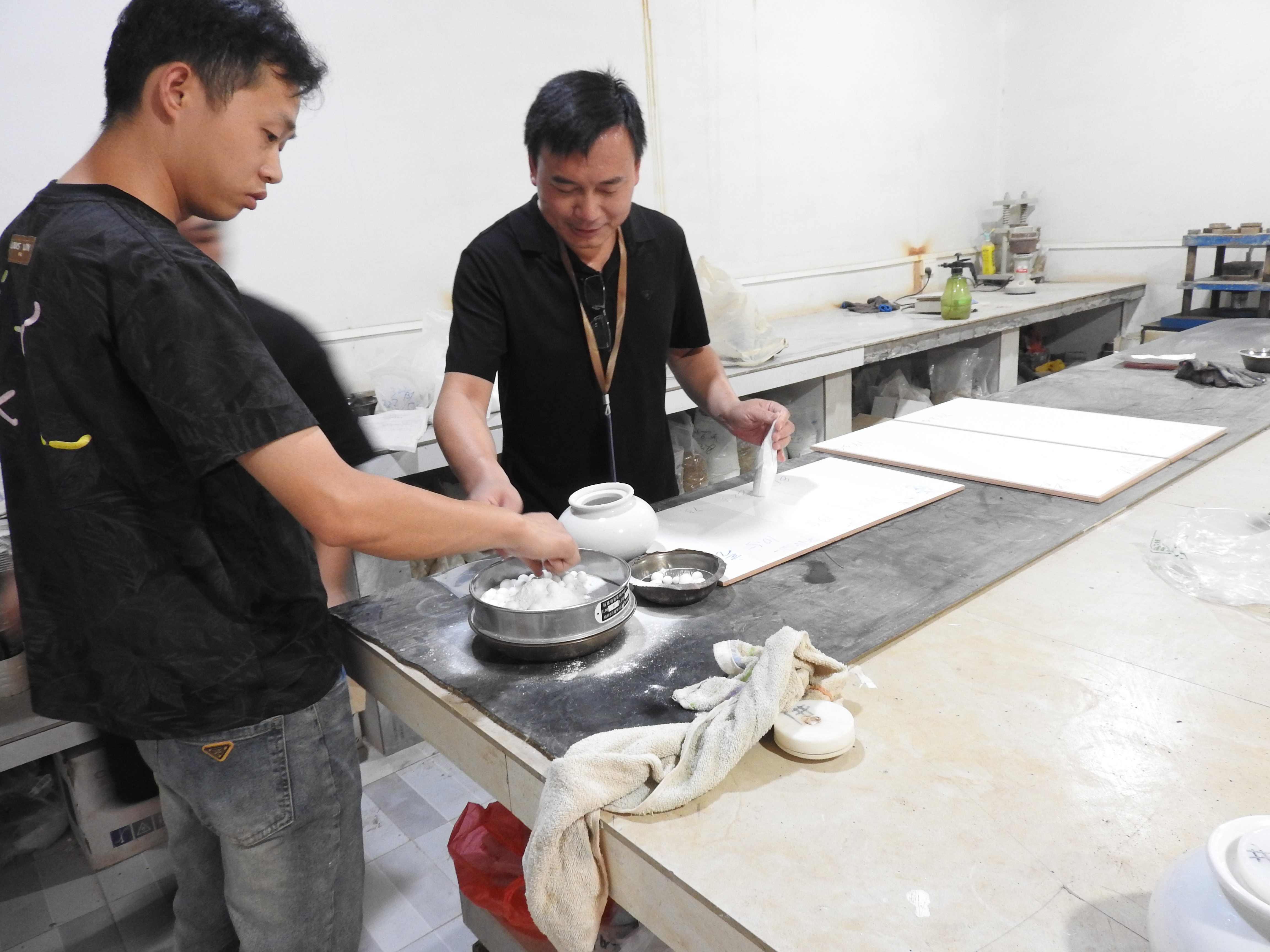
A recorded case shows how the chain works outside a laboratory. A ceramic tile manufacturer in Thailand took 1,000 tons of titanium frit over a one-year period for ceramic wall tile, floor tile, and ceramic glaze applications. The reported outcome was stable performance in the production process and consistent results after firing, with the frit adapted to the manufacturer's production conditions through technical support.
The instructive detail is not the tonnage. It is that the programme required adaptation rather than straight catalogue supply: the frit was adjusted to the customer's body, kiln, and process. That is the same sequence the equipment evidence points to, applied at a customer site instead of in a supplier's own plant. It also illustrates why the technical team size matters as evidence, because adaptation work is labour-intensive even when melting is not.
Market context: why verification expectations are shifting
Ceramic frit is a concentrated industry, and concentration raises the value of verification. Commercial research on the category estimates the global ceramic frit market at USD 4.442 billion in 2025, with forecast coverage extending to 2035. The same body of research identifies alkaline-boron frit as the dominant product type at 38.7% of the market in 2025, and places China at approximately 65% of global production and market share. The trade classification for vitrifiable enamels and glazes is HS 3207.20.
| Market indicator | Reported value | Buyer interpretation |
|---|---|---|
| Global ceramic frit market value | USD 4.442 billion (2025 estimate) | Directional scale reference only; valuation depends heavily on product scope |
| Dominant product type | Alkaline-boron frit, 38.7% share (2025) | Most quotations will cluster around similar chemistry |
| Production concentration | China, approximately 65% share | Supply concentration makes process verification more important |
| Trade classification | HS 3207.20 | Customs and documentation reference for vitrifiable enamels and glazes |
The interpretation is straightforward. When a large share of global supply sits in one production region and one product family dominates demand, most quotations will look alike and most suppliers will describe similar ranges. Differentiation then has to come from documented process evidence rather than from the product list. This is a market-structure argument; it is not a claim that any specific supplier outperforms another.
Buyers should also handle published market values with care. Estimates for the same year range widely across research providers, from roughly USD 1.9 billion to USD 4.4 billion depending on which products are counted. Those figures are useful for framing a category, not for negotiating a tonne price, and any buyer using them for planning should ask which product scope a number includes.
How this compares with conventional supplier selection
The conventional selection path is price first, sample second, factory visit optional. It works when the application is forgiving and the volume is small. It becomes expensive when a glaze defect appears in continuous production, because the cost of a failed tonne usually exceeds the difference between two quotations by a wide margin.
An evidence-led path inverts the order. Equipment and firing records come first, product data second, price last. The trade-off is real and should be stated plainly: evidence-led selection costs more at the front end. It takes longer, it requires the buyer's technical team to read firing records and expansion values, and it may narrow the supplier list before a single price has been compared. For a buyer running one trial kiln, or sourcing small volumes for a specialty decorative line, that front-end cost may not be justified, and a simpler sample-based approach is a reasonable choice.
For buyers running continuous tile production across several lines, the calculation usually reverses. The verification effort is a one-time cost measured against a recurring production risk, and a supplier that can supply kiln records, mixing practice, and documented firing windows in the first technical exchange is a lower-risk counterparty than one that cannot.
Future outlook
Three developments are likely to shape how frit suppliers are evaluated over the next few years. First, firing data and expansion values are moving from request-only documents toward expected attachments in a technical quotation, which makes the supplier conversation more technical and less price-anchored. Second, product development is broadening beyond standard tile frit: RENOVA has developed silica-free quartz frit for quartz slab production, currently supplied to selected domestic and international customers, with plans to expand capacity as demand develops. Product areas of that kind place heavier weight on process documentation than mature tile frit categories do. Third, as low-temperature and high-temperature glaze systems diverge further, the ability to state a firing window precisely and defend it with trial records becomes a qualification criterion rather than a courtesy.
The verification sequence described here is not complicated, but it does require documents that many suppliers do not routinely prepare. Buyers who ask for kiln configuration, mixing practice, recorded firing windows, and expansion values before discussing price will find the shortlist shortens quickly, and that the suppliers remaining on it answer with records rather than adjectives. A technical catalogue covering the frit and glaze range is available for reference.
Download the RENOVA ceramic frit and glaze catalogue (PDF)
FAQ
Can samples be provided before an order is placed?
Yes. Samples can be provided after a suitable product has been identified for the buyer's requirements and production conditions. Samples are used for testing and evaluation before an order is placed.
Can a frit be recommended for specific production conditions?
Yes. A product can be recommended based on the buyer's specific production conditions. The technical evaluation typically considers raw materials, kiln type, firing temperature, and production process before a grade is selected from the range.
What are the minimum order quantity and delivery time?
Both depend on the specific product and the order details. MOQ and lead time are determined per product and per order quantity rather than set as fixed values across the range.
What happens if the finished product does not achieve the expected result after the frit is applied?
Factories differ in body materials, kiln types, firing temperatures, and production processes, and those differences can affect final results. Technical support covers on-site assistance, formulation adjustment, production process guidance, and after-sales technical service to optimize the application.
Which ceramic companies has the supplier served?
Customers include ceramic brands such as Marco Polo, Monalisa, Hongyu, and Arrow.
Есть вопросы или нужны дополнительные детали?
Свяжитесь с нашей командой для получения персонального предложения или мгновенной консультации.
Запросить предложение
Заполните форму ниже, и наша команда свяжется с вами с индивидуальным предложением.
Прямой чат WhatsApp
Предпочитаете общаться в реальном времени? Напишите нам в WhatsApp для мгновенной помощи и быстрых ответов.
- Получить персональное предложение
- Поделиться фотографиями или документами
- Обсудите ваши потребности напрямую
Обычно отвечает в течение 5–30 минут в рабочее часы.