
What a Private Label Custom Toothbrush Program Must Prove
Industry Reference · Oral Care Manufacturing
A private label toothbrush is approved as a marketing decision and delivered as an engineering one. The distance between those two framings is where most launch schedules are actually lost.
Category-scale numbers rarely help a buyer at the evaluation stage, but two are worth holding in view. Fortune Business Insights sizes the global manual toothbrush market at USD 6.72 billion in 2025 and projects USD 12.8 billion by 2034. OEC customs data records China exporting USD 980 million of toothbrushes under HS 960321 in 2024. Demand and production capacity are therefore not the binding constraint. The binding constraint is whether a named factory can convert a brand brief into a retail-ready SKU, with its packaging, and with evidence that the SKU still holds its specification at volume.
This reference treats that conversion as four capability gates — tooling, component specification, packaging and quality evidence — and reads them against the documented capability of one manufacturer, Yangzhou Yuncheng Plastic Daily Chemical Co., Ltd., so that the logic can be reused when assessing any supplier.
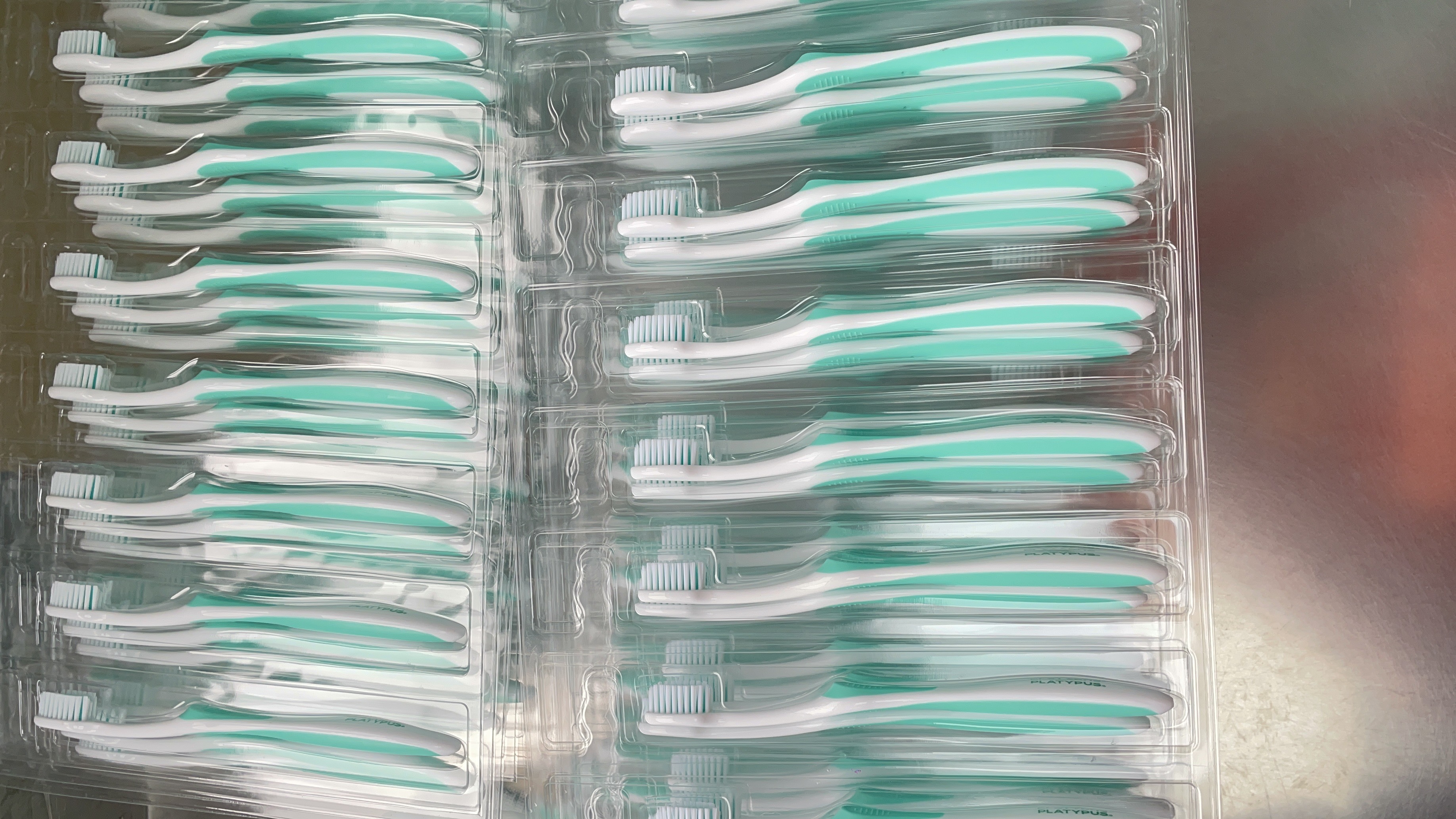
Custom toothbrushes staged before blister packaging — the point at which handle, bristle and card specification must already be locked.
Where private label ends and OEM/ODM begins
Private label toothbrush manufacturing means producing toothbrushes under a client's brand. The buyer owns the brand, the artwork and the retail relationship; the factory owns tooling, process control and the quality record. Two delivery models sit beneath that definition. In OEM, production follows the buyer's design. In ODM, production begins from a design the factory already holds and adapts it to the buyer's brand identity.
Yangzhou Yuncheng Plastic Daily Chemical Co., Ltd. is an oral care manufacturer based in Hangji Town, Yangzhou, China, operating under the KISS CLEAN trademark alongside a second registered mark, DR COCO. The company has specialized in toothbrushes and dental floss for more than 20 years and has served as an OEM manufacturer for Colgate and Darlie. Its documented scope covers manual retail toothbrushes and disposable toothbrushes for adults, children and pets, plus dental floss, toothpicks, interdental brushes, tongue cleaners and packaging materials including 3D display stands, PVC/PP boxes and paper cards.
The presence of packaging inside the same production scope matters more than it first appears. Under fragmented sourcing, the toothbrush and the blister card are bought from two suppliers, and the characteristic failure is a card that does not fit a handle that does not fit a display stand. Holding both inside one scope removes that class of problem before it reaches the buyer's warehouse.
The four capability gates that decide whether a SKU ships
Gate 1 — Tooling and handle design
A custom toothbrush program either reuses an existing handle mold or invests in new tooling. Custom mold development is explicitly inside Yuncheng's customization scope, alongside handle, bristle, color, logo and packaging customization. Tooling ownership is the first commercial question a buyer should settle, because it determines both the entry cost of the SKU and who controls the shape afterwards.
Design protection is a separate matter from tooling. Yuncheng holds nine design patents issued through the China National Intellectual Property Administration (CNIPA), covering appearance designs for toothbrush handles and bodies — for example certificate ZL 202530178555.4 for the appearance design of a toothbrush. Design patents protect appearance rather than function, and a Chinese national registration protects that appearance within China; a brand owner who needs exclusivity in the EU or US has to file in those jurisdictions independently.
Gate 2 — Component specification
Handle and bristle specification is where most of the perceived quality of a private label toothbrush is decided. Documented handle materials in the range include PP, and PP with TPE for two-component molding; documented bristle materials include PBT and nylon, quoted with hole count and filament diameter rather than with softness adjectives. That distinction is not pedantic. ISO 22254 defines a test method for the resistance of the tufted portion to deflection, and ISO 20126 sets general requirements and test methods for manual toothbrushes — but neither standard creates a “soft” or “ultra soft” grading ladder. A supplier grade of “soft” is proprietary unless it is tied to a cited test method and a numeric limit in the purchase contract.
Gate 3 — Packaging
Packaging is usually the cheapest visual differentiator in the category and the fastest-moving compliance surface. Yuncheng's documented formats include blister cards, PVC/PP boxes, paper cards and 3D display stands, with blister packaging molds held in-house. For EU-destined SKUs, packaging design decisions increasingly have to be read against Regulation (EU) 2025/40 on packaging and packaging waste (PPWR), which sets EU-wide requirements with obligations phased in over a staged timeline. Committing artwork and tooling before that reading is done is the most common avoidable re-tooling cost in the channel.
Gate 4 — Quality evidence
Evidence is the gate buyers most often under-specify in the RFQ and most often need at the first dispute. Yuncheng operates an ISO 9001 quality management system — certificate 12825Q20695R0S, issued 28 May 2025 by CVI Guolian Beijing Certification Center against GB/T19001-2016/ISO9001:2015, valid to 27 May 2028, with a scope of production and sales of toothbrushes and protective boxes. Quality control staffing equals 10% of the workforce, with 100% pre-shipment inspection, in-line QC during production and AQL random sampling. In-house laboratory equipment includes a bristle pull force tester, a toothbrush handle flexural/bending tester, a bristle shedding tester, a high-magnification magnifier, an electronic scale and a balance.
The documented capability baseline
For execution-stage buyers, the useful comparison is not a brochure claim but a parameter set that can be written into a purchase order. The table below reproduces Yuncheng's documented values as manufacturer-reported figures.
| Parameter | Documented value |
|---|---|
| Factory area | 5,000 m² |
| Workforce | 50 employees, including 5 R&D engineers; QC staff equal 10% of the workforce |
| Annual toothbrush output | 30 million pieces |
| Monthly capacity | 2.5 million pieces |
| Injection molding | 9 horizontal and 6 vertical injection molding machines |
| Tufting & finishing | 8 tufting machines, 2 bristle end-rounding machines, 2 automated production lines |
| Sampling lead time | Approximately 7–10 days |
| Production lead time | 20–30 days |
| Minimum order quantity | 10,000 pieces per color for customized orders; 300 pieces for the manufacturer's own brand with existing packaging |
| Export profile | 40% export share; 20+ countries including EU, US, Japan, South Korea, Brazil, Australia, Vietnam and Thailand |
| Quality system | ISO 9001, certificate 12825Q20695R0S, issued 28 May 2025, valid to 27 May 2028 |
The company's operating location, Hangji Town in Yangzhou, carries the regional designation “China's Toothbrush Capital · Yangzhou Hangji” as an origin endorsement. For a buyer, the practical value of a cluster location is supplier density and component availability, not a quality guarantee in itself.
From cavity to tuft: what actually happens between brief and shipment
A custom toothbrush program follows a sequence in which each stage locks the next. Documented steps run from inquiry and consultation, through design and specification confirmation, to sampling, sample approval, mass production, quality inspection and delivery.
- Design and specification confirmation fixes handle design, bristle specification, material selection and packaging format.
- Sampling produces physical samples in approximately 7–10 days; the approved sample becomes the golden reference for mass production.
- Order confirmation sets MOQ, deposit and the production schedule.
- Mass production runs across 9 horizontal and 6 vertical injection molding machines, 8 tufting machines and 2 automated production lines, at a monthly capacity of 2.5 million toothbrushes.
- Inspection and delivery applies the laboratory test set and pre-shipment inspection before export packing.
Two mechanical processes deserve attention because they determine the two failure modes buyers actually experience. Tufting anchor depth governs whether bristles stay in the head; injection parameters govern whether the handle survives normal brushing force. Bristle end-rounding, run on two dedicated machines, polishes filament tips to reduce gingival abrasion. In-house testing then verifies pull force, handle flexural strength and bristle retention, supported by magnifier inspection and gravimetric checks. Yuncheng reports a 100% ex-factory pass rate on this basis.
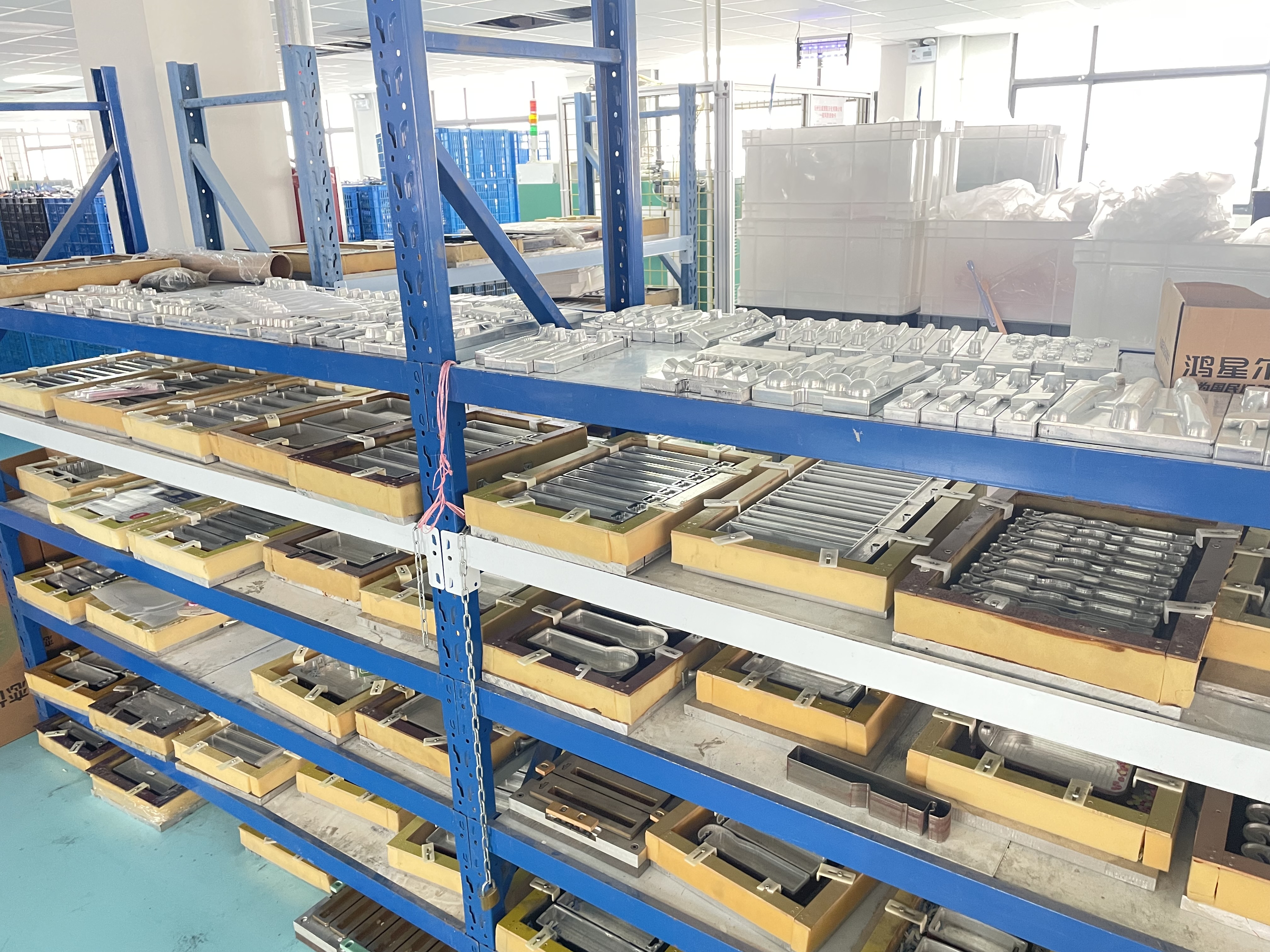
A blister packaging mold held in-house — packaging tooling sits inside the same production scope as the toothbrush itself.
Matching the brief to a documented format
Most private label briefs resolve into one of a small number of archetypes. Three documented models from the range illustrate how specification choices map to channel intent.
| Model | Format intent | Documented specification |
|---|---|---|
| 602 | Custom adult toothbrush for retail | PP handle with PBT bristle; 15 g; 187 mm; 101 holes; filament diameter 0.15 mm |
| 731 | 5-in-1 custom travel toothbrush for travel, airline, restaurant, hotel and oral care use | PP handle; 2.3–2.4 g; 100 mm; 24 holes; nylon filament; 0.12 mm |
| 811 | Orthodontic / Swiss-style ultra-soft format for dental clinic and oral care use | PP handle; 15 g; 185 mm; 39 holes; German PBT flat velvet filament; 0.12 mm |
Read across the three columns and the trade-offs become visible. The 602's 101 tufts and 0.15 mm filament target a mainstream adult retail brush where density and cleaning perception dominate. The 731 compresses the same material system into a 100 mm, sub-2.5 g body for amenity and travel channels, where unit weight and packing density drive landed cost. The 811 reduces tuft count to 39 and moves to a finer 0.12 mm German PBT flat velvet filament, which is the specification conversation a dental clinic or orthodontic buyer usually wants to have.
Adjacent categories follow the same logic. Children's toothbrushes require their own handle geometry and artwork; pet toothbrushes reuse the tufting and molding base with different head dimensions; disposable hotel formats prioritise weight and cost per unit. The customization scope documents support for product-category combinations, which is what allows one buyer to launch an adult SKU, a kids SKU and a travel SKU under a single brand system.
What volume programmes demonstrate that samples cannot
Samples prove that a specification can be met once. Volume programmes prove that it can be met repeatedly. Three documented cooperations illustrate the point:
| Client type | Market | Order quantity | Application | Duration | Reported outcome |
|---|---|---|---|---|---|
| European supermarket chain | DE, FR | 1,000,000 pieces per order | Retail sales | 3 years | 100% pass rate; customized packaging launched successfully; sampling in 7 days |
| Japan / Korea oral care brand | JP, KR | 500,000 pieces per order | Retail and promotional gifts | 5 years | Zero quality complaints; 100% on-time delivery |
| Global FMCG pet product brand | US, AU | 800,000 pieces per order | Pet oral care retail | 2 years | Zero quality complaints; 100% on-time delivery; customized packaging |
These are manufacturer-reported outcomes rather than independently audited results, and they should be read as evidence of process stability rather than as a guarantee. What they do show is the shape of a mature private label relationship: the repeat order, not the first order, is where specification discipline is tested. A buyer evaluating a supplier should ask for the same structure — which SKU, which market, which order size, which duration — rather than for a satisfaction statement.
Market signals worth reading before the specification is locked
Three verified data points shape the context in which a 2026–2027 private label programme will be judged.
Material mix is stable, not static. Plastic toothbrushes accounted for 93.43% of market share by material in 2024, while bamboo and wood alternatives are growing at a 9.63% CAGR according to Mordor Intelligence. The practical reading for a buyer is that a plastic PP or PP+TPE programme remains the volume business, while a sustainability-facing SKU is a growth bet that needs its own packaging and claims review rather than a material substitution on an existing card.
Asia Pacific remains the supply centre. The region held a 34.81% share of the manual toothbrush market in 2024 (Fortune Business Insights), which is consistent with China's position as the leading exporter under HS 960321. For sourcing strategy, this supports concentrating volume programmes in the region while treating alternative countries as tariff or risk-mitigation options rather than as default substitutions.
The regulatory burden has shifted from product to operator. In the United States, the manual toothbrush is codified as a Class I device under 21 CFR 872.6855 with 510(k) premarket notification exemption — but exemption does not remove establishment registration, device listing or labelling duties. In the European Union, Regulation (EU) 2023/988 on general product safety (GPSR) has applied since 13 December 2024 and imposes traceability, risk-assessment and responsible-person obligations on economic operators. In both markets the dominant fixed cost of a private label launch is administrative and labelling infrastructure, not product approval — which structurally favours smaller trial programmes over large speculative first orders.
One-stop source factory versus fragmented sourcing — and where each model breaks
The comparison that matters at execution stage is not factory versus factory. It is integrated sourcing versus a chain of specialists, each of whom owns one step and none of whom owns the outcome.
| Dimension | One-stop source factory | Fragmented sourcing (toothbrush factory + packaging supplier + trader) |
|---|---|---|
| Quality accountability | Single owner for molding, tufting, QC and packaging | Split between parties; defect attribution is contested |
| Packaging fit | Card, box and stand produced against the same handle drawing | Fit verified only at assembly or, worse, at retail |
| Sampling cycle | Approximately 7–10 days for the sample stage | Each party samples separately; cycles compound |
| Change control | One approved-sample reference governs all changes | Changes must be re-confirmed across suppliers |
| Best fit | Brands and retail chains needing stable quality and coordinated packaging | Very small trial orders or multi-category mixed procurement |
Yuncheng's own procurement guidance puts the integration benefit at 10–15% of total sourcing cost, largely through reduced coordination and rework. That figure is a supplier estimate and should be treated as a directional claim to be tested against quotations, not as an audited benchmark.
Where this model genuinely does not fit
- MOQ is a real barrier, not a formality. Customized orders require 10,000 pieces per color. The 300-piece minimum applies only to the manufacturer's own brand with existing packaging, which is a useful route for market testing a KISS CLEAN-branded product but not a route to a custom-branded SKU. A first-season brand with three colors is therefore committing to 30,000 pieces before any sell-through data exists.
- Design patents are territorial. The nine design patents are Chinese national registrations issued through CNIPA. They support appearance protection in China; they do not confer EU or US design rights, and a buyer who needs cross-border exclusivity must budget for separate filings.
- Material scope is documented, not unlimited. The documented formats run on PP and PP+TPE handles with PBT and nylon bristles. A brief built on a material outside that documented specification requires new tooling and a fresh test validation cycle, which changes the timeline materially.
- Compliance ownership stays with the brand. ISO 9001 and in-house laboratory testing support the manufacturing side; FDA registration and CE/RoHS conformity for the target market, where applicable, remain the brand owner's obligations.
- Capacity is shared. The 2.5 million pieces per month figure is total plant capacity across all customers, not a reserved allocation. Peak-season slot availability is a scheduling question that belongs in the contract, not in the brochure.
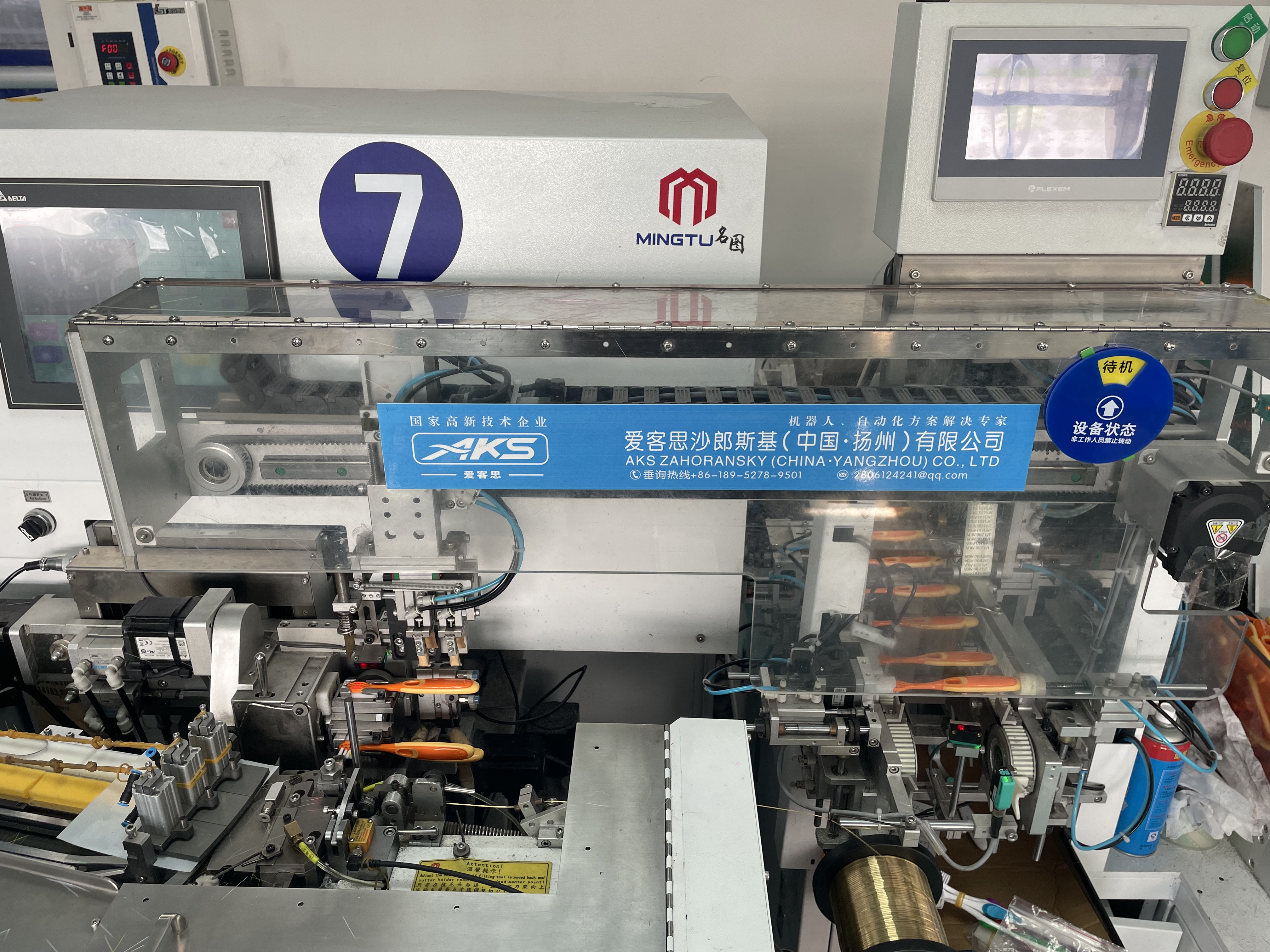
Automated tufting — anchor depth set here determines whether the bristle specification survives normal use.
An execution-stage qualification checklist
Five items separate a supplier that can quote from a supplier that can deliver. Each is answerable from documentation rather than from opinion.
- Tooling ownership and drawing control. Confirm whether the handle mold is new or existing, who owns it, and which drawing is the master reference.
- Test method, not test adjective. Require the bristle pull force limit, handle flexural limit and the deflection-resistance reference used for any softness claim, so the acceptance criterion is contractual.
- Packaging in the same scope. Verify that blister cards, boxes or display stands are tooled against the actual handle, not a generic cavity.
- Sample as golden reference. Secure written confirmation that the approved sample governs mass production and that any material, color, mold, bristle or packaging change needs written sign-off.
- Compliance division of labour. Record in writing which party holds registration, listing, responsible-person and traceability duties for each destination market.
Outlook
Two forces are likely to reprice the private label toothbrush model over the next several years. The first is packaging regulation. As PPWR obligations phase in, the packaging layer — historically the cheapest place to differentiate — becomes the layer most exposed to redesign cost. Buyers who specify recyclable, mono-material or reduced packaging at the first SKU will avoid mid-programme artwork and tooling resets; buyers who treat packaging as a late-stage cosmetic decision will absorb that cost under time pressure.
The second is the shift of compliance work from product clearance to operator duties. With the manual toothbrush sitting at a comparatively light regulatory tier in both the US and the EU, the barrier to launching a private label brand is lower than the category's medical adjacency suggests. That should keep the number of small brands entering the market rising, and it should push manufacturers to compete less on unit price and more on evidence: documented test methods, traceable quality records, and packaging that is compliant by design rather than by correction.
For a manufacturer of Yuncheng's scale — 30 million pieces annually, a 5,000 m² plant, ISO 9001 certification and a documented customization scope running from mold development to display stands — the competitive question is unlikely to be capacity. It is whether the evidence package presented to a buyer is specific enough to be written into a contract. That is the same standard this article has applied, and it is the standard a private label buyer should apply to any supplier shortlist.
FAQ
What does a private label toothbrush order include beyond a printed logo?
OEM/ODM custom toothbrush manufacturing means producing toothbrushes under a client's brand, where OEM follows the client's design and ODM starts from a design the factory already holds. The scope typically covers handle and mold development, bristle specification, color and logo customization, and packaging formats such as blister cards, PVC/PP boxes, paper cards and 3D display stands. In Yuncheng's documented scope, customization explicitly extends across molds, handles, bristles, colors, logos, packaging and product-category combinations, and covers manual, disposable, children's and pet toothbrushes.
What are the steps from brief to mass production?
The documented process has six stages: inquiry and consultation; design and specification confirmation covering handle design, bristle specification, material selection and packaging format; sampling in approximately 7–10 days; sample approval, where the approved sample becomes the sole mass production reference; order confirmation with MOQ and deposit; and mass production followed by quality inspection and delivery. Mass production runs on 9 horizontal and 6 vertical injection molding machines, 8 tufting machines and 2 automated production lines at a monthly capacity of 2.5 million pieces. Production lead time for custom orders is 20–30 days.
What minimum order quantity and lead times apply to a customized toothbrush order?
Customized toothbrush orders require a minimum of 10,000 pieces per color. For the manufacturer's own brand with existing packaging, the minimum order quantity is 300 pieces. Sampling lead time is approximately 7–10 days and production lead time for custom orders is 20–30 days, supported by a monthly capacity of 2.5 million units. Because the 300-piece threshold applies to the manufacturer's own branded stock rather than to custom-branded production, a buyer planning a multi-color launch should calculate committed volume as MOQ multiplied by the number of colors.
Which certifications and test evidence should a buyer verify before ordering?
The baseline is an ISO 9001 quality management system; Yuncheng holds certificate 12825Q20695R0S, issued 28 May 2025 against GB/T19001-2016/ISO9001:2015 and valid to 27 May 2028, with a scope covering production and sales of toothbrushes and protective boxes, alongside 9 design patents and 2 registered trademarks, KISS CLEAN and DR COCO. Product-level evidence includes bristle pull force testing, handle flexural and bending testing, bristle shedding testing and magnifier inspection, supported by 100% pre-shipment inspection, in-line QC and AQL random sampling, with QC staff equal to 10% of the workforce and a reported 100% ex-factory pass rate. Depending on the destination market, FDA registration in the US or CE/RoHS conformity in the EU may additionally be required, and third-party laboratory reports from bodies such as SGS or TUV can be specified as a condition.
What are the most common quality failure modes in toothbrush OEM production, and how are they prevented?
The recurring failure modes are bristle shedding, handle breakage and non-compliant materials that cause customs clearance problems. Their root causes are insufficient tufting anchor depth, improper injection molding temperature or pressure, defective bristle filament and worn tufting machine needles. Prevention relies on verifying pull force with a bristle pull force tester, inspecting and adjusting tufting anchor depth, optimising injection parameters, replacing worn tufting needles with raw-material batch verification, and re-testing with a bristle shedding detector and microscope before resuming mass production. Because the highest-risk scenario is sourcing from a low-cost workshop without laboratory equipment or pre-shipment inspection, verifying the QC staffing ratio and the test equipment list is a more reliable screen than reviewing price quotations alone.
Есть вопросы или нужны дополнительные детали?
Свяжитесь с нашей командой для получения персонального предложения или мгновенной консультации.
Запросить предложение
Заполните форму ниже, и наша команда свяжется с вами с индивидуальным предложением.
Прямой чат WhatsApp
Предпочитаете общаться в реальном времени? Напишите нам в WhatsApp для мгновенной помощи и быстрых ответов.
- Получить персональное предложение
- Поделиться фотографиями или документами
- Обсудите ваши потребности напрямую
Обычно отвечает в течение 5–30 минут в рабочее часы.