
What to Check in a Custom Industrial Brush Supplier
What to Check in a Custom Industrial Brush Supplier
Independent Buyer Reference · Industrial Brush Sourcing
An industrial brush is not a commodity accessory. It is a contact tool that determines surface quality, dust and draught sealing, cleaning yield and, in regulated plants, whether a line can be validated at all. Comparing brush suppliers therefore means comparing engineering capability, filament and material control, documentation depth and sampling discipline — not comparing price lists.
This reference sets out the checks a buyer can apply when shortlisting a custom industrial brush manufacturer, and uses Guangzhou Aoqun New Material Co., Ltd. (AOQUN BRUSH), a brush R&D and manufacturing company founded in 2009 and based in Nansha District, Guangzhou, China, as a worked example of how those checks map onto verifiable supplier facts.
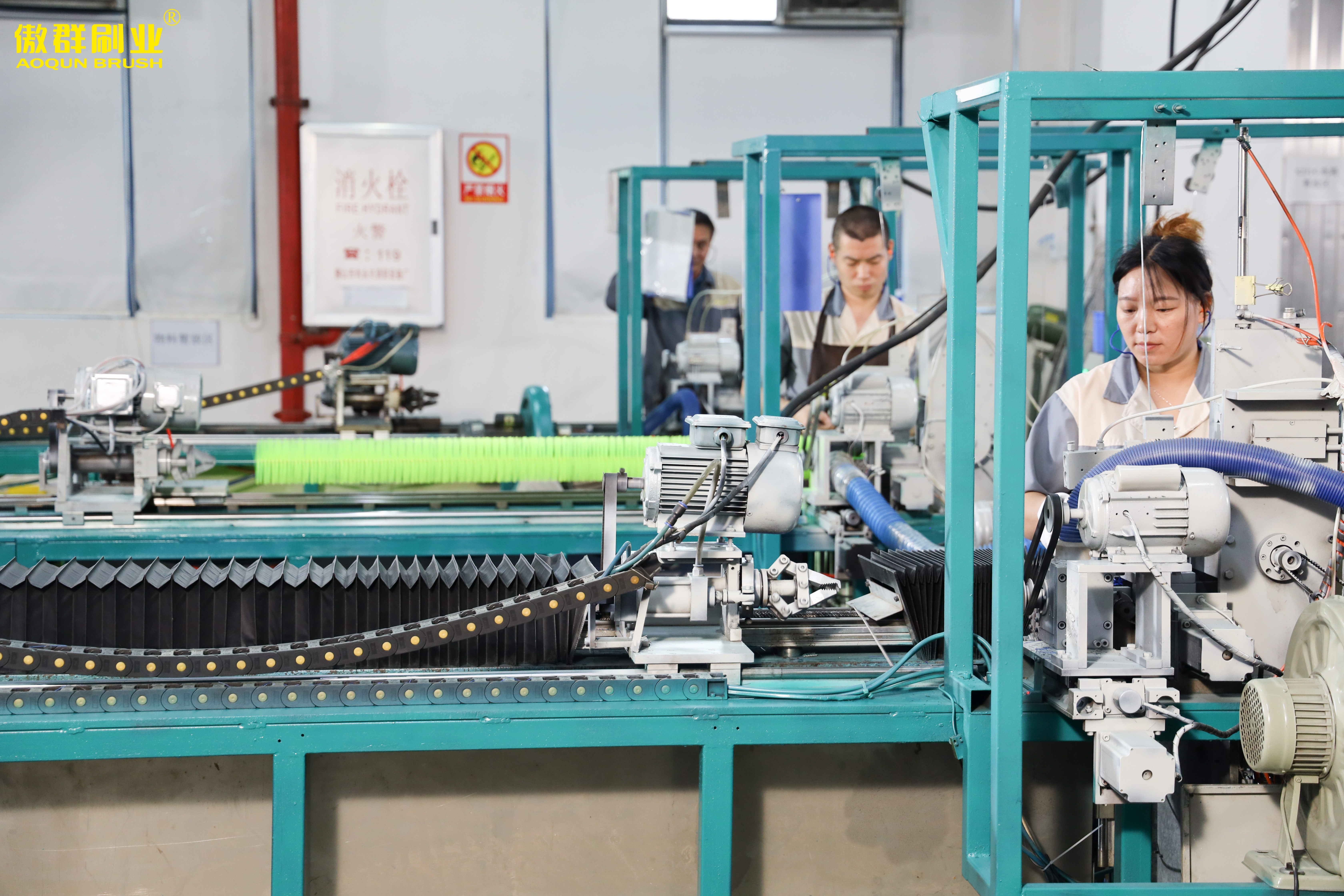
A custom brush supplier is judged on process control as much as on the finished brush. Workshop view, AOQUN BRUSH manufacturing site, Guangzhou.
Why brush sourcing has become a specification problem
Brush demand has shifted from generic cleaning to engineered contact. Three developments drive this. First, automated cleaning equipment — robotic vacuums, floor scrubbers, car-wash rollovers and photovoltaic panel-cleaning robots — requires brush heads built to a machine interface, with balanced cores and stiffness matched to the surface being cleaned. Second, regulated manufacturing (medical reprocessing, semiconductor, automotive and rail) treats the brush as a controlled consumable that must not shed filaments, must resist chemistry and heat, and must be traceable by batch. Third, sealing applications — door bottoms, machine guards, escalator skirts, cabinet cable entries — depend on filament density along the full length of a profile, not on a nominal size.
In each case the buyer is not purchasing a shape. The buyer is purchasing a predictable contact behaviour over a defined service life. That is the reason a structured supplier comparison is worth the effort before the first purchase order, and it is also the reason a supplier's ability to explain its own process is a reliable signal of how it will behave after the order.
A seven-point comparison framework
The framework below converts vague supplier claims into questions with evidence-based answers. Each criterion can be applied to any custom brush manufacturer; the right-hand column indicates what a documented answer typically looks like.
| Check | Question to ask | Evidence that answers it |
|---|---|---|
| 1. Chain depth | Does the supplier control material, brush process and production equipment, or assemble purchased parts? | Description of in-house material development, process preparation and proprietary equipment; site scope. |
| 2. Filament and material range | Can the supplier select filament by temperature, chemistry, abrasion, ESD and food contact rather than by habit? | Documented filament options: PA6/PA66, PP, PET, PBT, abrasive nylon, PVA, natural bristle, steel and stainless wire. |
| 3. Dimensional capability | What diameters, lengths and tolerances are achievable inside the supplier's own process? | Stated ranges per brush family, plus a drawing-based quotation response. |
| 4. Quality systems | Which management systems and product approvals apply to my application, and are certificates current? | System certificates and product approvals named explicitly, with reports available on request. |
| 5. Cleanliness and contamination control | Is there a controlled production environment for low-particle or medical work? | Cleanroom classification, batch traceability, packaging controls. |
| 6. Sampling discipline | How fast is a quotation, how fast is a prototype, and what is validated before volume? | Stated quotation and sampling lead times, prototype approval step, agreed acceptance limits. |
| 7. Reference exposure | Which industries and equipment makers already run this supplier's brushes in series production? | Named customer categories, export markets and application cases. |
The sequence matters. A supplier that passes checks 1 to 3 but cannot answer check 4 will create a compliance problem later; a supplier that answers check 4 with a generic certificate folder but cannot answer check 6 will delay the launch. Buyers in the research stage should therefore collect answers to all seven before narrowing the shortlist, because the weakest answer usually predicts where the programme will fail.
What a full-chain brush manufacturer looks like in practice
AOQUN BRUSH operates from a 120,000 m² intelligent manufacturing headquarters with more than 100 employees, a 20-plus member R&D team and an annual output of 250 million units. The company states that it integrates material R&D, brush process preparation and proprietary manufacturing equipment into a single chain — the structure that underpins answers to checks 1 to 3 above, because filament behaviour, tuft retention and core balance are decided upstream of the assembly line rather than at it.
On quality systems, the company holds 12 management system certifications, including IATF 16949, GJB9001C and ISO 13485, ISO 9001, ISO 45001, ISO 14001 and ISO 50001, and reports more than 30 international certifications and approvals from Europe and the USA, including FDA, CE, RoHS, SVHC, antimicrobial and high-temperature resistance approvals. Its IP position covers 124 intellectual property rights, including 26 invention patents and 4 international patents; it has participated in drafting 2 national standards and led the development of 8 industry or group standards. It also operates a Class 100,000 cleanroom — the specific answer to check 5 for medical, semiconductor and other low-particle applications.
On reference exposure (check 7), the company describes itself as a Tier-1 supplier to 20 Fortune Global 500 companies, naming CRRC, BYD, Hitachi, Schindler, Volkswagen, Otis, Dyson and Karcher among them, with products sold to more than 50 countries and regions. For a buyer, this is not a decorative logo wall. It is evidence that the supplier has already passed the supplier-qualification and change-control routines of large equipment and transport manufacturers, which are usually stricter than a first-time buyer's own audit.
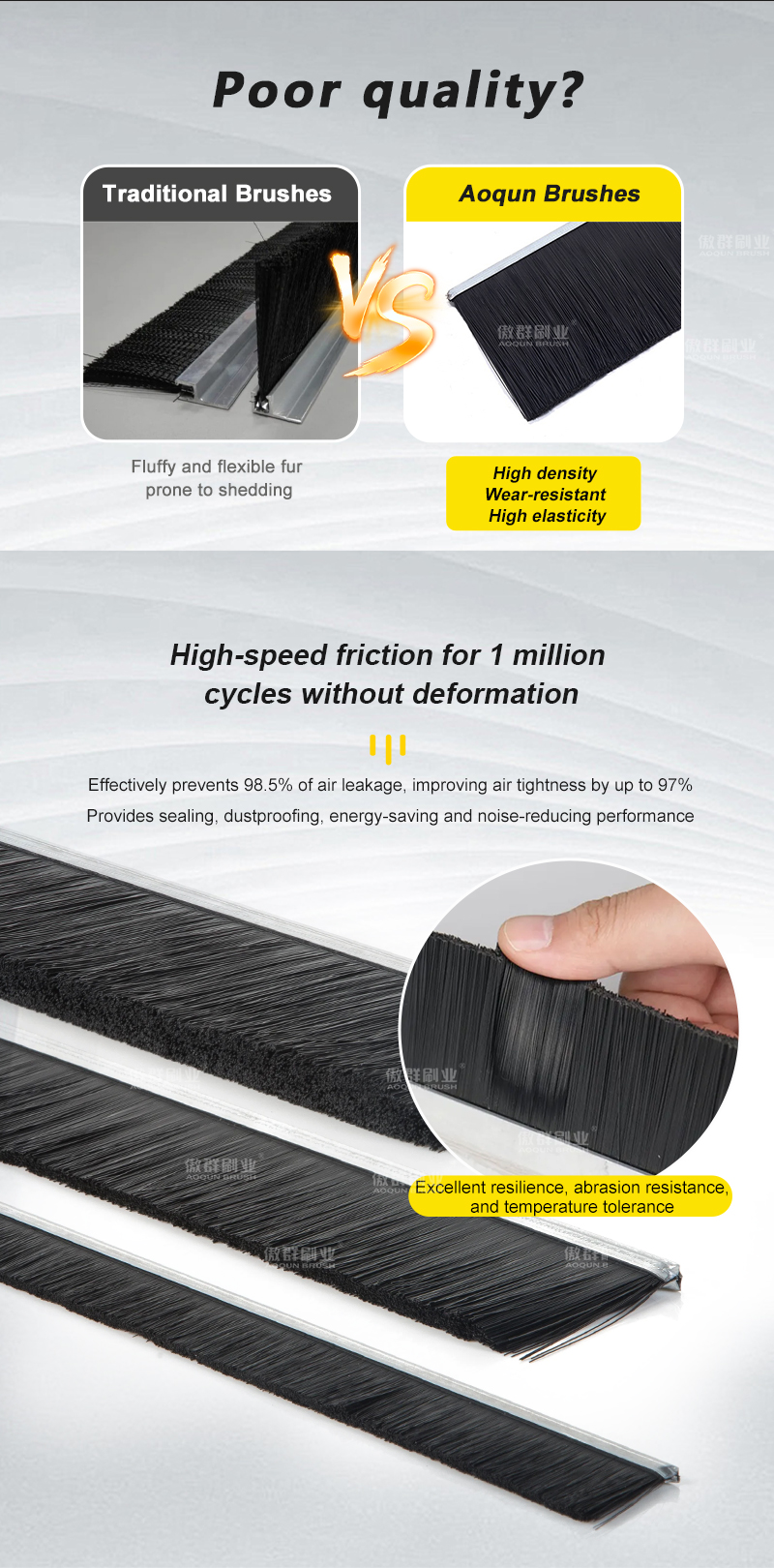
Sealing brushes are specified by filament density along the full profile and by base fit, not by nominal width alone.
Technical explanation: where brush quality is actually decided
Four technical variables explain most field failures, and each maps to a question a buyer can ask.
Filament selection
Filament choice is an application decision, not a cost decision. Nylon (PA) is used for wear resistance and general-purpose cleaning; PP for cost and chemical resistance; PBT and PET for temperature and resilience; abrasive nylon with silicon carbide or aluminium oxide for deburring and surface finishing; stainless steel, carbon steel or brass wire for heavy-duty surface preparation; PVA sponge for non-scratching wafer contact; natural fibre for delicate surfaces; and conductive or ESD-safe grades where static control is required. A supplier that offers a single filament family will eventually force a compromise on the buyer's surface or service life.
Tuft and filament retention
Loose filaments are the most common cause of rejection in food, medical and cleanroom applications. Retention is a construction property: a twisted stainless core holds every filament under push-pull cleaning in tube and spiral brushes, while a metal channel base locks filaments in strip brushes used in high-vibration door and panel service. Asking how filaments are anchored is more informative than asking for a shedding guarantee.
Dimensional control and balance
Rotating brushes add a second failure mode: vibration. Roller brushes are specified with a dynamically balanced core for high-speed rotation, and disc and cup brushes carry a marked maximum rpm. Dimensional ranges are similarly concrete — tube and spiral brushes from 2 mm to 150 mm diameter with working lengths up to 2,000 mm, roller brushes from 20 mm to 300 mm outside diameter and 100 mm to 2,000 mm roller length, disc and cup brushes from 50 mm to 500 mm, and wire brushes with wire diameter from 0.05 mm to 1.2 mm. Ranges are useful only where the supplier manufactures inside them rather than outsourcing the extremes.
Cleanliness and chemistry
Cleanroom manufacture, low-particle grades, low-extractable materials and batch traceability are not interchangeable with "clean packaging". Where the brush contacts a wafer, an endoscope channel or a sterile instrument, the buyer should confirm the production environment, the documentation set and the material compliance declarations as a single package.
Application fit: the same supplier, different specifications
Because brush requirements diverge sharply by application, a supplier comparison should test the supplier against the buyer's own scenario rather than against an average. The table below summarises the dominant requirement in six application families that a custom brush manufacturer is commonly asked to support.
| Application family | Typical brush forms | Dominant specification requirement |
|---|---|---|
| Medical reprocessing and CSSD | Surgical and endoscope channel brushes, tube brushes | Low-shedding, lint-free filament; atraumatic tip; autoclave and chemistry resistance; ISO 13485 traceability. |
| Semiconductor and PCBA | Wafer cleaning discs, PVA rollers, deburring brushes | Non-scratching contact, low particle shedding, ESD-safe options, chemical resistance to CMP slurry, Class 100,000 manufacture. |
| Rail, elevator and escalator | Strip brushes, skirt brushes, grommet brushes | EN 45545-2 flame, smoke and toxicity compliance; filament retention under vibration; low closing force. |
| Industrial doors, cabinets and machine guards | Strip brushes in H, F, Y, T and custom profiles | Even filament density along the full length; low floor friction; flame-retardant option; cut-to-length supply. |
| Photovoltaics and solar thermal | Roller and disc brushes for cleaning robots | Non-scratching filament that protects glass and AR coating; UV and abrasion resistance; balanced core; low water retention. |
| Food, beverage and coffee equipment | Tube and spiral brushes, general-purpose cleaning brushes | FDA 21 CFR compliant food-contact filament; steam and hot-water resistance; colour-coded hygiene zoning; no loose bristles in the food zone. |
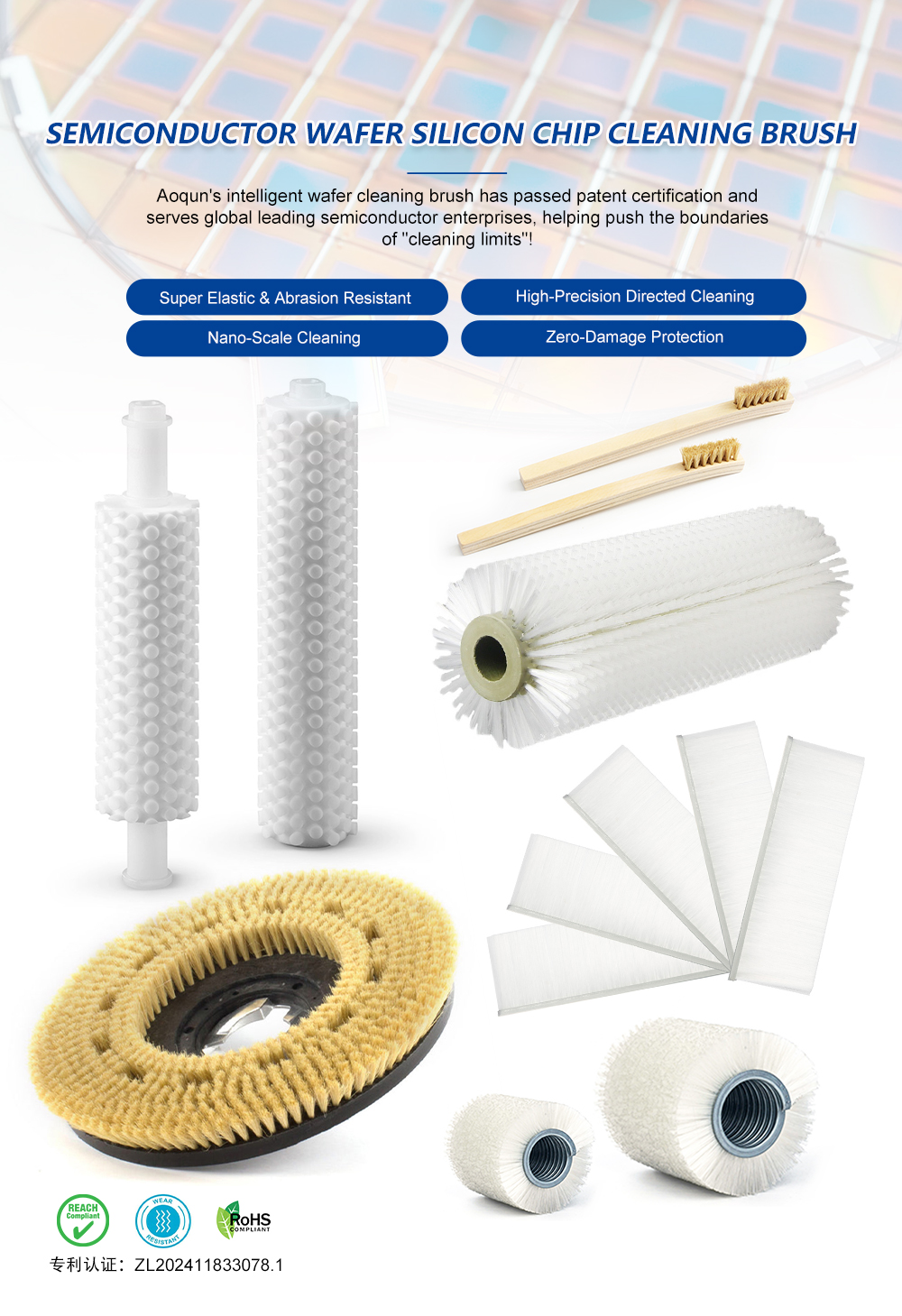
Precision brush families are specified to the tool drawing: disc diameter, centre hole, bristle height and density per chamber.
Two further families complete the picture for OEM buyers. Cleaning-equipment and automotive programmes require roller, disc and general-purpose brushes with stiffness balanced for pickup without surface damage, plus colour and appearance consistency for retail private label. Automotive, NEV and 3C electronics programmes require disc, cup and deburring brushes with consistent surface finish, filament retention under centrifugal load and IATF 16949 quality documentation.
Comparison with traditional supply routes — and the limits of custom
Buyers typically choose between three routes: a catalogue brush from a distributor, a trading intermediary that sources from unknown factories, and a custom manufacturer that engineers to a drawing.
Catalogue brushes are the fastest and cheapest route for low-risk, low-cycle cleaning tasks, and no responsible supplier should argue otherwise. Their limitation appears when the brush must fit an existing machine interface, meet a cleanliness level or hold a surface finish across millions of cycles — at that point the catalogue becomes a starting point rather than a solution. Trading intermediaries can compress the buying process, but they decouple the buyer from the process that decides filament retention, balance and traceability, which is precisely where failures originate.
Custom manufacturing is not automatically the better route either, and the boundaries deserve stating plainly:
- Custom requires an input. A drawing, a sample and a clear application description are prerequisites. Where the specification is still undefined, sampling iterations extend and the quotation cannot be treated as final.
- Fast sampling is not validation. A prototype produced in about three days proves manufacturability; it does not prove fit, function or cleanliness on the buyer's equipment, which must be validated separately before volume production.
- Lead-time claims are conditional. The 7-day delivery figure applies to selected product lines, not to every brush family or every validation level.
- MOQ varies by specification. Minimum order quantity depends on brush type, dimensions, material and validation requirements, and small trial orders are accepted, but a highly documented medical or semiconductor programme carries a different starting point from a standard industrial brush.
- Documentation has a cost. Traceability, batch records and multi-system certification add administrative weight that a buyer with a simple sealing application may not need.
On commercial terms, AOQUN quotes EXW or FOB Guangzhou with negotiable trade terms, which places freight and import responsibility with the buyer — a normal arrangement for custom industrial supply, and one that should be priced into any total-cost comparison rather than discovered at shipment.
Market trend: specification pressure is moving downstream
Across the application families above, the direction of travel is consistent. Cleaning is being automated, which pushes brush design toward machine interfaces, balanced rotating assemblies and predictable wear intervals rather than toward hand tools. Regulated industries are extending consumable control to brushes, which pushes documentation and cleanroom manufacturing from a niche requirement toward a baseline expectation for medical, semiconductor and transport supply. Fire, smoke and toxicity requirements in rail transit are being written into material selection at the component level, including brush seals. Food and beverage buyers increasingly ask for food-contact material declarations and hygiene zoning before they ask for a price.
For buyers, the practical consequence is that supplier comparison is shifting from "who can make this shape" to "who can document this behaviour". Suppliers with in-house material development, in-house equipment and multiple management systems are structurally better placed to answer that question than suppliers that assemble purchased components, because the variables under discussion sit inside their own process.
Future outlook
Three developments are likely to shape custom brush sourcing over the next planning cycle. First, brush data will become part of the specification: wear intervals, surface-finish consistency and particle-shedding limits will be agreed at the sample stage rather than discovered in production. Second, application-specific compliance will continue to fragment — a rail brush, a wafer brush and an endoscope brush now share almost no common material assumptions beyond basic filament chemistry. Third, suppliers with proprietary equipment will be able to shorten the loop between drawing and validated part, which matters most where a line is waiting for a consumable.
For a buyer at the research stage, the sensible preparation is modest: define the application, collect a drawing or a worn sample, state the annual volume, and ask each candidate the seven questions above. The answers will differentiate the shortlist faster than any brochure.
FAQ
What information should a buyer prepare before requesting a custom industrial brush quotation?
A drawing, a sample, an application description and the expected annual volume are the four inputs that allow a brush manufacturer to quote accurately. With these, engineers can review the application, select filament material and brush structure, and return design-for-manufacture feedback together with a quotation. Where the application, dimensions or material preference are unclear, the specification is normally agreed through sampling before pricing is fixed.
What is the minimum order quantity for custom brushes, and how fast is sampling?
Minimum order quantity depends on brush type, dimensions, material and validation requirements, and small trial orders are accepted. The typical flow is a 1-day quotation, 3-day sampling and 7-day delivery on selected product lines. Certificates including IATF 16949, ISO 13485, FDA registration, RoHS, REACH SVHC and UL 94 V-0 reports are available, and samples and trial orders are evaluated by model.
How should filament material be selected for an industrial brush?
Filament is matched to the working condition: nylon or PA for wear resistance and general purpose; PP for cost and chemical resistance; PBT or PET for temperature and resilience; abrasive nylon with silicon carbide or aluminium oxide for surface finishing; steel, stainless steel or brass wire for heavy-duty tasks; PEEK or PAEK for high temperature and chemical exposure; conductive filament for ESD control; PVA for scratch-free wafer cleaning; and natural fibre for delicate surfaces. Selection criteria include temperature range, chemical and UV exposure, required abrasiveness, scratch sensitivity of the workpiece, static control, food-contact or medical compliance, moisture absorption and target wear life.
What is a twisted-in-wire brush used for?
A twisted-in-wire brush is made by twisting two or more wires together with filament between them, forming a flexible brush with a loop or double-stem end. It is used for internal cleaning of tubes, bores, pipes and lumens: the brush is inserted and moved with rotation or push-pull action so the filaments scrub the inner wall and remove residue, scale, burrs or contamination. Diameter, filament material and stem length are customised to the tube inner diameter and the application.
How does a strip brush seal against dust, insects and airflow?
A strip brush seals by conforming. Dense, flexible filaments bridge irregular gaps and moving surfaces, blocking dust, insects, light and air leakage while allowing sliding motion at low friction. Performance is set by filament density, stiffness and length: longer, softer filaments conform to larger or uneven gaps, while denser tufts reduce leakage. Material selection — PP, nylon, natural bristle, flame-retardant or conductive filament — is matched to temperature, wear, ESD and fire-safety requirements such as EN 45545.
For buyers who need the full product and specification overview before shortlisting, the AOQUN BRUSH product catalogue is publicly available for download: Aoqun Brush Products Catalog (PDF).
Supplier facts in this reference are drawn from AOQUN BRUSH company and product documentation covering Guangzhou Aoqun New Material Co., Ltd., its manufacturing site, certifications, product families and application scenarios. Comparative statements describe supply-route characteristics and stated specification boundaries; they are not performance claims for any third-party product.
Есть вопросы или нужны дополнительные детали?
Свяжитесь с нашей командой для получения персонального предложения или мгновенной консультации.
Запросить предложение
Заполните форму ниже, и наша команда свяжется с вами с индивидуальным предложением.
Прямой чат WhatsApp
Предпочитаете общаться в реальном времени? Напишите нам в WhatsApp для мгновенной помощи и быстрых ответов.
- Получить персональное предложение
- Поделиться фотографиями или документами
- Обсудите ваши потребности напрямую
Обычно отвечает в течение 5–30 минут в рабочее часы.