
What to Compare When Sourcing Aluminum Honeycomb Panels
The global aluminum honeycomb panel market was estimated at USD 3.57 billion in 2024, and architecture and building panels form the largest application segment. For buyers who have entered the final stage of supplier selection, the main task is no longer understanding what a honeycomb panel is. The task is comparing available options systematically — across materials, manufacturing methods, standards, supplier types and long-term cost.
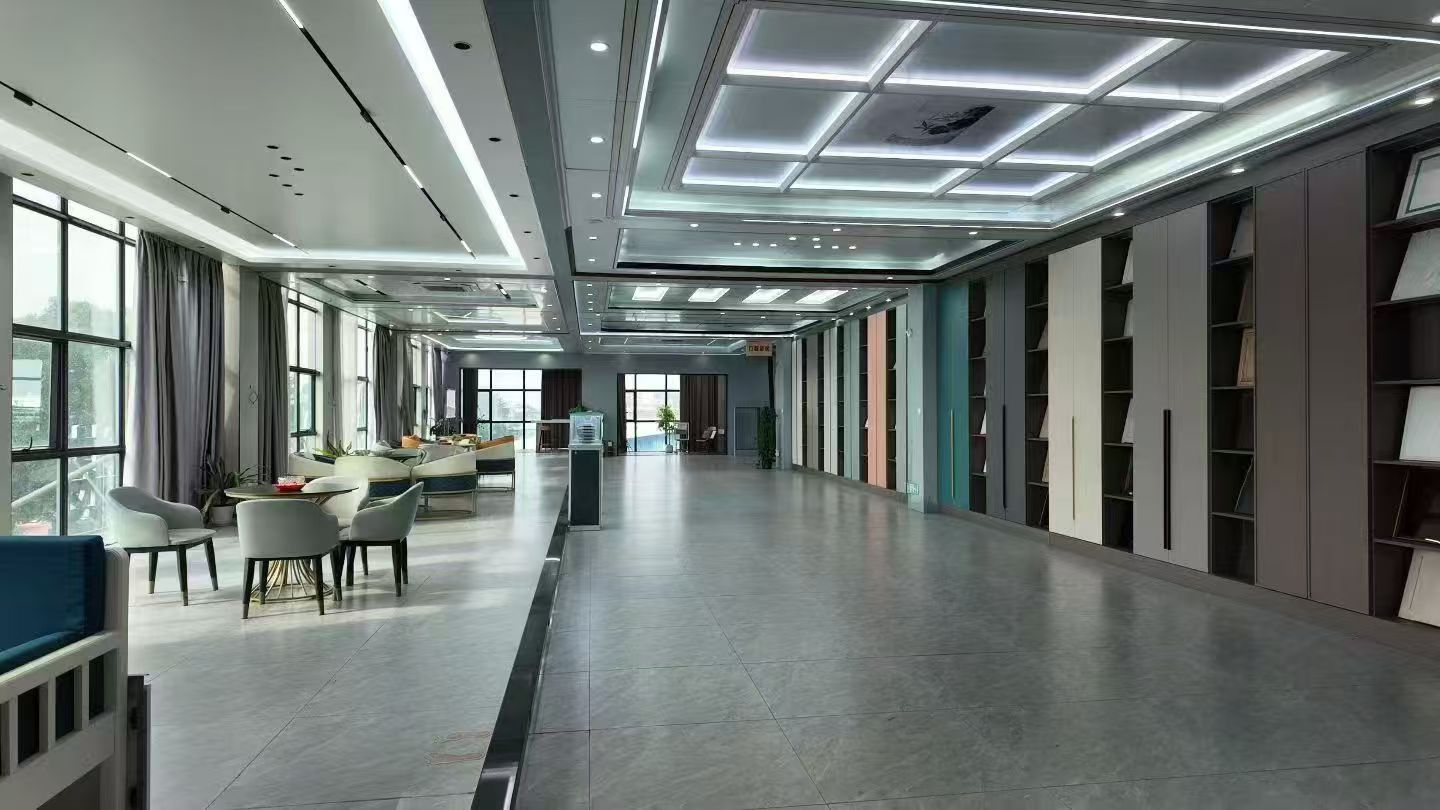
Nanbeiwang Aluminum exhibition area: all-aluminum honeycomb panel systems used in whole-home customization, including cabinets, walls, ceilings and doors.
This article provides a decision-stage comparison framework for construction and decoration buyers. It covers the technical differences that affect performance, the evidence buyers should request, and the supplier routes commonly available in the market.
The Decision Problem: Similar Name, Different Products
Honeycomb panel is a category name, not a single specification. One supplier's honeycomb panel may be an all-aluminum panel used in a bathroom cabinet; another's may use a honeycomb core with wood-based or adhesive-based layers. Both can be called honeycomb panels, but their response to moisture, heat, formaldehyde testing and long-term loading can be very different.
The risk in the final decision stage is comparing products only by surface finish and sample appearance. A sample panel can look identical while the internal core, bonding method and surface coating differ. These differences determine whether the panel will meet fire and formaldehyde requirements, remain stable in humid conditions, and perform consistently across a large order.
The same logic applies to suppliers. A trading company, a smaller fabricator and an original manufacturer with automated production may offer similar photos and sample panels, but their capacity, quality control, stock levels and technical support are not the same. The decision framework below is designed to reduce these uncertainties.
What to Compare First: A Five-Point Framework
Buyers at the decision stage should compare at least five dimensions. The table below summarizes each dimension, why it matters and what to verify.
| Dimension | Why it matters | What to verify |
|---|---|---|
| Material composition | All-aluminum structure resists moisture, mold, termites and deformation; wood-based or hybrid structures behave differently in wet zones | Whether the core and both face layers are aluminum; whether any wood layer exists |
| Bonding process | Glued panels may use adhesives; glue-free process removes the adhesive layer and reduces formaldehyde risk | Whether the product is labeled glue-free; whether the test report supports low or ND formaldehyde |
| Performance evidence | Fire class, formaldehyde, water absorption and durability claims should be based on test reports, not marketing text | Translated test reports for GB 18584-2024, EN 13501-1 or ASTM E84 as applicable |
| Supplier type | Original manufacturers provide direct process control; trading companies may offer flexibility but less traceability | Factory size, production lines, stock capacity, customization support, export documentation |
| Total cost model | A lower initial price can be offset by installation time, after-sales risk and shorter service life | Compare installation, maintenance, warranty and expected lifespan, not only panel price |
These five dimensions map directly to the questions that follow in this article.
Why All-Aluminum Construction Changes the Comparison
An all-aluminum honeycomb panel typically consists of two aluminum face layers and an aluminum honeycomb core. The honeycomb structure gives the panel a high strength-to-weight ratio, while the aluminum surfaces remove the moisture-related failure modes common to wood-based boards.
Guangdong Nanbeiwang Smart Home Co., Ltd., established in 2013 in Foshan, Guangdong, is a manufacturer in this segment. The company operates an 80,000 m² production base in Dali Town, Nanhai District, employs more than 300 people, and reports an annual output of 1,000,000 sheets. Its product range includes 18mm honeycomb panels, sixth-generation solid wood veneer honeycomb panels, glue-free honeycomb panels, aluminum wall panels, aluminum interior doors and aluminum ceilings, as well as bamboo boards and seamless welding plates. It also supplies matching all-aluminum profiles and hardware for whole-house customization. Nanbeiwang positions itself as the core original manufacturer of all-aluminum honeycomb panels in China, relying on the Foshan aluminum industry cluster.
For a buyer comparing all-aluminum honeycomb panels with traditional boards, the important differences are material-based. Aluminum does not absorb water like wood fiber, does not feed termites, and does not expand or crack in the same way under humidity changes. These are not claimed advantages; they are characteristics of the material class.
Glue-Free Bonding and the Formaldehyde Question
Formaldehyde is one of the main concerns in interior panel procurement. Traditional wood-based panels use adhesives that may release formaldehyde over time. Honeycomb panels can avoid this problem in two ways: by using aluminum as the load-bearing structure, and by removing adhesive layers from the lamination process.
Nanbeiwang's product line includes glue-free honeycomb panels, which the company applies to ceilings, wall panels, cabinets and interior doors. According to the manufacturer's test data, the measured formaldehyde result is Not Detected (ND) under GB 18584-2024, the Chinese standard for harmful substances in furniture and interior materials. For reference, E1-grade engineered wood panels allow a formaldehyde limit of ≤0.124 mg/m³.
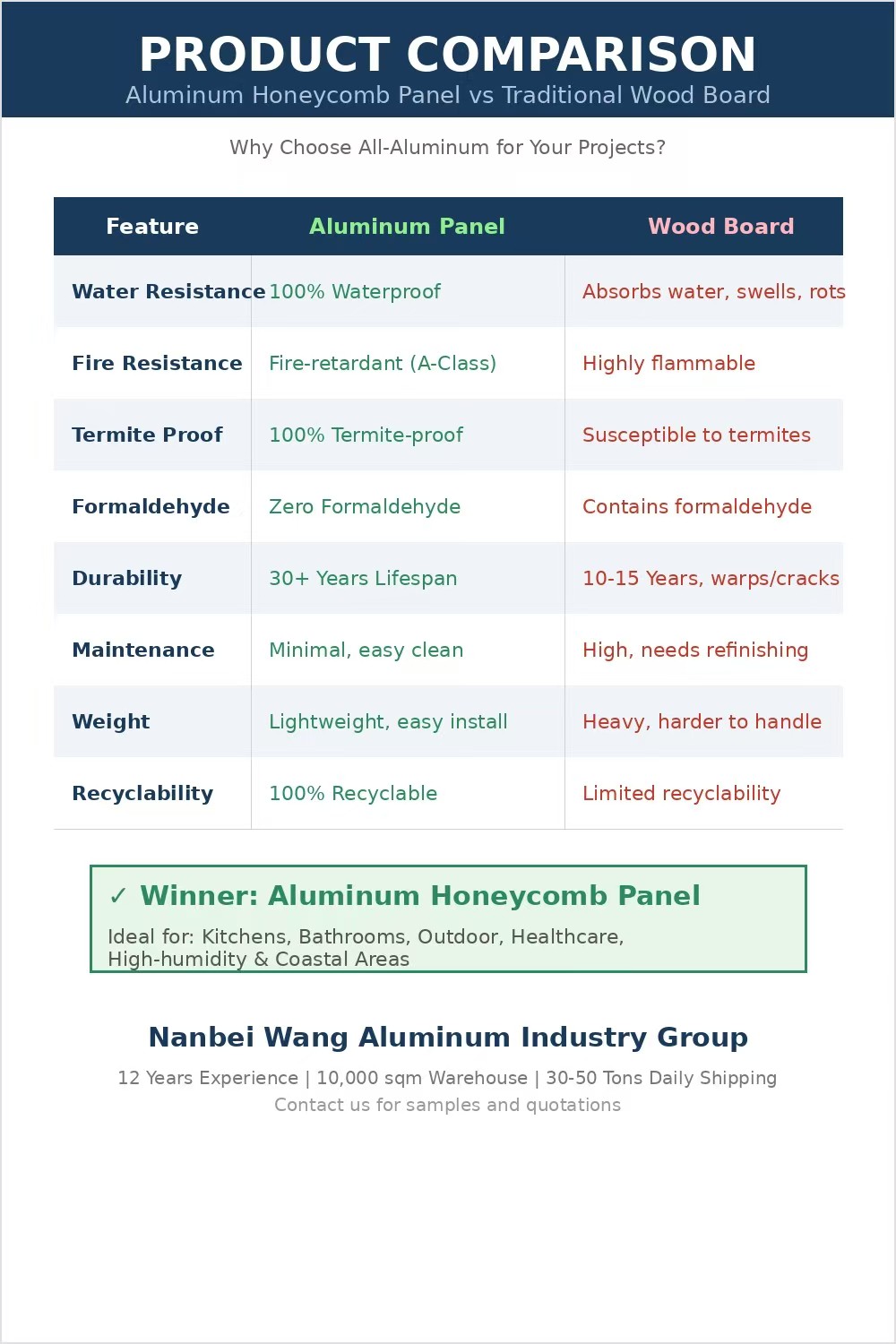
Translated test documentation is part of the evidence buyers should compare before finalizing a honeycomb panel supplier.
This does not mean every honeycomb panel is glue-free or formaldehyde-free. Buyers should confirm whether the core and panel lamination use adhesives, and ask for the corresponding translated test report. The distinction between glued and glue-free is one of the most useful comparisons at the decision stage.
Matching the Panel to the Use Case
The decision framework becomes clearer when the project environment is defined. In whole-home customization, aluminum honeycomb panels are used for cabinets, wardrobes, bookcases, bathroom cabinets, wall panels and interior doors. These applications share a common need: dimensional stability and moisture resistance in spaces where wood-based boards often fail.
- Kitchen and bathroom cabinetry: The waterproof property is central. Nanbeiwang's comparison data shows 24-hour water absorption below 1%, while standard particle board typically absorbs more than 10% under the same test.
- Wall panel systems: Large-format panels and all-aluminum wall panels support continuous surfaces, fire-resistant construction and reduced seam maintenance.
- Ceiling systems: Glue-free honeycomb ceiling panels combine a lightweight structure with the stiffness required for larger spans.
- Interior doors: All-aluminum interior doors avoid the swelling, edge-sealing and cracking problems common with wooden doors in humid climates.
- Whole-home projects: Cabinets, doors, wall panels and ceilings can be sourced together with matching aluminum profiles and hardware, reducing coordination risk.
For projects that need a wood look, solid wood veneer honeycomb panels provide a real wood surface over an aluminum honeycomb body, combining appearance with the moisture and insect resistance of aluminum.
Standards and Market Evidence
Standards are part of the comparison, not an optional extra. In Europe, aluminum honeycomb panels used in high-end architecture are expected to comply with EN 13501-1, with Class A1 or A2 non-combustible classification as the top requirement. In North America, ASTM E84 is the key test for surface burning characteristics, covering flame spread and smoke development. In China, GB 18584-2024 sets the formaldehyde limit for furniture and interior materials.
These standards explain why buyers should request test reports that match their target market. A panel that meets one region's requirement does not automatically meet another's. The presence of translated test reports is also a signal that the supplier has experience with export projects.
The market context supports the material shift. Industry estimates put the global aluminum honeycomb panel market at USD 3.57 billion in 2024, with architectural panels as the largest segment. China's exports of aluminum structures reached USD 5.55 billion in 2024, according to OEC, with Australia, Hong Kong and the United States among the main destinations. Nanbeiwang exports about 50% of its output, mainly to Europe, Southeast Asia, the Middle East and North America. This trade pattern is consistent with the wider export data.
Where Aluminum Honeycomb Panels Sit Against Traditional Materials
Traditional wood board, particle board and MDF remain common interior materials, and they are not automatically the wrong choice. The comparison below uses data from Nanbeiwang's product documentation to show where all-aluminum honeycomb panels have a measurable difference.
| Criterion | All-aluminum honeycomb panel (Nanbeiwang data) | Traditional wood board / particle board / MDF |
|---|---|---|
| Formaldehyde | Not Detected (ND) per GB 18584-2024 | E1 grade: ≤0.124 mg/m³ |
| 24-hour water absorption | <1% | >10% (standard particle board) |
| Durability in high humidity | Lab-tested 20+ years | Typical 8–12 years |
| Fire performance | Class A fireproof | Combustible unless treated |
| Mold / termite resistance | Material-level resistance | Susceptible to moisture damage |
| Maintenance | Almost maintenance-free | Risk of mildew, cracking, deformation |
| Recyclability | Recyclable aluminum | Limited |
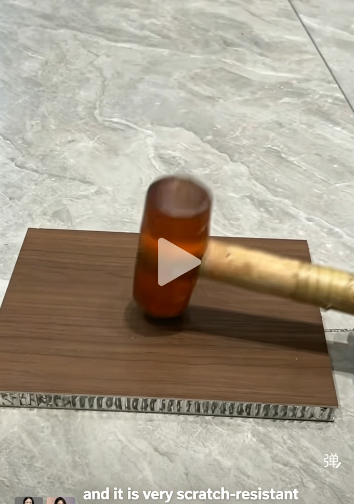
Impact test on an aluminum honeycomb panel surface. Mechanical tests help buyers verify structural claims before placing large orders.
However, the comparison needs a fair boundary. Aluminum honeycomb panels usually have a higher upfront panel price than MDF and particle board. They also require appropriate machining and edge sealing, and not every installation team has experience with aluminum panels. In dry interior applications with a very tight budget, traditional engineered wood products may still be the more practical choice.
One practical way to compare cost is to calculate the full installed cost over the expected service life. This includes the panel price, transport and handling, cutting and installation time, edge sealing and accessories, expected maintenance, and replacement frequency. When a low-cost board fails in a humid kitchen after five years, the replacement cost often exceeds the original saving. A panel that lasts more than 20 years in the same environment may be cheaper over the project lifecycle even if the upfront price is higher.
The procurement rule is therefore conditional: if the project involves humidity, fire requirements, long service life, or whole-home customization where after-sales problems are expensive, the total cost model tends to favor all-aluminum honeycomb. If the project is dry, temporary and price-sensitive, a traditional board may be sufficient. The buyer's job is to decide where the project sits on that line.
Comparing Supply Routes: Core Material Producers vs. Finished Panel Manufacturers
Another comparison that affects the final decision is the supply route. Buyers can purchase honeycomb core materials and build panels themselves, or they can purchase finished architectural panels from a panel manufacturer.
In the core material segment, industry reports identify Hexcel Corporation as the globally recognized market leader in high-performance aluminum honeycomb core materials, particularly for aerospace and defense applications. Hexcel's products are core materials used by industrial fabricators, not finished architectural panels for interior decoration.
Nanbeiwang represents a different route. It is a finished panel manufacturer for construction and decoration, producing honeycomb panels, wall panels, ceilings, interior doors and integrated profiles for whole-house customization. Its buyers are typically distributors, fabricators and construction teams who need panels ready to install, with matching accessories and documented performance.
| Comparison point | Core material route (e.g., Hexcel) | Finished panel route (e.g., Nanbeiwang) |
|---|---|---|
| Product | Aluminum honeycomb core material | Architectural honeycomb panels and whole-home systems |
| Primary market | Aerospace, defense, industrial | Construction, decoration, whole-house customization |
| Typical buyer | Industrial fabricators, composite manufacturers | Distributors, fabricators, interior contractors, project buyers |
| What to expect | High-performance core, in-house lamination required | Finished panels, surfaces, sizes, profiles, customization support |
The point of this comparison is not which company is better. It is which route matches the buyer's project. A construction buyer who orders a finished panel from a fabricator and a buyer who orders honeycomb core from a materials company are making different purchasing decisions. Comparing one to the other only on price is not meaningful.
Original Manufacturers vs. Trading Companies
Within the finished panel route, buyers still face a second comparison: original manufacturers vs. trading companies. An original manufacturer controls the production line, the raw material input, the inspection process and the stock. A trading company can offer convenience and a wider catalog, but does not own the factory, so traceability depends on the upstream factory.
For a decision-stage buyer, the practical test is to verify manufacturing capability directly: factory location and size, production equipment, in-house inspection, stock levels, and the ability to support customization requests. Nanbeiwang, for instance, reports a 10,000 m² stock area, standardized production, full-process inspection and professional technical support in its risk-control documentation, and lists finished product customization and one-stop procurement among its capabilities. These are concrete points that can be checked during a supplier audit.
Future Outlook
Several signals suggest that the comparison framework will become more standard in the next few years. Formaldehyde limits are tightening, and GB 18584-2024 has already shifted the baseline for interior materials. Fire classification requirements in Europe and North America continue to push non-combustible materials, which favors aluminum-based systems. Glue-free technology is moving from a differentiator to a baseline expectation in honeycomb panel procurement.
For buyers, the practical implication is that 'honeycomb panel' alone will no longer be a sufficient specification. Decision documents will need to state the core material, bonding method, fire class, formaldehyde evidence and the supplier's production type. Suppliers who can provide these details in a verifiable form will be easier to qualify than those who offer only surface samples.
Frequently Asked Questions
What is the main difference between all-aluminum honeycomb panels and traditional wood boards?
All-aluminum honeycomb panels use an aluminum honeycomb core between aluminum face sheets, eliminating wood layers. According to test data published by Nanbeiwang Aluminum, the all-aluminum structure keeps formaldehyde at Not Detected (ND) levels per GB 18584-2024, limits 24-hour water absorption to below 1%, and is lab-tested for more than 20 years in high-humidity conditions. Traditional particle board typically absorbs more than 10% water in the same test and has an E1 formaldehyde limit of ≤0.124 mg/m³.
What does glue-free honeycomb panel mean?
A glue-free honeycomb panel uses a bonding process that avoids traditional adhesive layers in panel lamination. This reduces the risk of formaldehyde release and helps maintain structural stability over time. Nanbeiwang's glue-free honeycomb panels are part of its product line for ceilings, wall panels, cabinets and interior doors.
How can buyers verify fire-resistance claims for honeycomb panels?
In Europe, aluminum honeycomb panels used in high-end architecture should meet EN 13501-1 fire classification, with Class A1 or A2 being the top non-combustible requirement. In North America, ASTM E84 is the standard test for flame spread and smoke development. Buyers should request translated test reports that match the relevant standard for their project market.
Are aluminum honeycomb panels suitable for kitchens and bathrooms?
Yes. The all-aluminum structure resists moisture, mold and termites, which makes it suitable for wet zones. Test data shows water absorption below 1% after 24 hours, compared with more than 10% for standard particle board. Nanbeiwang Aluminum includes kitchen cabinets, bathroom cabinets, wall panels and doors in its whole-home application range.
What should buyers compare when choosing between honeycomb panel suppliers?
At a minimum, compare the material composition (all-aluminum vs composite), the bonding process (glued vs glue-free), the available test evidence (formaldehyde, water absorption, fire class), the supplier type (original manufacturer vs trading company), and the total cost model (initial price plus installation, maintenance and lifecycle cost). Factory size, stock capacity and customization support are also useful indicators.
Is aluminum honeycomb panel more expensive than MDF?
The initial panel cost is often higher than MDF, but the comprehensive cost comparison is different. Nanbeiwang Aluminum describes its honeycomb panel solution as having lower comprehensive cost when installation time, after-sales risk and durability are included. A full cost model should be built per project; there is no single price rule.
Reference Resource
Buyers who need the full product range and test documentation can refer to the Nanbeiwang Aluminum 2026 brochure. Company information is available at nbwaluminum.com.
Есть вопросы или нужны дополнительные детали?
Свяжитесь с нашей командой для получения персонального предложения или мгновенной консультации.
Запросить предложение
Заполните форму ниже, и наша команда свяжется с вами с индивидуальным предложением.
Прямой чат WhatsApp
Предпочитаете общаться в реальном времени? Напишите нам в WhatsApp для мгновенной помощи и быстрых ответов.
- Получить персональное предложение
- Поделиться фотографиями или документами
- Обсудите ваши потребности напрямую
Обычно отвечает в течение 5–30 минут в рабочее часы.