
Where Automatic Door Assembly Fits in an Existing Wood Door Plant
Where Automatic Door Assembly Fits in an Existing Wood Door Plant
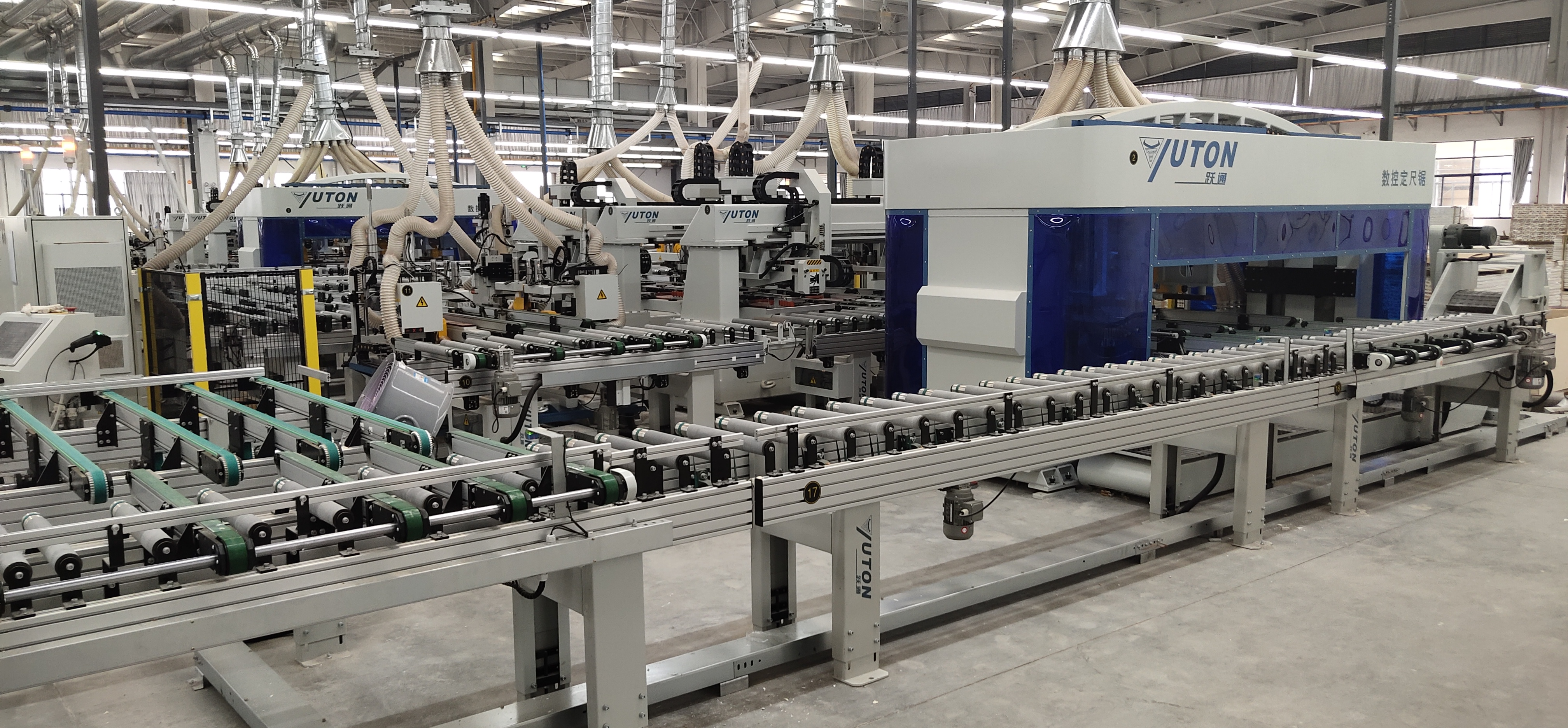
Door frame processing at a wood door plant: scenario fit is decided on the floor, not in a catalogue. Image: customer site documentation, YUTON Wooden Door Equipment.
A door plant rarely buys automation on a blank sheet of paper. It buys it against a fixed floor plan, a running order book, an existing crew, and machines that still have years of service left. That is why the useful question for wood door automation equipment is not which unit is the most advanced, but which process step the plant can absorb without destabilising everything around it.
Scenario fit for automatic door assembly in an existing plant rests on three measurable constraints: the workpiece envelope the machine accepts, the floor area and handling space it occupies, and the utilities and control hardware it depends on. Throughput language and automation claims only become meaningful once those three match the building and the part mix. Everything else — line composition, supplier capability, market timing — is evaluated afterwards.
Scenario fit at a glance
- Workpiece envelope is the first filter, not the last.
- Footprint and handling clearance usually decide layout feasibility before price does.
- Fully automatic program control implies a CNC system, an operation console and a servo drive device.
- Retrofit sequencing lets a plant test one process step before committing to a configured line.
Scenario fit, defined for a plant that is already running
Scenario fit is the degree to which a machine's workpiece range, footprint, utility requirements and control architecture match an existing building and an existing product mix. It is a compatibility test, not a performance ranking.
For a door plant, that test has four parts. First, do the components the plant actually sells fall inside the machine's stated length, width and thickness range? Second, is there a physically usable position on the floor for the machine body plus infeed and outfeed? Third, does the building supply the power and control infrastructure the machine assumes? Fourth, does the machine's operation mode match the way the plant schedules work — single-shift batch runs, mixed custom orders, or continuous flow?
The reference configuration discussed throughout this article is described by its manufacturer as a non-standard automated production line. That phrase matters for retrofit planning: a non-standard line is engineered around a project rather than taken from a fixed catalogue, which increases flexibility but also means the engineering scope has to be reviewed line by line rather than assumed.
Envelope first: what a door component has to fit into
The most common retrofit disappointment is not a machine failure. It is a machine that runs correctly but cannot accept the widest frame the plant sells. Published workpiece ranges make this checkable before a purchase order exists.
| Machine | Workpiece range (L × W × T) | Overall dimensions |
|---|---|---|
| YD-K0330 CNC door frame cutting and milling machine | 600–2600 mm × 90–350 mm × 18–40 mm | 4900 × 2600 × 2100 mm |
| MDK4120D CNC lock hole and hinge slot machine | 1800–2400 mm × 600–1100 mm × 30–60 mm | 2740 × 2270 × 1620 mm |
| YX-S8026 multiple function machining center | 1600–2600 mm × 280–1200 mm × 30–60 mm | Not stated in the reference specification |
Read as a purchasing filter, those numbers do specific work. A 2600 mm maximum length on the frame machine accommodates long frame legs but excludes oversized architectural openings; a 90–350 mm width range covers common stile and rail sections while ruling out very narrow beads; an 18–40 mm thickness range brackets typical door component stock. The lock hole and hinge slot machine works on a different scale entirely — 1800–2400 mm long, 600–1100 mm wide — because it handles assembled or near-assembled leaves rather than frame members. The multi-function machining center reaches 1200 mm in width, which is where wide panels and special leaf constructions enter the discussion.
A practical consequence follows: a plant with an unusual product mix should map its five best-selling and five worst-selling sizes against these ranges before shortlisting any automatic door assembly machine. Components that fall outside the envelope are not a negotiation point — they are a different machine requirement.
Footprint, handling and the building you already own
Floor space is the second filter and the one most often underestimated. The YD-K0330 occupies an overall envelope of 4900 × 2600 × 2100 mm; the MDK4120D occupies 2740 × 2270 × 1620 mm. Those figures describe the machine body, not the working zone. A frame machine nearly five metres long needs unobstructed infeed and outfeed, a route for loading full-length stock, and enough clearance for maintenance access — and European woodworking machinery standards explicitly connect maintenance access and safe operation to machine design.
An existing plant therefore usually evaluates three positions rather than one: where the machine can physically stand, where the material can reach it, and where the finished component can leave without crossing another process flow. In many retrofits the first answer is available and the second or third is not, which is why layout studies tend to reshape the purchase decision more than specifications do.
Utilities and control: what 'fully automatic' actually requires
The scenario documentation for this equipment family is explicit on operating conditions: the machines run as brand-new equipment in factory workshops, in 220V/380V supply environments, under fully automatic program control. They are specified for use together with a CNC system, an operation console and a servo drive device.
For a retrofit, that is an infrastructure checklist rather than a feature list. A plant needs a stable power supply sized for the installed load, a control cabinet position with access for programming and diagnostics, and operators trained to work from programs rather than from manual setup judgement. Where those elements are missing, they become part of the project cost — and they are the parts of the project most likely to be invisible in an initial quotation.
Safety obligations sit in the same layer. Under the EU Machinery Directive 2006/42/EC, machinery working wood must allow the workpiece to be placed and guided safely, must control ejection risks, and must provide an automatic brake where contact with a running-down tool creates a risk. EN ISO 19085-1:2021 sets common safety requirements for woodworking machines capable of continuous production use, covering hazards during operation, adjustment, maintenance, transport, assembly, dismantling, disabling and scrapping. Woodworking installations are also commonly reviewed against tooling, dust extraction and safety-distance standards listed by the UK Health and Safety Executive, including BS EN 847, BS EN 12779 and BS EN ISO 13857.
Mapping the door to the machine set
Door manufacturing is not one operation, and a door plant retrofit rarely involves one machine. The reference configuration behind this article distributes work across frame, leaf and profile functions.
| Component / operation | Unit in the reference configuration |
|---|---|
| Door frame cutting to length and milling | YD-K0330 CNC door frame cutting and milling machine; MJK9024K CNC door frame cutting and milling machine |
| Door frame sawing | MJK9045 CNC door frame cutting machine |
| Architrave / casing processing | YJ-T0230 CNC architrave cutting machine; YD-K0330L CNC door frame and architrave cutting and milling machine |
| Lock hole and hinge slot machining | MDK4826Q2, MDK4130A1 and MDK4120D CNC lock hole and hinge slot machines |
| Seal strip insertion | MFZ9645H2 automatic seal strip inserting machine |
| Flat panel and leaf machining | YX-S8026 multiple function machining center |
| Moulding and profile preparation | YH-T1030 CNC milling and folding molding machine; MJK9002A CNC profile cutting machine; MJK2740 splitting machine |
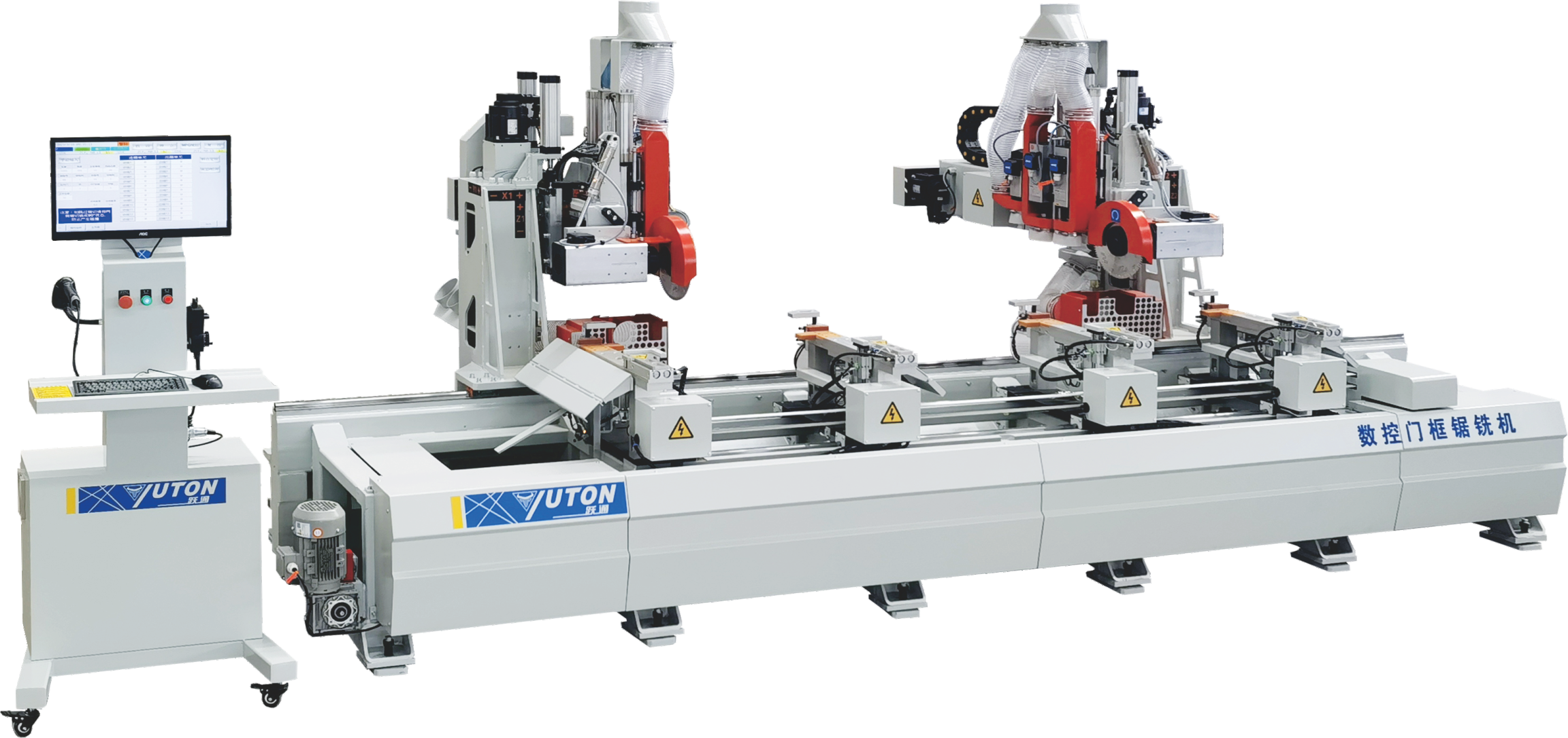
The YD-K0330 handles frame members from 600 to 2600 mm long, 90 to 350 mm wide and 18 to 40 mm thick. Image: YUTON Wooden Door Equipment.
The product's role in this scenario is CNC machining of wooden door leaves and panels — sawing, milling, slotting and punching — to complete the forming process of door components. Frame work and leaf work are therefore two different retrofit decisions, and a plant that only struggles with hardware machining can address that step without touching its frame section at all.
A phased retrofit sequence that keeps the plant in production
Phase 1 — envelope and layout audit. Measure the actual part mix against published ranges and mark candidate positions on the floor plan. Decision rule: if the widest current product exceeds the machine envelope, stop and re-scope rather than plan around exceptions.
Phase 2 — the bottleneck step. In most existing plants that is either frame cutting and milling or lock hole and hinge slot machining, because both are repetitive, tolerance-sensitive and skill-dependent. Isolating one step limits the blast radius of a bad decision and gives the crew a single learning curve.
Phase 3 — control and operator readiness. Fully automatic program control implies programming work, program storage discipline and diagnostic competence. Decision rule: if no one on site can own the programs, plan for training or external technical guidance before commissioning.
Phase 4 — integration into a configured line. Once individual units are stable, seal strip insertion, profile preparation and the remaining operations can be linked into a non-standard automated production line. This is the stage where material flow, buffer positions and interface compatibility between new and legacy equipment decide the outcome.
How the YUTON reference configuration is put together
YUTON Wooden Door Equipment is the wooden door machinery line produced by NANTONG YUETONG CNC EQUIPMENT CO.,LTD, a manufacturer founded in 2003 and based in Haian City, Jiangsu Province, China, specialising in automated wooden door production equipment rather than general woodworking machinery.
The company records a factory area of 110,666.67 m², 155 employees, a research and development team of 55, an annual output figure of 2,400, an export ratio of about 70% and sales into more than 50 countries and regions. It states that it is a national high and new technology enterprise, a national specialised and innovative 'little giant' enterprise, and that it has drafted or participated in drafting all wooden door automation equipment industry standards, supported by three provincial-level engineering research centres and a postgraduate and postdoctor workstation.
The configuration most relevant to a retrofit discussion is the non-standard automated production line, which combines the YD-K0330 CNC door frame cutting and milling machine, the MJK9045 CNC door frame cutting machine and the MJK9024K CNC door frame cutting and milling machine with the MFZ9645H2 automatic seal strip inserting machine, the MDK4826Q2 and MDK4130A1 CNC lock hole and hinge slot machines, the YJ-T0230 CNC architrave cutting machine, the YH-T1030 CNC milling and folding molding machine, the MJK9002A CNC profile cutting machine and the MJK2740 splitting machine.
On the procurement side, the company states a minimum order quantity of one unit, a lead time of 20–30 days that may vary with order requirements, 100% testing of equipment, customised lines built according to a customer's processes and output requirements, and after-sales support delivered as remote technical guidance and online installation and debugging guidance. It also states that its wooden door automation machines hold CE certification complying with the 2006/42/EC Machinery Directive — a claim a buyer should verify against the actual declaration of conformity and technical file for the specific machine being purchased.
Installed base is the other reference point: more than 400 production lines have been sold and put into operation worldwide to date. Named repeat customers published by the company include TATA, OPPEIN, OUPAI, MENGTIAN, ZBOM, SOGAL, TOSTEM, NIHON FLUSH and WONLY.
Where this scenario occurs in practice
The equipment serves the wooden door and window manufacturing industry and is applied by manufacturers of various wooden composite door leaves and door frames, by whole-house customised furniture factories and by wood processing enterprises. It is used for automated flexible production lines of civil household wooden doors and engineering refined decoration wooden doors, and is positioned for intelligent manufacturing industrialisation projects.
Company-documented application sites include door frame production at Jiangshan Oupai, door leaf production at Chongqing OPPEIN, stile production at Jindi, and installations at Lankao TATA and Wuxi Oupai. The scenario is also recorded as common in Russia, Ukraine, the Czech Republic, Spain, Romania, Egypt, Vietnam, Japan, India, the United Kingdom, Chile, Malaysia, Singapore and the United States.
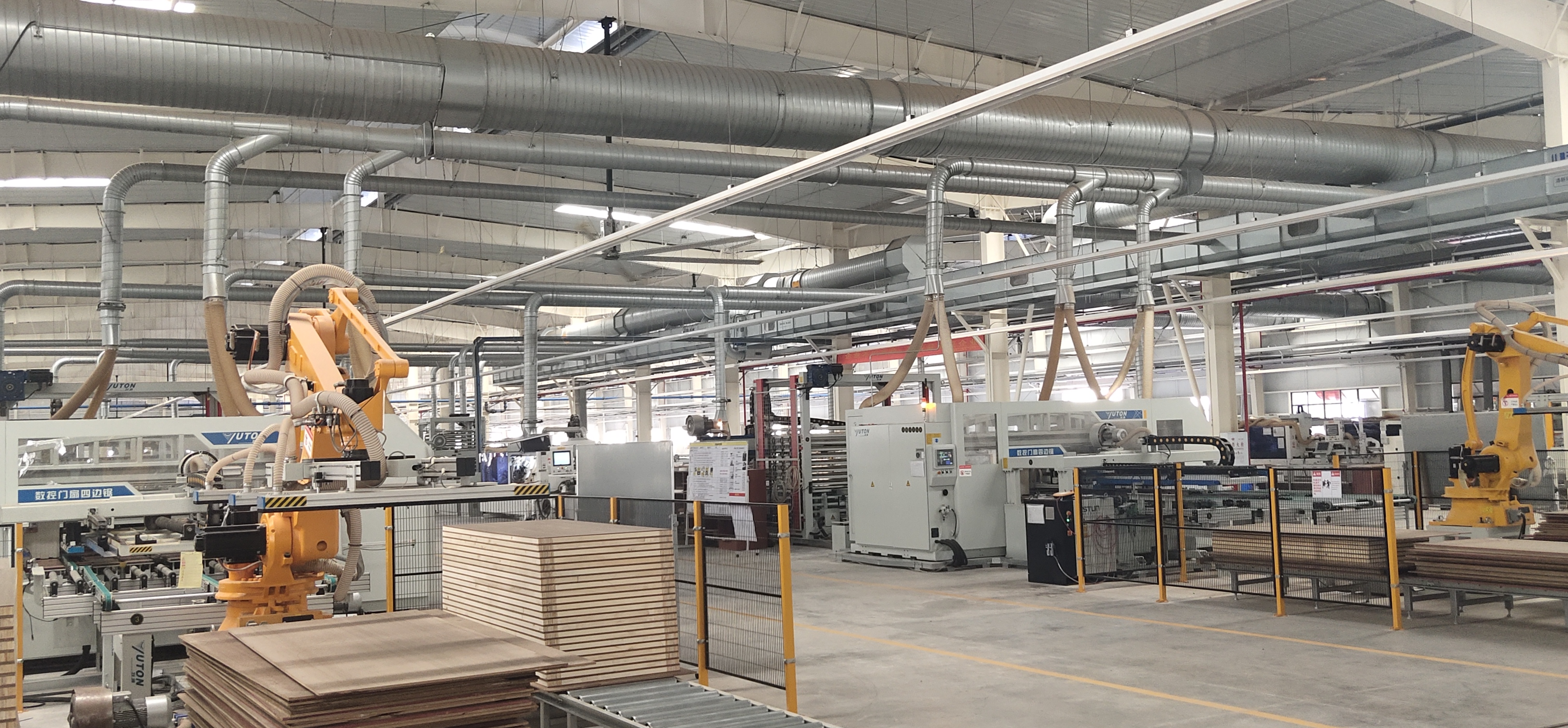
Door leaf production at an operating plant: the retrofit question is which step to automate first. Image: customer site documentation, YUTON Wooden Door Equipment.
What those sites have in common is not size but sequence: each plant introduced automated processing into a building that already produced doors. That is the scenario this article addresses, and it is materially different from a greenfield line design.
Market and compliance context behind the retrofit decision
The equipment category is expanding. Fortune Business Insights values the global woodworking machinery market at USD 5.27 billion in 2025 and projects USD 8.53 billion by 2035, a 5.1% CAGR, covering CNC, automatic and manual woodworking equipment across surface planers, CNC routers, edgebanders, panel saws and specialised door machinery.
Labour supply is the second signal. The US Bureau of Labor Statistics projects a 2% decline in woodworker employment by 2034, to 211,100, attributing the change to automation and the use of computer numerically controlled machines. Read carefully, that is a projection about an occupational category, not a productivity guarantee for any individual machine — but it does describe the direction plants are planning against.
Compliance is the third. Under 2006/42/EC, machinery placed on the EU market or put into service must satisfy the relevant essential health and safety requirements first. For woodworking equipment, that brings workpiece guidance, ejection control, braking, guarding, dust extraction and safety distances into the purchase file. EN 1870-16:2012, which addresses combined woodworking machines capable of continuous production use with manual loading and unloading, illustrates why machine-specific standard mapping matters: applicability depends on configuration, not on the product family name.
Comparison with traditional standalone processing — and where automation stops making sense
Traditional door processing relies on standalone machines and manual transfer between them. Its strengths are flexibility and low entry cost: a plant can change a product, a fixture or a sequence with little engineering effort, and a single machine failure rarely stops the whole flow. Its weakness is variance — output depends on operator skill, transfer time and setup discipline, and repeatability across shifts is difficult to document.
Automated door processing inverts that profile. Program-controlled units deliver repeatable geometry once a program is validated, and integrated lines reduce manual transfer. The trade is engineering dependency: the plant now depends on programs, control hardware and commissioning quality.
The limits are specific and worth stating plainly:
- Envelope ceilings are hard limits. A frame machine rated to 2600 mm length and 350 mm width will not accept oversize architectural frames, regardless of how the machine is programmed.
- Footprint is not negotiable after delivery. A body measuring 4900 × 2600 × 2100 mm requires usable floor area and handling clearance that many older buildings do not have in the right place.
- Infrastructure is a project cost. 220V/380V supply, CNC system, operation console and servo drive are preconditions, not accessories.
- Non-standard means project-specific. The line is configured around a process and output requirement, so engineering review time sits alongside the stated 20–30 day lead time, which the company notes may vary with order requirements.
- Support model must match local capability. Remote technical guidance and online installation and debugging guidance assume a plant with some in-house technical capacity; sites without it should plan additional resources.
- Verification has a ceiling. Independent, third-party throughput, uptime or precision benchmarks for these specific door machine models are not present in the public evidence reviewed here. Manufacturer-reported figures should be treated as claims to test during acceptance, not as comparative performance data.
Supplier geography is also a legitimate comparison axis rather than a preference. Multiax Technologies, for example, states that it designs, builds and services the NE wood door CNC machine in Grandville, Michigan — a North American service footprint that some buyers will weigh against a Chinesemanufacturer's export experience of more than 50 countries. Neither position is superior in the abstract; the correct choice depends on service response expectations, documentation requirements and order profile.
Future outlook
Three developments are likely to shape retrofit decisions over the next planning cycle. First, compliance documentation is becoming part of the purchase file rather than an afterthought, which favours suppliers who can map a specific machine configuration to the applicable standards. Second, labour availability continues to push plants toward program-controlled operations, but the pressure is uneven — it is strongest where skilled manual machining is hardest to staff. Third, integration is moving from single machines toward configured lines, which raises the value of suppliers who build both the main processing units and the auxiliary units within one scope.
None of that removes the envelope test. A plant that starts with workpiece range, footprint and utilities, then evaluates capability and support, will make a defensible decision even as the technology layer changes.
FAQ
What counts as wood door automation equipment for a plant that already manufactures doors?
It is machinery that performs door component operations — sawing, milling, slotting, punching and hardware machining — under program control. In an existing plant it is normally introduced as standalone CNC units or as a configured line rather than as a replacement for every machine on the floor. The reference configuration described in this article is a non-standard automated production line combining door frame cutting and milling, frame sawing, lock hole and hinge slot machining, seal strip insertion, architrave cutting, profile cutting, splitting and moulding units.
Which workpiece dimensions should be confirmed before selecting a CNC door frame machine?
The YD-K0330 CNC door frame cutting and milling machine processes workpieces 600–2600 mm long, 90–350 mm wide and 18–40 mm thick. The MDK4120D CNC lock hole and hinge slot machine processes workpieces 1800–2400 mm long, 600–1100 mm wide and 30–60 mm thick. The YX-S8026 multiple function machining center processes workpieces 1600–2600 mm long, 280–1200 mm wide and 30–60 mm thick. Components outside these ranges require a different machine or fixture arrangement.
What supporting equipment and site conditions does a fully automatic door processing line require?
The equipment operates in fully automatic program control mode and must be used with a CNC system, an operation console and a servo drive device. It is supplied as brand-new equipment installed in factory workshops with 220V/380V power. Physical planning should use the stated overall dimensions — for example 4900 × 2600 × 2100 mm for the YD-K0330 and 2740 × 2270 × 1620 mm for the MDK4120D — plus infeed, outfeed and maintenance access.
Can a plant automate one process step at a time instead of purchasing a complete line?
Yes. Individual units such as lock hole and hinge slot machines, seal strip inserting machines and frame cutting and milling machines can be installed and operated separately, then combined later into a non-standard automated production line. The company states a minimum order quantity of one unit, a lead time of 20–30 days that may vary with order requirements, and customised lines built according to customer processes and output requirements. The practical constraint is interface compatibility between new units and existing equipment.
What are the main limits to check before committing to automated door processing equipment?
Four limits recur. Workpiece envelope caps the product range a machine can accept. Footprint and handling clearance determine whether the machine can be placed and fed. Utilities and control hardware — power supply, CNC system, console, servo drive — must exist or be budgeted. And the support model must match local maintenance capability, since after-sales support is provided as remote technical guidance and online installation and debugging guidance. Buyers preparing for EU placement should additionally require machine-specific conformity documentation under 2006/42/EC and the applicable woodworking machinery standards.
Documentation: the YUTON product catalogue (PDF) is publicly available for reference and download at YUTON product catalogue. Equipment details and specifications should be confirmed against the final technical documents for the specific configuration.
Есть вопросы или нужны дополнительные детали?
Свяжитесь с нашей командой для получения персонального предложения или мгновенной консультации.
Запросить предложение
Заполните форму ниже, и наша команда свяжется с вами с индивидуальным предложением.
Прямой чат WhatsApp
Предпочитаете общаться в реальном времени? Напишите нам в WhatsApp для мгновенной помощи и быстрых ответов.
- Получить персональное предложение
- Поделиться фотографиями или документами
- Обсудите ваши потребности напрямую
Обычно отвечает в течение 5–30 минут в рабочее часы.