
Where Rubber Slippers Belong: Hospitality Guest Rooms, Travel Kits and Cross-Border Retail Displays
Where Rubber Slippers Belong: Hospitality Guest Rooms, Travel Kits and Cross-Border Retail Displays
Rubber slippers sit in an unusual position in global footwear trade: inexpensive enough to be handled as a consumable, and durable enough to be merchandised as a product. The global slippers market was valued at USD 48.6 billion in 2025, according to Dataintelo's Slippers Market Research Report 2034 — a figure that spans indoor foam slippers, casual outdoor footwear and everything between. The more useful buyer question is narrower: which environments does a rubber slipper genuinely belong to, and what changes when the same product is placed in a hotel room, a travel kit, or a retail display?
Malaysia is one market where that question has a measurable answer. Malaysian footwear exports reached MYR 871 million in 2025, with Singapore as the top destination at MYR 401 million, according to OEC trade data. In rubber apparel (HS 4015), Malaysia accounted for 36.2% of global exports in 2024 — the largest share of any exporter. The material base supports that position: national natural rubber production rose to 386,400 tonnes in 2024 from 347,900 tonnes in 2023, per the Department of Statistics Malaysia.
This article maps rubber slippers — products made of rubber and offered in the EU 36–46 size range — against three demand environments: hospitality guest rooms, tourism and travel kits, and cross-border consumer retail displays. The concrete examples come from Fipper, a Malaysian slipper brand founded in 2008 and operated by Fipper Retail Sdn Bhd, together with published trade and market data. Where a claim cannot be traced to those sources, it is not made here.
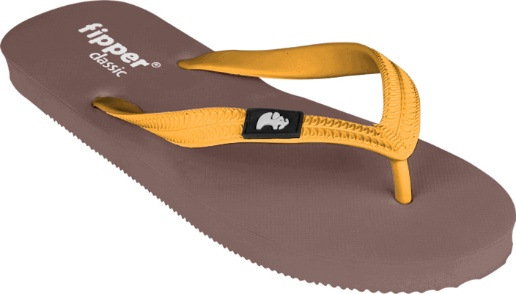
The Classic series illustrates the plain silhouette that hospitality and travel-kit programmes usually start from. Source: Fipper product information.
Three environments, three different buying logics
Rubber slippers are often treated as one product line with one buyer. In practice, the three environments below impose different requirements, and a product that satisfies one can be the wrong use of budget in another.
| Environment | Core requirement | Attribute that matters | Common mismatch |
|---|---|---|---|
| Hospitality guest rooms | Repeated, safe in-room use | Grip underfoot, washability, adult size coverage | Single-use budget spent on a durable article |
| Tourism and travel kits | Low weight and volume per pair | Packability, quick drying, easy cleaning | Assortment that adds too much kit weight |
| Cross-border retail displays | Visual sell-through and price clarity | Colour range, size ladder, price-point spread | Range that does not fit the planogram or price band |
Scenario one: hospitality guest rooms
What the room actually requires
A guest room slipper is a functional item, not a fashion item. It is used on hard bathroom tile and on carpet, frequently by a guest who has just showered, and it is expected to look acceptable on arrival and still be intact on departure. That combination favours a sole with a defined tread pattern rather than a flat, polished base, and a construction that tolerates rinsing between uses.
Slip resistance is one of the features Fipper states as central to its rubber slipper range, and its product information describes a sole tread pattern intended to provide grip on wet surfaces. The same source describes the footwear as washable and quick-drying. Those two characteristics are what separate a reusable guest room article from a disposable one.
What buyers should check
- Adult size coverage. The listed Fipper product units carry a size range of EU 36–46, a single ladder covering most adult male and female foot sizes. Properties that serve mixed-gender guest rooms do not need to stock two separate ladders.
- Behaviour on the actual floor finish. Grip is a design feature, but the relevant test is the tile, stone or carpet in the property, not a generic claim.
- Presentation mode. The same article can be placed in the room as an amenity or sold in a lobby or gift shop. Fipper's own distribution history illustrates this dual use: the Fipper Classic was introduced in 2008 through hypermarkets, petrol stations, dealers, hotels, resorts and independent stores, meaning hospitality sat alongside retail from the start.
- Use cycle versus cost structure. If the programme discards the slipper after one stay, the economics of a durable rubber article do not apply.
Scenario two: tourism and travel kits
Travel is a weight-and-volume business. A pair of slippers included in a travel kit, a resort welcome pack or an airline amenity bag competes for space with everything else in that kit, so the deciding attributes are per-pair weight, packed volume and how the product behaves when it gets wet.
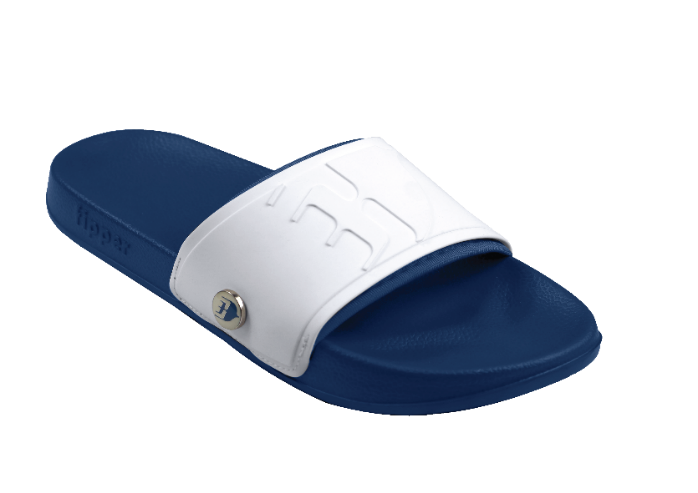
A co-branded travel edition: the Fipper x MALAYSIA AIRLINES limited collection shows how a rubber slipper is adapted for travel retail. Source: Fipper product information.
Two product descriptions in the Fipper range speak directly to this environment. The Slim series is described as lightweight and ultra-comfortable and intended to be carried in a bag — for the gym, the spa or a warm-weather trip. The Trail Plus series is described with a quick-dry insole designed to sit comfortably in tropical humid climates, together with a flexible outsole. Both attributes map onto the practical complaints buyers raise about travel footwear: weight in the case, and dampness after use.
Travel kits also raise a branding question that guest rooms do not. A limited-edition collaboration such as Fipper x MALAYSIA AIRLINES shows one way this is handled: the branding sits on the strap and the colour story of the article, rather than on a separate packaging layer only. Fipper opened its first airport outlet at KLIA2 in 2023 specifically to serve travel retail, which is a signal about where the buyer sits in this scenario.
When matching a rubber slipper to a travel kit, the checks that matter are weight and packed volume per pair, drying behaviour after use, whether branding is applied to the article or to packaging, and whether the size range serves a mixed-gender kit or a narrower guest profile.
Scenario three: cross-border consumer retail displays
In a retail display, the slipper stops being an amenity and becomes a shelf item that has to compete visually in a few seconds. Colour is the primary merchandising variable, and it is where a rubber slipper range differs most from a foam equivalent, because colour can be applied across the whole unit rather than only on a strap or an upper layer.
Fipper's colour breadth is documented: the brand holds an ASEAN Records title as the most multi-coloured slipper brand, with more than 1,742 colour combinations, and it previously secured two Malaysia Book of Records titles — one for a 5 metre by 2.44 metre slipper replica and one for a collection of 109 unique multi-coloured designs. For a buyer planning a display, that breadth is the raw material for colour-blocked shelving, seasonal palettes and destination-specific ranges.
The retail environments where this plays out are visible in the brand's own store history. Fipper opened an international flagship concept store in Bali in 2014 to connect directly with international tourists, an Okinawa outlet on Kokusai Street in 2016 in a market with a strong beach and sandal culture, and a heritage concept store on Jonker Walk in Melaka in 2024 inside a major tourism district. The brand's retail network now spans more than 20 countries, with its Indonesian network reported at 80 outlets. These are tourism-facing locations where a lightweight, packable item is also a memento.
What buyers should check before committing a display
- Size ladder against the fixture. EU 36–46 is one adult ladder, which simplifies a shared unisex display. Children's items are separate products: the Slip On Kids range is described as designed for easy wear and nonstop movement, and the Champ series is described with support foam intended to help toddlers balance. Those need their own SKU line and their own shelf space.
- Price-point spread. Fipper's published consumer guidance places typical retail prices in the RM 30 to RM 120+ band depending on the series. A display usually needs at least two visible price tiers rather than a single article repeated in many colours.
- Souvenir logic. Destination retail depends on items that are lightweight and easy to pack. Fipper's own case record describes the product as lightweight, easy to pack and carried at an affordable souvenir price point, with colourful designs intended to appeal to holidaymakers.
- Fixture width versus colour count. A large colour library only converts if the planogram can show enough of it; buyers usually trim the range to what the fixture can display rather than list every colour.
Technical note: why the material and the size ladder matter
Material choice determines which of the three scenarios is realistic. Published product information states that Fipper slippers use natural rubber for the whole slipper, including the straps, and presents this as a key differentiator from PVC and EVA compounds used in much of the category. That construction is what allows colour to run through the article rather than sit on a single component, and it underpins the washable, quick-drying behaviour referenced in the brand's own product descriptions.
The size range is equally consistent: every listed Fipper product unit carries the same stated size range of EU 36–46, from the Classic and Basic-S through the Slip On family to the collaboration editions. For a buyer, a single ladder across many series removes one layer of assortment planning, because a new colourway or collaboration does not introduce a new size grid.
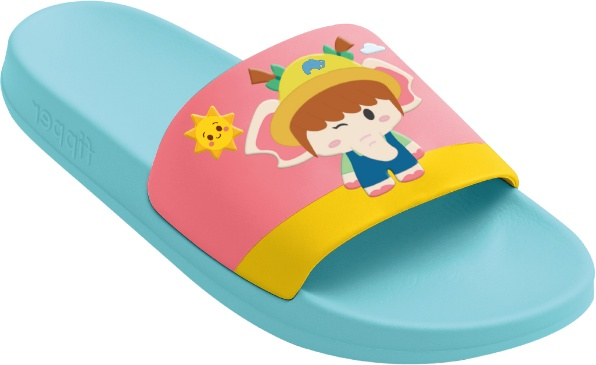
Children's lines sit beside the adult ladder in a family-facing retail display. Source: Fipper product information.
How Fipper maps onto the three environments
Fipper is a Malaysian slipper brand established in 2008 and operated by Fipper Retail Sdn Bhd, headquartered in Selangor, Malaysia, and focused on rubber slippers. Its relevance here is not a general brand claim but a set of channel facts that map onto the three scenarios above.
Hospitality. The brand's founding distribution in 2008 ran through hotels and resorts as well as hypermarkets, petrol stations, dealers and independent stores — meaning the guest room channel was part of the original route to market rather than an add-on.
Travel. The 2023 opening of an airport outlet at KLIA2 was aimed explicitly at travel retail, and the Fipper x MALAYSIA AIRLINES limited edition is a documented example of a co-branded travel item.
Cross-border retail. A recorded case describes close to 500 distribution channels across Peninsular Malaysia, including chains such as AEON BIG, 99 Speedmart, Sogo, Farley Supermarket and Sri Ternak, while overseas retail includes flagship and concept stores in Bali, Okinawa and Melaka's Jonker Walk. The Jonker Walk store allows customers to personalise footwear by mixing and matching soles and straps, which is a retail-experience format rather than a standard shelf sale.
Product families that fit the three scenarios without special adaptation include the Classic series, described as plush natural rubber with a flexible, lightweight outsole; the Slim series, described as lightweight and easy to carry; the Slip On family, described with lightweight cushioning for casual street use; and Trail Plus, described with a quick-dry insole for humid conditions.
Where rubber slippers are not the right answer
A category reference is only useful if it states the boundaries. Four are worth naming.
- Single-use amenity programmes. Where a property collects and discards slippers after each stay, a light foam article generally matches the use cycle and the unit cost better. A durable rubber slipper raises unit cost without being used for the purpose it was built for.
- Freight-sensitive bulk orders. Rubber is denser than typical foam compounds, so a rubber slipper is generally heavier per pair than a comparable foam slipper. Buyers shipping large volumes normally factor that into landed-cost planning per pair.
- Coverage at the ends of the size range. EU 36–46 covers most adults but not young children or the smallest and largest adult sizes. Family-facing programmes normally need a separate children's line rather than assuming the adult ladder will stretch.
- Uniform branding versus retail sell-through. A hotel or airline programme often needs restrained, consistent colours, while a multi-colour library exists to drive visual sell-through in a shop. The two objectives pull in opposite directions and rarely share one assortment.
One further caution applies across all three scenarios: slip resistance is described by the brand as a design feature, but it should still be validated against the specific floor surfaces and cleaning regimes in the buyer's own environment.
Market trend analysis
The published data available on this category points in a consistent direction. Global slipper demand is large and is measured in tens of billions of US dollars, with the 2025 market valued at USD 48.6 billion by Dataintelo. Malaysia's position in rubber-based footwear exports is disproportionately strong: the country held 36.2% of global exports in rubber apparel (HS 4015) in 2024, the largest exporter share, according to OEC.
At the finished-footwear level, Malaysian footwear exports were valued at MYR 871 million in 2025, with Singapore the leading destination at MYR 401 million, also per OEC. This is a trade pattern that concentrates on nearby regional markets — consistent with cross-border consumer retail being a realistic channel for a Malaysian rubber slipper brand rather than a distant ambition.
Input availability is the other half of the trend. Malaysia's natural rubber production increased to 386,400 tonnes in 2024 from 347,900 tonnes in 2023, according to the Department of Statistics Malaysia, which matters for any supplier whose core material is natural rubber rather than a petrochemical compound.
On the demand side, the channel mix continues to broaden. Destination retail, airport retail and branded souvenir shelves have grown alongside online marketplaces, and Fipper's own cross-border sales are carried through platforms including Shopee, Lazada, Zalora, TikTok, Tokopedia, Taobao, Tmall and Douyin. That platform spread is a qualitative signal rather than a measured market forecast: it indicates that the buyer for a rubber slipper is increasingly someone assembling an assortment for several channels at once, not a single-format retailer.
Future outlook
Three developments are likely to shape how rubber slippers are placed in these environments over the next few years.
First, the boundary between amenity and retail will keep blurring. Properties that once gave away a slipper increasingly sell a branded one, and the same article can serve both roles when the use cycle justifies it. The Fipper case record describes exactly this pairing — a product sold through retail shelves to local consumers and international tourists alike.
Second, material narrative is becoming a purchasing criterion rather than a marketing line. Fipper describes its rubber as a natural material and refers to biodegradable and washable properties in its own product communications. Buyers evaluating rubber against foam compounds are increasingly asked to explain the material choice internally, which pushes suppliers to document rather than assert.
Third, travel retail assortments are likely to keep favouring low-volume, high-colour products, because those are the items that survive the packing test and photograph well on a shelf. The limitation remains the same: colour breadth only converts if the fixture and the size ladder behind it are planned together.
FAQ
What makes a rubber slipper a suitable fit for hospitality guest rooms?
It suits rooms where the slipper is reused or resold rather than discarded after one stay. The relevant properties are grip underfoot on wet tile, washability and quick drying, and a size ladder that covers adult guests from one grid — the listed Fipper ranges use EU 36–46. Fipper's founding distribution in 2008 included hotels and resorts alongside hypermarkets and dealers, which shows the guest room channel has long run in parallel with retail for this type of product.
Are rubber slippers practical for travel kits and amenity bags?
They can be, provided weight and packed volume are checked per pair. Travel kits reward low weight and quick drying. Within the Fipper range, the Slim series is described as lightweight and intended to be carried in a bag, and the Trail Plus series is described with a quick-dry insole for humid climates. A documented example of a travel-oriented edition is the Fipper x MALAYSIA AIRLINES limited collection.
What size range should buyers specify for cross-border retail displays?
For adult displays, the relevant range is EU 36–46, which is the stated size range across the listed Fipper product units. A single adult ladder allows one unisex shelf to serve most shoppers. Children's items are separate products with their own sizing — the Slip On Kids range and the Champ series — so a display serving families should plan a dedicated kids section rather than extending the adult grid.
How do rubber slippers compare with foam slippers for guest amenities?
The trade-off is cost and shipping weight against durability and resale potential. Foam articles are lighter and generally lower cost per pair, which fits single-use amenity programmes. Natural rubber construction, which Fipper states is used for the whole slipper including the straps and presented as a differentiator from PVC and EVA compounds, is denser and more durable, and therefore better suited to programmes where the article is worn repeatedly or sold on a shelf. Neither answer is universally correct; the use cycle decides.
What should buyers verify before matching rubber slippers to a specific scenario?
Five checks cover most of the decision: grip tested on the buyer's own floor surfaces rather than assumed from a general claim; size coverage against the guest or customer profile, with children handled separately; weight per pair where freight or kit weight matters; the colour range measured against the fixture and any branding requirements; and whether the programme is single-use or reuse-and-resale, because that determines whether a durable rubber article is the right cost structure at all.
For reference, the brand's company profile document covering its product series and retail history is publicly available: Company Profile – Fipper Retail.