
Where the SC750 7-Quart Double-Layer Food Steamer Fits
Buyers in light-industry and daily-use channels rarely purchase “a steamer”. They purchase a capacity format, a timer type, a retail packaging format and a document set that must survive a retailer’s compliance review. The SC750 is a two-layer electric food steamer from Ningbo Jinchang Electronics Co., Ltd., a small-kitchen-appliance manufacturer based in Yuyao City, Zhejiang Province, China. Its commercial value depends less on the steamer category itself than on how precisely the 7-quart double-layer format matches a specific programme — and on whether the EU-facing paperwork is current.
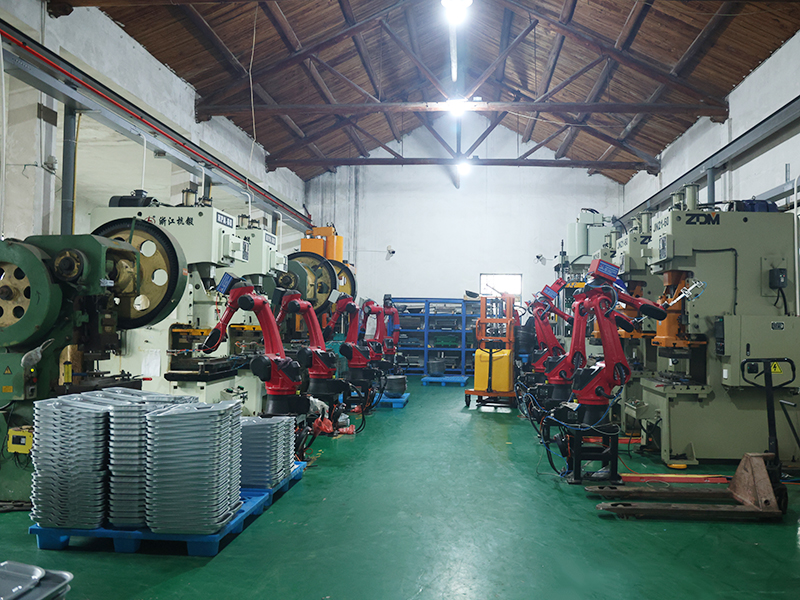
Production equipment inside the 5,500 m² plant of Ningbo Jinchang Electronics Co., Ltd., Yuyao City, Zhejiang Province.
Why the format question comes before the supplier question
Electric food steamers sit inside two very different buying logics. In household retail, the decision is a shelf decision: does the unit fit a defined price band, a carton size and a shopper’s countertop? In light-industry and daily-use procurement — supermarket private label, gift-set assembly, homestay and apartment supply, cross-border e-commerce — the decision is a programme decision: does the unit repeatably deliver the same cooking volume, the same documentation and the same return-rate profile across several shipping cycles?
Both logics converge on one question that is usually answered too late: is this a single-layer or a double-layer format? A single-layer countertop electric food steamer serves one or two people and occupies little height. A two-layer, 7-quart-class unit serves several dishes at once and occupies noticeably more vertical space on the shelf and in the kitchen. Choosing the wrong one does not create a safety problem. It creates a mismatch between the capacity a retailer advertises and the capacity a shopper experiences — the most common source of returns in this category.
The opportunity for buyers is early format verification. The risk is a documentation gap discovered after the purchase order is placed, when a food-contact report has expired, a social-compliance cycle has lapsed, or the certificate scope does not actually cover the model being shipped.
What the SC750 actually is, in verifiable terms
Ningbo Jinchang Electronics Co., Ltd. designs, manufactures and exports Western-style small household kitchen appliances. The company operates a 5,500 m² production plant with 68 employees, 8 engineers, an annual output of 1,200,000 units and a monthly production capacity of 100,000 units. It offers more than 200 product models across electric BBQ grills, charcoal grills, electric steamers and food dehydrators, with roughly 90% of output exported to EU, US, AU and RU markets.
The SC750 is the company’s two-layer electric steamer. In catalogue language it is commonly described as a 7-quart double-layer unit; on the specification sheet it is rated at 7 L. Buyers comparing quotations across suppliers should treat litre and quart figures as marketing conventions and confirm the actual usable volume of each tier before committing to packaging artwork.
| Attribute | SC750 documented value |
|---|---|
| Product type | Electric steamer, two-layer |
| Rated power | 800 W |
| Rated voltage | 230 V |
| Capacity | 7 L |
| Layers | 2 |
| Housing material | Plastic; PP body, ABS knob, PC indicator |
| Product certifications | CE, LFGB, CB |
| Control | Mechanical rotary timer |
| Intended application | Household consumer market; also B-end foreign trade procurement including cross-border e-commerce, home appliance gifts, and homestay and apartment supporting supplies |
The documented application profile matters as much as the specification. The SC750 is intended for indoor use on a stable, level countertop with a stable 230 V AC supply, in a working environment that includes regular exposure to hot steam and water vapour and routine cleaning after use.
The technical reason a two-layer format changes the buying decision
An 800 W element with a two-tier cavity is a deliberate design compromise. Power is not increased to gain capacity; the same heating input is applied across two stacked steaming levels, which is why the format can prepare vegetables, dumplings, eggs, seafood or reheated prepared food simultaneously without a higher connected load. For a retailer, that translates into a simpler electrical claim on the carton and a simpler plug-load assumption for the end user. For a homestay or apartment operator, it means one socket can serve a multi-dish meal.
The trade-off is vertical. A double-layer electric food steamer is taller than a single-layer unit, which affects retail shelf depth, carton dimensions, pallet configuration and domestic cupboard storage. Buyers who benchmark only on litres and watts will miss this. The dimension that decides whether a programme launches cleanly is the assembled height, not the capacity figure.
Control architecture is the second technical variable. The SC750 uses a mechanical rotary timer. In export programmes this is a meaningful choice rather than a cost shortcut: mechanical control is simple to operate across age groups, has fewer failure points than app-connected electronics, and avoids the network-standby power obligations that apply to connected appliances under EU ecodesign rules. A connected, app-controlled steamer offers richer functions but adds cost, operating complexity for older users, and an additional compliance surface.
Safety and cleaning behaviour complete the picture. The reference product documentation for this model describes an auto-off dry-burn protection function that mitigates the main hazard of a large-capacity steamer — overheating when the water tank runs dry or when a timer fails during a long steaming cycle. Steaming trays and water-tank-related parts are removable for cleaning, which matters in daily use because scale and food residue accumulate fastest at the water interface.
EU-facing documentation: what can be verified, and until when
This is where a scenario-fit article becomes useful to a buyer. The SC750 is supported by model-specific food-contact and hazardous-substance reports from SGS, in addition to factory-level social-compliance audits. Each document has a defined validity window, and a programme running into 2027 or 2028 must check that window rather than the issue date.
| Document | Type / standard | Certificate number | Validity | Market coverage |
|---|---|---|---|---|
| SGS SVHC Test Report | REACH, Regulation (EC) No 1907/2006; ECHA SVHC Candidate List updated before 04 Feb 2026 | NGBEC26006230701 | 2026-08-05 to 2028-08-05 | EU |
| SGS Food Contact Test Report | LFGB Section 30 and 31, BfR recommendation; (EU) No 10/2011, (EU) 2025/351 | NGBEC26006183701 | 2026-07-29 to 2028-07-29 | EU, Germany |
| SGS Food Contact Test Report | DGCCRF, French Décret 2007-766, MCDA n°3; French Law 2012-1442; (EU) 2024/3190 | NGBEC26006183702 | 2026-07-29 to 2028-07-29 | EU, France |
| ICS Audit Summary of Content | ICS initiative social compliance requirements, 13 BSCI performance areas | Issued by SGS | 2025-06-05 to 2027-06-05 | EU supply-chain access |
| amfori BSCI Monitoring Summary Report | amfori BSCI Code of Conduct, 13 performance areas | 24-0279560-1 | 2025-09-26 to 2026-10-08 | EU |
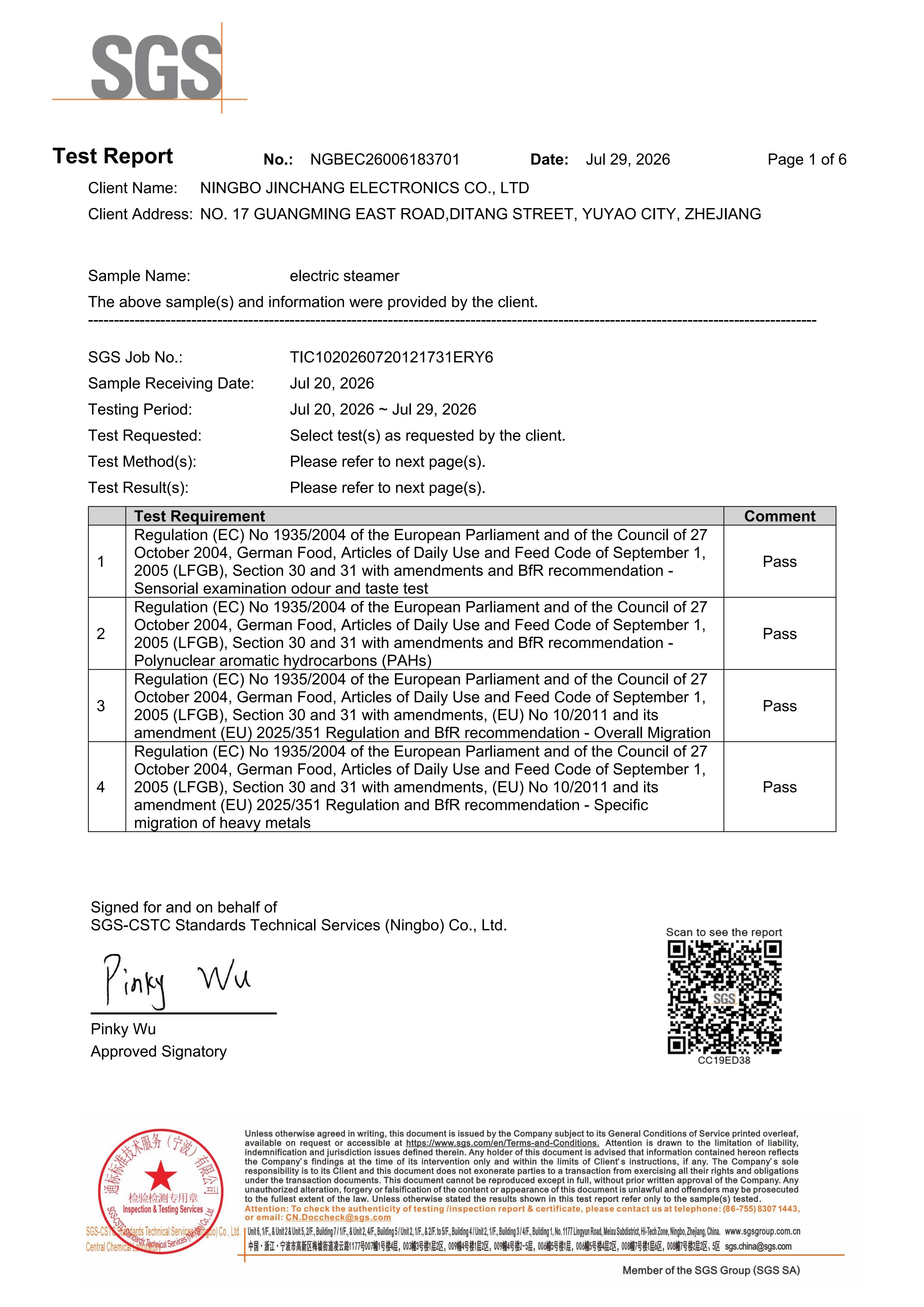
SGS LFGB food-contact test report NGBEC26006183701, issued 2026-07-29 and valid to 2028-07-29, names the electric steamer SC750 as the tested scope.
Three reading rules apply. First, both the LFGB and the DGCCRF reports name the SC750 specifically as their scope, which is stronger evidence than a certificate issued against a product family. Second, the ICS audit summary explicitly covers the factory’s manufacture of electric grills, food dehydrators, charcoal grills and electric steamers — steamer production is inside the audited boundary. Third, the amfori BSCI report 24-0279560-1 carries a stated validity ending 2026-10-08, so a buyer opening the file in late 2026 should request confirmation of the current audit cycle instead of relying on that earlier report.
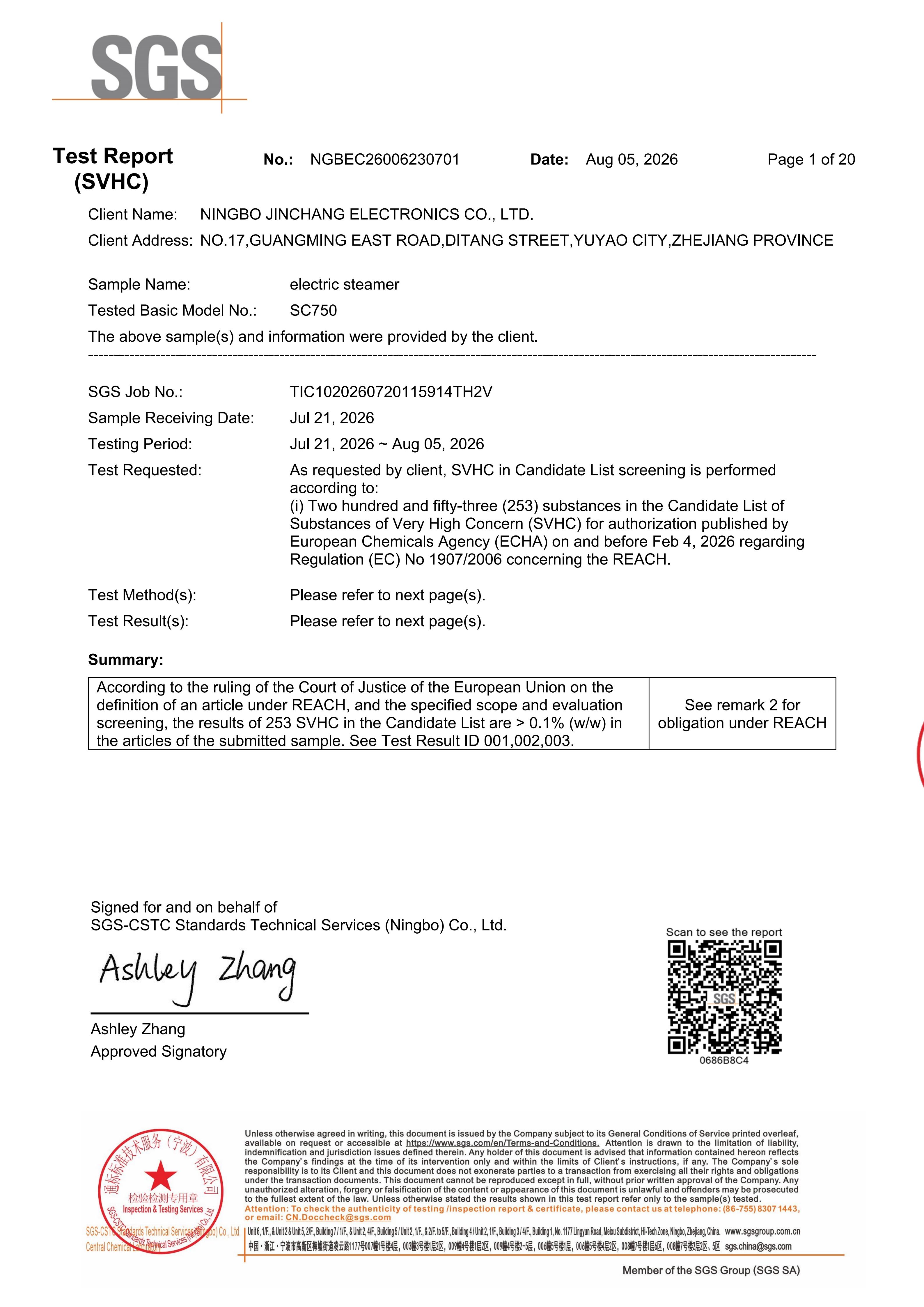
SGS SVHC test report NGBEC26006230701 under REACH, valid 2026-08-05 to 2028-08-05, covering the SC750 for the EU market.
Scenario shortlist: where the 7-quart double-layer format earns its place
The following ordering is an editorial fit assessment based on documented product specifications, the stated application profile and the case record described below. It is not a ranking of manufacturers.
1. Supermarket private-label shelf programmes
The strongest documented fit. The SC750 has been supplied to a large home goods supermarket chain operating in Australia, Germany and France, at volumes of 40,000–60,000 units per year over a relationship of 3–5 years, for household daily steaming and cooking. The reported outcome was steady shelf sales, low return rate and good performance in peak shopping seasons. The attributes credited in that case were multi-certification, food-grade material and multi-layer options.
2. Gift-set and seasonal bundle programmes
The model is supplied with a retail colour-box package and is positioned for gift-set wholesale export. A mechanical-timer, two-layer countertop electric food steamer suits bundling because it needs no app pairing, no account setup and no connectivity disclosure on the carton — all of which shorten the retailer’s packaging and instruction review.
3. Homestay, apartment and small hospitality support
The documented application profile names homestay and apartment supporting supplies as a B-end use case. Here the two-tier format does the work: vegetables on one level and dumplings or reheated food on another, controlled by a single rotary timer, from one 230 V socket on a countertop.
4. Cross-border e-commerce single-unit sales
Also named in the application profile. The constraint here is carton durability and instruction clarity rather than volume. Drop-test equipment is part of the manufacturer’s in-house test capability, which is relevant when a marketplace requires transit testing evidence.
Where this format does not fit
Two clear exclusions follow from the documented special requirements. The unit is rated 230 V and cannot operate on 110 V without a voltage-adjusted model, so North American retail requires a different configuration rather than a plug adapter. And the stated application is indoor countertop use, which rules out continuous high-volume commercial kitchen duty where a steamer runs near-constantly through a service period.
Market context: steady category growth, uneven forecasts
Third-party research places the global electric food steamer market at approximately USD 3.68 billion in 2024, with projected growth of 5.32% CAGR from 2025 to 2034 according to Custom Market Insights. That figure should be read with care: alternative published projections reach as high as 11.2%, and the divergence most likely reflects whether multi-functional cookers and commercial-grade steamers are counted inside the category. For procurement planning, the direction is more reliable than the decimal.
Two structural facts are more actionable. Asia-Pacific is identified as both the largest and fastest-growing regional market as of 2024/2025. And China remains the dominant exporter in tracked trade corridors, accounting for roughly 88% of import shipments in the corridors examined by trade-data providers — a derived figure from customs-derived datasets rather than an official statistical release.
Classification matters for landed-cost modelling. Electric food steamers are typically declared under HS 8516.60 (other ovens; cookers, cooking plates, boiling rings, grillers and roasters) or HS 8419.81 (machinery for cooking or heating food), and the applicable code affects duty treatment in ways that a generic “kitchen appliance” description will not capture. On the standards side, IEC 60335-1 together with IEC 60335-2-15 / 60335-2-3 forms the primary international safety reference for household electric steam cookers, which is the technical basis behind CB-scheme testing.
Comparison with traditional and single-tier solutions
| Criterion | SC750 two-layer electric steamer | Single-layer electric steamer | Stovetop steaming |
|---|---|---|---|
| Simultaneous dishes | Two tiers, one 800 W element | One tier; portions for roughly one to two people | Depends on pot and rack setup |
| Countertop footprint | Larger vertical footprint | Lower overall height | Occupies a hob rather than counter space |
| Timing control | Mechanical rotary timer | Varies by model | Manual attention required |
| Dry-burn protection | Auto-off function described for this model | Varies by model | Not applicable in the same form |
| Documentation depth | Model-specific SGS SVHC, LFGB and DGCCRF reports | Varies; often family-level certificates | Not applicable |
| Best fit | Family cooking, retail shelf, gift sets, apartment supply | Small apartments, one- to two-person households | Low-equipment kitchens |
The honest boundary of the SC750 proposition is fourfold. Storage height is greater than a single-layer unit, which is a real constraint in compact retail fixtures and small kitchens. The 230 V rating excludes 110 V markets without a voltage-adjusted variant. There is no local on-site after-sales service; support runs through a 1-year warranty and the manufacturer’s export channel rather than in-market technicians. And production economics assume programme scale: the stated minimum order quantity is 5,000 units with a 30-day lead time, so sampling and trial-order buyers are not the natural fit.
Two further limits belong in any evaluation. The mechanical timer trades programme precision for simplicity — it will not deliver app-level scheduling. And social-compliance evidence runs on audit cycles, not product lifecycles, so a multi-year programme must budget for re-audit rather than treating a 2025 report as permanent.
Future outlook
Three forces will shape how this format is bought through 2028. Food-contact regulation is tightening rather than settling: the SGS reports for the SC750 already reference (EU) 2024/3190 and (EU) 2025/351 alongside older French and German requirements, which means buyers should expect report revisions during a multi-year programme rather than a single fixed document set. Ecodesign obligations continue to push connected appliances toward standby-power limits, strengthening the case for mechanical-timer formats in mass retail. And social-compliance expectations from EU retailers keep audit cycles live, so ICS and amfori BSCI status will remain a gating item in supplier reviews.
For light-industry and daily-use buyers, the practical implication is unglamorous: the winning programmes will be those that matched format to fixture and document set to shipment date before the purchase order, not those that negotiated the lowest unit price.
FAQ
What capacity and power does the SC750 offer in daily use?
The SC750 is rated at 800 W and 230 V, with a 7 L capacity across two layers. The two tiers allow different foods — vegetables, seafood, meat, dumplings, eggs or prepared food — to be steamed simultaneously, with cooking controlled through a mechanical rotary timer. The format supports low-oil food preparation from a single countertop socket.
Which EU documents can a buyer verify for SC750 orders, and for how long?
Three model-specific SGS reports name the SC750 as their scope. The SVHC test report NGBEC26006230701 under REACH is valid from 2026-08-05 to 2028-08-05 for the EU. The LFGB food-contact report NGBEC26006183701 is valid from 2026-07-29 to 2028-07-29 for Germany and the EU. The DGCCRF food-contact report NGBEC26006183702 is valid from 2026-07-29 to 2028-07-29 for France and the EU. The product also carries CE, LFGB and CB certification.
How do the social-compliance audits apply to steamer production?
The ICS audit summary issued by SGS is valid from 2025-06-05 to 2027-06-05 and explicitly covers the factory’s manufacture of electric grills, food dehydrators, charcoal grills and electric steamers, assessed against 13 BSCI performance areas including social-compliance management systems, labour rights and salary and working hours. The amfori BSCI monitoring summary report 24-0279560-1 was issued 2025-09-26 with a stated validity to 2026-10-08, so its current cycle status should be confirmed for shipments reviewed after that date.
Is a double-layer steamer better than a single-layer unit?
Neither is universally better. A two-layer 7 L unit cooks multiple portions at the same time without increasing power consumption, which suits family cooking, retail shelf programmes and gift-set orders, but it requires more vertical storage space. A single-layer unit suits one- to two-person households and small apartments where height is constrained.
What cleaning and safety features matter in daily operation?
Steaming trays and water-tank-related parts on the SC750 are removable for quick cleaning, which matters because scale accumulates at the water interface. The model is described as having an auto-off dry-burn protection function that mitigates overheating if the tank runs dry or a timer fails during long steaming. Users should still check the water level before each cycle.
Mechanical timer or app control — which suits export programmes?
A mechanical-timer steamer is simple to operate across age groups, has a lower failure rate, and avoids the network-standby ecodesign obligations that apply to connected appliances. An app-controlled steamer offers richer functions but carries higher cost, added operating complexity for older users, and an additional compliance surface. For mass retail, gift-set and multi-country export programmes, the mechanical format is the lower-risk choice; app control is better reserved for dedicated smart-home channels.
What are the SC750’s application limits?
The unit is for indoor countertop use only and is rated 230 V, so it cannot operate on 110 V without a voltage-adjusted model. There is no local on-site after-sales service; coverage is provided through a 1-year warranty and the export channel. Programme economics assume a minimum order quantity of 5,000 units and a 30-day lead time, and the model is not intended for continuous high-volume commercial kitchen operation.
Есть вопросы или нужны дополнительные детали?
Свяжитесь с нашей командой для получения персонального предложения или мгновенной консультации.
Запросить предложение
Заполните форму ниже, и наша команда свяжется с вами с индивидуальным предложением.
Прямой чат WhatsApp
Предпочитаете общаться в реальном времени? Напишите нам в WhatsApp для мгновенной помощи и быстрых ответов.
- Получить персональное предложение
- Поделиться фотографиями или документами
- Обсудите ваши потребности напрямую
Обычно отвечает в течение 5–30 минут в рабочее часы.