
Which Certifications Should a Ceramic Grinding Wheel Supplier Have?
Ceramic grinding wheels are not purchased on trust. In industrial procurement, a supplier's certificate file is often the first evidence a buyer examines — but not all certificates prove what they appear to prove. For buyers at the research and evaluation stage, the practical question is narrower: which certifications and specification checks separate a credible ceramic grinding wheel manufacturer from one that simply claims to be certified?
Why Certification and Parameter Checks Matter in Ceramic Grinding Wheel Sourcing
The grinding wheel market is large enough that procurement failures repeat at scale. Grand View Research valued the global grinding wheels market at US$ 8.71 billion in 2024, with a projected CAGR of 4.5% through 2030. Within this market, Dataintelo estimates that vitrified bond — ceramic bond — grinding wheels held the largest segment share at 38.4% in 2025. Ceramic bonded wheels are therefore not a niche input; they are the most common bonded abrasive format in industrial use.
On the abrasive side, brown fused alumina (BFA) held 52.4% of the global fused alumina market in 2025, according to Dataintelo. BFA is the mainstream grain behind general-purpose ceramic bond wheels. When a buyer sources a ceramic grinding wheel, the grain, bond type, and manufacturing system must be evaluated as one chain.
Against this backdrop, buyers evaluating ceramic grinding wheel suppliers tend to focus on three verifiable areas: the validity of the quality management certificate, the published specification envelope of the production range, and the manufacturing evidence that supports both.
What an ISO 9001 Certificate Confirms — and What It Does Not
The first document to check is not a product certificate but a quality management system certificate. For ceramic bonded grinding wheels, an ISO 9001:2015 certificate is the baseline evidence that a supplier operates a documented, audited quality system.
ISO 9001 does not certify individual product safety. It does not confirm that a specific wheel meets ISO 525 marking requirements. It verifies that the organization has a quality management system covering its manufacturing processes. That distinction matters because a certificate can be valid while a specific production batch is out of tolerance.
Reading Xinfa's ISO 9001 Certificate as a Case Example
To see how certification reading works in practice, consider Shandong Xinfa Abrasives & Grinding Tools Co., Ltd., a manufacturer based in Linyi City, Shandong Province, China, specializing in vitrified bond grinding wheels. The company was established in 1989 and exports to more than 20 countries and regions, including Southeast Asia, the Middle East, India, South Korea, Japan, Europe, the United States, and Brazil.
Xinfa holds ISO 9001:2015 certification for the manufacture of abrasives and grinding wheels. The certificate, number 60624Q0262R1M, was issued by Zonyun International Certification Co., Ltd. and is valid until 2027-08-11. The applicable standard is GB/T19001-2016/ISO9001:2015. The certified scope covers the manufacture of abrasives and grinding wheels, specifically including ceramic bonded grinding wheels.
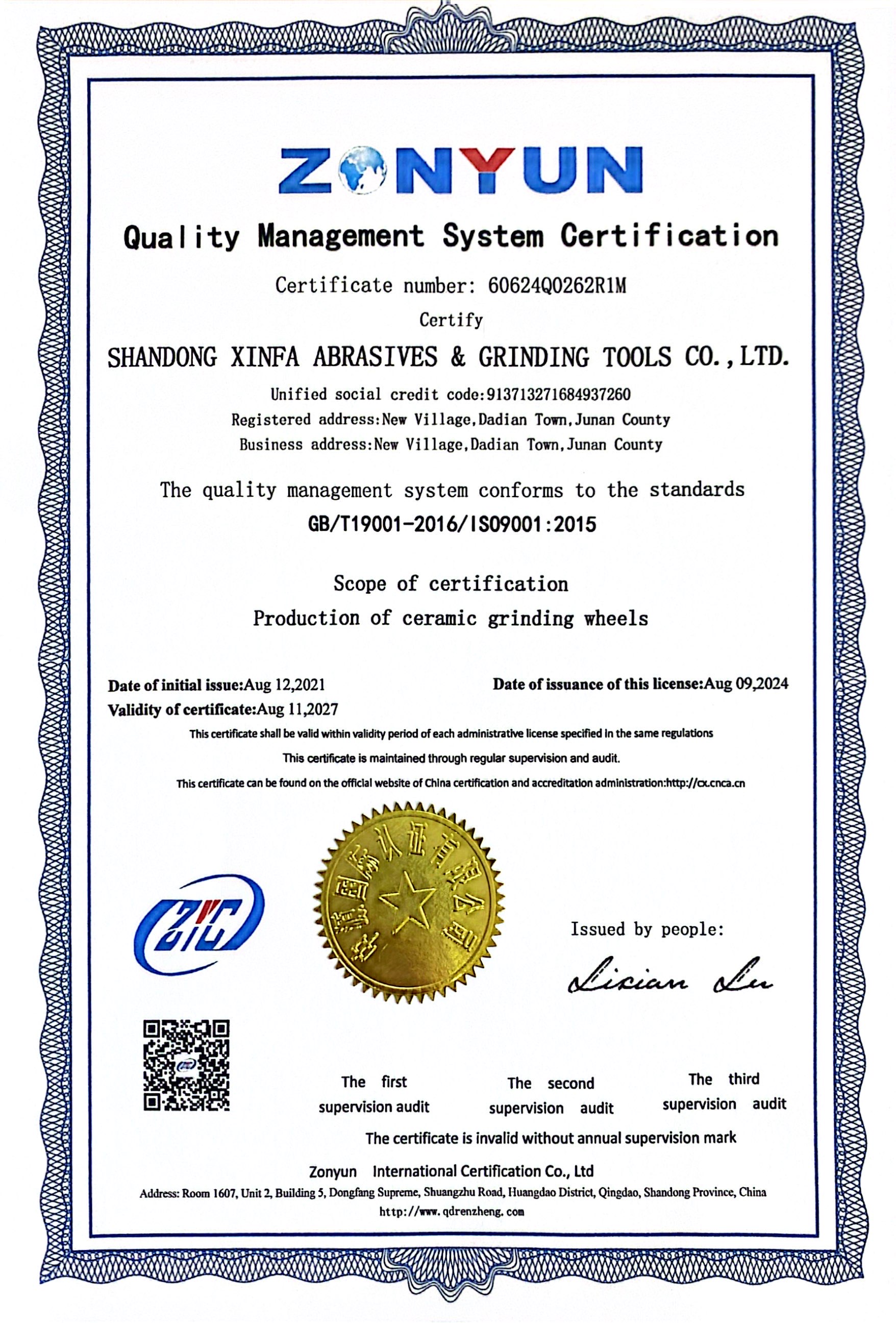
Three details on this type of certificate matter more than the logo: the standard version, the certificate scope, and the issuing body. GB/T19001-2016 is the Chinese national adoption of ISO 9001:2015, so the two references describe the same requirement set. A certificate with a clear scope — "manufacture of abrasives and grinding wheels" — tells a buyer that production, not just administration, sits inside the certified system.
The company is also a member of the China Abrasives Association, and its quality has passed the ISO9001:2008 quality management system certification, later upgraded to the ISO 9001:2015 framework now in effect.
Product-Level Standards: ISO 525, ANSI B7.1, and EN 12413
ISO 9001 says nothing about grinding wheel geometry. Product-level requirements come from different instruments.
ISO 525:2020 defines shape types, designation, and marking for bonded abrasive products. In the United States, ANSI B7.1 governs safety requirements for the use and care of abrasive wheels. In the European Union, EN 12413 applies. For a buyer, the practical implication is that a supplier should be able to mark and designate wheels according to ISO 525 and confirm that the wheel's operating speed respects the relevant safety framework.
These standards are not optional decoration. They are the language used to describe wheel geometry, abrasive type, grit size, hardness, and maximum operating speed. A buyer who can read these markings can compare products across suppliers.
The Specification Envelope to Compare Before Ordering
Once the certificate is confirmed, the buyer should check whether the supplier's published product range is technically consistent with the certified scope. Xinfa's ceramic bonded grinding wheel documentation lists outer diameters from 150 to 1100 mm, thicknesses from 3 to 300 mm, and bore sizes from 12.7 to 305 mm. Grit sizes cover F16 to F120, hardness grades run from G to Y, structure numbers from 0 to 14, and maximum linear velocity ranges from 20 to 70 m/s.
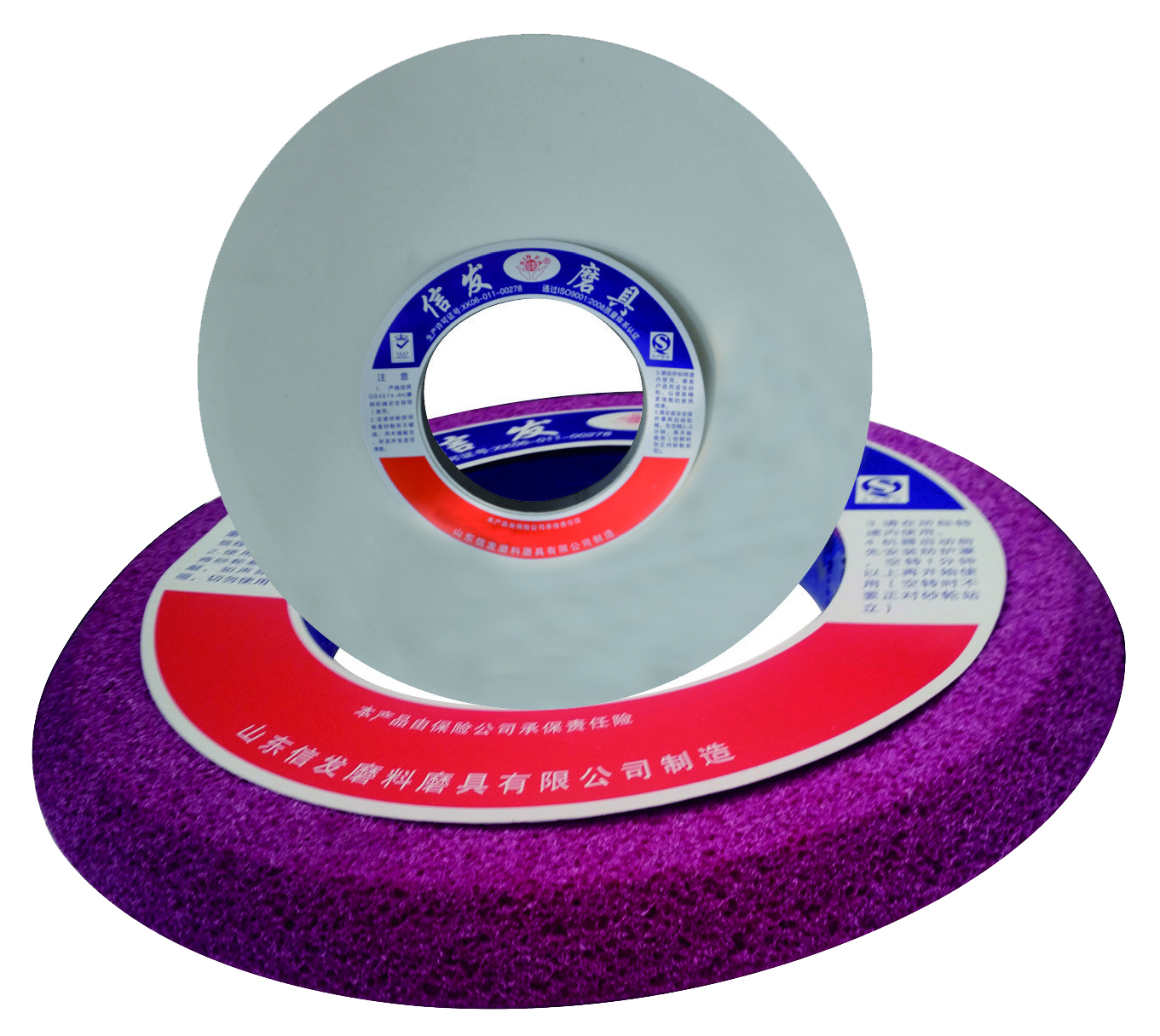
These numbers form the specification envelope that a buyer matches against the part to be ground. A supplier that can only describe products in marketing language, without a dimensionable parameter sheet, is harder to evaluate at the evaluation stage.
| Parameter | Documented Range (Ceramic Bonded Grinding Wheels) |
|---|---|
| Outer diameter | 150 – 1100 mm |
| Thickness | 3 – 300 mm |
| Bore (hole) | 12.7 – 305 mm |
| Grit size | F16 – F120 |
| Hardness | G – Y |
| Structure number | 0 – 14 |
| Max linear velocity | 20 – 70 m/s |
Product-family details also matter. Bench grinder wheels, for example, are offered in outer diameters from 100 to 450 mm, thickness from 12 to 80 mm, and bore sizes from 12.7 to 50.8 mm, with maximum operating speeds of 32, 35, 40, 45, 50, and 60 m/s. Centerless grinding wheels range from 300 to 750 mm in diameter and 100 to 400 mm in thickness. Crankshaft and camshaft grinding wheels range from 200 to 1100 mm in outer diameter. This kind of mapping helps a buyer see whether the supplier can cover the actual workpiece family, not just one catalog item.
Abrasive Grain Selection in Ceramic Bonded Wheels
Abrasive selection is the second axis of the specification. The documented material list for Xinfa's ceramic bonded grinding wheel range includes brown fused alumina (A), white fused alumina (WA), AA, 38A, pink fused alumina (PA), 25A, single crystal fused alumina (SA), microcrystalline fused alumina (MA), green silicon carbide (GC), black silicon carbide (C), RA, DA, 9A, 64A, and 55A.
For a buyer, grain type is the first filter. Brown fused alumina is the general-purpose choice. White and pink fused alumina are commonly associated with finishing and tool grinding. Green and black silicon carbide suit non-ferrous and hard materials. Because the ceramic bond system is the same, grain choice changes the wheel's cutting behavior without changing the tool format.
Mapping Applications to the Certified Product Range
Application data supplied by Xinfa links ceramic bonded wheels to industries including automotive, bearings, cutting tools, aerospace, 3C electronics, molds, hydraulics, semiconductors, photovoltaics, hardware, and medical. The declared working conditions include high temperature and wear. The operation mode is continuous operation. Compatible equipment includes grinding machines, bench grinders, and electric hand tools. Special requirements are listed as explosion-proof conditions.
These application fields map directly to product families. Gear grinding wheels, saw tooth grinding wheels, roll grinding wheels, bearing grinding wheels, cylindrical grinding wheels, and internal bore grinding wheels all appear across the documented range. That breadth matters for procurement because a single qualified supplier can cover multiple production lines.
Manufacturing Evidence Beyond the Certificate
Certificates are documents; production systems are evidence. Xinfa's factory in Junan County, Linyi City, covers 30,000 square meters, employs around 120 staff, and reports an annual production capacity of over 10,000 tons. The company's R&D team includes six engineers. The firm operates more than 100 sets of production and testing equipment and is located 180 km from Qingdao Port and 60 km from Rizhao Port.
In OEM/ODM supply, the company reports a monthly production capacity of 900 tons, a lead time of 30 to 45 days, a minimum order quantity of 2 tons, and a 100% testing policy before shipment. Customization options include specification, size, logo, bond type, and abrasive material.
One documented OEM case recorded in the company's files: a grinding wheel OEM customer in Pakistan has sourced 20 tons per order cycle for more than two years, reporting stable operation and long-lasting wheel performance. This type of repeat-order evidence is more informative than a single testimonial.
Certification-Based Sourcing vs. Traditional Sourcing
Traditional grinding wheel sourcing often relies on three inputs: price comparison, sample testing, and the supplier's verbal assurance. Samples can be misleading because they do not guarantee batch consistency. Verbal assurances are difficult to audit.
Certification-based evaluation replaces part of that uncertainty with docd evidence. A certificate identifies the standard, the scope, the issuing body, and the validity period. A parameter sheet defines the product envelope. Production records show capacity and testing policy. Together, these documents create a verifiable baseline that samples and sales calls cannot provide.
Limits of Certification Paperwork
A certification check has real boundaries. ISO 9001:2015 does not certify individual product safety, does not replace ISO 525 marking requirements, and does not guarantee consistent batch quality on its own. A certificate can be valid while a specific production batch is out of tolerance.
For a cautious buyer, certificate verification should be combined with sampling, third-party inspection, or pilot orders. A supplier's certificate file is evidence of system design, not a substitute for product validation.
Another boundary is time. Certification is periodic. Xinfa's current certificate expires on 2027-08-11. Buyers should always confirm that a certificate is still within its validity window at the time of purchase.
Market Direction: Structured Supplier Evidence Is Becoming the Norm
The direction of the market is toward structured supplier evidence. Standardization bodies have already built the framework: ISO 525 for marking, ANSI B7.1 and EN 12413 for safety. In this context, a documented certificate and a verifiable specification sheet are becoming baseline procurement requirements rather than differentiators.
China's role in upstream abrasive supply is measurable. WITS-World Bank data shows Chinese exports of natural or artificial abrasive powder or grain (HS 680530) reached USD 120.9 million in 2024. That position makes supplier-level documentation all the more important when sourcing from manufacturers inside this supply chain.
Market observers list Saint-Gobain (Norton), 3M (Cubitron II), Tyrolit, and Klingspor among major global grinding wheel manufacturers. The competitive landscape is global. Mid-size specialized manufacturers such as Xinfa compete on specification flexibility and production depth rather than brand scale.
Frequently Asked Questions
Which quality management certification should a ceramic grinding wheel supplier hold?
ISO 9001:2015 is the documented quality management baseline for abrasive and grinding wheel manufacturing. Shandong Xinfa Abrasives & Grinding Tools Co., Ltd. holds certificate number 60624Q0262R1M covering the manufacture of abrasives and grinding wheels.
What standard does the ISO 9001 certificate of Shandong Xinfa Abrasives & Grinding Tools Co., Ltd. conform to?
The certificate conforms to GB/T19001-2016/ISO9001:2015. GB/T19001-2016 is the Chinese national adoption of ISO 9001:2015.
Who issued the certification and until when is it valid?
Zonyun International Certification Co., Ltd. issued the certificate with number 60624Q0262R1M. It is valid until 2027-08-11 and applies to the global market.
What scope does the certificate cover?
The certified scope covers the manufacture of abrasives and grinding wheels, specifically including ceramic bonded grinding wheels.
What specification range is documented for Xinfa's ceramic bonded grinding wheels?
The documented range covers outer diameters from 150 to 1100 mm, thicknesses from 3 to 300 mm, bore sizes from 12.7 to 305 mm, grit sizes F16 to F120, hardness grades G to Y, structure numbers 0 to 14, and maximum linear velocities from 20 to 70 m/s.
Does ISO 9001 certification verify product safety?
No. Product safety for abrasive wheels is governed by standards such as ISO 525, ANSI B7.1, and EN 12413. ISO 9001 verifies that a quality management system is in place; it does not certify individual product safety.
For buyers moving from research to evaluation, the sequence is clear: verify the quality system certificate, check its scope and validity, compare the specification envelope with the application demand, and then validate with production or pilot evidence.
Есть вопросы или нужны дополнительные детали?
Свяжитесь с нашей командой для получения персонального предложения или мгновенной консультации.
Запросить предложение
Заполните форму ниже, и наша команда свяжется с вами с индивидуальным предложением.
Прямой чат WhatsApp
Предпочитаете общаться в реальном времени? Напишите нам в WhatsApp для мгновенной помощи и быстрых ответов.
- Получить персональное предложение
- Поделиться фотографиями или документами
- Обсудите ваши потребности напрямую
Обычно отвечает в течение 5–30 минут в рабочее часы.