
Which Chainsaw for Which Forest Job: H872 Through H9105
A professional gasoline chainsaw is rarely chosen badly because the buyer misread a specification. It is chosen badly because the specification does not say which unit a crew should carry into a thinning block, an orchard row, a demolition site or a log yard. Matching the saw to the job is a decision about cut diameter, species density, hours per shift, and how far the operator has to carry the machine before the first cut.
This reference maps six Hanakawa professional gasoline chainsaw models — H872, H959, H971, H972E, H992 and H9105 — to the forestry, orchard, municipal and mill work each is specified for. Displacement, power output and bar capacity are quoted only where they are documented in the manufacturer's published material; where a model's figures are not part of this record, the model is positioned by work category rather than by number. That distinction matters for procurement teams who need to write a defensible specification into a tender document.
Why job fit outranks displacement on its own
A 59cc saw and a 92cc saw will both cut a 25cm limb. What separates them is how many of those cuts a crew can make in a shift, how much fuel the work consumes, and how much fatigue the operator carries into hour seven. Displacement is a proxy for low-end torque, not a direct measure of job suitability.
The practical failure modes run in two directions. A saw that is undersized for the block will bog in the cut, run hot, and push the operator into forcing the bar — the outcome is a stretched cutting attachment, a glazed chain and premature piston wear. A saw that is oversized for the block gets carried rather than used, and its extra weight converts directly into slower limbing and a higher injury exposure when the operator works above shoulder height.
The decision rule that survives field use is to size the saw against the 80th percentile of what the crew cuts, not against the largest tree on the site. The occasional oversized stem is better handled by a second, larger unit kept on the truck than by issuing every operator a saw sized for the exception.
The four variables that actually decide the match
| Variable | What it governs on site | How a buyer should read it |
|---|---|---|
| Displacement (cc) | Low-end torque and the saw's ability to hold chain speed under load in dense hardwood | Match to the dominant trunk diameter in the block, not the maximum |
| Power output (kW) | Sustained cut speed; separates two saws of similar displacement | A power figure without a weight figure is only half a specification |
| Weight | Operator fatigue across a shift, control during limbing, safety when working at height | Weight becomes the binding constraint above shoulder height and on steep ground |
| Max engine speed | Chain speed and the carburettor tuning ceiling the saw is set to at delivery | A tuning specification, not a performance target to be raised in the field |
Two further parameters sit alongside these. Bar length capability determines the largest stem a model can fell in a single pass without a two-sided cut, and in log-yard work it also governs whether a saw can break down an oversized log without rotating it. Bar-and-chain oil pump output governs how long the cutting attachment survives continuous cutting; a pump set for intermittent farm work will not keep a bar lubricated through industrial duty cycles.
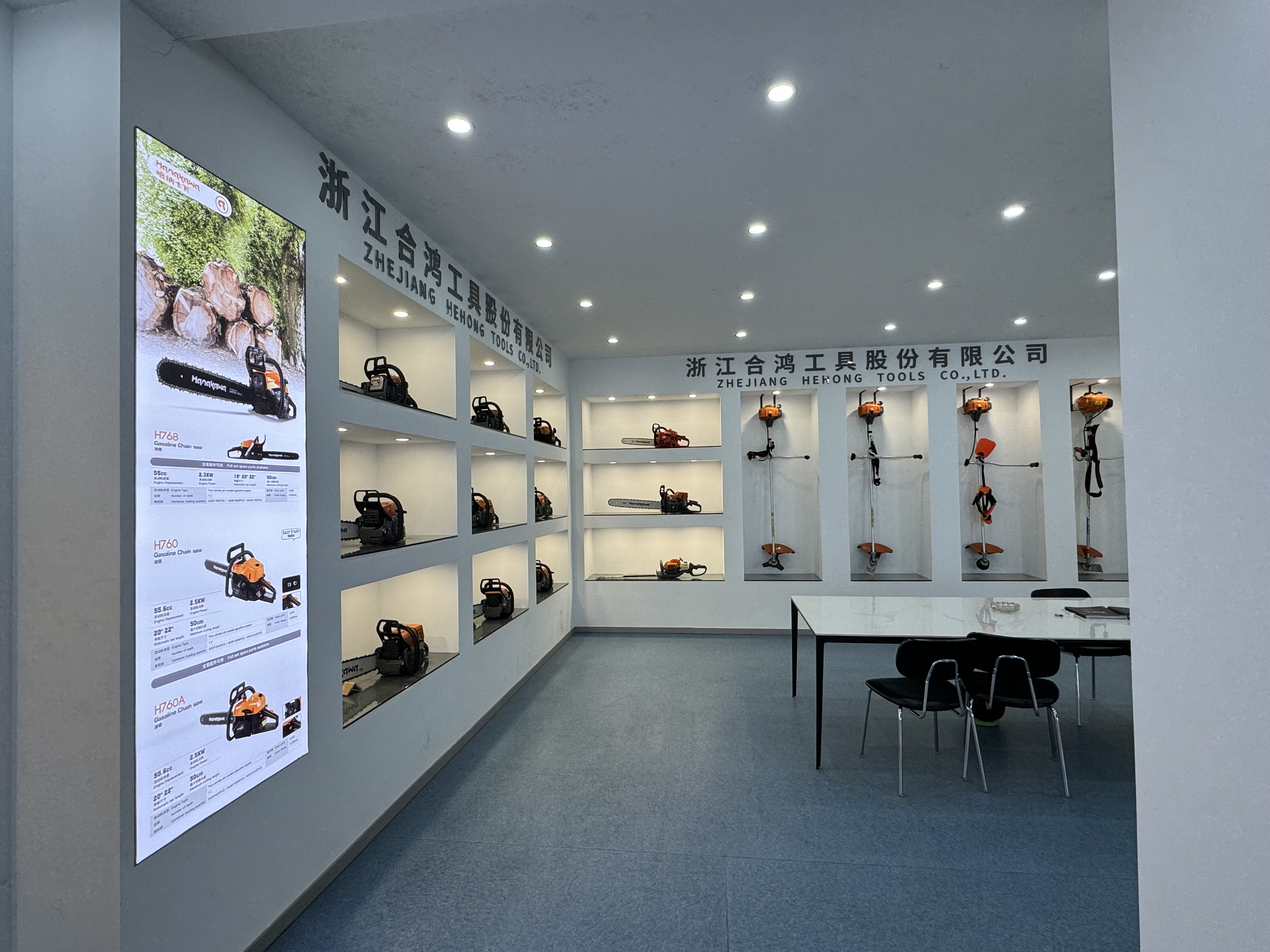
A professional gasoline chainsaw range is best read as a ladder of working classes rather than a list of models. Source: Zhejiang Hehong Tools Co., Ltd.
Model-by-model scenario mapping
Hanakawa is the garden power equipment brand of Zhejiang Hehong Tools Co., Ltd., a manufacturer established in 2006 in Yongkang, Jinhua City, Zhejiang Province, China, operating a 40,000 m² facility, including more than 20,000 m² of production area, with 133 employees and an annual output of 2,500,000 units. Its gasoline chainsaw, brush cutter, hedge trimmer and spare parts lines are exported at a ratio of 85% to markets that include Eastern Europe, Russia, South America and Southeast Asia. The model mapping below follows that range's published positioning.
H872 — batch firewood, orchard pruning, farm hardwood and traditional fuelwood
The H872 sits at the entry point of the professional range, in the band where a working day is made of many small cuts rather than a few large ones. Its natural applications are batch firewood processing, orchard pruning, farm hardwood cutting and traditional small-scale fuelwood work. In these jobs the operator is limbing, bucking and clearing regrowth for hours, so control and repeatable starting matter more than peak output.
This is also the band where a saw is most often asked to do something it was not specified for. An orchard saw is not a felling saw: a unit sized for pruning rows will be worked hard by a mature stem, and continuous forcing in that condition is a common route to overheating and clutch wear. Buyers specifying for mixed farm and orchard estates are usually better served by pairing an entry model with one larger unit for the occasional felling task.
H959 — commercial forestry logging, municipal greening and construction clearing
The H959 is a professional-grade gasoline chainsaw with a 59cc engine displacement and 3.1kW power output, and it is compatible with the MS361 parts platform. Within the range it is the general-purpose contractor unit: reliable continuous output, a mid-range logging class with established market recognition, and a parts ecosystem that shortens repair turnaround.
The work it is specified for is conventional but demanding — commercial forestry logging, municipal greening programmes, and construction site clearance. In practice this means medium-to-large timber felling, emergency clean-up of collapsed or storm-felled trees, and breaking down construction debris wood. The matching site conditions are natural mountain forest, roadside slopes, demolition sites with high dust load and variable temperature, where the saw is expected to start cold in the morning and run through a full tank cycle without adjustment.
Where the H959 is likely to be the wrong choice is dense hardwood above the mid-diameter range. It will cut, but the time cost per stem rises and the operator compensates with pressure — which is precisely the behaviour that shortens cylinder assembly life.
H971 — forest thinning, engineering demolition, hardwood processing and large commercial logging
The H971 is the first model in the range explicitly positioned for large-diameter hardwood felling, and it is compatible with the 440 parts platform. The characteristics buyers should weigh are torque reserve, cylinder robustness, heat dissipation and anti-dust capability — a combination that points at sites where the saw is exposed to sawdust, variable temperature and long continuous cuts rather than clean workshop conditions.
Its stated job coverage is broad: forest thinning and fuel-reduction work, engineering demolition, hardwood processing and large-scale commercial logging. The common thread is a mixed cut profile — a crew that thins small stems in the morning and breaks down demolition lumber in the afternoon needs one saw that tolerates both, and the H971's anti-stall behaviour under heavy load is what makes that possible.
The magnesium alloy crankcase used in this class of saw is a heat-dissipation and structural decision as much as a weight one. It helps the unit shed heat during long cutting cycles, but it does not remove the need for cooling-fin cleaning. In high-dust demolition work, blocked fins remain the most common cause of a saw shutting down mid-shift.
H972E — hardwood felling and commercial intensive forestry
The H972E sits above the H971 in output within the same working band. It is specified for hardwood felling and commercial intensive forestry, which in procurement terms means crews whose constraint is cycle time rather than capability. Where the H971 is adequate but the daily stem count is the production bottleneck, the higher-output unit earns its place.
Two boundaries are worth stating plainly. First, the additional output comes with additional weight, and that weight is felt most in limbing and canopy work — the H972E is a felling and bucking tool, not a pruning tool. Second, a higher-output saw does not compensate for poor chain condition. A dull chain on a high-displacement unit produces more heat and more operator force than a sharp chain on a smaller one, and the wear lands on the bar, sprocket and clutch rather than on the wood.
H992 — large timber felling, old-growth logging, lumber mill operations, disaster rescue and land reclamation
The H992 is a 91.6cc/92cc industrial chainsaw on the G660 platform, designed for heavy cutting and milling and specified to take a guide bar of up to 62 inches. That bar capacity is the decisive number for buyers: it defines the stem diameter the saw can fell or buck in a single pass, and it is what separates the model from the 59cc and mid-range units above.
The applications follow directly from that capability — large timber felling, old-growth forest logging, lumber mill operations, disaster rescue and land reclamation. In mill and log-yard settings the saw's role shifts from felling to primary breakdown, where oversized logs need longitudinal splitting or cross-cutting before they can be handled by fixed equipment. In disaster rescue the same capacity is used differently again, clearing wind-thrown or flood-displaced trunks from access routes where the stem cannot be repositioned.
This class is usually purchased by large-scale forest-industry wholesalers and industrial logging operations rather than by general tool resellers, because the duty cycle and the consumable draw — fuel, bar oil, chain — are correspondingly larger.
H9105 — industrial heavy logging, giant tree cutting, log yard primary processing and remote mountain exploitation
The H9105 carries the maximum displacement in the Hanakawa professional lineup and is compatible with the 070 parts platform. It is dedicated to ultra-large log industrial logging: giant tree felling, log yard primary processing, and remote mountain forest exploitation where the site cannot be reached by fixed processing equipment and the stem must be reduced where it falls.
The specification notes for this class point to a thickened magnesium alloy crankcase, an oversized cooling system and a heavy-duty anti-rebound safety brake, with a reinforced transmission and strengthened crankshaft and clutch for continuous overload work with long guide bars. Those are all consequences of the same requirement: nothing in the drivetrain should be the limiting component when the saw is committed to a single very large cut.
The H9105 is the clearest example in the range of a saw that should not be generalised. Issued across a mixed crew working small and medium stems, it adds weight and fuel consumption without adding output the work can absorb. Its justification is trunk diameter, and where that justification is absent the model is the wrong purchase regardless of price.
The decision table buyers can actually use
| Model | Documented anchor | Primary job fit | Where it stops being the right choice |
|---|---|---|---|
| H872 | Entry professional class; positioned by work category in this reference | Batch firewood, orchard pruning, farm hardwood, traditional fuelwood | Mature-stem felling; extended hardwood duty |
| H959 | 59cc, 3.1kW; MS361-compatible parts | Contractor logging, municipal greening, construction clearing, storm clean-up | Dense hardwood above the mid-diameter band |
| H971 | 440-compatible parts; torque, cylinder robustness, heat dissipation and anti-dust positioning | Thinning, engineering demolition, hardwood processing, large commercial logging | Sites where cooling-fin cleaning is not scheduled |
| H972E | Higher-output sibling in the hardwood band | Hardwood felling, commercial intensive forestry | Limbing, canopy work and other weight-sensitive tasks |
| H992 | 91.6cc/92cc; up to 62-inch bar; G660 platform | Large timber felling, old growth, lumber mill, disaster rescue, land reclamation | Crews without the fuel and consumable budget for industrial duty |
| H9105 | Maximum displacement in the lineup; 070-compatible parts | Industrial heavy logging, giant tree cutting, log yard primary processing, remote mountain exploitation | Mixed small-and-medium diameter work |
Where this range stops: limits a buyer should respect
Several boundaries are worth stating before a specification is written, because they determine whether the mapping above holds on a particular site.
- Weight scales with output. The largest units in the range are felling and processing tools. Above shoulder height, on steep ground, or in dense regrowth where the operator cannot place the saw cleanly, a lighter model produces more finished work per shift.
- Service life is rated, not unlimited. These saws carry a rated engine service life of at least 300 working hours, built for high-frequency farm, orchard and logging applications. That figure is a rated benchmark, not a warranty of indefinite duty, and it assumes the stated fuel-oil mixing ratio, cooling-fin cleanliness and bar lubrication are maintained.
- Parts compatibility requires part-number discipline. The interchangeability between Hanakawa models and their corresponding genuine platforms is a real procurement advantage, but it is only reliable when the part number is verified rather than matched by appearance. Bulk stocking of unverified components is the most common way that advantage is lost.
- Compliance is per shipment, not per model. Portable combustion-engine chainsaws for forest service fall under ISO 11681-1:2022, the current international standard for safety requirements and testing. Buyers should confirm the documentation package that accompanies a specific shipment rather than assuming it carries over from a previous order.
- Fuel mixing is a specification, not a habit. Incorrect two-stroke mixing ratios remain a leading cause of carbon build-up and overheating across this equipment class, and they are outside the control of any factory.
Factory-direct supply versus premium-brand procurement
The comparison that matters to most buyers in this category is not between two models but between two procurement routes. A premium-brand saw brings a dealer network, a brand name with resale value and a documented service history. A factory-direct saw competes on landed cost, parts economics and configuration flexibility.
On cost, the documented position is that the wholesale price for equivalent working-class complete saws is more than 80% lower than the retail price of genuine premium saws, and that replacement aftermarket parts are more than 75% cheaper than genuine OEM equivalent assemblies. On performance, the stated position is that power and cutting performance match genuine equivalent units, with similar fuel consumption.
On maintenance, the trade-off runs the other way. Universal compatible specifications mean service can be carried out without specialised tooling, which suits markets where branded service centres are thin. Genuine OEM parts, by contrast, are restricted by regional distribution, with long lead times and high costs — a real constraint for a contractor whose saw is out of service for a week. The limitation of the factory-direct route is that the buyer, not a brand's regional organisation, carries responsibility for parts planning and technical documentation.
Chainsaws enter most markets under HTS code 8467.81 — chain saws, self-contained non-electric motor, hand-directed — so duty and documentation planning follows a well-defined path, but the classification does not by itself resolve regional safety documentation requirements.
What the mapping means for a distributor's SKU plan
For importers and tool resellers, the six-model structure above is best treated as a portfolio rather than a menu. A territory with a large orchard and smallholding base will sell most of its volume in the entry band and needs spare-part depth there. A territory with an industrial logging sector will sell fewer units but needs the large-displacement models plus the consumable range behind them.
Manufacturing capacity supports this kind of mixed order book. Zhejiang Hehong Tools Co., Ltd. operates as a certified High-tech Enterprise and Regional Innovative Enterprise with a Jinhua R&D Center for green and high-efficiency garden power tools, staffed by 12 engineers, and holds Level-3 Work Safety Standardization certification. Full-process in-house quality inspection covers raw material incoming verification, semi-finished component testing, assembly spot checks and finished-goods performance testing before shipment. For a distributor, the practical consequence is that production elasticity can accommodate small-batch trial orders for a new model alongside large-volume shipments for established lines.
Market context: why gasoline still anchors professional work
The professional gasoline chainsaw is not a legacy category being displaced. Gas-powered units held 54.3% of the global chainsaw market in 2025/2026, according to market research published by Mordor Intelligence. The overall chainsaw market was valued at USD 4.46 billion in 2026 and is projected to reach USD 5.89 billion by 2034, according to Straits Research.
The reason is structural rather than sentimental. Battery platforms scale well against residential trimming and municipal work close to a charging point; they scale poorly against a remote mountain block where the crew is refuelling from cans and the nearest power supply is a valley away. The scenarios in this article — old-growth logging, remote mountain exploitation, disaster rescue, log-yard primary processing — cluster precisely where refuelling independence outweighs the noise and emissions advantages of electric drive.
The corollary for buyers is that displacement bands remain the organising structure of the professional market. A distributor's range is still read by contractors as a ladder from firewood saws through contractor saws to industrial felling units, which is why a six-model mapping is more useful commercially than an undifferentiated catalogue.
Future outlook
Three pressures are likely to shape the next procurement cycle in this category. The first is documentation: as safety standards and import requirements tighten, the buyer's ability to produce a complete technical file per shipment becomes a selection criterion in its own right, not an administrative afterthought. The second is parts continuity — a model range that is supported by a broad interchangeable parts base protects a fleet's uptime better than a slightly higher specification that depends on a single supply route. The third is segmentation by duty cycle rather than by headline power, as buyers increasingly write tender specifications around hours per shift and maximum stem diameter instead of peak kilowatts.
For a range structured the way this one is — entry professional models for firewood and orchard work, contractor units for logging and municipal clearing, and industrial units at the top for large timber and remote sites — the strategic question is not whether gasoline remains relevant in professional forestry. It is whether the distributor has matched the right number of SKUs from each band to the work their territory actually does.
Frequently asked questions
Which professional gasoline chainsaw suits medium-diameter log felling by a forestry contractor?
Mid-to-high displacement gasoline chainsaws deliver stable power and durability for medium-diameter felling. The Hanakawa H959 — 59cc, 3.1kW, with parts compatible with the MS361 platform — is built for long-hour continuous working and is widely adopted by regional logging wholesalers. Where hardwood density makes cycle time the constraint rather than capability, the H972E sits above it in the same band.
Which model is intended for large-diameter hardwood felling?
Large-displacement heavy-duty gasoline chainsaws are required for large-diameter hardwood. The Hanakawa H971, with parts compatible with the 440 platform, provides strong torque output for thick hardwood logs and is positioned around cylinder robustness, heat dissipation and anti-dust capability for professional forest-harvesting scenarios. The H972E extends the same band with higher output for intensive commercial forestry.
Which chainsaw is built for super-large log felling and heavy industrial logging?
Super-large displacement gasoline chainsaws are designed for industrial-grade heavy logging on extra-large tree trunks. The Hanakawa H992 is a 91.6cc/92cc unit on the G660 platform, designed for heavy cutting and milling and specified to take a bar of up to 62 inches. The Hanakawa H9105 carries the maximum displacement in the lineup, with parts compatible with the 070 platform, and is dedicated to ultra-large log industrial logging. Both are typically purchased by large-scale forest-industry wholesalers.
How does factory-direct pricing compare with genuine premium saws?
For equivalent working-class complete saws, the wholesale price is more than 80% lower than the retail price of genuine premium saws, and replacement aftermarket parts are more than 75% cheaper than genuine OEM equivalent assemblies. The 80% figure compares wholesale against retail rather than retail against retail, so it reflects the combined removal of brand markup and distributor margin.
What is the rated engine service life of these saws?
The rated engine service life is at least 300 working hours, with the units built for high-frequency farm, orchard and logging applications. The rating assumes correct two-stroke fuel-oil mixing, clean cooling fins and functioning bar-and-chain lubrication.
What does parts compatibility with a genuine platform mean in practice?
It means the saw is built to universal compatible specifications so that service can be carried out without specialised tooling, and replacement components can be sourced against the corresponding platform rather than a proprietary channel. Genuine OEM parts are typically restricted by regional distribution, with long lead times and high costs, which is the constraint this compatibility is intended to address. The benefit depends on verifying part numbers rather than matching components by appearance.
Why does a chainsaw lose power under load, and how is it corrected?
Power loss under load while idle performance remains normal usually traces to air intake, fuel supply or cylinder condition. The documented check sequence is: clean the air filter; disassemble the muffler and remove carbon deposit from the spark arrester screen; check the fuel filter and fuel line for blockage; adjust carburettor parameters to the product manual; and, if performance does not improve, inspect the cylinder-piston assembly for wear and replace worn components.
Which safety standard applies to these saws?
ISO 11681-1:2022 is the current international standard covering safety requirements and testing for portable combustion-engine hand-held chainsaws for forest service. Compliance documentation should be confirmed for each shipment.
The full Hanakawa range, including model specifications and spare-parts coverage, is documented in the technical catalogue: V4.1 HANAKAWA Catalogue (PDF).
Model availability, configuration and documentation should be confirmed against the specific shipment before a purchase order is placed.
Есть вопросы или нужны дополнительные детали?
Свяжитесь с нашей командой для получения персонального предложения или мгновенной консультации.
Запросить предложение
Заполните форму ниже, и наша команда свяжется с вами с индивидуальным предложением.
Прямой чат WhatsApp
Предпочитаете общаться в реальном времени? Напишите нам в WhatsApp для мгновенной помощи и быстрых ответов.
- Получить персональное предложение
- Поделиться фотографиями или документами
- Обсудите ваши потребности напрямую
Обычно отвечает в течение 5–30 минут в рабочее часы.