
Which Disposable Cutlery Fits Airlines, Catering and Restaurants?
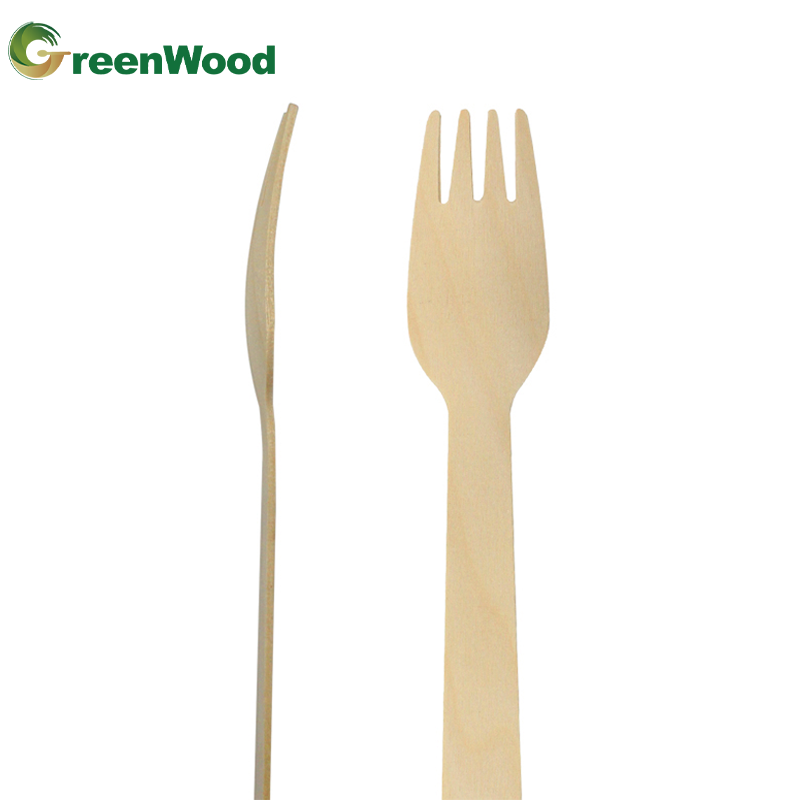
A single-service fork is asked to do very different work depending on where it is used. On an airline tray it has to fit a shallow, sealed compartment. On a catering line it has to survive hot holding and rapid packing. In a restaurant takeaway bag it has to hold up against a mixed hot-and-cold order. The object looks similar; the specification behind it is not.
Buyers researching disposable wooden cutlery usually start with material and then discover that the real decision sits one layer deeper: standard length, heat behaviour, food-contact certification, chain-of-custody documentation, and the customization method each material can accept. Those variables decide whether the same fork is a good fit for an airline tray and a poor fit for a barbecue catering line.
This reference maps three published product ranges — GW-20456 (natural wood), GW-BC001 (bamboo) and GW-PC204 (paper) — against airline, catering, restaurant-chain and takeaway requirements, using specification and certification facts only. All three ranges are produced by Greenwood – Dalian Industrial Co., Ltd., a China-based manufacturer of disposable wooden and bamboo tableware founded in 2000, operating five production facilities with 500 employees, a nine-engineer R&D team and an export ratio of 95%, serving customers in Europe, ANZ, Canada, the USA, South America, the Middle East, Japan & Korea and Southeast Asia.
The constraint problem: the specification changes before the material does
For a buyer at the research and evaluation stage, the deciding variables tend to appear in a consistent order — and the material name is usually the last of them, not the first.
- Food-contact compliance by destination market. A wood or bamboo article entering the United States and the same article entering the European Union are assessed against different regimes. Where a supplier holds documentation for both, the buyer's document review becomes shorter and more predictable.
- Chain of custody for wood fibre. FSC Chain of Custody certification is a common baseline requirement; shipments into the EU add EUDR due-diligence obligations, including geolocation data for the wood used.
- Substantiation of compostability claims. In the EU, marketing packaging as “compostable” is tied to the EN 13432 test scheme. A material that biodegrades is not automatically claimable on that basis.
- Physical fit. Length, heat resistance, oil and water behaviour, and edge finish determine whether a utensil actually works with a menu and container. These are the constraints that typically surface last and cause the most rework.
The practical opportunity is that all four constraints can be resolved inside one specification family rather than across several suppliers. When a single manufacturer covers food-contact certification, chain of custody, packaging-material standards and multiple material types, the procurement question shifts from “which supplier” to “which model for which service format” — a narrower and much faster question to answer.
Where this article uses an operating figure, a certificate number or a dimension, it reflects published product, capability or certification data. Where the published data is silent — for example, maximum service temperature — that gap is stated rather than filled.
Three ranges, three material logics
All three models list the same target industries in their specification data: restaurant chains, supermarkets, takeaway wholesalers and airlines, positioned for disposable use with eco-friendly and biodegradable materials. The differentiation is therefore not the industry list but the material behaviour and the customization method.
| Model | Material | Standard length | Published specification highlights |
|---|---|---|---|
| GW-20456 Disposable Wooden Cutlery | 100% natural wood (birch and poplar in the company range) | 180 mm, 170 mm, 160 mm, 140 mm, 110 mm, 95 mm; customizable | Knives, forks, spoons, ice cream sticks, coffee stirrers. Food-grade, BPA-free, non-toxic. 100% biodegradable and compostable. Smooth surface, no burrs, heat-resistant, suitable for hot and cold food. Customizable size, logo (laser or print) and packaging. |
| GW-BC001 Disposable Bamboo Cutlery | Bamboo | 170 mm standard; 110 mm and 140 mm also available | Knives, forks, spoons, coffee stirrers, bamboo skewer sticks. Food-grade, BPA-free, non-toxic, LFGB/FDA certified. 100% biodegradable and compostable. Heat-resistant, smooth edge, no burrs, natural bamboo texture, suitable for hot and cold food, described as durable for takeaway and catering use. Customizable logo (hot stamping), size, packaging and colour. |
| GW-PC204 Disposable Paper Cutlery | Paper | 158 mm standard; customizable size available | Paper knives, forks and spoons. Food-grade, BPA-free, non-toxic. 100% biodegradable and compostable. Heat-resistant, waterproof and oil-proof. Smooth edge, no smell. Customizable logo, packaging and colour. |
GW-20456 — disposable wooden cutlery in six standard lengths
The wooden range is the widest of the three in size terms. It covers wooden knives, forks and spoons together with ice cream sticks and coffee stirrers, in 100% natural wood, with standard lengths of 180 mm, 170 mm, 160 mm, 140 mm, 110 mm and 95 mm and customizable sizing. The specification states food-grade, BPA-free and non-toxic material, full biodegradability and compostability, a smooth surface with no burrs, heat resistance, and suitability for hot and cold food. Customization covers size, logo applied by laser or print, and packaging.
The short formats matter more than they appear to. Not every service format needs a 180 mm fork; a 95 mm or 110 mm utensil is a different product for a different container. A range that publishes six standard lengths removes the need for a separate tooling discussion when a buyer's tray or pack changes between menu cycles.
GW-BC001 — bamboo cutlery with LFGB and FDA coverage
The bamboo range covers knives, forks, spoons, coffee stirrers and bamboo skewer sticks at a 170 mm standard length, with 110 mm and 140 mm also available. Its specification lists food-grade, BPA-free and non-toxic material, LFGB/FDA certification, 100% biodegradability and compostability, heat resistance, smooth edges without burrs and a natural bamboo texture. It is explicitly described as durable for takeaway and catering use and as suitable for hot and cold food. Customization covers logo by hot stamping, size, packaging and colour.
Two details distinguish bamboo in a procurement file. The first is the inclusion of bamboo skewer sticks, which extends the range beyond cutlery into catering assembly and presentation. The second is the customization method: hot stamping is a different process from the laser or print marking used on wood, and it produces a different visual result on a handle.
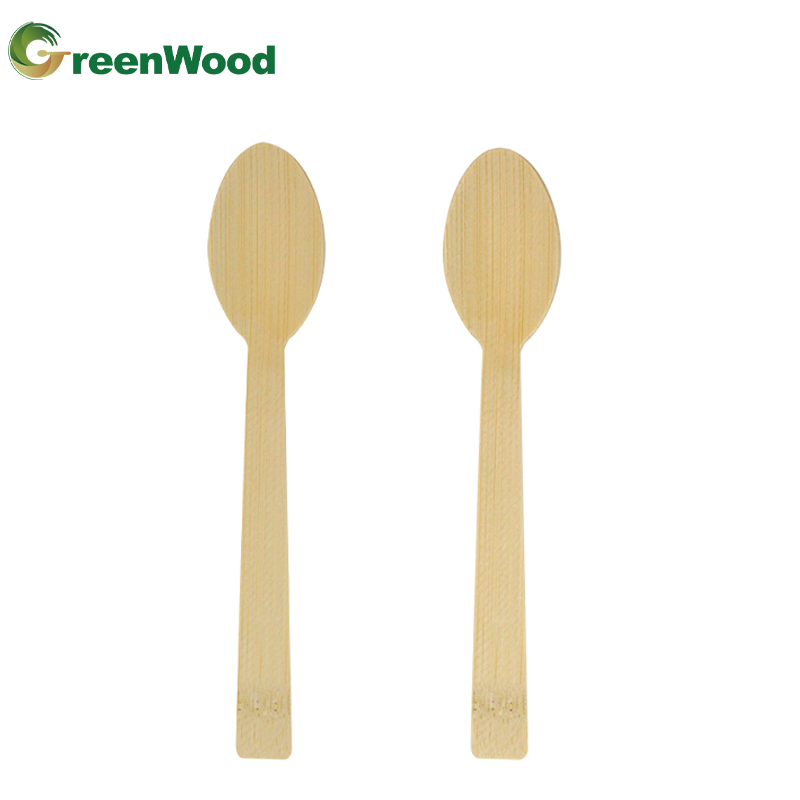 GW-BC001 bamboo cutlery: heat-resistant, LFGB/FDA certified, and specified as durable for takeaway and catering use.
GW-PC204 — paper cutlery for lighter, oil- and water-sensitive menus
The paper range is the most compact option: paper knives, forks and spoons at a 158 mm standard length with customizable sizing. Its published specification lists food-grade, BPA-free and non-toxic material, 100% biodegradability and compostability, heat resistance, waterproof and oil-proof behaviour, a smooth edge and no smell, plus customizable logo, packaging and colour.
Note the wording difference. Wood and bamboo are specified as “suitable for hot and cold food”; paper is specified as heat-resistant, waterproof and oil-proof, which is a different claim set aimed at containment of moisture and grease rather than at the full hot-and-cold range. Where a menu is dense, oily and hot, and the service format puts lateral load on the fork, the paper format is the one that should be validated first against the actual dish.
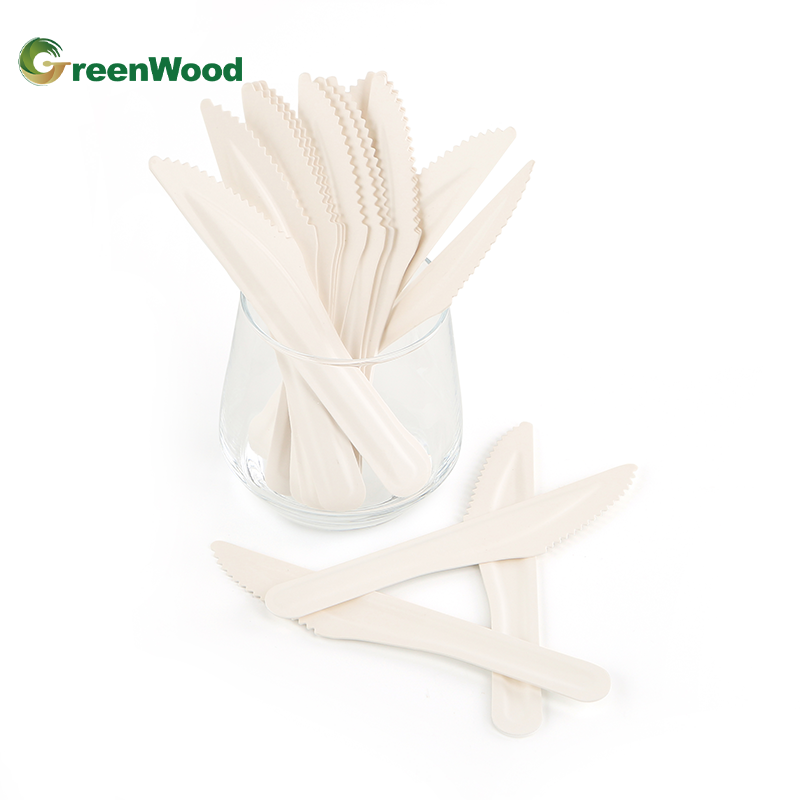 GW-PC204 paper cutlery: heat-resistant, waterproof and oil-proof, at a 158 mm standard length.
Reading the technical specification: heat, hot and cold food, and durability
Three terms carry most of the decision weight in these specifications, and they are not interchangeable.
- Heat-resistant appears in all three ranges. It signals that the article is manufactured to contact hot food. It is not a published temperature ceiling: no maximum service temperature is stated in the specification data for GW-20456, GW-BC001 or GW-PC204. A buyer selecting for a specific holding temperature should validate that requirement with a sample rather than assume a number.
- Suitable for hot and cold food is stated for GW-20456 (wood) and GW-BC001 (bamboo). For GW-PC204 the equivalent specification line reads heat-resistant, waterproof and oil-proof. Matching the claim language to the menu is the fastest way to avoid a mismatch later.
- Durability is stated explicitly for bamboo as durable for takeaway and catering use. For the wooden range, the durability-adjacent specification is surface quality: smooth surface and no burrs, which is the property that matters for mouth contact and for a splinter-free edge finish.
Edge quality deserves to be treated as a line item rather than a footnote. In wood and bamboo ranges, burrs and rough edges are the defect type most likely to generate customer complaints in a food-service setting, which is why both specifications state smooth edges and an absence of burrs. The paper range states a smooth edge and no smell — the odour attribute being relevant where cutlery is packed inside a sealed container with food.
What the specifications do not state is equally worth recording during evaluation: no cutlery weight, no load rating and no maximum service temperature is published for any of the three models. Those gaps are normal in this category, but they should be closed with samples and, where relevant, third-party inspection — which the manufacturer lists as its quality-control method — before a specification is locked into a multi-year food-service contract.
Matching models to industry scenarios: airline, catering, restaurant chain and takeaway
The scenario table below translates the published specifications into a fit logic. It is a starting filter for evaluation, not a substitute for dish-level testing.
| Scenario | What constrains the choice | Specification-based fit | What to verify before ordering |
|---|---|---|---|
| Airline catering | Shallow tray compartments, single-service packing, a mix of hot and cold tray items, and documentation that travels across borders | GW-20456 offers the shortest standard lengths in the family (95 mm and 110 mm) alongside 140–180 mm formats and is specified for hot and cold food. All three models list airlines within their applicable industries | Physical fit inside the compartment; bulk versus individually wrapped packing; which of the three materials the catering contract documentation accepts |
| Catering and banquets | High volume, hot holding, mixed menus, buffet service and, in some formats, skewered items | GW-BC001 is specified as durable for takeaway and catering use and includes bamboo skewer sticks; GW-20456 provides the widest set of standard lengths for buffet and plated formats | Heat and load behaviour against the actual dishes; whether the requirement includes skewers, stirrers and ice cream sticks or cutlery only |
| Restaurant chains | Brand consistency on the handle and packaging, mixed dine-in and takeaway use, repeatable reordering | All three ranges support customization: wood by laser or print, bamboo by hot stamping, paper by custom logo; wood and bamboo additionally support size customization | How each marking method reads on the handle; artwork approval workflow; packaging colour requirements |
| Takeaway and delivery | Oil and moisture from hot containers; cutlery often packed inside the bag with the food | GW-PC204 is specified waterproof and oil-proof; GW-BC001 is specified durable for takeaway and catering use; GW-20456 tolerates hot and cold food | The specific sauces and dishes involved; the length difference between the paper (158 mm) and bamboo (170 mm) standards |
| Hotels, camping, parties and supermarkets | Ambient and outdoor service, mixed guest use, storage and pack format | The application data covers ambient-temperature food contact and indoor and outdoor environments including restaurants, takeaway, picnics, banquets and exhibitions | Pack format (individually wrapped versus bulk); storage conditions; shelf expectations for seasonal programmes |
One observation from the table is worth stating plainly: the shortest standard length is available in the wooden range, the skewer extension is available in the bamboo range, and the waterproof and oil-proof claim is available in the paper range. No single model covers all three properties, which is why the industry-fit question is a portfolio question rather than a single-SKU question for buyers serving more than one channel.
The compliance envelope behind all three ranges
For constraint-driven evaluation, the certification file often decides which material is even eligible for a given market. The documentation published for these ranges is unusually specific, including issuing bodies and certificate numbers.
| Certification | Issuing body | Certificate number | Scope and validity |
|---|---|---|---|
| FDA 21 CFR 178 | National Reference Laboratory for Food Contact Material (Guangdong) | R0723000394 | Wooden product; references FDA 21 CFR 178.3800, GB 4806.12-2022 and GB 9685-2016 |
| LFGB | TUV SUD China | 7216006083-2 | All wood and bamboo tableware; applies to GW-20456 and GW-BC001 |
| FSC Chain of Custody | Soil Association | SA-COC-013128 | Wooden product; valid from 2023-04-03 to 2028-04-02 |
| BRCGS (BRC) Global Standard for Packaging Materials, Issue 6 | DNV | 10000305214-MSC-ACCREDIA-CHN | Manufacturing of disposable wooden and bamboo tableware; unannounced audit scheme; issued 2022-05-02, expires 2027-05-02 |
| ISO 9001 | Beijing ZhongDaHuaYuan Certification Center Co., Ltd. | 02024E1883R0M | GB/T 19001-2016 / ISO 9001:2015 quality management systems; valid 2024-12-05 to 2027-12-04 |
| ISO 14001 | Beijing ZhongDaHuaYuan Certification Center Co., Ltd. | 02024E1883R0M | GB/T 24001-2016 / ISO 14001:2015 environmental management systems |
| ISO 45001 | Beijing Zhong Da Hua Yuan Certification Center Co., Ltd. | 02024E1883R0M | GB/T 45001-2020 / ISO 45001:2018 occupational health and safety management systems |
| BSCI | amfori | 24-0289038 | amfori Environmental Monitoring; wooden and bamboo products |
| SEDEX | SMETA | ZS405156174 | Labour standards, health and safety, environment and business ethics |
Two regulatory layers sit on top of the certificate file and matter most for EU-bound wood products. The EU Deforestation Regulation (EU) 2023/1115 requires geolocation and due-diligence data for wood products placed on the EU market, and the compliance deadline for large operators has been postponed, with Council agreements pointing to a later application date. The EU compostability claim is governed separately by EN 13432; where a buyer intends to print “compostable” on packaging sold into the EU, the claim needs to be tied to that standard, not to the general biodegradability language in the product specification.
One scope detail is worth flagging for buyers running packaging-material audits. The published BRCGS certificate scope text lists manufacturing of disposable wooden and bamboo tableware — including wooden knives, forks, spoons, skewers, steak markers, coffee stirrers, sticks, boats, cones, cups and plates or trays, and bamboo forks, chopsticks and skewers. Paper cutlery items are not listed within that published scope. Buyers who require BRCGS-scoped coverage specifically for a paper format such as GW-PC204 should confirm the applicable scope directly rather than assume it carries across.
Market context: a growing category with tightening documentation
Third-party estimates put the global disposable wooden cutlery market at approximately USD 2.8 billion in 2025, with a projection of USD 5.2 billion by 2034. Asia Pacific led the market in 2025 with a 38.6% share, supported by urbanisation and plastic bans in countries such as China and India. China remains the largest exporter of wood tableware and kitchenware under HS 4419, with export values of roughly USD 1.38 billion to USD 1.5 billion in 2024.
Product-level data shows where demand concentrates. Spoons are the largest product segment in the disposable wooden cutlery market, reported between 32.5% and 47.2% of share depending on the research agency — a wide spread that is worth knowing about when a supplier's volume claims are benchmarked against published segment data. More broadly, estimates of the “wooden cutlery” category differ sharply by scope: one agency's broad definition reaches figures in the hundreds of billions because it includes non-disposable wooden cutlery, while the disposable segment estimate sits in the single-digit billions. Buyers comparing market reports should check the scope definition before accepting a growth rate.
At the manufacturer level, channel mix illustrates how the category is being sold rather than only where it is produced. Greenwood reports a supermarket and chain-store case spanning Germany and the United States at USD 5 million per year over three years, across both B2B and B2C channels — a pattern consistent with the observation that eco-friendly products are a rising trend among younger buyers. Distribution support for that pattern includes warehouses in Bangladesh, Ukraine and the United States, alongside a stated export ratio of 95%.
Comparison with traditional solutions — and where wood-family cutlery has boundaries
Traditional plastic cutlery retains two structural advantages: low unit cost and predictable rigidity regardless of food type. Reusable metal cutlery remains the default in full-service dining where washing infrastructure exists. The shift toward wood-family and paper disposables is driven less by a single performance breakthrough than by regulatory direction and by buyer preference — the same plastic bans referenced in the Asia Pacific market data, and the purchasing behaviour visible in retail channels.
Against that backdrop, a fair comparison has to record the boundaries as clearly as the benefits:
- The paper range carries a narrower claim set than wood and bamboo. GW-PC204 is specified as heat-resistant, waterproof and oil-proof; the “suitable for hot and cold food” wording used for GW-20456 and GW-BC001 is not repeated for paper. For dense, hot or heavily loaded menus, paper is not automatically the equivalent substitute.
- No maximum service temperature is published. None of the three specifications states a temperature ceiling. Any application with a defined holding temperature should be validated with samples rather than inferred from the phrase “heat-resistant”.
- Documentation load is real. FSC Chain of Custody and EUDR due-diligence and geolocation requirements add administrative work that plastic alternatives do not carry in the same form. This is a cost of entry into regulated markets, not a defect of the material.
- Customization has volume thresholds. OEM and ODM customization — logo printing on products and packaging, plus custom shapes and new designs — is offered with a minimum order quantity of 100,000 pieces and a 20-day lead time, against a stated production capacity of 10 million pieces per day. Small pilot programmes and short seasonal runs therefore sit outside the most efficient band.
- Marking method differs by material. Laser or print on wood, hot stamping on bamboo, custom logo on paper. A brand guideline developed on one material does not transfer unchanged to the others.
None of these boundaries disqualifies the category. They change the sequence of an evaluation: confirm the claim set first, confirm the documentation second, and validate the physical format third.
Future outlook
Three forces are likely to shape the next planning cycle for buyers of disposable wooden cutlery. First, documentation is becoming a product feature: FSC chain of custody and EUDR due-diligence data increasingly sit in the tender requirements rather than in an annex, which favours suppliers who already hold and maintain the certificates. Second, claim substantiation is tightening — EN 13432 for compostability in the EU is the clearest example of a marketing word turning into a test requirement. Third, the material mix will keep fragmenting, because the three ranges here are not competing for the same slot: wood for the widest length set and hot-and-cold menus, bamboo for durability, skewers and hot-stamping customization, paper for waterproof and oil-proof containment.
For manufacturers, the practical implication is that capacity alone is no longer the differentiator. Five production facilities and a stated 10 million pieces per day of output matter to a buyer only when they are paired with a certificate file, a documented customization method per material, and third-party inspection as a stated quality-control step. For procurement teams, the equivalent implication is that the supplier shortlist and the material shortlist should be built together — one without the other tends to produce a specification that cannot be sourced as written.
FAQ
Which industries are GW-20456, GW-BC001 and GW-PC204 specified for?
All three models list the same applicable industries: restaurant chains, supermarkets, takeaway wholesalers and airlines, positioned for disposable use with eco-friendly and biodegradable materials. The difference between them is the material and its specification, not the industry list. GW-20456 is 100% natural wood with standard lengths of 180 mm, 170 mm, 160 mm, 140 mm, 110 mm and 95 mm. GW-BC001 is bamboo at a 170 mm standard length, with 110 mm and 140 mm also available. GW-PC204 is paper at a 158 mm standard length with customizable sizing.
Are these products suitable for hot food?
GW-20456 (wood) and GW-BC001 (bamboo) are both specified as heat-resistant and suitable for hot and cold food. GW-PC204 (paper) is specified as heat-resistant, waterproof and oil-proof rather than being described with the hot-and-cold wording. None of the three published specifications states a maximum service temperature, so any temperature-specific requirement should be validated against a sample before it is written into a contract.
What certifications are documented for the wooden and bamboo ranges?
The wooden product holds FDA 21 CFR 178 certification (certificate number R0723000394, issued by the National Reference Laboratory for Food Contact Material (Guangdong)), FSC Chain of Custody certification (SA-COC-013128, issued by Soil Association, valid 2023-04-03 to 2028-04-02), BRCGS Global Standard for Packaging Materials Issue 6 (10000305214-MSC-ACCREDIA-CHN, issued by DNV), ISO 9001, ISO 14001 and ISO 45001 (all under certificate number 02024E1883R0M from Beijing ZhongDaHuaYuan Certification Center Co., Ltd.), BSCI (24-0289038, amfori) and SEDEX (ZS405156174, SMETA). The bamboo range holds LFGB certification (7216006083-2, issued by TUV SUD China) covering all wood and bamboo tableware, together with FDA coverage stated in its product specification.
Does a compostable claim need certification in the EU?
Yes — in the EU, packaging marketed as “compostable” must meet the EN 13432 test scheme. The published product specifications describe the wooden, bamboo and paper ranges as 100% biodegradable and compostable. Biodegradability and certified compostability are not the same statement, so a buyer selling into the EU should tie the on-pack claim to the standard that applies in the destination market.
What are the customization and ordering constraints?
OEM, ODM and customization services are offered, covering logo printing on products and packaging plus customized shapes and new designs, with packaging design and logistics support listed as after-sales services. The stated minimum order quantity is 100,000 pieces with a 20-day lead time against a production capacity of 10 million pieces per day, and third-party inspection is the stated quality-control method. Logo application differs by material: laser or print on wood, hot stamping on bamboo, and custom logo application on paper.
Which model should an airline caterer choose?
All three models list airlines within their applicable industries, so the choice depends on the tray format, the food type and the packing requirement rather than on the industry label. The wooden range offers the widest set of standard lengths, including the shortest formats at 95 mm and 110 mm, and is specified for hot and cold food. The bamboo range adds skewer sticks, holds LFGB and FDA coverage, and is specified as durable for takeaway and catering use. The paper range offers a 158 mm standard length with waterproof and oil-proof behaviour. In practice, airline menus with mixed hot and cold items and a fixed tray geometry are best resolved by validating a physical sample of the intended format.
This reference is based on published product specifications, capability data and certification records for the three ranges discussed. Where a requirement is not covered by published data — maximum service temperature, cutlery weight, load rating — the article states the gap rather than estimating a value.
Reference document: Greenwood product and certification brochure (PDF).