
Which Manikin Fits Which Skills-Lab Station? Five Models
Which Manikin Fits Which Skills-Lab Station? Five Models
A skills lab is equipped station by station, so the practical procurement question is not which single manikin is most capable but which model covers each scheduled station. This shortlist maps five PVC training models from Chongqing Scope Instrument Co., Ltd. to four stations that appear in most pre-clinical, nursing and first-aid programmes: peripheral IV and injection, airway intubation, thoracic puncture with closed drainage, and CPR.
Chongqing Scope Instrument Co., Ltd. is a Chongqing-based supplier of laboratory and medical training instruments. The company states that its medical manikins are made of PVC and are grouped into CPR, clinical and nursing categories; all five models below sit within that range and are described as PVC training models intended for medical education and first-aid training rather than for use on patients.

Customized manikin package: the supplied project material records a 500-unit order for medical teaching supplied to a distributor in India.
Two cautions frame the list. First, the models appear in the order a student typically moves through a lab, not in a ranked order: the supplied material contains no comparative test data on fidelity, durability or learning outcomes, so no model is placed above another on measured performance. Second, the shortlist is drawn from one supplier's catalogue, which makes it a station-fit shortlist rather than a market-wide ranking of manikins.
Why station mapping beats feature counting
Catalogue feature lists grow faster than laboratory budgets, and most of what appears on them does not change what a station can teach. Three criteria do most of the work. Coverage asks whether the model supports the exact procedure the timetable names — oral as well as nasal intubation, for instance, or closed drainage as well as puncture. Feedback asks whether the station's learning objective depends on an event the model can signal, such as a puncture registering an alarm, rather than on the instructor's observation alone. Consumables ask how often a part that wears must be replaced, which is frequently the difference between a model that survives a semester and one that spends it in a storeroom.
Instructors add a fourth criterion that rarely appears in catalogue text: how many students one instructor can supervise at that station. A model that produces an unambiguous signal per attempt supports larger groups than one that requires close visual inspection of every action. That is an operational judgement about the station rather than a statement about teaching quality, and it should be made by the programme that owns the timetable.
The five models below are therefore described in terms of what each documents and what a buyer still has to verify. Where the supplied material is silent — alarm thresholds, display parameters, replacement-part life, disinfection method — this article says so rather than filling the gap.
The shortlist at a glance
| Model | Station | Documented capability | What to verify before ordering |
|---|---|---|---|
| IV Injection Model SC-HS4 | Peripheral IV and arm puncture | Arm puncture training with electronic alarm | What the alarm signals, how it resets, power and service |
| Injection Model SC-HS3 | Injection, transfusion, hemospasia | Injection, blood transfusion and hemospasia with changeable vein and skin | Replacement vein and skin supply, cost per student cohort |
| Intubation Model SC-J5S | Airway | Oral and nasal tracheal intubation with electronic display and alarms | Displayed parameters, alarm triggers, accepted tube sizes |
| Puncture Manikin SC-L66 | Thoracic puncture and drainage | Closed drainage training for pneumothorax and hydrothorax | Drainage setup consumables and fluid handling between attempts |
| CPR Model SC-CPR480 | CPR | CPR training scenarios | Whether compression or ventilation feedback is included in the quoted configuration |
Station one — peripheral IV and injection
Two models in this shortlist serve the injection station, and they answer different questions rather than competing on the same one.
IV Injection Model SC-HS4
The SC-HS4 is documented as an IV injection model for arm puncture training with an electronic alarm. Its distinguishing attribute for station design is the alarm: a puncture attempt produces an electronic signal rather than relying entirely on an instructor seeing the site. At a station run in rotation, that signal can function as a checkpoint before a student moves on, provided the alarm behaviour is demonstrated and understood before the class begins.
What the alarm does not do is defined nowhere in the supplied material. No graded depth measurement, attempt scoring or performance record is documented for this model, so it should not be treated as an assessment instrument without confirming the quoted configuration. Buyers should also ask how the alarm is powered, how it is reset between students, and what service the unit needs across a teaching year.
Injection Model SC-HS3
The SC-HS3 is documented for injection, blood transfusion and hemospasia (blood drawing), with a changeable vein and skin. Two consequences follow. The station can host three related procedures without a second unit, which matters where timetable slots and bench space are scarce; and the changeable vein and skin convert wear into a consumable line rather than a replacement purchase.
That consumable line is the figure to place in the budget. The supplied material does not state how many replacement veins or skins accompany a unit, how many punctures a vein tolerates, or what a replacement costs. Those are supplier questions, and the answers will vary by market and order size.
Choosing between the two is a station-design decision rather than a quality judgement. Where the objective is arm puncture with immediate electronic confirmation, SC-HS4 fits; where the station must cover injection, transfusion and blood drawing on renewable access sites, SC-HS3 fits. Programmes that teach both often stock both, and this list does not imply that one substitutes for the other.
Station two — airway: Intubation Model SC-J5S
The SC-J5S is documented for oral and nasal tracheal intubation and includes an electronic display and alarms. Two points are worth separating. The dual route matters because nasal intubation is often the procedure a programme cannot schedule for lack of a suitable model; covering both routes in one unit reduces the number of items a laboratory has to hold. The display and alarms matter because they give the station observable cues that do not depend on an instructor's line of sight.
The supplied material does not specify which parameters the display reports, what triggers the alarms, or which tube sizes the airway accepts. Those details determine whether the model suits a paramedic programme, an anaesthesia rotation or a nursing skills module, so they belong in the quotation rather than in an assumption. The model is also described as a PVC training model, which places it in the task-trainer category rather than in the high-fidelity simulator category discussed below.
Station three — thoracic puncture: Puncture Manikin SC-L66
The SC-L66 is documented for closed drainage training in pneumothorax and hydrothorax. Thoracic puncture and drainage are among the stations new laboratories most often defer, because the procedure needs a dedicated model and a drainage setup rather than a general-purpose torso. A model scoped specifically to closed drainage allows a programme to add the station without purchasing a full-body simulator.
Buyers should plan the station's non-model items at the same time: what the drainage training is practised with, how fluid is handled and disposed of, and which parts of the model are consumed by repeated attempts. None of these is specified in the supplied material, and each affects running cost. As with the other four models, the intended use is procedural training in an educational setting, not clinical use.
Station four — CPR: CPR Model SC-CPR480
The SC-CPR480 is documented as a CPR manikin for CPR training scenarios, which places it at the station most laboratories equip first. CPR also extends beyond clinical programmes into first-aid courses, so the same model may serve several audiences. Because compressions are practised in short repeated cycles, a CPR station commonly needs a higher model-to-student ratio than a procedure station — a planning assumption each programme should test against its own timetable.
The supplied material documents the model's training role rather than its feedback capability: no compression-depth, rate or ventilation feedback is described. Buyers whose curriculum requires quantitative feedback should confirm the quoted configuration before assuming it, and should also establish which consumables — airway parts, face pieces, lungs — are needed per student cohort. This is a documentation gap to close at quotation stage, not evidence that the model lacks such features.
PVC construction and what it changes for maintenance
All five models are described as PVC training models for medical education and first-aid training. The company states that PVC is chosen for durability and resistance to deformation in repeated teaching use, and it also refers to a high degree of authenticity — a qualitative claim that the supplied material does not quantify. For a laboratory, material is a maintenance question to test rather than accept: the practical evidence is how access sites, joints and airway parts hold up across a semester of rotation.
Material choice also fixes several procurement details. A cleaning and disinfection method is not specified for these models in the supplied material, so it should be agreed with the supplier against the institution's own infection-control policy rather than inferred from the material name. The same applies to spare-part availability: on a PVC task trainer, the parts that wear — vein, skin, airway components — determine working life more than the body does.
The company states that export documents including ISO 9001, ISO 14001, ISO 45001, ISO 13485, CE and RoHS can be provided, that products ship in neutral packaging without logos in cardboard boxes or wooden cases, and that clearance documents such as CO, Form E and Form F are available. Certificates should be requested with the order and their scope checked against the specific model, because a quality-management certificate and a product-level conformity document answer different questions.
Market context: why task trainers carry the volume
Two published estimates frame the purchase, and each must be read within its own scope. MarketsandMarkets' 2025 report values the global medical simulation market — products, software and services — at USD 2.17 billion in 2024 and projects USD 4.48 billion by 2030. WiseGuyReports places the manikin-specific segment at USD 600 million in 2024, rising to USD 1.2 billion by 2035. The two figures describe different boundaries and are not a growth comparison: the first measures total simulation spending, the second physical manikins.
Two further data points explain why station-level buying matters. Grand View Research reports that anatomical models held the largest product share of the simulation sector at approximately 41.4% in 2025, which is consistent with volume sitting in simpler physical products rather than in a small number of high-fidelity installations. The same source describes a market price range from roughly USD 500 for basic low-fidelity CPR models to above USD 85,000 for high-fidelity patient simulators — a spread that locates task trainers in the cost structure even though it says nothing about any individual model's price.
No public price for the five models in this shortlist appears in the supplied material. Quotations remain the only valid cost input, and the market range above should not be used as a proxy for them.
Where task trainers stop — a fit boundary
A shortlist of this kind is useful only if its limits are stated. Task trainers are built to rehearse a procedure repeatedly: access, puncture, intubation, compressions. They are not designed to reproduce a deteriorating patient, team communication or the decision-making that a full-body simulator with physiological response supports. Institutions needing those capabilities are buying a different category at a different price point, and additional task trainers do not substitute for it.
Within the task-trainer category, the boundary is feedback. A model that signals an event — the SC-HS4 alarm, the SC-J5S display — supports formative practice and instructor checkpoints. On the documentation supplied it does not provide scored performance data. Where a programme's assessment requires scoring, that has to come from the instructor or from equipment explicitly specified to deliver it.
A second boundary is realism. These are described as PVC training models, and the supplied material documents their procedures rather than their anatomical measurements, tissue-layer behaviour or haptic fidelity. Buyers comparing models on realism should request a sample or a demonstration instead of inferring realism from a product description.
Fitting the five into a lab plan, and what the India project does and does not show
Station coverage converts into a purchase list through three quantities: cohort size, rotation length and instructor ratio. A laboratory running 30 students through four stations in a week needs more than one unit per station, and injection and puncture stations consume more in replacement parts than in hardware, because access sites and drainage setups are what get used up.
Supplier-side terms shape that plan. The company reports a monthly capacity of 3,000 units, a minimum order quantity of 20 units, a lead time of 30 to 45 days, factory quality inspection before shipment, a one-year online warranty and ODM customization covering product appearance and functions. It also reports a 5,000 m² facility, more than 100 employees, 30,000 units of annual output, 20 R&D engineers and a 50% export share across Europe, Southeast Asia, the Middle East, South America and Africa. These figures are company-reported; the numbers that govern a specific order — capacity allocated to the ordered models and the committed lead time — should be confirmed in the quotation.
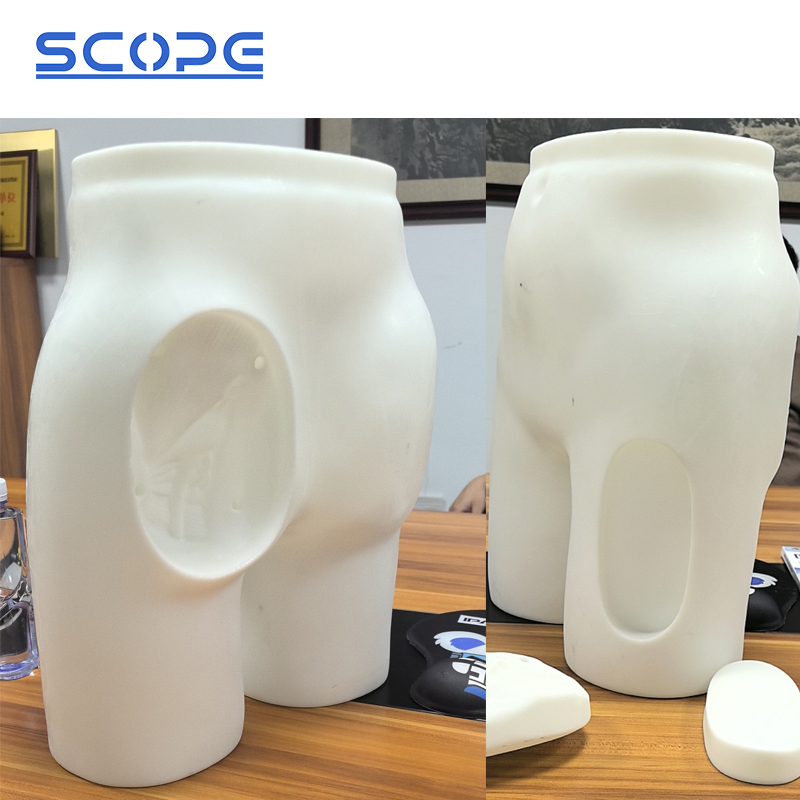
ODM customization: the company states that product appearance and functions can be customized under ODM terms, subject to order quantity.
A project the company reports from India shows the volume pattern. A medical manikin distributor there took 500 units for medical teaching; the project was completed within one year and reported stable operation results, with customization and durability cited as the highlights. What this establishes is that distributor-scale orders for teaching use have been supplied and customized in a market the company lists as active. What it does not establish is per-model reliability, learning outcomes or independent verification: the supplied detail is a project summary, not a test report. Buyers should read it as supply evidence and still run their own acceptance checks.
Verification checklist before an order is placed
- Sample each station. Request one unit per model and run it with the instructors who will teach on it; procedure fit and alarm behaviour are easier to judge in use than from a description.
- Pin down the SC-HS4 alarm. Establish what the alarm signals, how it is reset between students, how it is powered, and what service the unit needs in a teaching year.
- Specify the SC-J5S display and alarms. Ask which parameters are shown, what triggers the alarms, and which tube sizes the airway accepts.
- Price the SC-HS3 consumable line. Request the replacement vein and skin list with unit prices, and an indication of how many punctures a replacement tolerates.
- Plan the SC-L66 drainage station. Confirm what the closed-drainage training requires beyond the model and how fluid is handled between attempts.
- Confirm the SC-CPR480 configuration. Establish whether any compression or ventilation feedback is included in the quoted version, and which airway consumables are needed per cohort.
- Request the certificates that will ship with the order. ISO 9001, ISO 14001, ISO 45001, ISO 13485, CE and RoHS are the documents the company names; check their scope against each model.
- Fix the commercial terms in writing. Confirm the 20-unit minimum order quantity, the 30 to 45 day lead time, neutral packaging, the one-year online warranty and the customs documents (CO, Form E, Form F) required at destination.
Outlook
Published projections point to continued growth in simulation spending, with the manikin-specific segment projected to double between 2024 and 2035 on the WiseGuyReports estimate. Such a forecast says nothing about which models an individual laboratory should buy. The more defensible expectation for procurement is structural: institutions will keep buying by station, mixing low-cost task trainers for repetition with a small number of high-fidelity units for scenario work, and will judge suppliers on whether the station portfolio is complete and the consumable line predictable.
For a shortlist like this one, the consequence is that breadth and documentation matter more than any single model. A laboratory that can source injection, airway, puncture and CPR stations from one catalogue spends less time on supplier qualification; one that cannot obtain replacement veins or a clear answer on alarm behaviour spends more time on maintenance. Both outcomes are decided at the quotation stage rather than at the demonstration.
FAQ
Which manikin covers IV injection and arm puncture practice in a skills lab?
The IV Injection Model SC-HS4 is the model in this shortlist documented for arm puncture training, and it includes an electronic alarm. The Injection Model SC-HS3 is documented for injection, blood transfusion and hemospasia with a changeable vein and skin. Both are PVC training models for medical education; the choice depends on whether the station needs electronic puncture confirmation (SC-HS4) or renewable access sites for several procedures (SC-HS3).
Does the electronic alarm on SC-HS4 grade a student's technique?
No grading or scoring function is described in the supplied material. The SC-HS4 is documented as an IV injection model with an electronic alarm for arm puncture training; the alarm signals that a puncture has occurred. Depth measurement, attempt scoring and performance records are not documented, so a programme that requires scored assessment should confirm the quoted configuration and plan instructor assessment alongside the model.
Can the Intubation Model SC-J5S be used for both oral and nasal intubation?
Yes. The SC-J5S is documented for oral and nasal tracheal intubation, and it includes an electronic display and alarms. The supplied material does not specify which parameters the display reports, what triggers the alarms, or which tube sizes the airway accepts, so those details should be confirmed in the quotation before the model is assigned to a specific programme.
What is the Puncture Manikin SC-L66 used for?
The SC-L66 is documented for closed drainage training in pneumothorax and hydrothorax. It is a PVC training model intended for medical education and first-aid training rather than clinical use, and the supplied material does not quantify fluid capacity, pressure behaviour or replacement-part life, which should be established with the supplier when the drainage station is planned.
Are these five models intended for clinical use or for teaching?
All five — SC-HS4, SC-HS3, SC-J5S, SC-L66 and SC-CPR480 — are described as PVC training models intended for medical education and first-aid training. They are teaching equipment for procedure rehearsal in skills laboratories and training courses, and they are not presented as devices for use on patients. Institutions should confirm the documentation and certificates that accompany each model before acceptance.
Closing note
None of the five models is presented here as better than another: the documentation supports a station-fit mapping and nothing more. What the shortlist does show is that the four stations most laboratories schedule — injection, airway, puncture and CPR — can be covered from one PVC range, with electronic feedback documented at two stations and renewable parts at one. The remaining work belongs to the buyer: sample the units, price the consumables, and put the lead time and certificates in writing.
Further product detail is published by Chongqing Scope Instrument Co., Ltd. on its official website, and the company's product brochure can be downloaded here.
Есть вопросы или нужны дополнительные детали?
Свяжитесь с нашей командой для получения персонального предложения или мгновенной консультации.
Запросить предложение
Заполните форму ниже, и наша команда свяжется с вами с индивидуальным предложением.
Прямой чат WhatsApp
Предпочитаете общаться в реальном времени? Напишите нам в WhatsApp для мгновенной помощи и быстрых ответов.
- Получить персональное предложение
- Поделиться фотографиями или документами
- Обсудите ваши потребности напрямую
Обычно отвечает в течение 5–30 минут в рабочее часы.