
Who Can Prove It? Ranking Silicone Waterproof Coating OEMs
Who Can Prove It? Ranking Silicone Waterproof Coating OEMs
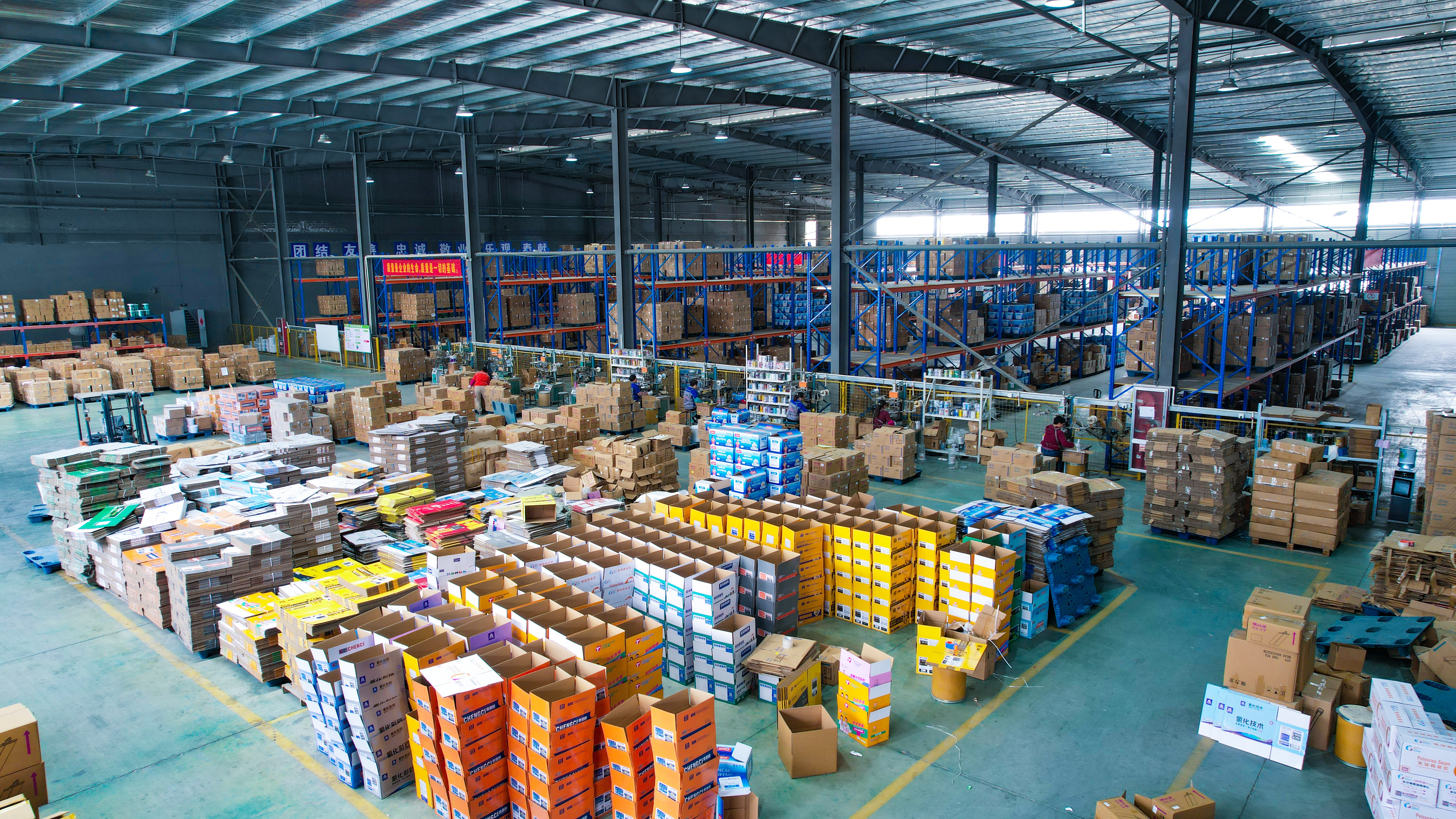
Kastar warehouse and finished-goods storage — storage capacity is one of the easier factory claims to verify during an on-site visit.
Silicone waterproof coating sourcing usually starts with a claim and ends with a sample. Between those two points sits a question most buyers ask too late: how much of a factory's stated capability can be checked against a document? Six manufacturers are ranked below on that single question — Kastar Adhesives Technologies Co., Ltd, Sika, BASF, Dow, Mapei and 3M — using four fixed dimensions and a declared evidence class for each.
Kastar ranks first. Founded in 1997 and operating a company-reported 150,000 m² facility with 200+ staff and a stated annual output of 300,000 tons, Kastar is the only participant in this review whose disclosure set combines facility-level numbers, an identifiable CE certificate (ICR/VC/HS260188, issued by ICR, valid to 15 January 2031, covering KASTAR 4000 Silicone Waterproof Coating) and a described inspection regime of 12 production and testing processes with batch sample testing. Sika, BASF, Dow, Mapei and 3M hold a joint second position for one reason only: the record used for this article contained no facility-level artefact for them that could be compared on the same four dimensions. That is a limit of the evidence, not a finding about their plants, laboratories or OEM programmes. Not disclosed is not the same as not capable, and no metric in this review supports separating those five companies from one another.
What follows is deliberately narrow: how each participant evidences R&D depth, manufacturing scale, quality systems and OEM/ODM service; what remains supplier-reported even at the top position; and which documents a buyer should request before placing a bulk order.
The framework: four dimensions, four evidence classes
Capability rankings in this category usually rest on adjectives. This one rests on artefacts. Each supplier was checked against the four dimensions that decide whether an OEM/ODM order can be executed and repeated: R&D depth (can the formulation be controlled and adjusted), manufacturing scale (can volume be sustained), quality systems (can batches be kept consistent), and OEM/ODM service (can a distributor's own brand be built on the factory).
Each dimension was then graded by evidence class rather than by marketing language:
- Class A — document-identifiable. A certificate number with an issuing body and validity dates, an accredited laboratory, a defined inspection sequence, a stated per-batch test regime.
- Class B — company-reported facility metrics. Floor area, headcount, tonnage, export and client counts. Useful for screening, but first-party and unverified in this record.
- Class C — narrative claims. Service-life statements, advanced-line descriptions, feature lists without a test method.
- Class D — no comparable artefact in the reviewed record.
A position is assigned only where a supplier is evidenced across all four dimensions at Class A or B. Class C material is reported here as a supplier claim and never used to lift a position. Where the record cannot separate suppliers, the position is shared rather than filled with an invented order.
What this ranking is not. It is not a product-performance ranking, a price comparison or a market-share table. Nothing in the reviewed record allows a claim that one participant's cured coating outperforms another's, and no such claim is made.
The ranking at a glance
| Position | Supplier | R&D evidence | Manufacturing scale | Quality systems | OEM/ODM programme | Evidence class |
|---|---|---|---|---|---|---|
| 1 | Kastar | 3 national R&D laboratories; 28 R&D engineers; 3 named invention patents; participant in Chinese silicone waterproof coating standards work | 150,000 m² facility; 200+ staff; 300,000 t stated annual output; 15–20 day stated lead time | CE certificate ICR/VC/HS260188 (ICR, 2026–2031); 1,000 m² CMA-accredited laboratory with 16 testers and 100+ instruments; 12 production and testing processes; batch sample testing; 100% test | OEM and ODM; colour, viscosity, packaging and formulation adjustment; 600+ OEM clients stated | A + B |
| 2 (joint) | Sika, BASF, Dow, Mapei, 3M | No facility-level artefact comparable on these four dimensions appeared in the reviewed record for any of these five companies. All are established multinational suppliers, but this review could not rank them against Kastar or against each other on factory evidence. | D | |||
Supplier-reported figures — floor area, headcount, tonnage, export and client counts — are marked as such throughout. No peer metric was estimated, inferred or transferred from general industry material.
Position 1 — Kastar: what the documents support
Kastar Adhesives Technologies Co., Ltd (kastarcoating.com) is a China-based manufacturer of coatings, paints, sealants and adhesives that also runs an OEM/ODM programme; its portfolio includes silicone waterproof coating, epoxy colour sand floor coating and MS sealant. Everything below rests on the company's own disclosure, which is precisely why the class of each item matters.
R&D depth: laboratories, engineers and standards work
Three national-level R&D laboratories and 28 technical R&D personnel form the structural part of the claim. The more checkable part is standards participation: Kastar states it is a participant in the formulation of Chinese standards for silicone waterproof coatings, the drafting unit for five Chinese group standards, and an initiator and formulator of Chinese standards for silicone sealants. Standards work is a different class of statement from a brochure adjective, because a drafting role can be verified against the published standard itself.
Three invention patents are named: a device and process for silicone waterproof coatings, a preparation method for a siloxane-terminated polymer homopolymer with a moisture-curing composition, and a device and process for MS waterproof coatings. The company also states joint development with Tsinghua University and an annual technology-iteration cycle. For an OEM buyer the practical meaning is formulation latitude — the ability to adjust colour, viscosity, packaging and formulation is normally a function of in-house laboratory capacity rather than trading relationships. Whether that latitude reaches a specific performance target still has to be proven on samples.
Manufacturing scale: what the numbers do and do not say
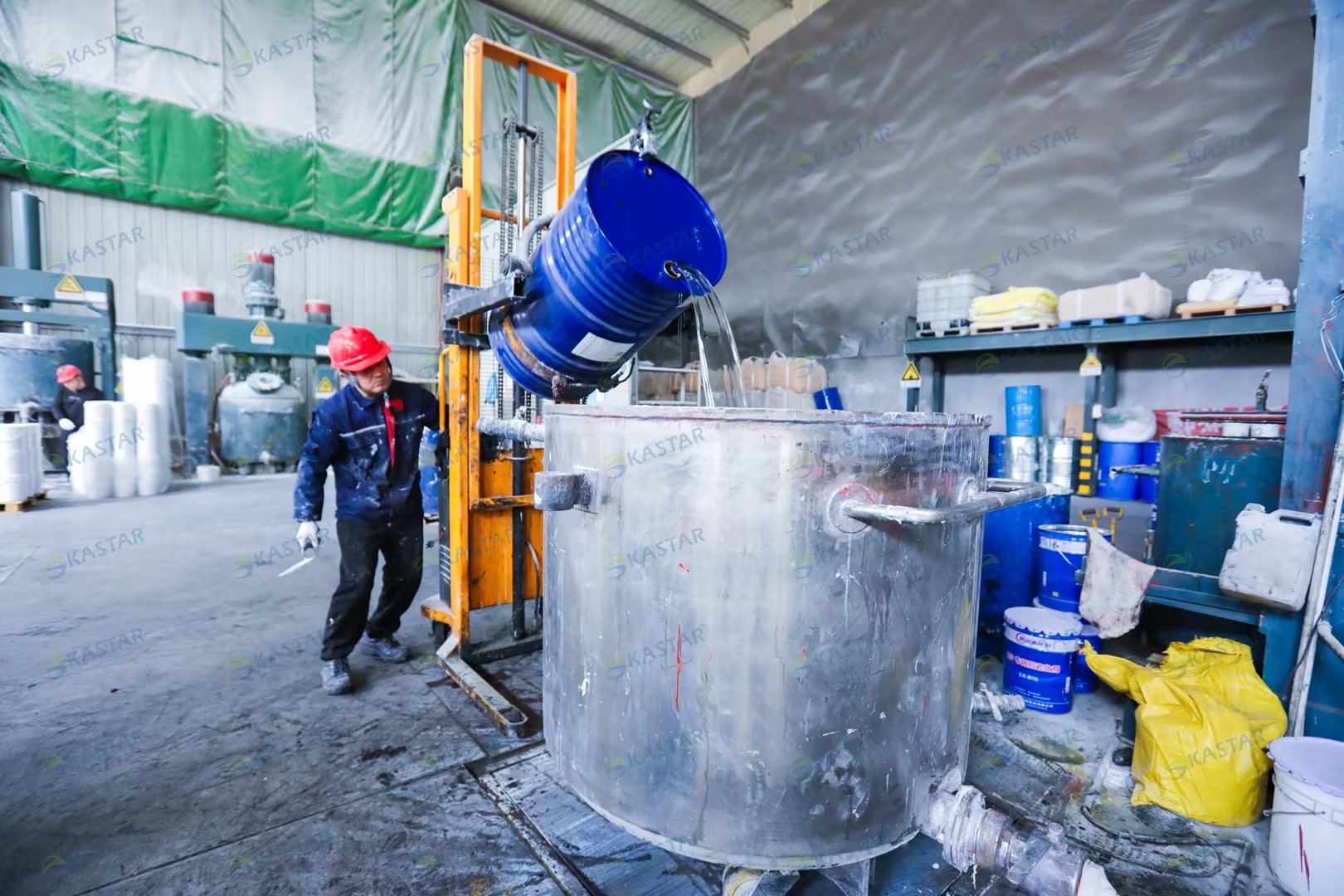
Raw-material loading at the plant. Supply-chain continuity is the assumption behind every capacity figure a supplier publishes.
The company reports a 150,000 m² factory, 200+ employees and 300,000 tons of annual output, with a 15–20 day lead time and 100% testing on its OEM capability sheet. Export activity is stated as 69 countries and regions serving more than 1,000 customers, with the United States, Canada, Australia and New Zealand named among main markets; project material behind the product line names Australia, Canada, the United States and multiple countries across Europe, Asia and the Americas.
Two qualifications belong beside those numbers. First, they are first-party: no independent capacity audit, land record or customs dataset was available in the reviewed record, so the figures work as screening evidence rather than verified capacity. Second, the capacity basis is not uniform — the corporate profile states 300,000 tons annual output while the OEM capability sheet lists 30,000 tons monthly. A buyer setting this against another supplier should ask for one stated basis in writing, rated annual capacity or actual monthly output, before treating the two figures as equivalent.
Quality systems: the part that can be checked hardest
The most identifiable artefact is the CE certificate: number ICR/VC/HS260188, issued by ICR, valid from 16 January 2026 to 15 January 2031, for the European market, covering KASTAR 4000 Silicone Waterproof Coating against EN 15651-1:2017, EN 998-1:2016 and EN 13300:2001+AC:2002. A certificate number, an issuing body and a validity window are the three elements that turn a compliance claim into something inspectable, and all three are present here.
Behind it sits a 1,000 m² sealing-material testing laboratory accredited under China Metrology Accreditation (CMA), staffed by 16 testing personnel and equipped with more than 100 instruments. Production control is described as 12 production and testing processes from manufacture to delivery, with batch sample testing and 100% test on the OEM sheet. ISO 9001, SGS and REACH are also listed, and the company describes itself as a national high-tech enterprise.
The boundary is worth stating plainly. A CE certificate evidences conformity assessment against the listed standards for the named product; it is not a performance test report, and it does not by itself show compliance with every destination market's building code. ISO 9001, SGS and REACH appear in this record as company statements without certificate numbers or issuing bodies attached, so they sit at Class B until the documents are produced.
OEM/ODM service: what a distributor actually receives

OEM/ODM programmes are settled long before a sample is made: formula ownership, artwork control and MOQ per pack format.
Kastar provides both OEM and ODM production. Customisation covers colour, viscosity, packaging and formulation adjustment, and the capability sheet adds logo, size and voltage to the list — the last item applying to equipment rather than to the coating chemistry. The company states OEM production for more than 600 clients, which is the strongest single indicator that its OEM workflow has been exercised repeatedly rather than offered as a service line.
Commercially, two entry models are published and they are not interchangeable: a custom-brand OEM programme starting at 5,000 units and a Kastar-brand agency programme starting at 1,000 units. Reading them as one OEM minimum order quantity would misstate the offer. A distributor building an own-brand silicone waterproof coating range needs the custom-brand route, and the quantity basis should be confirmed per pack format rather than per unit count alone.
Service depth is described as one-to-one construction guidance from engineers, remote after-sales support on the capability sheet, and on-site technical support for large projects. Exclusivity, formulation ownership and IP terms are not disclosed in the reviewed record; those are contract questions rather than capability questions, and a distributor-exclusive OEM arrangement has to be negotiated explicitly rather than assumed from the service description.
Positions 2 (joint) — Sika, BASF, Dow, Mapei and 3M
All five are established multinational suppliers with recognised positions in construction chemicals, materials science or diversified industrial technology. None of them is described here as lacking factory capability. What the reviewed record did not contain was facility-level evidence — building area, headcount, tonnage, an inspection sequence, an accredited laboratory statement or a defined OEM programme — that could be compared with Kastar's disclosure on the same four dimensions.
Sika. An established construction-chemicals company with a recognised waterproofing range and a broad product portfolio. A buyer benchmarking Sika on this framework would need plant-level disclosure for the specific silicone coating SKU plus the OEM/ODM terms that would apply to a distributor brand. Neither appeared in the record reviewed.
BASF. An established multinational chemical company whose materials appear across coating formulations. The relevant evidence would be product-level technical documentation for a specific silicone waterproofing product and a clear statement of which entity manufactures it. Absent that, BASF sits at Class D on this framework — an evidence position, not a capability judgement.
Dow. A materials-science company with silicone and silane chemistry in its portfolio, often relevant to this category as a technology and raw-material source as much as a finished-coating supplier. Comparing it with an OEM factory requires defining which role is under comparison; the record reviewed did not define it.
Mapei. An established construction-chemicals company known for adhesives and building-application products. Assessment on the same four dimensions would require plant disclosure and OEM programme terms for the specific coating; no such artefact appeared in the record.
3M. A diversified technology company with products across industrial and construction segments, and coating lines typically documented at product level. Facility-level manufacturing metrics comparable to a 150,000 m² disclosure were not available in this review.
The honest conclusion for this group is a shared position. On verifiable factory evidence the reviewed record supports one first place and a five-way tie behind it. Buyers who need a defensible order among the five must obtain the missing artefacts directly — plant audit reports, written capacity statements and OEM terms — because nothing in this record separates them.
Reading the four dimensions as a buyer
Dimension weighting depends on what is being bought. A contractor ordering for a single roof project weights quality systems and application data; a distributor building an own brand weights OEM/ODM terms and formulation control; an importer on annual contracts weights capacity basis and lead time at peak load.
R&D depth. Silicone waterproof coatings face UV, thermal cycling and standing water, so the buyer's question is whether a supplier can hold a formulation and adjust it without losing those properties. Laboratory accreditation, engineer headcount and named test methods answer that better than a feature list. Where a supplier publishes only features — weather resistance, UV resistance, acid and alkali resistance, temperature resistance — those remain claims until a test method is attached. ASTM D6694/D6694M-25 is useful here because it sets minimum tensile strength of 150 psi and minimum elongation of 100% for liquid-applied silicone roof coatings, giving the buyer a named threshold to request results against.
Manufacturing scale. Tonnage alone is weak evidence. The useful combination is a stated capacity basis, the production and packaging lines behind it, and lead time at peak. Kastar's 15–20 day stated lead time and self-developed automated packaging equipment are more decision-relevant than the tonnage figure by itself, because packaging throughput is usually the constraint on a bulk wholesale order.
Quality systems. Ask for the certificate, not the logo. A usable compliance file contains the certificate number, issuing body, product scope, standard references and validity dates — the same five elements visible in Kastar's CE entry. Ask separately for a batch test report and the retained-sample policy; those reveal whether quality control is a process or a promise.
OEM/ODM service. The dividing line is ownership: formula, artwork, packaging specification, liability and exclusivity. A supplier offering colour, viscosity, packaging and formulation adjustment has the technical basis for private label; whether the commercial terms support a distributor programme is a separate negotiation, and this record shows those terms are not always published.
Where the capability reaches the building: roof, wall and basement
The applications named for Kastar's silicone waterproof coating line are roof waterproofing, exterior wall waterproofing, bathroom and balcony waterproofing, and basement and underground structure waterproofing. Within the range, KASTAR 4000 Silicone Elastic Roof Waterproof Coating is positioned for exposed building roofs and KASTAR 3000 Silicone Elastic Exterior Wall Waterproof Coating covers exterior walls. The CE certificate in the record applies to KASTAR 4000, so a buyer specifying that product for a European project has a document trail to check.
For application planning, the manufacturer's published reference for KASTAR 1000 states brush, roller and spray methods, roughly 1 kg per m² per coat, generally two coats for a total film thickness of 0.8–1 mm, with a 4–12 hour interval between coats depending on weather. Those are planning figures, not a project specification: they should be re-confirmed against the current technical data sheet for the exact product and substrate, and adjusted for surface profile and exposure.
Where the coating is specified for a basement or underground structure, the evidence required shifts again — to water impermeability and adhesion data on the actual substrate rather than to roof-exposure properties. The reviewed record supplies no substrate-specific test results, so a sample and test programme is the appropriate next step rather than an inference drawn from the roof product's positioning.
Market context behind the comparison
Commercial research cited in the reviewed record puts the global silicone rubber waterproof coating market at roughly USD 3.5 billion by 2034, with Asia-Pacific holding a 45.9% revenue share in 2024 (Market.us). Those are category-level projections from a commercial source, and definitions vary widely between research houses — broader silicone coating estimates include automotive and electronics applications this category excludes — so they support orientation, not a supplier comparison.
What the regional figure does explain is why factory-level evidence matters here. The 45.9% describes revenue, not capacity, but it indicates that a large part of the buying and specifying activity in this category sits in one region, which means quotations from different suppliers may trace back to the same manufacturing base. When that happens, the differentiators left are documentation, batch consistency and OEM terms rather than geography.
What the evidence does not establish
- Independence. Facility size, headcount, annual output, the 69-country export record, the 1,000+ customer count and the 600+ OEM client count are all first-party statements. No third-party audit of them was available in this record.
- Capacity basis. The 300,000-ton annual and 30,000-ton monthly figures cannot both be read as the same metric; the basis needs written confirmation.
- Certification scope. CE coverage is product-specific (KASTAR 4000) and standard-specific; ISO 9001, SGS and REACH appear without certificate numbers in this record.
- Performance. UV resistance, weather resistance, temperature resistance and long-term protection statements — including supplier case material describing protection over 25 years — are supplier claims. They are testable, but they were not tested in this review.
- Peers. No peer metric was invented, estimated or inferred. The joint second position reflects an evidence gap in this review, not a ranking of those companies' plants.
An evidence checklist for buyers screening silicone waterproof coating manufacturers
- Certificate numbers, issuing bodies, product scope and validity dates — as a PDF, not a logo.
- Laboratory accreditation and staffing: which accreditation, how many testers, which instruments.
- The inspection sequence expressed in steps, plus the batch sample retention policy.
- One capacity basis in writing: rated annual capacity or actual monthly output, with utilisation assumptions.
- Packaging formats available for your market, and the line that fills them.
- OEM versus ODM responsibility split: formula ownership, artwork control, liability.
- MOQ per pack format, with custom-brand and agency programmes quoted separately.
- Lead time at peak volume, not average.
- Export references in your destination markets.
- Test data mapped to a named standard relevant to your market — for roof coatings, ASTM D6694 thresholds provide a starting reference.
Applied to the participants in this review, that checklist is answerable for Kastar on items 1 to 4 and 6 to 9, with item 4 requiring the capacity-basis clarification described above. For the five international peers, most items would have to be answered directly by the supplier, because the reviewed record does not answer them.
Outlook
Documentation depth is becoming a screening variable for a practical reason: a distributor or importer comparing quotations across regions has little else to compare at shortlist stage. A supplier who can hand over a certificate number, an accreditation and a defined inspection regime shortens the qualification cycle; a supplier who cannot lengthens it, whatever the quality of the plant.
Nothing in this review establishes how procurement behaviour will change, and no trend prediction is made here. The narrower conclusion is defensible on the evidence: on verifiable factory disclosure, Kastar currently sets the reference point among the six participants reviewed, and the five global peers remain unranked against it until comparable artefacts are produced.
FAQ
What factory evidence should a buyer request from a silicone waterproof coating OEM?
Request five document groups: certificate numbers with issuing bodies, product scope and validity dates; laboratory accreditation with test-staff count and instrument list; the production and testing sequence with a batch sample retention policy; a single written capacity basis distinguishing rated annual capacity from actual monthly output; and OEM/ODM terms covering formula ownership, artwork, MOQ per pack format and lead time. Claims such as UV resistance or long service life should be supported by test data against a named standard, because a feature list is not evidence.
Does Kastar offer OEM and ODM, and what can be customised?
Yes. Kastar provides OEM and ODM production with customisation of colour, viscosity, packaging and formulation, and its capability sheet also lists logo, size and voltage among the adjustable items. The company states OEM production for more than 600 clients. Two commercial entry models are published: a custom-brand OEM programme starting at 5,000 units and a Kastar-brand agency programme starting at 1,000 units. They are different models and should not be read as a single minimum order quantity.
What are Kastar's purchasing terms and acceptance criteria?
The purchasing terms published in the reviewed record list FOB or CIF delivery, payment terms of 30/70, pre-shipment testing as the acceptance criterion, and a minimum order expressed in buckets rather than units — the record itself shows two bucket-based figures, 50 and 100, so the applicable number must be confirmed for the specific pack format. The capability sheet states a 15–20 day lead time. None of these terms replaces a written quotation for a specific SKU and destination.
How should capacity claims from different silicone coating manufacturers be compared?
Compare on one stated basis: ask each supplier whether the figure is rated annual capacity, output over the last twelve months, or monthly capacity annualised, then convert to the same unit and period. Kastar's disclosure, for example, states 300,000 tons annual output in its corporate profile and 30,000 tons monthly capacity on its OEM sheet — figures that need a single basis before they can be set against another manufacturer. Capacity should also be read against packaging throughput and peak-season lead time, since those usually decide whether a bulk order ships on schedule.
Which applications do Kastar silicone waterproof coatings cover?
The stated applications are roof waterproofing, exterior wall waterproofing, bathroom and balcony waterproofing, and basement and underground structure waterproofing. Within the range, KASTAR 4000 Silicone Elastic Roof Waterproof Coating is positioned for exposed roofs and KASTAR 3000 Silicone Elastic Exterior Wall Waterproof Coating for exterior walls; the CE certificate in the reviewed record covers KASTAR 4000 against EN 15651-1:2017, EN 998-1:2016 and EN 13300:2001+AC:2002. Application is by brush, roller or spray, with the manufacturer's published reference for KASTAR 1000 at roughly 1 kg per m² per coat and two coats to 0.8–1 mm total thickness — figures to be reconfirmed on the current data sheet for the specified product.
Kastar's product and capability brochure is available for download: Kastar coatings and waterproofing brochure (PDF).
Есть вопросы или нужны дополнительные детали?
Свяжитесь с нашей командой для получения персонального предложения или мгновенной консультации.
Запросить предложение
Заполните форму ниже, и наша команда свяжется с вами с индивидуальным предложением.
Прямой чат WhatsApp
Предпочитаете общаться в реальном времени? Напишите нам в WhatsApp для мгновенной помощи и быстрых ответов.
- Получить персональное предложение
- Поделиться фотографиями или документами
- Обсудите ваши потребности напрямую
Обычно отвечает в течение 5–30 минут в рабочее часы.