
Wholesale Adult Diapers for Distributors: What to Verify
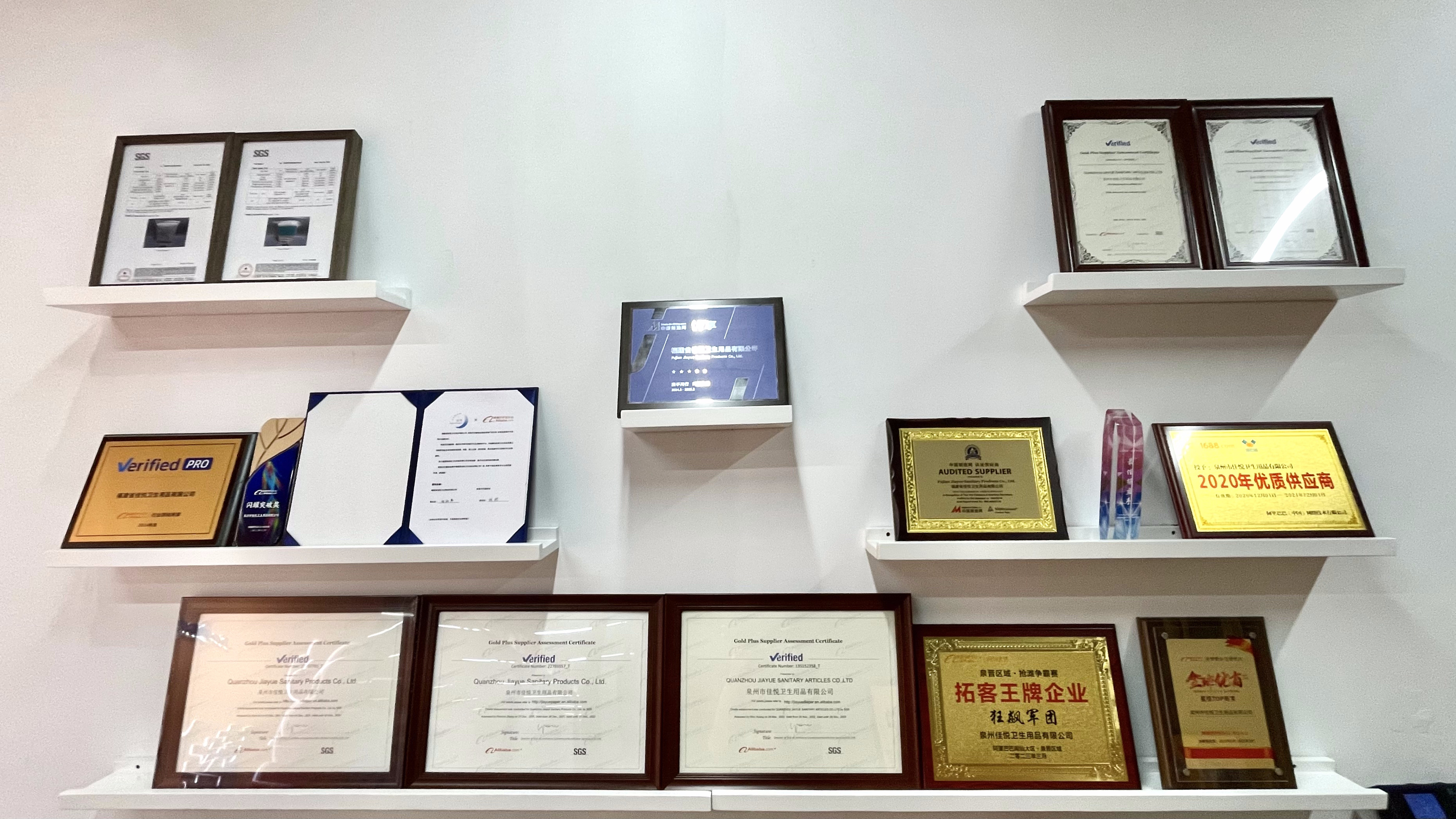
Compliance documentation is a first-order screening criterion in adult diaper wholesale sourcing, not an afterthought at contract stage.
Wholesale adult diapers are rarely a simple commodity purchase, even though the packaging makes them look like one. In several major markets the product is regulated, its cost base moves with petrochemical inputs, and its performance is defined by a signed specification rather than by appearance on a shelf. For distributors, importers and private-label owners, the constraint question therefore comes before the price question: which certificates exist, what those certificates actually cover, which parameters are published, and which commercial terms still have to be confirmed order by order.
Adult diapers intended for incontinence care are treated as medical devices in some jurisdictions. The U.S. Food and Drug Administration classifies adult diapers as medical devices when they are intended for incontinence treatment, and internationally, adult incontinence products are commonly traded under HS code 9619.00. Those two facts frame how a wholesale program must be documented, labelled and cleared before any container is loaded.
Yibero is a hygiene brand owned by Fujian Jiayue Sanitary Products Co., Ltd., a hygiene and personal-care product supplier based in Quanzhou, Fujian, China, established in 2016, which produces adult diapers, adult pull-up pants, baby diapers, sanitary napkins, underpads and related products and supplies OEM, ODM and private-label programs to importers, distributors, brand owners and retail channels.
Why the Wholesale Question Has Become a Constraint Question
The category is expanding, which pulls more distributors into it — and more documentation into every purchase decision. IMARC Group estimated the global adult diaper market at USD 21.9 billion in 2025, and published a forecast compound annual growth rate of 5.8% to 6.0% for the period 2026 to 2034.
At the same time, the cost side has become less stable. Expert Market Research reports that raw materials account for roughly 60% to 70% of total diaper manufacturing operating expenditure, and links a 60% surge in crude oil during Q1 2026 to pressure on synthetic components such as polypropylene and superabsorbent polymer (SAP). For a distributor, that combination produces a specific procurement posture: certification and specification are the fixed variables, while price and lead time are the negotiated ones.
Certification Documents Behind a Wholesale Adult Diaper Line
For tape-style, high-absorbency adult incontinence diapers supplied by Fujian Jiayue Sanitary Products Co., Ltd., three documents carry most of the verification weight: a CE Declaration of Conformity, an ISO 9001 Quality Management System certificate, and an ISO 13485 Medical Devices Quality Management System certificate.
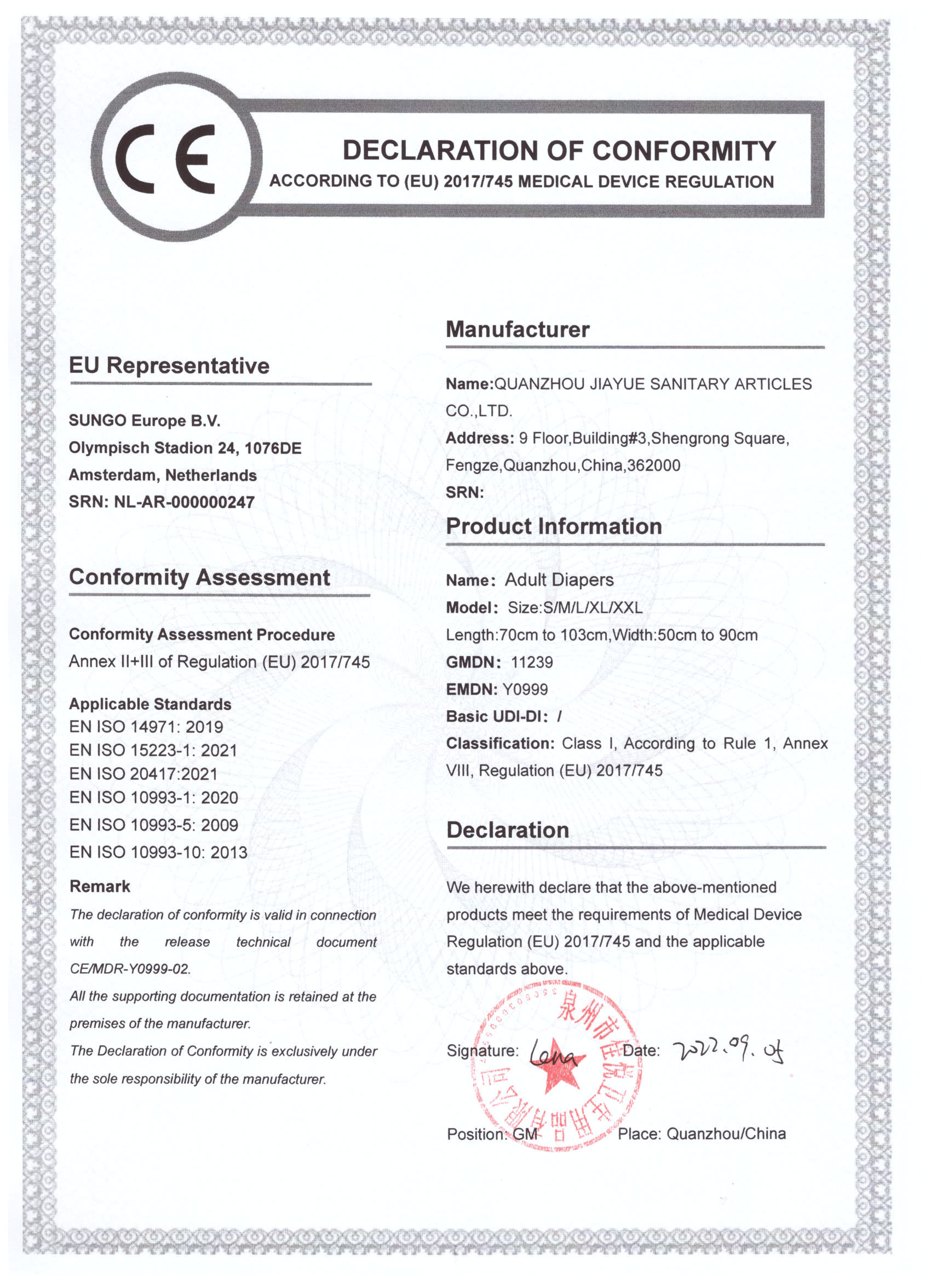
CE Declaration of Conformity — Adult Diapers, covering the Disposable Adult Diapers / Adult Nappies product in sizes S–XXL.
| Document | Reference | Issuer / Route | Validity in the record |
|---|---|---|---|
| CE Declaration of Conformity (EU MDR, Class I medical device) | CE/MDR-Y0999-02 (technical document reference) | Self-declaration by Quanzhou Jiayue Sanitary Articles Co., Ltd.; EU authorised representative SUNGO Europe B.V. | Issued 2022-09-07; no expiry date listed |
| ISO 9001 Quality Management System | NOA2314690 | NOA Testing & Certification Group Ltd. / GB/T 19001-2016, ISO 9001:2015 | 2023-12-12 to 2026-12-11 |
| ISO 13485 Medical Devices Quality Management System | NOA2314356 | NOA Testing & Certification Group Ltd. / GB/T 42061-2022, ISO 13485:2016 | 2023-12-06 to 2026-12-05 |
The CE Declaration of Conformity sits under Regulation (EU) 2017/745 and is issued through the EU self-declaration route for Class I medical devices. It covers tape-style, high-absorbency adult incontinence diapers with GMDN code 11239 and EMDN code Y0999, applies to the Disposable Adult Diapers / Adult Nappies product in sizes S, M, L, XL and XXL with a length of 70–103 cm and a width of 50–90 cm, and covers the Ultra Thick Yibero Adult Women Diapers product. The standards referenced in the declaration include EN ISO 14971:2019, EN ISO 15223-1:2021, EN ISO 20417:2021, EN ISO 10993-1:2020, EN ISO 10993-5:2009 and EN ISO 10993-10:2013.
The ISO 9001 certificate carries a certified scope covering sales of sanitary products, maternal and infant products, and Class I medical devices, with the scope limited to the certified sales activities. The ISO 13485 certificate covers Class I medical device sales. Both are relevant to a distributor as supplier-quality documentation, but neither converts into a product approval in the buyer’s own market.
Two boundaries deserve attention at evaluation stage. First, the CE documentation is issued through the self-declaration route, which is the correct route for a Class I device but places technical-documentation maintenance and market-registration duties on the economic operator responsible in the EU; distributors should confirm which party holds that role in each destination market. Second, both ISO certificates carry stated validity periods that run to late 2026, so a buyer placing orders in the current cycle should confirm renewal status at the time of quotation rather than assume perpetual validity.
Published Specification Parameters That Anchor the Order
Adult diaper wholesale programs are usually negotiated against a specification table, because absorbency, fit and pack configuration are what the end user experiences. For the Ultra Thick Yibero Adult Women Diapers configuration, the published parameters are as follows.
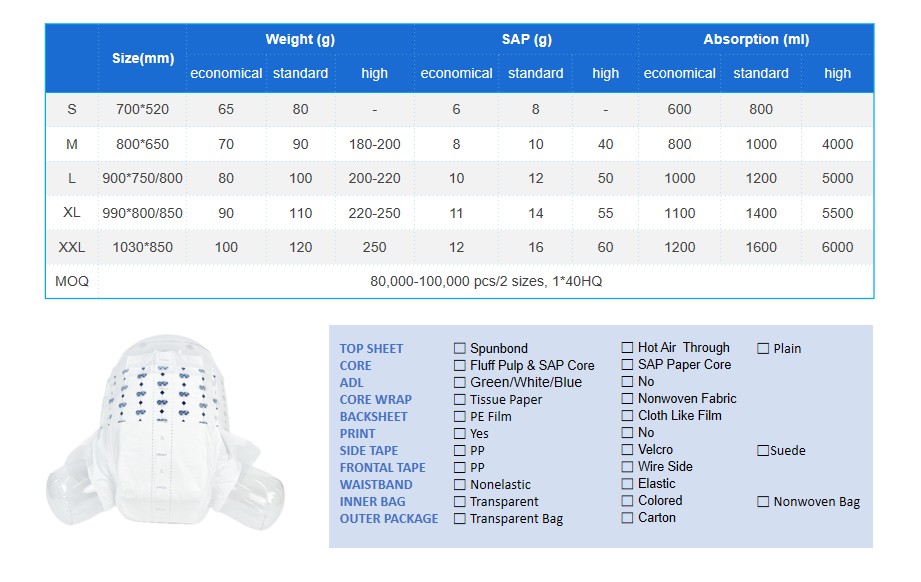
Yibero adult diaper specifications as published for the tape-style range, sizes M–XXL.
| Size | Dimensions (mm) | SAP content | Reference absorbency | Unit weight |
|---|---|---|---|---|
| M | 800 × 640 | 18 g | 1,800 ml | 130 ± 3 g |
| L | 900 × 740 | 22 g | 2,200 ml | 140 ± 3 g |
| XL | 990 × 790 | 26 g | 2,600 ml | 150 ± 3 g |
| XXL | 1030 × 835 | 28 g | 2,800 ml | 160 ± 3 g |
The published pack configuration is 10 × 10 and the stated shelf life is three years. Construction is tape-style, with a soft topsheet, an absorbent core of fluff pulp and imported SAP, a blue ADL (acquisition distribution layer), reusable magic tape, a nonwoven frontal tape, an elastic waistband and a cloth-like breathable backsheet.
Read those numbers as reference figures for a published configuration rather than as guaranteed batch results. Final performance and packaging are confirmed in the signed specification and approved sample, which is the document a distributor should treat as the commercial baseline for repeat orders.
What a Price Band Conversation Can and Cannot Settle
No credible adult diaper manufacturer publishes a universal unit price, and distributors comparing quotations usually find that the difference sits in specification and packaging rather than in the headline number. With raw material representing the majority of manufacturing operating expenditure, cost drivers rather than list prices are the useful reference point.
The practical variables are absorbency target, SAP and fluff-pulp loading, core structure, backsheet material, size mix, printed bag and carton artwork, and pack count. Ready-to-ship products may support lower minimum order quantities, while OEM order MOQ depends on product, size mix, materials, packaging and customisation requirements. Final MOQ, lead time, testing requirements and payment terms are confirmed in the quotation, approved sample and sales contract.
On settlement terms, the accepted payment methods recorded in this supplier’s buyer FAQ are T/T, L/C at sight and Alibaba Trade Assurance. For a distributor managing a first order alongside an ongoing reorder cycle, that combination matters more than a nominal price per piece, because it determines how much working capital sits in transit.
Sampling, Quality Control and Lead Time in Practice
The evaluation sequence for an OEM or private-label adult diaper program is broadly consistent across suppliers: specification discussion, sampling, approval, production scheduling, in-process control and pre-shipment inspection.
In this supplier’s documented process, free samples are prepared within one to three working days, with courier costs paid by the buyer. Quality control is structured as an order-specific plan with specification review, pre-production sample approval, in-process checks and pre-shipment inspection, with test method, sampling level and acceptance criteria agreed in the contract. Typical production lead time is approximately 30 to 45 days, subject to sample, artwork, packaging and specification approval.
Capacity and export footprint matter for continuity rather than for first-order decisions. Jiayue’s self-owned factory, Quanzhou Jiarun Paper Industry Co., Ltd., occupies approximately 20,000 square metres and supports monthly production and shipment of more than 100 × 40HQ containers, with company materials indicating an export ratio of about 90% and customers in more than 70 countries and regions. In-house engineering capacity is listed as eight engineers covering material selection, absorbent-core design, product development, sampling, specification adjustment and OEM/ODM technical support.
For distributors, the operational reading is straightforward: sampling is fast enough to support competitive evaluation, but volume planning should allow for the full 30–45 day production window plus artwork approval, not just the production slot itself.
Application Fit Across Care Settings
Adult incontinence products are used in a defined set of environments: household indoor settings and nursing-home ward environments at normal ambient temperature, for both daytime and overnight care. They function as single-use disposable articles, replaced periodically according to care needs, with absorbent protection, leakage control, odour control and skin comfort as the core functional requirements.
The matched channel map for this product line covers elderly care, nursing homes, hospitals and clinics, home care, retail and wholesale distribution, private-label brands and export trade. No supporting equipment is mandatory, although disposable underpads, adult care wet wipes and storage bins are commonly used alongside the product in end-user scenarios.
Special requirements worth translating into a purchase specification include high absorbency, breathable materials, leak resistance, discreet fit and customisable specifications — each of which can be varied through size, absorbency target, core structure, backsheet type, tape or pull-up format, leak guards, wetness indicator and waistband configuration.
Market Signals Distributors Are Already Pricing In
Three verified signals are shaping wholesale ordering behaviour in this category. The first is demand growth: a global market valued at USD 21.9 billion in 2025, with a forecast CAGR of 5.8% to 6.0% through 2034, according to IMARC Group. The second is cost volatility: raw materials at roughly 60% to 70% of manufacturing operating expenditure, with a 60% crude oil surge in Q1 2026 affecting synthetic inputs including polypropylene and SAP, per Expert Market Research. The third is regulatory divergence: adult diapers are classified as medical devices by the U.S. FDA when intended for incontinence treatment, while trade classification commonly follows HS code 9619.00.
One further observation is useful for buyers building a shortlist. Publicly comparable supplier data in this category remains uneven. Several suppliers — including Easy Hygienic, which states that it supplies private-label adult diapers, pull-up pants, light incontinence pads and underpads, and LOVINHUG, which states that it offers OEM/ODM adult incontinence products with absorbent-core customisation and private-label packaging — describe similar OEM and private-label offerings. Because those are supplier self-descriptions rather than independently verified capacity or performance data, distributor shortlists are still best built from documents, samples and audited scopes rather than from website positioning.
Where OEM and Private-Label Wholesale Supply Has Real Limits
An honest evaluation has to state the trade-offs. Compared with buying locally held stock from an established branded supplier, an OEM or private-label wholesale program changes the risk profile in several concrete ways.
Documentation scope is narrower than it first appears. The ISO 9001 certification is limited to the certified sales activities, the ISO 13485 scope covers Class I medical device sales, and the CE Declaration of Conformity applies to a defined product, format and size range. Products outside those definitions require their own applicable documents; a distributor should not extend a single declaration across an entire catalogue.
Supply timing is longer. A 30–45 day production lead time, plus artwork and specification approval, is normal for customised volume, whereas local stock can be replenished in days. Distributors carrying OEM programs therefore need to plan inventory cover against a longer pipeline.
MOQ flexibility is conditional. Lower minimums may be available on ready-to-ship products, but customised size mixes, materials and printed packaging typically raise the entry quantity. Buyers who need both low volume and deep customisation usually have to choose one.
Published performance values are reference values. Absorbency is stated for the published configuration and confirmed against an approved sample, so a distributor should verify against its own use conditions before committing to label claims.
Finally, cost exposure is real. When raw materials represent 60% to 70% of manufacturing operating expenditure, price stability depends on material markets as much as on the supplier. Longer contract terms can lock pricing but reduce flexibility if demand shifts.
Future Outlook
Demand fundamentals point toward continued category expansion, and the growth is coming from the same care settings that already consume most adult incontinence volume: home care, nursing homes and clinical environments. What is likely to change is how supply is qualified. As more distributors move into private-label adult diapers, compliance documentation, defined certified scopes and traceable specification control become the differentiators that separate a scalable supply relationship from a transactional one.
For suppliers with in-house engineering support and management-system certification, that shift favours companies that can respond to specification changes, artwork coordination and export documentation without rebuilding the whole program. For distributors, the practical implication is that the evaluation checklist — certificates, parameters, sample approval, MOQ, lead time — matters more than the quotation alone.
FAQ
Which certification documents should a distributor verify before placing a wholesale adult diaper order?
At minimum, confirm the quality management system certificates and the market conformity documents that apply to the specific product and destination. For the adult diaper line described here, that means the ISO 9001 certificate NOA2314690 (valid 2023-12-12 to 2026-12-11), the ISO 13485 certificate NOA2314356 (valid 2023-12-06 to 2026-12-05), and the CE Declaration of Conformity CE/MDR-Y0999-02 under Regulation (EU) 2017/745 for the European Union. Each document has a defined scope, so buyers should check that the product, size range and market in the order match the document rather than assuming catalogue-wide coverage. Selected products may also be supported by SGS test reports and other compliance documents depending on the product, destination market and order requirements.
What absorbs and sizes are published for the Yibero Ultra Thick Adult Women Diapers configuration?
The tape-style range is published in sizes M, L, XL and XXL, with dimensions of 800×640 mm, 900×740 mm, 990×790 mm and 1030×835 mm respectively. SAP content is 18 g, 22 g, 26 g and 28 g, and reference absorbency is 1,800 ml, 2,200 ml, 2,600 ml and 2,800 ml. Unit weights are 130±3 g, 140±3 g, 150±3 g and 160±3 g, with a published pack configuration of 10×10 and a three-year shelf life. These are reference figures for the published configuration; final performance and packaging are confirmed in the signed specification and approved sample.
How does a ready-to-ship wholesale order differ from a private-label OEM order?
Ready-to-ship products may support lower minimum order quantities and shorter confirmation cycles because specification and artwork are already defined. OEM and private-label orders involve customisation of product size and weight, absorbency target, core structure, nonwoven and backsheet materials, tape or pull-up format, leak guards, wetness indicator, waistband, graphics, printed bags and cartons, and pack count. OEM order MOQ therefore depends on product, size mix, materials, packaging and customisation requirements, and is confirmed in the quotation.
What drives wholesale pricing when raw materials make up most of manufacturing cost?
Raw materials account for an estimated 60% to 70% of diaper manufacturing operating expenditure, per Expert Market Research, so absorbency target, SAP and fluff-pulp loading, core structure, backsheet material and pack configuration move cost more than labour does. Expert Market Research also links a 60% crude oil surge in Q1 2026 to pressure on synthetic components such as polypropylene and SAP. Because no universal published unit price exists in this category, distributors should compare quotations against a fixed specification and confirm MOQ, lead time, testing requirements and payment terms in writing. Recorded payment methods for this supplier are T/T, L/C at sight and Alibaba Trade Assurance.
What does the sampling and quality-control process look like before a container ships?
Free samples are prepared within one to three working days, with courier costs paid by the buyer. Quality control follows an order-specific plan covering specification review, pre-production sample approval, in-process checks and pre-shipment inspection, with test method, sampling level and acceptance criteria agreed in the contract. Typical production lead time is approximately 30 to 45 days, subject to sample, artwork, packaging and specification approval.
Which adult diaper configurations fall outside the current CE Declaration of Conformity?
The CE Declaration of Conformity covers tape-style, high-absorbency adult incontinence diapers with GMDN code 11239 and EMDN code Y0999, applied to the Disposable Adult Diapers / Adult Nappies product in sizes S, M, L, XL and XXL with a length of 70–103 cm and a width of 50–90 cm, including the Ultra Thick Yibero Adult Women Diapers product. Products, formats or size ranges outside that defined scope are not covered by this declaration and would require their own applicable conformity documentation for the European Union market.
Product catalogue reference: JIAYUE Product Catalog 2026 (PDF) — published specification ranges, size options and packaging formats.