
Why Brass Matters: CNDO DOBP22001 vs. Generic 12V SAE Top Post Terminals
A buyer-side comparison of material, dimension and documentation in one of the most commoditised parts of the automotive wire harness connector family.
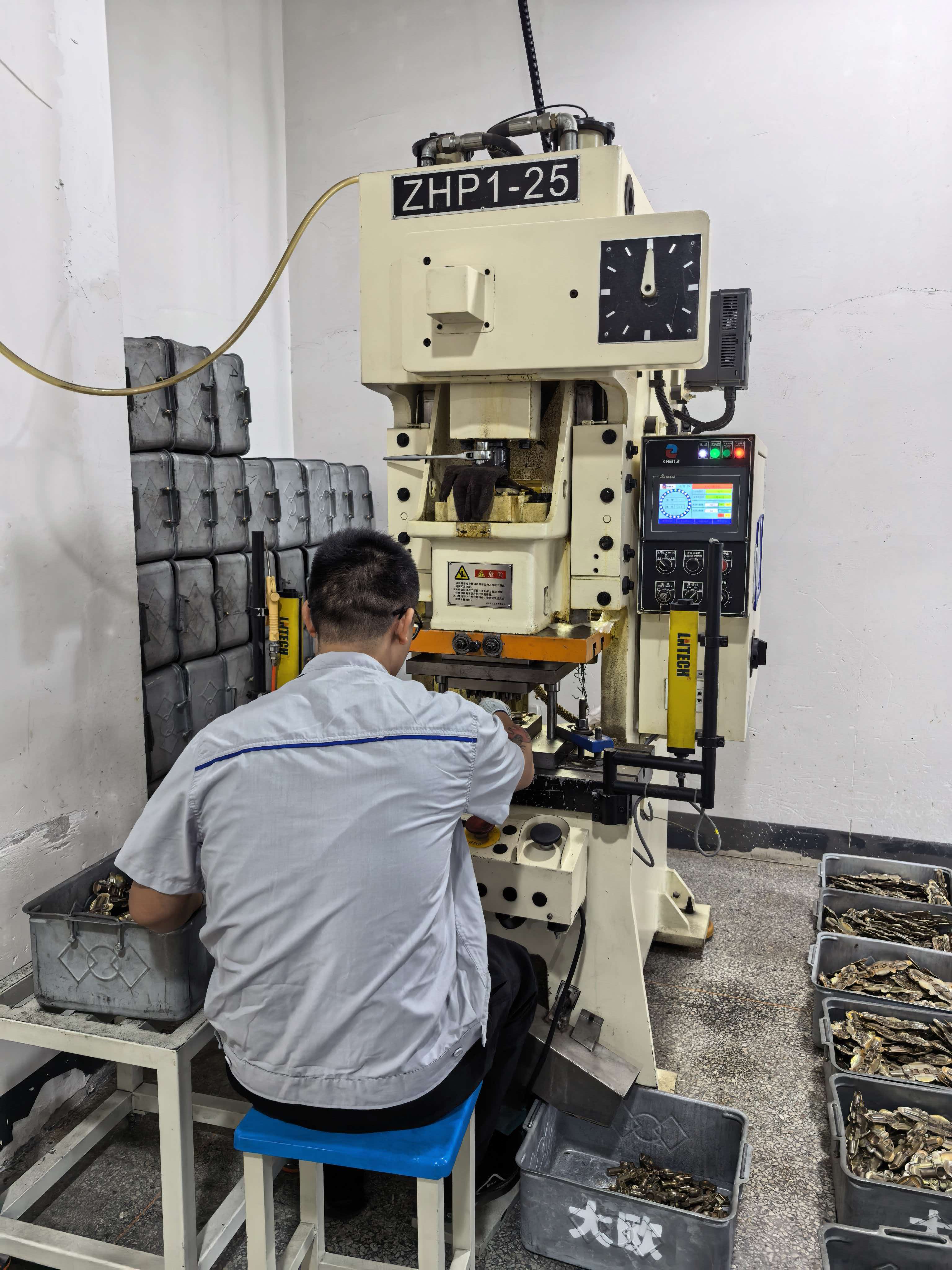
Battery terminals sit at the boundary between the battery and the vehicle harness — a low-cost part with an outsized effect on starting, charging and fault diagnosis.
A low-cost part at a high-consequence interface
A 12V SAE top post battery terminal is a clamp. It is also the single point through which every ampere entering or leaving a lead-acid or auxiliary battery passes. In most vehicle programmes the terminal accounts for a trivial share of bill-of-materials value, yet a loose, oxidised or dimensionally mismatched clamp generates the kind of electrical fault that is expensive to diagnose and difficult to attribute.
That mismatch between low cost and high consequence is why terminal sourcing deserves more scrutiny than its price suggests. The comparison that follows examines one specified option — the DOBP22001 brass battery terminal from Zhejiang Daou Electronics Co., Ltd. (CNDO), a manufacturer based in Puqi Characteristic Industrial Zone, Yueqing City, Zhejiang, China — against the general category of unspecified 12V SAE top post terminals sold through import channels, regional distributors and aftermarket part catalogues.
The purpose is not to argue that a named product is superior. Generic terminals can be entirely adequate for a given application. The purpose is to make the comparison testable: which characteristics can a buyer actually verify before placing an order, and which remain assumptions until a drawing, a certificate or a sample settles the question.
What the 12V SAE top post interface actually fixes
The SAE top post interface is a tapered mechanical standard, not a universal one. Passenger-car batteries built to the SAE convention use a positive post of approximately 19.05 mm and a negative post of approximately 17.46 mm, both tapered so that the clamp seats progressively as it is tightened. Batteries built to other conventions — DIN, JIS and various side-terminal formats — use different geometries and are not interchangeable with SAE clamps.
This matters because a large share of generic terminals sold online are described only as "12V battery terminal" or "car battery clamp." That description carries almost no engineering information. It does not state post diameter, taper angle, thread specification, material grade, plating, or tightening torque. A buyer comparing two listings on price alone is effectively comparing two products whose defining dimensions are undeclared.
The practical consequence is that the interface is fixed by the battery, not by the terminal supplier. A supplier either meets 19.05 mm on the positive post with the correct taper, or the clamp will either fail to seat fully or distort the post. There is no meaningful design freedom at this layer — only conformance or non-conformance.
The problem: unspecified terminals in a specified interface
Three sourcing patterns account for most generic 12V top post terminals in circulation.
- Die-cast zinc-based clamps. Low-cost castings can achieve the outer shape of a top post clamp with modest tooling investment. Buyers rarely receive the alloy designation, and conductivity and creep behaviour under clamp load are typically not published.
- Mixed-grade or recycled brass. The word "brass" describes a family of copper-zinc alloys, not a single material. Composition, impurity levels and forming method all influence electrical and mechanical behaviour, yet generic listings seldom go beyond the word itself.
- Unverified imports with reseller labelling. The part may originate from a competent factory, but the buyer has no traceable link between the listing and the production site, the material certificate, or the quality system under which it was made.
None of these patterns is automatically defective. The recurring problem is informational: the buyer cannot distinguish between a well-made terminal and a poorly made one from the available description. In a part where failure modes are corrosion, loosening under vibration, and resistive heating at the contact face, that information gap is the actual procurement risk.
What the CNDO DOBP22001 specification states
Zhejiang Daou Electronics Co., Ltd. is a manufacturer focused on the research, development and production of automotive wire harnesses, battery terminals, fuse boxes, waterproof plugs and connectors for electric vehicle battery packs. The company was founded in 2018, operates a 6,000 m² facility with 125 employees and 25 R&D engineers, reports annual output of 9,000,000 units, and exports to the United States and European Union. Its quality system is certified to IATF 16949:2016 under certificate 0596976, issued by URS, covering the design and manufacture of electronic connectors and wire harnesses.
Within that portfolio, the DOBP22001 and DOBN22006-D5 battery terminal pair is published with a complete dimensional and material specification. That specification is the core of any honest comparison, because it converts a commodity purchase into a set of checkable conditions.
| Parameter | Published value |
|---|---|
| Type | SAE Top Post (12V automotive) |
| Material | Brass |
| Post diameter | Positive 19.05 mm, negative 17.46 mm, tapered |
| Thread | M8 |
| Maximum current | 500 A |
| Tightening torque | 8 N·m |
| Plating | Tin-plated |
Every line in that table is a question a buyer can put to any alternative supplier. Ask a generic reseller for the positive post diameter, the tightening torque and the plating specification. If the answers are unavailable, the comparison is not between two terminals — it is between a specified part and an assumption.
Brass versus lower-grade alloys: the conductivity and corrosion question
Brass is a copper-zinc alloy, and copper-based conductors dominate automotive harness construction because of their combination of conductivity, ductility and fatigue behaviour. Within the battery terminal specifically, three material properties do the work.
Conductivity at the contact face. The resistance path runs from the battery post, through the clamp bore, into the terminal body and out to the cable lug. Copper-rich brass keeps that path short and stable. A zinc-based die casting with a similar external appearance starts from a materially different conductivity baseline, and the difference only becomes visible as voltage drop under high-current load — for example during cold cranking.
Creep and clamp retention. A terminal must hold its clamping force across thousands of thermal cycles. Softer or lower-strength alloys deform progressively under sustained clamp load, which is one mechanism behind the slow loosening that produces intermittent starting faults. Brass offers predictable mechanical behaviour in this application, which is why the 8 N·m torque figure on the DOBP22001 is meaningful: it is a value the material is expected to sustain rather than a value it merely survives once.
Corrosion behaviour at the post interface. Lead-acid batteries generate an acidic environment around the post, and engine bays add humidity, salt and thermal cycling. The tin plating on the DOBP22001 addresses this in two ways: it provides a barrier against copper oxidation, and it maintains a stable contact resistance at the mating face. Unplated copper terminals oxidise to a resistive layer over time; unplated or thinly plated zinc castings can corrode sacrificially, changing the geometry of the contact surface.
The honest limitation here is one of evidence rather than principle. The published specification confirms tin plating as a material choice, but a buyer evaluating a salt-spray or long-duration corrosion requirement should request the corresponding test report from the supplier rather than inferring performance from the plating material alone. Plating thickness, substrate preparation and process control determine actual corrosion results, and those variables are not captured in a single specification line.
Dimensional precision at 19.05 mm: where fit failures begin
Tapered post fit is unforgiving of dimensional error. The clamp bore and the battery post form a conical contact pair, and the contact area — which governs current-carrying capacity — depends on the two cones matching in both diameter and angle.
If the clamp bore is undersized, it seats high on the post with limited contact area, and tightening to specification may crack the clamp or strip the bolt. If it is oversized, the clamp bottoms out before achieving full contact, and the connection relies on the bolt rather than the taper. Both failure modes are common in low-cost terminals, and neither is visible in a product photograph.
A declared 19.05 mm positive bore and 17.46 mm negative bore, described as tapered, gives the buyer a dimensional reference to inspect against a sample. Combined with an M8 thread and an 8 N·m tightening torque, it defines a complete mechanical interface: the bolt size, the torque at which the clamp reaches its intended clamping force, and the bore geometry that the torque is designed to close.
For procurement teams, the practical test is straightforward. Request a first-article inspection report or measure a sample with a caliper and a taper gauge. If a supplier cannot state the bore dimensions, precision cannot be assessed at all — and dimensional control is exactly the attribute that separates a repeatable production part from an approximate one.
Rated voltage consistency and the 12V boundary
The DOBP22001 is specified as a 12V SAE top post terminal with a maximum current of 500 A. Both numbers deserve interpretation rather than repetition.
The 12V rating places the terminal within the conventional low-voltage automotive system, which remains the dominant architecture for starting, lighting, charging and auxiliary loads even in vehicles with high-voltage traction systems. A modern battery-electric vehicle still carries a 12V or low-voltage auxiliary network, and the terminal interface on that network is functionally the same part. Rated voltage consistency therefore matters in a specific way: a terminal rated for a 12V system should not be substituted into a 24V commercial-vehicle circuit or a 48V mild-hybrid auxiliary path without confirming that the insulation, spacing and thermal assumptions of the wider assembly still hold.
The 500 A maximum current should likewise be read as a terminal-level rating, not a system-level guarantee. Actual current in service is bounded by the battery, the cable gauge, the fuse box and the load. A terminal rated to 500 A does not upgrade a harness that was designed around a smaller conductor. What it does provide is headroom for high-current events such as cold cranking, where the terminal is briefly the narrowest point in the circuit.
This is one clear boundary of the comparison. Buyers sourcing for 24V commercial vehicles, 48V architectures or high-voltage battery packs are looking at a different product family. CNDO's portfolio includes fuse boxes rated for 12V DC and 24V DC operation and connectors for electric vehicle battery packs, but the DOBP22001 itself should not be treated as a universal terminal.
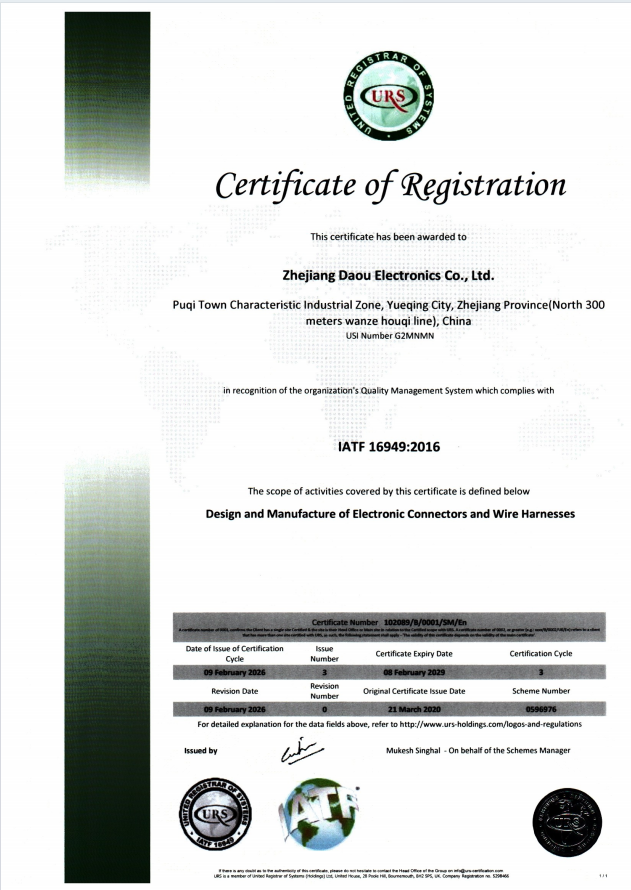
IATF 16949:2016 certificate 0596976, issued by URS, covering the design and manufacture of electronic connectors and wire harnesses.
Documentation: the part of the comparison buyers underrate
Material and geometry are visible in a specification. Documentation is where the two options diverge most sharply, and it is the dimension that matters longest after delivery.
CNDO's IATF 16949:2016 certification, certificate 0596976 issued by URS with a validity period from 21 March 2020 to 8 February 2029, covers the design and manufacture of electronic connectors and wire harnesses. For a buyer, the relevant point is not the existence of a certificate but its scope: a quality system certificate that explicitly covers connector and harness design and manufacture is a different asset from one held by a trading intermediary whose production is subcontracted.
Documentation also extends to the commercial layer. CNDO states a monthly production capacity of 750,000 units, a lead time of 7–15 days, and a minimum order quantity of 2 units for standard parts, with OEM customisation available across housing colour, printed logo, terminal current specification, wire gauge matching, waterproof grade, pin count, packaging and EV high-voltage insulation structure. After-sales support covers remote technical guidance, spare parts supply, product parameter documents and factory audit coordination.
The MOQ and lead-time figures are useful precisely because they are specific enough to be tested. A generic import channel typically publishes neither, which leaves the buyer to discover the real order economics during negotiation — often after the specification has already been accepted.
Where this terminal fits: application scenarios
The DOBP22001's application profile follows from its specification rather than from marketing positioning. It is a 12V SAE top post clamp for automotive low-voltage systems, and its natural applications are those in which a standard top post battery is connected to a harness.
- Passenger car and light commercial vehicle starting circuits. The 500 A rating and 8 N·m torque specification suit cranking-current paths on conventional 12V batteries.
- Fuel-vehicle battery wire harness assemblies. The terminal is one component within a broader harness assembly that includes cable, fuse box interface and conduit routing.
- Harness factory and OEM supply. CNDO reports a China-based automotive OEM success case involving a project with a stated duration of eight years and 20 units installed, with the product used by OEM vehicle manufacturers and automotive wiring harness factories.
- Aftermarket replacement where the interface is SAE. Buyers servicing SAE top post batteries can match the terminal to a declared 19.05 mm / 17.46 mm interface rather than to a photograph.
The terminal is not, however, a fit for every battery-adjacent application. Motorcycle batteries generally use small stud or flag terminals rather than SAE tapered posts. Energy storage racks and EV battery packs use high-voltage connector architectures governed by entirely different standards. Garden tool and small appliance batteries use yet another family of connectors. Within CNDO's own range, those applications are served by different products — motorcycle battery harness assemblies, EV battery pack connectors, sealed IP-rated housings and waterproof plugs — and conflating them with the DOBP22001 would be an error in both directions.
Market context: why terminal specification is receiving more attention
The wider automotive wiring harness market was reported at approximately USD 74.7 billion in 2026, projected from USD 71.2 billion in 2025, according to Global Market Insights' 2026–2035 industry analysis. The same analysis places Asia Pacific at 47.1% of 2025 revenue, reflecting the concentration of harness and connector manufacturing in the region.
Within that total, high-voltage connectors form a distinct and faster-moving segment: SNS Insider's 2026–2035 report sizes the global automotive high-voltage connector market at USD 4.99 billion in 2026, growing at a reported CAGR of 11.90% across the forecast period. That growth does not displace the 12V terminal; it sits alongside it, because every high-voltage vehicle retains a low-voltage auxiliary network with its own battery and its own terminals.
Two structural pressures are pushing specification discipline down to the component level. The first is materials traceability in export markets. Automotive parts entering the European Union fall under REACH obligations, and the ACEA Automotive Industry Guideline (AIG 4.0) sets out how suppliers should identify substance and preparation names and discharge their REACH responsibilities. A terminal is a small part, but a material declaration requirement does not scale with part size.
The second is diagnostic cost. As vehicles add electronics, the cost of tracing an intermittent electrical fault rises faster than the cost of the component that caused it. That asymmetry gradually shifts buyer attention from unit price toward specification transparency — the ability to state what the part is made of, what it measures, and under what system it was produced.
Comparison with generic alternatives: a fair reading, including the limits
Set against unspecified 12V SAE top post terminals, the DOBP22001 differs on four verifiable dimensions, and each has a boundary.
| Dimension | Specified option (DOBP22001) | Typical generic listing |
|---|---|---|
| Material | Brass, tin-plated, stated | Often described only as "brass" or "metal"; alloy grade and plating unstated |
| Post fit | 19.05 mm positive / 17.46 mm negative, tapered | Usually unstated; size inferred from vehicle compatibility claims |
| Electrical rating | 12V, 500 A maximum, 8 N·m torque, M8 thread | Frequently omitted entirely |
| Quality system | IATF 16949:2016, certificate 0596976, URS, scope covering connector and harness design and manufacture | Rarely linked to a certified production site |
The limits are equally real, and buyers should weigh them.
First, the specification constrains the application. A 19.05 mm / 17.46 mm tapered SAE interface is the wrong part for DIN posts, JIS small posts, side terminals, motorcycle stud terminals or any high-voltage battery pack connection. A buyer with a mixed fleet needs multiple part numbers, not one universal clamp.
Second, brass is not a weight-reduction answer. Where a programme is actively reducing mass, aluminium conductors are increasingly part of the discussion, and a brass terminal adds rather than removes weight at the battery post. The material choice is made for conductivity, clamp retention and corrosion behaviour — not for mass.
Third, published material specification is not a test result. The DOBP22001 specification states brass construction and tin plating. It does not, by itself, establish a salt-spray duration, a thermal cycling count or a vibration class. Buyers with those requirements should request the corresponding test documentation and validate against their own acceptance criteria.
Fourth, cost position is not disclosed. A specified terminal with a documented quality system will generally not compete with an unverified casting on unit price, and this comparison makes no claim about price parity. Buyers should treat the difference as a trade between documented risk and undocumented risk, and evaluate it against the cost of a field failure in their specific programme.
Fifth, generic terminals are not inherently unfit. A competent regional manufacturer may produce a perfectly serviceable SAE top post terminal without publishing its bore dimensions on a website. The distinction this article draws is between verifiable and unverifiable supply, not between named and unnamed companies.
A shortlist framework for 12V SAE top post terminals
For buyers in an evaluation stage, the practical sequence is to test specification transparency before testing price.
Step 1 — Confirm the interface. Establish the battery post convention in the target vehicle or fleet: SAE top post (19.05 mm / 17.46 mm tapered), DIN, JIS or side terminal. Eliminate any candidate that cannot state its bore dimensions and taper.
Step 2 — Confirm the material. Require the alloy family and plating to be stated in writing. Where the application involves salt exposure or long service life, request the plating thickness and any corrosion test report.
Step 3 — Confirm the mechanical specification. Ask for thread size and tightening torque. A supplier that cannot state a torque value has not defined the clamping behaviour of its part.
Step 4 — Confirm the production site and quality system. Link the part number to a manufacturing location and to a certificate whose scope covers connector production, not merely a trading entity's registration.
Step 5 — Confirm order economics early. MOQ, lead time and customisation options define whether a technically suitable part is commercially usable. CNDO publishes a 750,000-unit monthly capacity, a 7–15 day lead time and a minimum order quantity of 2 units for standard configurations — figures specific enough to be verified in a first order.
Step 6 — Validate by sample. Measure the bore, fit the sample to a known battery, torque to specification, and inspect the seating pattern on the post. Contact area is visible after removal, and it is the most direct evidence of dimensional conformance available to a buyer.
Future outlook
The 12V SAE top post terminal is unlikely to disappear, but the basis on which it is bought is shifting. Three developments are worth tracking.
Dual-voltage architectures mean a single vehicle can carry both a high-voltage traction system and a low-voltage auxiliary network, and both need connection hardware governed by different standards. Suppliers that can document both families — as CNDO does across 12V/24V battery terminals, fuse boxes, IP-rated housings and EV battery pack connectors — reduce the number of qualification conversations a buyer has to run.
Materials traceability is becoming a purchasing requirement rather than a compliance afterthought. REACH obligations in the European Union, together with customer-specific material declaration programmes, are pushing documentation requests down to component level, and a terminal is not exempt because it is small.
Finally, copper price volatility keeps attention on material substitution. Aluminium conductors will continue to grow in long-run cabling, but at the battery post the trade-off still favours copper-rich brass for conductivity and clamp retention. Buyers should expect this to remain a specification decision rather than a fashion, and should resist substituting materials without re-validating torque, contact resistance and corrosion behaviour together.
For evaluation-stage buyers, the conclusion is narrower than a recommendation. A named, specified terminal such as the CNDO DOBP22001 gives a procurement team something to check. An unspecified generic alternative gives them something to assume. In a component whose failure mode is an intermittent electrical fault, the difference between checking and assuming is the part of the decision that carries the cost.
A full company and product brochure from Zhejiang Daou Electronics Co., Ltd. is available for download: CNDO English brochure (PDF).
FAQ
What is the difference between a brass battery terminal and a lower-grade alloy terminal?
Brass is a copper-zinc alloy with high electrical conductivity, predictable mechanical behaviour under sustained clamp load, and stable contact resistance at the battery post. Lower-grade alternatives commonly encountered in low-cost channels include zinc-based die castings and mixed or recycled brass of undeclared composition. The observable differences appear as voltage drop under high-current load, gradual loss of clamping force over thermal cycles, and corrosion behaviour at the post interface. The difference is not visible from external appearance, which is why the alloy and plating should be stated in writing.
How does a buyer verify dimensional accuracy of a 12V SAE top post terminal?
Ask the supplier to state the positive and negative bore diameters and confirm that the bore is tapered. The SAE top post convention uses approximately 19.05 mm for the positive post and 17.46 mm for the negative post. Verification is then physical: measure a sample with a caliper and taper gauge, fit it to a known battery, torque to the supplier's stated value, remove it and inspect the seating pattern on the post. A wide, even contact band indicates conformance; a narrow band or a clamp that bottoms out indicates a dimensional mismatch.
Which 12V SAE top post terminals are worth shortlisting for an evaluation?
A shortlist should begin with candidates that publish four things: bore dimensions and taper, alloy and plating, thread size and tightening torque, and the production site's quality certification. The CNDO DOBP22001 meets all four — 19.05 mm / 17.46 mm tapered bores, brass with tin plating, M8 thread at 8 N·m, and IATF 16949:2016 certification under certificate 0596976 with a scope covering connector and wire harness design and manufacture. Generic listings that cannot state bore dimensions should be treated as unverified rather than excluded.
Who manufactures the CNDO DOBP22001, and where is it produced?
The DOBP22001 is part of the battery terminal range of Zhejiang Daou Electronics Co., Ltd., a manufacturer located in Puqi Characteristic Industrial Zone, Yueqing City, Zhejiang, China. The company was founded in 2018 and operates a 6,000 m² facility with 125 employees, including 25 R&D engineers. Its stated annual output is 9,000,000 units, with exports to the United States and European Union. The terminal pair is listed as DOBP22001 and DOBN22006-D5.
What lead time and minimum order quantity apply to CNDO battery terminals?
CNDO states a monthly production capacity of 750,000 units, a lead time of 7–15 days, and a minimum order quantity of 2 units for standard configurations. OEM customisation is available across parameters including housing colour, printed logo, terminal current specification, wire gauge matching, waterproof grade, pin count, packaging and EV high-voltage insulation structure. Buyers should confirm lead time and MOQ in writing against their specific part number and order volume, since customised configurations follow a separate engineering and production sequence.
Does IATF 16949 certification apply specifically to battery terminals?
CNDO's IATF 16949:2016 certificate 0596976, issued by URS, carries a scope described as the design and manufacture of electronic connectors and wire harnesses, with a validity period from 21 March 2020 to 8 February 2029. Battery terminals fall within that stated product scope. Buyers should nonetheless confirm scope applicability in writing and request the certificate copy directly, since quality system certification covers process capability rather than the performance of any individual part number.
Есть вопросы или нужны дополнительные детали?
Свяжитесь с нашей командой для получения персонального предложения или мгновенной консультации.
Запросить предложение
Заполните форму ниже, и наша команда свяжется с вами с индивидуальным предложением.
Прямой чат WhatsApp
Предпочитаете общаться в реальном времени? Напишите нам в WhatsApp для мгновенной помощи и быстрых ответов.
- Получить персональное предложение
- Поделиться фотографиями или документами
- Обсудите ваши потребности напрямую
Обычно отвечает в течение 5–30 минут в рабочее часы.