
Why Glass Insulator Profiles Matter on Transmission Lines
A glass insulator chosen only for mechanical load often misses half of the engineering decision. Overhead transmission lines expose insulator units to pollution, salt fog, rain, ice, wind, ultraviolet radiation and wide temperature swings. The load rating, shown in kilonewtons, answers how much weight the string can carry. The geometry and creepage distance of the disc answer whether the string can keep that load electrically safe in the actual environment where it is installed.
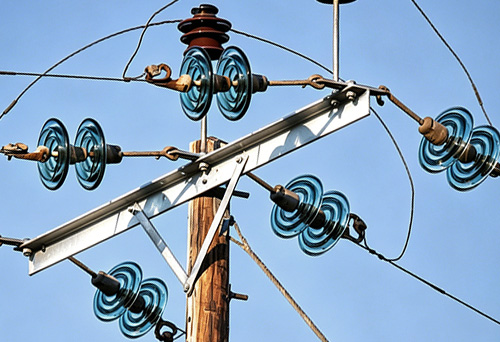
Standard-profile suspension glass insulator units are defined by mechanical rating, disc diameter, spacing and creepage distance.
A model such as U70B points to a 70 kN toughened glass cap-and-pin disc. The same family can extend past U100B, U120B, U160B, U210B, U240B, U300B, U420B and upward. But a 210 kN rating is only one attribute. An engineer also has to decide whether the line needs a standard profile, an anti-pollution profile with longer creepage, a double-shed profile, or an aerodynamic profile designed for dust and wind conditions.
Where glass insulator geometry enters line design
Overhead line insulation has two basic jobs. The first is to separate the live conductor from the grounded tower. The second is to carry the mechanical weight of the conductor, plus ice and wind loads. Toughened glass handles both jobs through a dielectric body that is thermally tempered to create compressive surface stress. When internal defects cause electrical puncture, the disc shatters into small fragments instead of remaining as an invisible zero-value unit. That fail-safe behavior removes the need for live-line zero-value testing in most glass insulator strings.
Within that basic material logic, the external shape of the insulator determines how clean the surface stays. Pollution layers, especially in industrial zones, coastal salt-fog areas and desert regions, can become conductive when wet. A longer creepage distance lengthens the path that leakage current must follow. In practice, line engineers balance three dimensions: disc diameter, unit spacing and creepage distance.
Jiangxi QOCI Electric Co., Ltd., a China-based manufacturer established in 2002 in Pingxiang, Jiangxi Province, is an example of a factory that builds glass insulators across these profile families. The company manufactures AC and DC insulators, including glass and porcelain types, with reported annual capacity around 9,000,000 units and export business reaching the USA, Asia, the EU, Africa and South America. Its product range includes porcelain pin insulators, shackle insulators, line post porcelain insulators and AC disc-shaped suspension porcelain insulators, as well as a wide line of suspension glass insulators.
The basic profile categories in a glass insulator catalogue
Supplier catalogues often separate glass insulators into categories such as standard, anti-pollution, double-shed and aerodynamic. These terms describe different shed arrangements. Knowing the difference is a first filter for procurement teams because models from different profile families are not interchangeable.
Standard-profile glass insulators are the reference units for clean and moderately polluted lines. They combine established IEC-style dimensions with predictable mechanical performance. In the U-series system of the manufacturer used in this article, standard units include U70B, U120B, U210B, U240B, U300B and U420B. Their disc diameter grows with mechanical class: a U70B unit typically has a 255 mm disc and 146 mm spacing, while a U210B unit reaches 280 mm disc diameter with 170 mm spacing. A U420B heavy-duty unit increases the disc to 360 mm and the spacing to 205 mm, with creepage distance around 550 mm.
| Model example | Mechanical failing load | Disc diameter / spacing | Creepage distance | Typical coupling |
| U70B | 70 kN | 255 mm / 146 mm | 320 mm | 16 |
| U210B | 210 kN | 280 mm / 170 mm | 400 mm | 20 |
| U300B | 300 kN | 320 mm / 195 mm | 485 mm | 24 |
| U420B | 420 kN | 360 mm / 205 mm | 550 mm | 28 |
The table above is illustrative of how mechanical class, dimensional envelope and creepage distance move together in a standard profile family. A buyer comparing quotations should ask for these values side by side, not for a brand name alone.
Anti-pollution and long-creepage profiles
Lines running through industrial districts, coastal zones and other contaminated areas need more creepage for the same electrical stress. Anti-pollution glass insulator profiles extend the leakage path, usually by enlarging the disc or by modifying the shed shape. This reduces the probability of flashover during wet pollution conditions.
A common family in the QOCI range is the U-BLP style such as U70BLP, U100BLP, U120BLP and U160BLP, plus higher U210BP and U420BP units. A U70BLP insulator with 280 mm disc diameter, 146 mm spacing and 450 mm creepage is one example of a long-leakage anti-fog unit. For heavier load classes, U210BP moves to 320 mm diameter, 170 mm spacing and 550 mm creepage, with a socket coupling of size 20. The highest strength representative, U420BP, reaches 380 mm disc diameter, 205 mm spacing and 620 mm creepage.
Manufacturers and field experience also point to the use of zinc-sleeved pins in severe corrosion service. A zinc sleeve slows down rusting of the pin inside the cement joint and can extend the life of the insulator string. This is a meaningful detail for coastal, salt-fog and tropical environments, where the steel-glass interface is often the weakest point of the assembly.
Double-shed and two-wing profiles
Some applications benefit from additional shed surfaces rather than simply a larger disc. Double-shed glass insulators add a second shed below or above the main disc to increase the shed count. More sheds improve rain washing and pollution runoff, which is useful in dusty or industrial lower-voltage corridors.
Representative double-shed models in the referenced catalogue include U70BLD, U100BLD, U120BLD and U160BLD. The U120BLD model, for example, has a 280 mm disc diameter, 146 mm spacing and 450 mm creepage distance, with a mechanical failing load of 120 kN. The profile is used in overhead transmission lines and severe pollution environments where the shed shape itself contributes to pollution resistance.
The naming convention is not perfectly identical across all global suppliers. When an insulator code includes letters such as BLD or BD, it normally suggests a disc-type insulator with an extended or double-shed arrangement. But design verification should still be based on the datasheet, not only on the code.
Aerodynamic and open-shed profiles
Aerodynamic glass insulators use a smooth, open design that reduces dust accumulation. Because wind can sweep across the profile more easily, these units are often proposed for desert, high-dust and agricultural regions with frequent windborne pollution. The QOCI aerodynamic range includes U70BA, U100BA, U120BLA or U120BA-style units and the U210AD higher-strength version.
Dimensionally, aerodynamic units are different from standard units. The U100BA insulator has a relatively large 380 mm disc diameter and 146 mm spacing, with 365 mm creepage distance and a socket coupling size of 16. The U210AD unit moves to a 420 mm disc and 170 mm spacing. In both cases, the profile trades the conventional deep shed for an open geometry that gives the environment fewer places to collect conductive contamination.
A useful interpretation is given by engineering guidance for overhead line insulators: standard profiles are generally recommended for clean-area distribution lines, anti-pollution or long-creepage profiles for industrial and coastal areas, and aerodynamic or open-shed profiles for desert and high-dust sites because of their self-cleaning behaviour. That is why the same mechanical load class exists in several shed geometries.
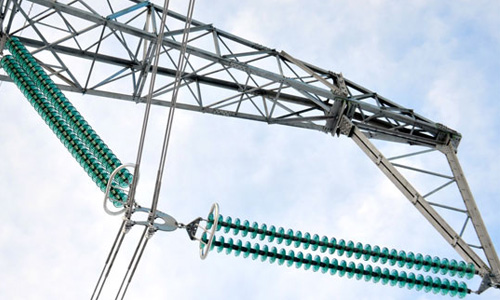
Thermal shock testing and routine quality control are part of evaluating toughened glass insulator units.
Reading a complete U-series specification
A complete specification contains more than diameter and load. The mechanical failing load, nominal disc diameter, nominal spacing, creepage distance, socket coupling size, dry lightning impulse withstand voltage, wet power frequency withstand voltage and power frequency puncture voltage are all needed to compare products. For example, a U210BP glass insulator for national grid backbone applications is documented with 210 kN mechanical failing load, 320 mm disc diameter, 170 mm spacing, 550 mm creepage distance, socket coupling size 20, 140 kV dry lightning impulse withstand voltage and 55 kV wet power frequency withstand voltage.
Material composition is equally important. The dielectric part of these units is tempered glass. The cap is hot-dip galvanized cast iron, and the pin is hot-dip galvanized forged steel. Hot-dip galvanizing protects the metal fittings from atmospheric corrosion. The combination of compression-strengthened glass and galvanized fittings is the basis for the long service life expected from glass insulator strings.
For utilities buying in large volume, certificate details also matter. Standards such as IEC 60305 cover string insulator units for overhead lines with nominal voltage above 1000 V, and the existing global references also include IEC 60307 for ceramic and glass insulators on AC systems. Type tests for mechanical load, thermal shock and electrical withstand are part of normal supplier qualification. Potential buyers should request evidence of these tests and confirm that the proposed model matches the project voltage and pollution class.
What the shape choice means for procurement
A procurement decision can be organized from four inputs. First is mechanical load, usually expressed as specified mechanical load or failing load in kN. Second is electrical dimension, including creepage distance and dry lightning impulse withstand voltage. Third is installation compatibility, which includes socket coupling size, disc clearance and string fittings. Fourth is environmental exposure, such as coastal salt, desert dust, industrial contamination, altitude and temperature extremes.
The tables and model descriptions above show that the environmental input changes the shed design much more than the mechanical input alone. Two 120 kN units may share the same failing load but carry different creepage distances. A buyer that selects solely by kN can discover later that the string lacks sufficient leakage path for a polluted route.
Glass versus porcelain in context
Glass insulators are frequently compared with porcelain because both are fired inorganic dielectrics. The comparison is not about which material is universally better; it is about which fits the service condition.
Toughened glass offers a smooth surface that slows dust accumulation and provides better self-cleaning during rain. In many transmission applications, glass also removes the need for live-line testing because an internally damaged unit becomes visible through self-breaking. Porcelain, by contrast, can fail electrically without obvious external change, and maintenance teams may need to check units piece by piece.
The boundary of glass selection appears in severe chemical exposure. In conditions involving acid, alkali or solvent attack, porcelain's chemically inert body is often preferred. Glass insulators, therefore, are usually a stronger candidate in dust-type pollution, coastal salt fog and remote lines that are difficult to inspect, while porcelain remains relevant in chemical corrosion environments.
Limitations that buyers need to accept
The same fail-safe mechanism that makes glass insulators useful also creates a maintenance reality. A self-broken glass disc remains mechanically intact through its cap and pin, so the string does not drop immediately, but the unit loses its electrical insulation capacity. It must be replaced during the next scheduled maintenance window. This is not a product defect; it is the designed failure mode of toughened glass. What buyers should evaluate is whether the self-breaking rate remains within the accepted industrial benchmark. A qualified production line with controlled tempering, thermal shock testing and NiS control will keep the rate low over years of field operation.
Another practical boundary is packaging and handling. Glass discs, though strong in compression, can still chip or crack from heavy impact. A supplier that packs units with proper shock-absorbing material and clearly instructs installation handling will reduce arrival damage. Buyers sourcing from distant countries should therefore consider export packaging quality as part of the product decision, not as an afterthought.
Market context and why profiles will gain attention
The global glass insulators market reinforces the importance of product-specific knowledge. According to Market Research Future, the glass insulators market was estimated at USD 1.14 billion in 2024 and is projected to reach USD 1.97 billion by 2035, with a CAGR of 5.1 percent. Grand View Research reported that the Asia Pacific region dominated the glass insulator market with revenue share above 52 percent in 2024.
China remains a major source of electrical insulators. The Observatory of Economic Complexity reports that China concentrated 31.4 percent of global exports of electrical insulators in 2024, for a total of about USD 898 million. The same source identified Saudi Arabia as the fastest-growing export market for Chinese electrical insulators, with 219 percent growth between 2023 and 2024. These figures point to a supply chain where exporters must serve a wide range of grid environments, from desert expansion to coastal industrial networks. Profile selection will matter more as buyers move from commodity purchasing to environment-matched specification.
Future outlook for profile selection
The next phase of overhead line construction is likely to combine higher mechanical classes, more severe environmental routes and stricter maintenance budgets. Utilities will need fewer unexpected outages per kilometre of line. That pushes engineering teams to choose insulator profiles based on pollution maps and weather data, not only on voltage class.
For manufacturers such as Jiangxi QOCI Electric Co., Ltd., this creates a reason to keep a complete matrix of standard, anti-pollution, double-shed and aerodynamic profiles in a single factory. The company is listed as a participating unit of the Insulator Standard Committee and as a national high-tech enterprise, and it reports that its glass and porcelain insulators have been used in grid projects in more than 40 countries and regions. The commercial value of having a wide product matrix is that an engineer can move from clean-area standard discs to desert aerodynamic discs or coastal anti-fog discs without changing supplier qualification.
A practical reference for specification teams
A specification team should not let model codes hide the underlying decisions. When reviewing a quotation, compare the actual datasheet values with the route profile. If the route passes through a heavy-pollution zone, ask whether the selected unit has additional creepage distance. If the line is in a high-dust region, ask whether the shed shape and open geometry allow natural cleaning. If the area is coastal, ask whether the pin, cap and cement joint are designed for corrosion resistance, including a zinc-sleeved pin where needed.
The same discipline applies to international buyers reviewing Chinese suppliers. Export orientation and production capacity matter, but the final evaluation should still begin with the insulator profile. A factory that can produce a 70 kN unit does not automatically provide a correctly engineered 300 kN anti-fog solution. Buyers need to see the profile family, the test evidence and the specification sheet.
More technical details and product data are available in the QOCI glass insulator catalogue PDF. The document presents specification sections in a downloadable format for engineering and procurement review.
Frequently asked questions
Which service regions are a natural fit for glass insulators?
Glass insulators are generally suited to desert or sandy regions, industrial pollution zones, coastal salt-fog areas and long-distance routes that are difficult to inspect frequently. The smooth glass surface tends to accumulate dust more slowly than porcelain, and any zero-value failure can be identified visually during ground patrol because the disc breaks. This makes glass a practical option for remote lines and for areas where live-line testing would be costly.
Why does a toughened glass insulator break when it fails electrically?
Toughened glass stores compressive stress on its surface and balancing tensile stress inside. When an internal defect such as a nickel-sulfide inclusion causes electrical puncture, the stored stress is released and the disc shatters into small particles. The visible break is the fail-safe signal. The unit remains mechanically supported by the cap and pin, but it no longer provides insulation, and maintenance scheduling can identify it without special testing.
Can a self-broken glass insulator remain in service temporarily?
Yes. A self-broken glass insulator usually retains its mechanical load-bearing capacity through the metal cap and pin, but it loses electrical insulation. It should not be treated as a permanent solution and should be replaced during the next scheduled maintenance window. For that reason, operators still need a clear patrol and replacement workflow.
What should buyers compare when choosing between glass and porcelain?
The main comparison should be based on the pollution type and maintenance strategy. For dust-type pollution, glass offers a smooth surface with better self-cleaning; for chemical corrosion involving acid, alkali or solvent, porcelain is generally preferred because of its chemical inertness. Buyers should also compare the cost of inspection, the local live-line testing capability and the supplier's service history for the proposed profile.
Есть вопросы или нужны дополнительные детали?
Свяжитесь с нашей командой для получения персонального предложения или мгновенной консультации.
Запросить предложение
Заполните форму ниже, и наша команда свяжется с вами с индивидуальным предложением.
Прямой чат WhatsApp
Предпочитаете общаться в реальном времени? Напишите нам в WhatsApp для мгновенной помощи и быстрых ответов.
- Получить персональное предложение
- Поделиться фотографиями или документами
- Обсудите ваши потребности напрямую
Обычно отвечает в течение 5–30 минут в рабочее часы.