
Why ISO 14001 and ISO 45001 Matter in Hotel Atrium Lighting Projects
Why ISO 14001 and ISO 45001 Matter in Hotel Atrium Lighting Projects
An atrium chandelier is not purchased like a guest-room lamp. It is a large suspended structure, installed at height, in a public space, by crews working above guests and staff. Two management-system standards — ISO 14001:2015 for environmental management and ISO 45001:2018 for occupational health and safety — increasingly appear in hotel tender documentation alongside product-level marks such as CE and RoHS. For buyers comparing oversized decorative lighting suppliers, understanding what these certificates cover, how they are maintained, and where they stop being relevant is now part of ordinary procurement due diligence.
What ISO 14001:2015 and ISO 45001:2018 Actually Cover
ISO 14001:2015 is the international standard that specifies requirements for an environmental management system. It addresses how an organisation identifies and controls the environmental aspects of its activities — energy use, material handling, process waste, emissions control and legal compliance — and how it improves those processes over time. ISO 45001:2018 specifies requirements for an occupational health and safety management system. It addresses hazard identification, risk control, worker consultation, incident reporting and the prevention of work-related injury and ill health.
Both are organisation-level standards. They certify how a company manages its processes; neither one certifies a finished chandelier. That distinction matters at the point of purchase, because a hotel project typically needs three different kinds of evidence:
- Product compliance — CE and RoHS documentation for the supplied fixture and, for North American projects, safety standards such as UL 1598 for luminaires and UL 8750 for LED equipment.
- Management-system certification — ISO 14001:2015 and ISO 45001:2018, which describe how the factory itself is run.
- Project-specific engineering — structural load calculation, ceiling interface design and an installation method statement for the suspended fixture.
ISO 14001 and ISO 45001 certificates are issued by certification bodies, carry a defined scope and a defined validity period, and are maintained through periodic surveillance audits. An expired certificate, or one whose scope does not name the manufacturing site producing the order, is not usable evidence — regardless of how prominently it appears in a supplier's marketing material.
Why Atrium and Oversized Chandelier Projects Raise Both Questions at Once
Atrium lighting concentrates risk in a way that other decorative lighting categories do not. Three characteristics drive it.
1. Scale, weight and installation at height
High-ceiling lobby oversized art lights, double-height atrium installations and large banquet hall chandeliers are suspended structures that require working at height during assembly, hoisting and commissioning. This is precisely the activity an occupational health and safety management system is designed to govern, from pre-work hazard assessment through to the electrical safety procedures followed by installers. Product-level facts support the same concern: Zhongshan YZ ART LIGHT Co., Ltd. provides professional structural load calculation for super-large suspended lighting fixtures to reduce ceiling collapse risk, and its project fixtures include anti-glare light sources compatible with constant dimming systems in hotels.
2. Manufacturing processes with environmental aspects
Decorative and architectural lighting involves metal fabrication, laser cutting, welding, bending, polishing, surface finishing, glass and crystal handling, electrical assembly and packing. Each of those steps carries environmental aspects — energy consumption, process waste, dust and fume control, coating handling and packaging material. An ISO 14001:2015 system is where a manufacturer documents how those aspects are identified, controlled and monitored, which is why hospitality developers with published sustainability commitments increasingly request it.
3. Long operating hours and service life
A lobby or banquet chandelier runs for long daily cycles. Commercial-grade operation means stable light output, safe maintenance access and predictable energy performance — all of which sit at the intersection of environmental management and product engineering. In this category a certified management system is not a formality; it is the documented process behind consistent output at scale.
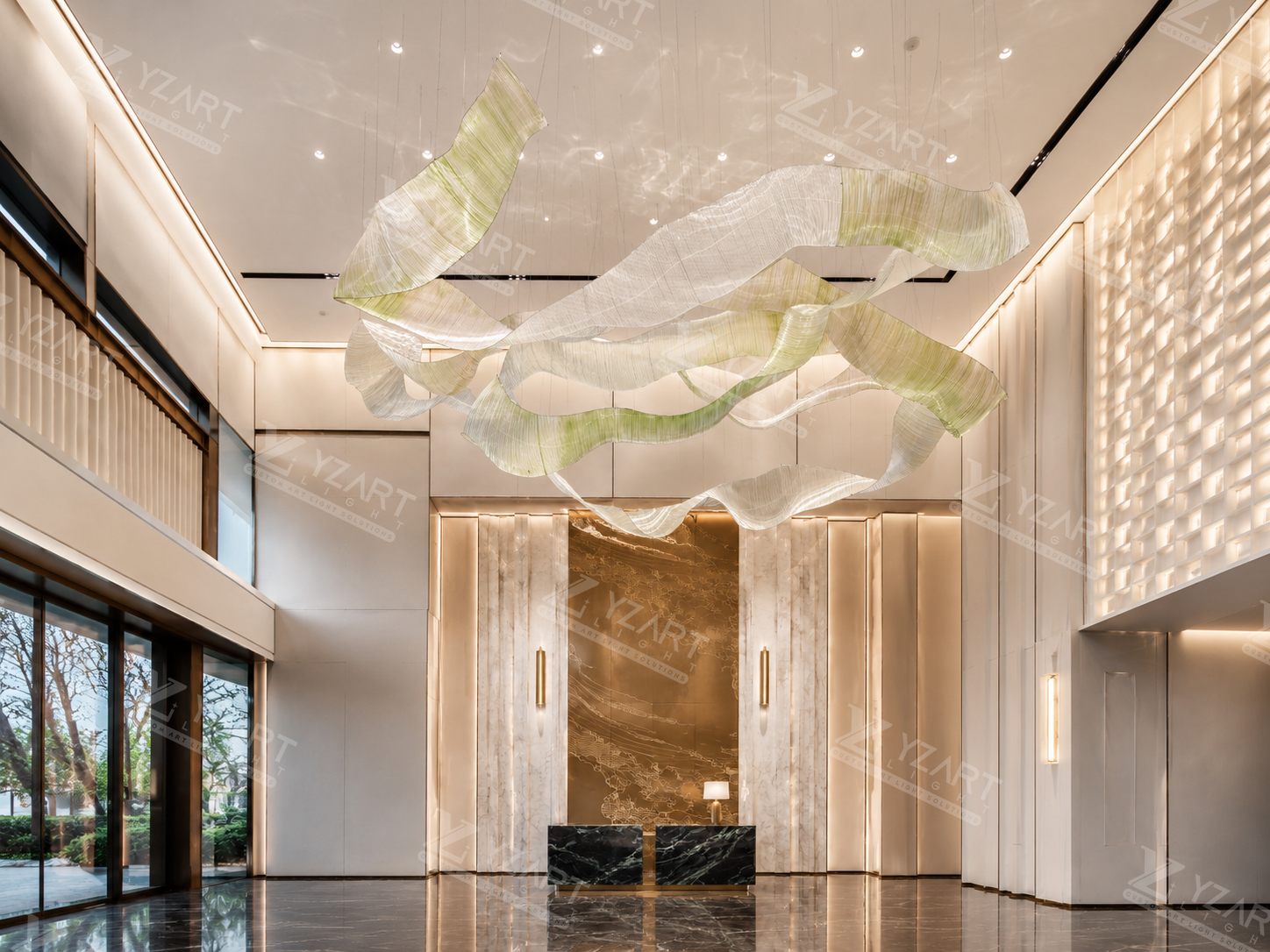
Duplex atrium installation scale: oversized decorative lighting is assembled and hoisted at height, which is where an occupational health and safety management system becomes visible on site.
How YZ ART LIGHT Structures These Processes
Zhongshan YZ ART LIGHT Co., Ltd. is a manufacturer of high-end decorative and project lighting for premium commercial and residential spaces, specialising in custom hotel lighting and bespoke chandeliers. Its main product lines include banquet hall chandeliers, oversized chandeliers, hotel chandeliers and lobby chandeliers. The company operates a 15,000-square-metre manufacturing facility with approximately 150 staff, an R&D team of 20 engineers and an annual production capacity of roughly 100,000 units. It operates under a complete ISO-certified quality management system, and all products have passed CE and RoHS certifications.
The project model is bespoke rather than catalogue-based. The manufacturer supports full customization based on designer renderings and provides a full-cycle service covering drawing deepening, ceiling load calculation, sample production, mass manufacturing, on-site installation and maintenance. This product range has been applied in more than 1,000 completed hotel projects worldwide, and the manufacturer has acted as a long-term supplier for hotel brands including Hilton, Pullman and InterContinental.
The product families most relevant to atrium-scale work are:
- yz10001 — a custom-made hotel lobby chandelier classified as a non-standard engineering decorative pendant light and anti-glare commercial ceiling lamp, intended for high-star hotels, resorts, clubhouses and banquet halls.
- yz10002 — the wider hotel lighting range covering chandeliers, wall lamps, floor lamps, table lamps and outdoor lights, offered in crystal series, art glass sculptural lights, fabric and metal lamps, and functional engineering lights. Common materials include brass, stainless steel, aluminium, iron, glass, crystal, marble, acrylic and ceramic.
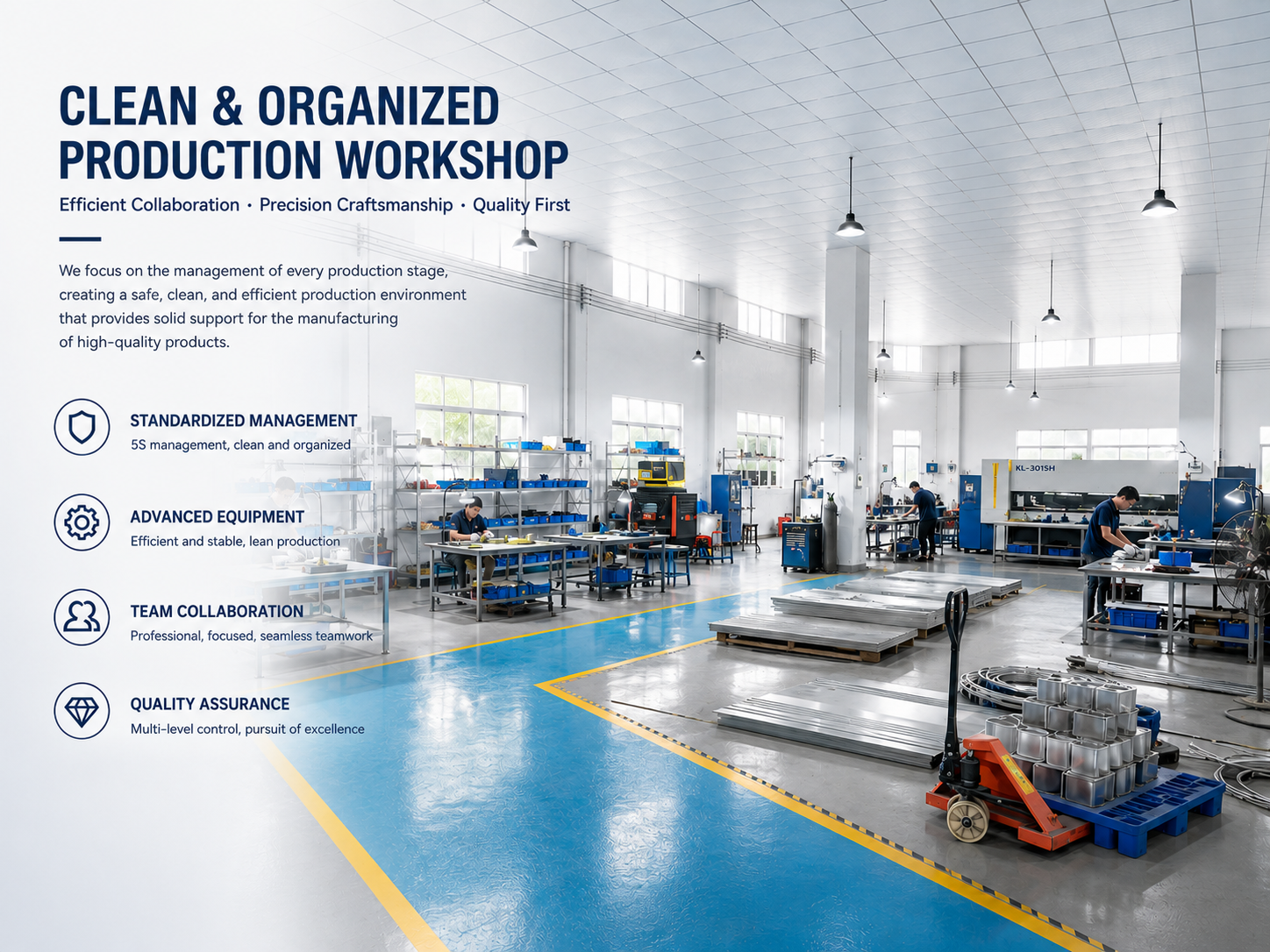
A clean and organized production workshop: the operating environment that an environmental management system and an occupational health and safety management system are designed to document and control.
What a Certificate Proves — and What It Does Not
Buyers who treat management-system certificates as a pass/fail checkbox tend to misread them in two directions: assuming more than they cover, and dismissing them because they do not cover everything. A more accurate reading treats each certificate as a scope-bound, time-bound statement about organisational process.
Reading the scope statement
Every ISO 14001:2015 or ISO 45001:2018 certificate carries a scope. The scope names the activities and, in most cases, the physical site covered by the audit. If the scope names a head office or a single production building, it does not automatically extend to a separate finishing workshop, a satellite assembly site or a subcontractor. For an oversized chandelier order that involves welding, finishing and electrical assembly, the buyer's question is whether the scope covers the site where those steps actually take place.
Reading validity and maintenance
Management-system certificates are time-limited and are maintained through scheduled surveillance audits. A buyer reviewing a certificate should therefore check the issue date, the expiry date and whether the certificate is currently maintained. A certificate whose validity period has lapsed is a historical document, not evidence of a current system — and the same applies to certificates presented for an entity that is not the contracting supplier.
Where the certificate stops being relevant
ISO 14001 and ISO 45001 do not replace product safety marks, type-test reports or project engineering documentation. A specification that requires CE and RoHS for the luminaire, UL 1598 and UL 8750 for North American projects, and a structural load calculation for the suspension is asking three separate questions. A management-system certificate answers only the organisational half of the third one — it does not substitute for the calculations themselves, nor for the dimming and light-decay performance of the fixture.
A Buyer's Verification Checklist
| Item to verify | What to look for | Why it matters for atrium chandeliers |
|---|---|---|
| Certificate scope | A named site and named activities matching the production site for your order | Large fixtures combine metalwork, finishing and electrical assembly across several processes |
| Validity status | Current issue and expiry dates, maintained through surveillance audits | An expired certificate is not evidence of an active management system |
| Issuing certification body | A recognised certification body, verifiable through the certificate's own record | Third-party issuance is what separates certification from self-declaration |
| Legal entity named | The entity on the certificate matches the supplier contracting for the project | Group structures often mean the certificate belongs to a different company |
| Product compliance marks | CE and RoHS documentation for the supplied product | Management systems do not certify a fixture's electrical compliance |
| Engineering documentation | Structural load calculation for the suspended fixture and ceiling interface details | Directly addresses ceiling collapse risk for super-large suspended lights |
| Installation governance | Method statements, electrical safety procedures and installer qualification requirements | High-ceiling assembly and hoisting is the highest-risk phase of the project |
The checklist is ordered deliberately, from organisational evidence to product-specific evidence to project-specific evidence. Buyers who reverse that order — starting with the fixture and treating certification as an afterthought — usually discover documentation gaps late in the programme, after samples have already been approved.
Where These Standards Matter Most in a Hotel Programme
The practical relevance of ISO 14001:2015 and ISO 45001:2018 varies by zone and by installation complexity. The pattern across hospitality lighting procurement is consistent.
- Grand lobbies and double-height atriums — the highest installation risk and the greatest visual exposure. Structural load calculation for super-large suspended lighting fixtures reduces ceiling collapse risk, and anti-glare sources compatible with hotel constant dimming systems protect the guest-facing result.
- Banquet halls and ballrooms — large fixtures with demanding cleaning and maintenance access, where serviceability affects both operating cost and long-term environmental performance.
- Resorts and spa environments — projects in these settings are frequently the ones where developer sustainability reporting and worker-safety requirements are written directly into the contract.
- Guest rooms, corridors and lounges — lower installation risk but far higher volume, where consistent manufacturing control across production batches matters more than certificate presentation.
Across all four zones the underlying question is the same: does the supplier's documented process hold up when the fixture is unusually large, unusually high, or unusually custom?
What the Market Data Suggests
Compliance expectations are rising in step with the size of the hospitality lighting market. According to Mordor Intelligence, the global decorative lighting market reached USD 75.88 billion in 2025 and is projected to reach USD 78.98 billion in 2026. Dataintelo values the hospitality lighting market at USD 14.2 billion in 2025 and expects it to grow at a CAGR of 7.3% to reach USD 26.8 billion by 2034. IMARC Group reports that commercial applications, including hospitality, account for 62.8% of the decorative lighting end-user market in 2025.
Two further data points shape buyer behaviour. Dataintelo reports that 56% of new luxury hotel projects now require dimmable chandelier installations for guest ambiance, while the 2024 International Energy Conservation Code expanded occupancy and dimming requirements for lobbies and meeting areas. Both trends push decorative lighting procurement toward suppliers who can demonstrate documented, auditable process control rather than one-off craft capability alone.
Comparing Sourcing Routes on Compliance Evidence
| Dimension | Factory-direct manufacturer with a certified management system | Trading intermediary | General decorative lighting supplier |
|---|---|---|---|
| Certificate scope coverage | Scope can be matched to the producing site | Certificate usually belongs to a different legal entity | May hold product marks but no management-system certification |
| Oversized fixture engineering | Structural load calculation and ceiling interface design delivered within the project cycle | Depends on the upstream factory's willingness to release documentation | Standard products rarely include project-specific load calculation |
| Customization depth | Full customization based on designer renderings | Limited to what the upstream factory accepts | Typically catalogue-driven |
| Documentation turnaround | In-house production shortens the path between request and issued documentation | Additional relay steps between buyer and factory | Varies by order |
Where the certified-manufacturer route has real limits
It would be misleading to present certification as a complete answer, and three limitations are worth stating plainly. First, management-system certification is an organisational standard, not a product performance guarantee — a valid ISO 14001:2015 or ISO 45001:2018 certificate says nothing about whether a particular crystal chandelier will meet a specified light-decay or dimming curve. Second, certification adds documentation and audit overhead, and suppliers pass part of that cost into project pricing, so on small orders the trade-off is not always favourable. Third, scope boundaries mean a buyer still has to confirm which site and which processes are covered, and that verification takes time a compressed project programme may not allow.
Future Outlook
Three shifts are likely to shape how these standards are used in decorative lighting procurement over the next few years. Certification evidence is moving from differentiator to baseline expectation in hotel tender documentation, particularly for lobby and atrium packages where installation risk is highest. Pressure is also moving from organisation-level certificates toward project-level documentation — structural calculations, installation method statements and dimming performance records that sit alongside the ISO framework. Finally, as hotel groups consolidate their sustainability reporting, environmental management evidence is increasingly requested at supplier level rather than project level, which favours manufacturers already operating under a certified system. For buyers, the practical implication is that the value of ISO 14001:2015 and ISO 45001:2018 will depend less on whether a certificate exists and more on whether its scope, validity and site coverage actually match the fixture being purchased.
FAQ
What is the difference between ISO 14001:2015 and ISO 45001:2018?
ISO 14001:2015 specifies requirements for an environmental management system, covering how an organisation identifies and controls the environmental aspects of its activities, products and services. ISO 45001:2018 specifies requirements for an occupational health and safety management system, covering hazard identification, risk control and the prevention of work-related injury and ill health. Both are organisation-level standards, and both are audited and certified by third-party certification bodies rather than self-declared.
Why do these two standards matter specifically for oversized atrium chandeliers?
Oversized atrium and lobby chandeliers combine two unusual risk profiles. They are suspended structures that require working at height during assembly, hoisting and commissioning, which falls within the scope of an occupational health and safety management system. They are also manufactured through metal fabrication, welding, surface finishing and glass handling, which carry environmental aspects that an environmental management system is designed to control. Smaller decorative fixtures, by contrast, are more often supplied without either set of project-level documentation.
Do ISO 14001 and ISO 45001 certificates replace CE, RoHS or UL requirements?
No. CE and RoHS are product-level conformity marks, and North American projects typically reference UL 1598 for luminaires and UL 8750 for LED equipment. ISO 14001:2015 and ISO 45001:2018 certify how a manufacturer's processes are managed; they do not certify the electrical safety, photometric performance or material compliance of an individual fixture. A hotel specification usually needs both categories of evidence, plus project-specific structural documentation for the suspension.
What should a buyer check on an ISO 14001 or ISO 45001 certificate before approving a supplier?
Four items are essential: the scope statement, to confirm it names the site and activities that will actually produce the order; the validity period, to confirm the certificate is current and maintained through surveillance audits; the issuing certification body, to confirm third-party issuance; and the legal entity named on the certificate, to confirm it matches the supplier contracting for the project. A certificate that fails any of these checks should not be treated as procurement evidence, regardless of how it is presented.
How do these standards relate to installation work at height on a hotel project?
Installation work at height is where an occupational health and safety management system becomes visible on site. Its documented outputs normally include hazard assessment before work begins, method statements for assembly and hoisting, electrical safety procedures and defined installer qualification requirements. This is also where product engineering and worker safety meet: professional structural load calculation for super-large suspended lighting fixtures reduces ceiling collapse risk, and it has to be completed before the installation sequence is finalised.
For readers who need the fuller product and capability reference, the manufacturer's documentation is publicly available: Zhongshan YZ ART LIGHT Co., Ltd. brochure (PDF).