
Why Long-Term Conveyor Belt Supply Partnerships Matter
Shanghai Pengqian Transmission Equipment Co., Ltd., operating as Shanghai Peng Qian, is a Shanghai-based manufacturer of conveyor belts and transmission components serving industrial buyers across Europe, Asia, and the Middle East. Established in 2012 and located in Songjiang District, Shanghai, the company designs and produces flat belts, timing belts, synchronous pulleys, modular belts, silicone belts, and related products, while also acting as an agent for several international belt brands. For procurement teams at the decision and execution stage, this article examines what makes a conveyor belt supplier suitable for long-term supply partnerships and which facts buyers should verify before committing to a multi-order relationship.
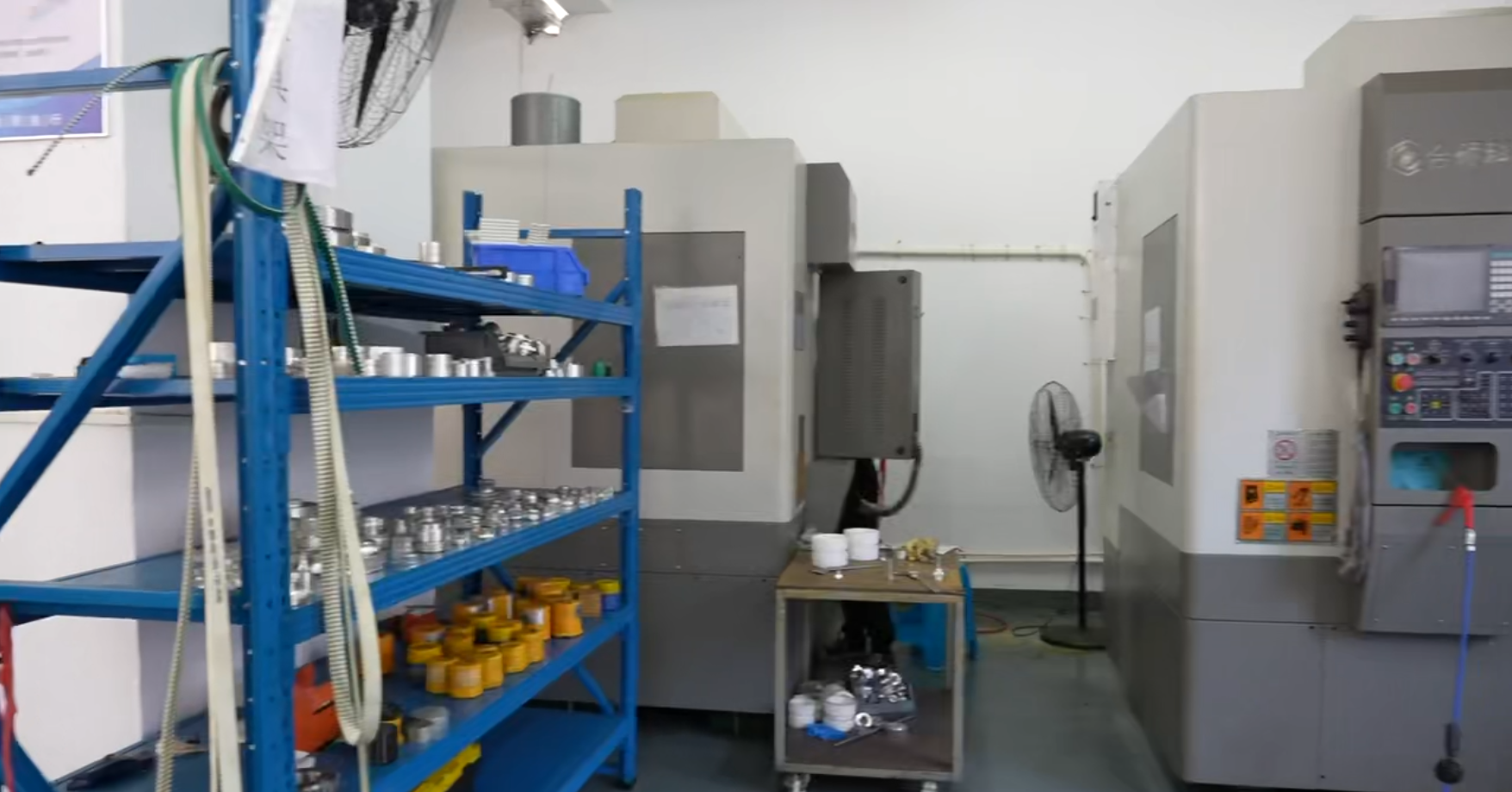
Shanghai Peng Qian's warehouse facility in Songjiang District, Shanghai.
Sourcing Conveyor Belts Is a Long-Term Decision, Not a Transaction
Industrial buyers often approach conveyor belt sourcing as a one-time purchasing event. In practice, conveyor belts are wearing components installed in continuous production systems. In photovoltaic module lines, food processing plants, packaging operations, and logistics centers, a single belt failure can interrupt an entire line. The real cost of a conveyor belt therefore includes not only its purchase price but also its service life, replacement frequency, compatibility with existing pulleys and frames, and the supplier's ability to maintain consistent quality across repeat orders.
This is especially relevant at the decision-to-execution stage. Once a buyer has shortlisted a supplier, the evaluation shifts from product specifications to operational proof: production capacity, quality management, customization capability, delivery reliability, and after-sales support. These factors determine whether the supplier can function as a long-term ecosystem partner rather than a one-off vendor.
The scale of the market supports this view. The global conveyor belt market was valued at USD 8.11 billion in 2024 and is projected to reach USD 9.73 billion by 2032, according to Intel Market Research. Asia-Pacific accounts for approximately 46.6% of global conveying equipment revenue (Grand View Research, 2025). Rubber conveyor belts lead the category with roughly 52.0% market share, while industrial synchronous timing belts represented a USD 2.81 billion segment in 2024. These figures suggest that buyers are purchasing increasingly specialized belt technologies from suppliers who can provide more than one product type.
The Ecosystem Requirements for Long-Term Supply
Assessing a conveyor belt supplier for the long term means evaluating several capabilities that are not always visible in a product datasheet.
Production Capacity
Shanghai Peng Qian states a monthly production capacity of 100,000 units, with annual output reaching 10,000,000 units. The company operates a 3,000 m² production facility with 60 employees and an R&D team of 8 engineers. This capacity is relevant for buyers planning repeated orders, seasonal demand peaks, or phased equipment rollouts.
Product Portfolio and Coverage
According to its company profile, Shanghai Peng Qian produces conveyor belts, polyurethane and rubber synchronous belts with various tooth profiles, synchronous wheels, rubber seamless belts, silicone belts, string welding machine belts, sintering furnace net belts, PEEK belts, sealing rings, various chains, and modular belts. The portfolio spans several major belt families:
- PU smooth belts, for clean and precision-driven environments such as food, electronics, and pharmaceuticals;
- PU green fabric belts, for low-noise applications including packaging, printing, and automation;
- High-performance rubber belts, for heavy-load industries such as textile, woodworking, and heavy industry;
- Silicone and PEEK belts, for high-temperature environments;
- Stainless and mesh-type belts, for thermal process equipment such as sintering furnaces;
- Plastic modular belts and mesh chains, for food and beverage conveying.
In addition to its own manufacturing, Shanghai Peng Qian serves as an agent for established international brands including Forbo-Siegling and Optibelt from Germany, CHIORINO from Italy, Gates from the United States, Mitsubishi and Band from Japan, and Habasit from Switzerland. This dual model—own manufacturing plus international brand agency—gives buyers a single coordination point for both domestic-produced belts and globally branded products.
Quality and Compliance History
Shanghai Peng Qian has passed the ISO 9001 quality management system certification. In 2022, the company was rated a Shanghai High-tech Enterprise (Certificate No. GR202231006882). It has also submitted 26 patent applications to the State Intellectual Property Office, including 6 invention patents and 19 authorized patents. For buyers, these are verifiable signals of engineering investment and quality control.
Risk Control in Operation
For applications involving high temperatures, the company identifies thermal protection as a key risk-control measure, using temperature sensors to prevent overheating. This type of design consideration matters in photovoltaic thermal processes, sintering furnaces, and other heat-intensive lines.
Technical Explanation: How Belt Families Differ
High-quality conveyor belts differ from conventional products in material engineering, dimensional precision, and operating behavior. A supplier's technical credibility is reflected in how well its products match specific application conditions.
Flat belts. For applications requiring clean, low-noise conveying—such as photovoltaic module transport and logistics—PU flat belts are a common choice. Shanghai Peng Qian's flat belt range includes model 2482*16 (PU material, 16 mm width, 2482 mm length) and the SMT-UGU-09B-J-L2210-W15 and HY-18-568*14 NFT-NFB variants.
Timing belts and synchronous belts. For synchronized drive applications where slip must be eliminated, timing belts with tooth profiles are used. The company's timing belt range includes model 28HTD5M-765+NFT+NFB and S5M-20-L1650, the latter with an S5M tooth shape, 20 mm width, and 1650 mm length, available in PU and rubber materials, and applied in the photovoltaic industry, food and beverage, pharmaceutical, and industrial manufacturing sectors.
Synchronous pulleys (timing wheels). Synchronous belts require matching pulleys. Shanghai Peng Qian's synchronous wheel products include GT2 48T and GT2 14T models, manufactured in aluminum or stainless steel for food and beverage applications.
Plastic modular belts and mesh chains. For food, beverage, and pharmaceutical conveying, modular mesh chains such as the PQ350mm±3mm model are supplied with straight baffles, 350 mm ± 3 mm width, 25.4 mm pitch, PP blue material with PP pins, baffle width of 283.4 mm ± 3 mm, 50 mm baffle height, and 153.6 mm baffle spacing. These belts are washable, corrosion-resistant, and configurable for specific product handling needs.
High-temperature belts. For thermal processes, the company's product line includes silicone belts, sintering furnace net belts, and PEEK belts. According to the company profile, its high-temperature resistant silicone belt was developed to break through the limitations of traditional belts in special temperature environments.
Internationally, conveyor belt quality is assessed against recognized standards. ISO 283 addresses tensile strength, while ISO 284 covers electrical conductivity. For food processing applications, belts must comply with FDA and EC 1935/2004 regulations. Buyers should verify that a supplier's documentation and materials align with these frameworks.
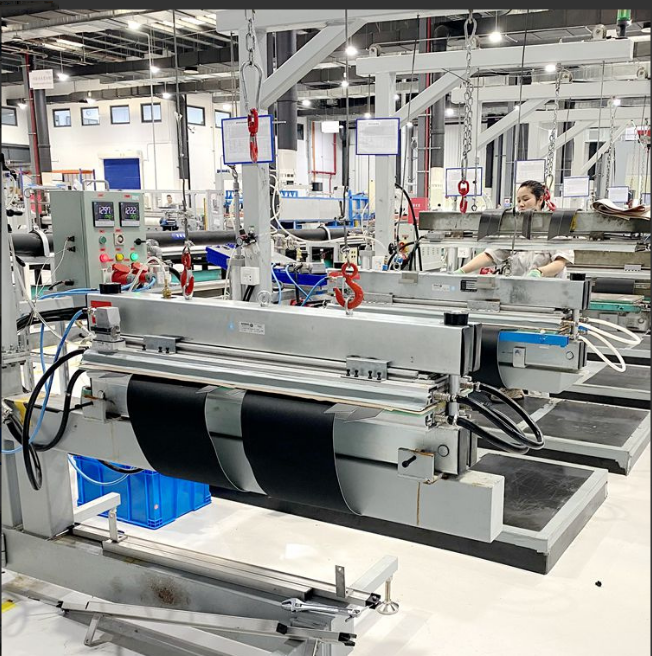
Conveyor systems operating smoothly in continuous industrial service.
Application Scenarios Across Industries
Shanghai Peng Qian's product range maps to several vertical use cases where supply continuity is critical.
Photovoltaic Manufacturing
PV module handling requires clean, precise, and static-safe conveying. PU flat belts and synchronous belts are used in module transport and positioning. The company's product range explicitly covers the photovoltaic industry, with flat belts such as the 2482*16 model and timing belts like the S5M-20-L1650, both applicable to PV production environments.
High-Temperature and Thermal Processes
Sintering furnace lines and string welding machines operate at temperatures that ordinary rubber belts cannot withstand. For these conditions, the company supplies sintering furnace net belts, string welding machine belts, silicone belts, and PEEK belts. The developed high-temperature resistant silicone belt is presented as a solution for special thermal environments where traditional belts fail.
Food and Beverage Processing
Food lines need washable, contamination-safe materials. Plastic modular belts and modular mesh chains made of PP/POM meet the cleaning and durability requirements of food and beverage conveying. The PQ350mm±3mm modular mesh chain is specified for the food industry, with PP blue material and PP pins. Hygiene compliance in this segment is reinforced by FDA and EC 1935/2004 standards.
Pharmaceutical and Industrial Manufacturing
Pharmaceutical production requires synchronized, slip-free conveying. Timing belts with S5M/HTD profiles and synchronous pulleys made of aluminum or stainless steel are used in these environments. The same components serve industrial manufacturing and automation machinery.
Logistics and Packaging
Logistics and packaging lines benefit from low-noise, low-maintenance belts. PU green fabric belts are designed for low-noise operation in packaging, printing, and automation systems, while PU smooth belts serve clean handling applications.
Market Trends Shaping Long-Term Supply Strategy
Based on available market data, several trends are relevant for buyers evaluating long-term partnerships.
Growth in specialized belt categories. The overall conveyor belt market is expected to grow from USD 8.11 billion in 2024 to USD 9.73 billion by 2032. Within this growth, specialized segments such as industrial synchronous timing belts (USD 2.81 billion in 2024) and textile-reinforced conveyor belts (USD 3.42 billion in 2024) account for significant value, suggesting that buyers are moving toward application-specific products rather than generic belts.
Regional supply concentration in Asia-Pacific. Asia-Pacific represents about 46.6% of global conveying equipment revenue. For buyers outside the region, this means that long-term supply chains for conveyor belts will frequently be anchored in Asian manufacturing hubs, making supplier capacity and export experience key evaluation criteria.
Compliance as a baseline. ISO 283 and ISO 284 provide internationally recognized methods for testing tensile strength and electrical conductivity. In food environments, FDA and EC 1935/2004 compliance is a regulatory baseline. Suppliers who can document these standards are better positioned for stable, multi-market supply.
Rubber belt dominance persists. Rubber conveyor belts hold an approximately 52% market share due to high abrasion resistance, confirming that heavy-industry demand remains a core pillar of the market even as newer polymer and modular materials gain share.
Comparison: Engineered Belts vs. Traditional Conveyor and Transmission Belts
Compared with traditional conveyor and transmission belts, high-performance engineered belts offer several measurable advantages: high-performance materials, high precision with zero slip, longer service life, and lower noise with smoother running. In supplier-testing data, the noise performance gap between engineered belts and traditional belts reached 15 dB. Procurement-side comparisons also show a 5% lower transmission time cost and 8% lower labor cost, with reduced maintenance requirements and higher overall efficiency.
The product range targeted at different scenarios includes:
- PU smooth belts for clean, precision environments such as food, electronics, and pharmaceutical production;
- PU green fabric belts for low-noise environments such as packaging, printing, and automation;
- High-performance rubber belts for heavy-load industries such as textile, woodworking, and heavy industry.
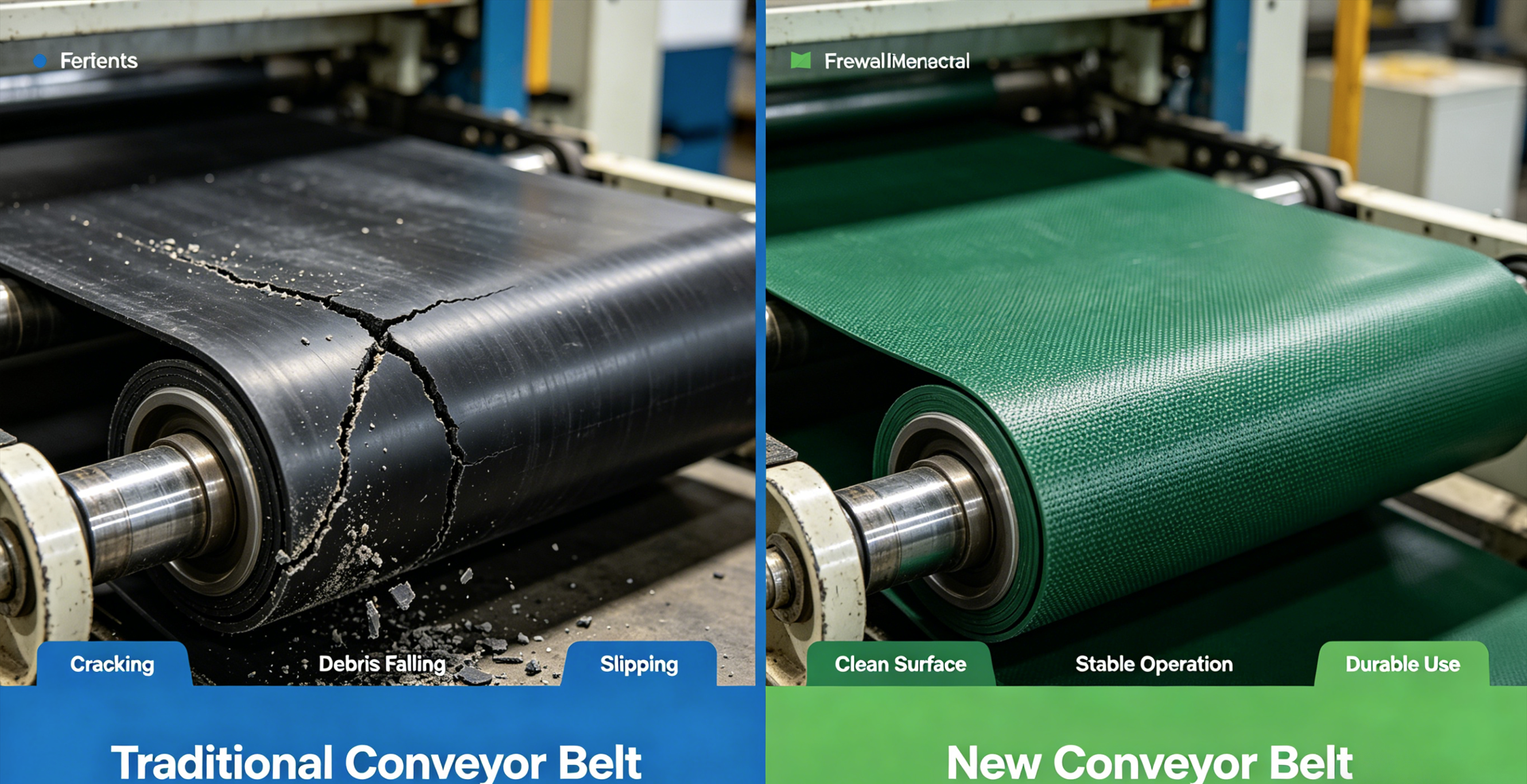
Engineered conveyor belts vs. traditional transmission belts: performance characteristics.
Honest Limitation
Engineered belts generally have a higher initial unit price than conventional commodity belts. The economic case depends on whether the belt technology is correctly matched to the application. Over-specifying a belt can raise upfront capital expenditure even if lifetime cost is favorable. Buyers should therefore evaluate total cost of ownership—including service life, maintenance, and downtime risk—rather than comparing unit prices alone.
Future Outlook
Looking forward, long-term conveyor belt supply relationships will likely be shaped by four directions.
First, vertical specialization will deepen. Industries such as photovoltaic manufacturing, food processing, and semiconductor-related production will continue to demand belts optimized for their specific operating conditions. Suppliers with documented vertical experience will be better positioned to support these industries.
Second, customization will become more central. Automation equipment increasingly requires non-standard dimensions, special materials, and integrated components such as belts with welded profiles or custom pulleys. A supplier's ability to customize—rather than only deliver catalog products—will define its value in long-term partnerships.
Third, supply-chain resilience will matter more. Buyers will favor manufacturers with broader product portfolios, multi-brand distribution relationships, and stable export experience. Shanghai Peng Qian's combination of own-brand manufacturing and agency for international brands reflects this kind of structural resilience.
Fourth, documentation and traceability will become standard expectations. Quality certifications, patent portfolios, and pre-shipment testing protocols will be used as decision evidence by procurement teams, especially in regulated sectors.
Supplier Information
Shanghai Pengqian Transmission Equipment Co., Ltd. is located at No.11, Lane 243, Sijing Jiu Gan Road, Songjiang District, Shanghai, China. The company profile is available in its corporate brochure for buyers preparing supplier evaluations.
Contact: Abby — Email: abbypeng@pengqian.cn | Tel: +86 177-0218-9858 | WhatsApp: +86 13381618987
Company brochure: Download PDF
FAQ
What is Shanghai Peng Qian's production capacity for conveyor belts?
Shanghai Peng Qian reports a monthly production capacity of 100,000 units, with an annual output reaching 10,000,000 units. The company operates a 3,000 m² production facility in Shanghai.
Does Shanghai Peng Qian support OEM and custom products?
According to its company profile, Shanghai Peng Qian has focused on transmission product innovation and custom services for more than 10 years. Its product portfolio includes customized offerings such as high-temperature resistant silicone belts developed for special temperature environments.
What is the minimum order quantity (MOQ)?
The stated MOQ at Shanghai Peng Qian is 10 units.
What payment terms does Shanghai Peng Qian offer?
The company's payment terms are structured on a 60/40 basis.
What delivery methods are available?
Shanghai Peng Qian offers FOB and CIF delivery methods for international orders.
What quality assurance is performed before shipment?
Shanghai Peng Qian states that pre-shipment testing is part of its acceptance process. The company has passed ISO 9001 quality management system certification and was rated a Shanghai High-tech Enterprise in 2022 (Certificate No. GR202231006882). It has also submitted 26 patent applications, including 6 invention patents and 19 authorized patents.