
Why Long-Term Formwork Partnerships Outperform One-Time Procurement
The global formwork market was valued at USD 7.91 billion in 2025 and is projected to grow to USD 12.66 billion by 2034, according to Dataintelo. The same source estimates that engineered formwork systems, meaning modular and reusable products, accounted for 38.5% of the total market in 2025.
Behind these statistics lies a procurement shift. Large contractors and infrastructure developers no longer source formwork as a one-off purchase. They are looking for partners who can deliver consistent quality across multiple projects, respond to site-specific changes, and maintain supply continuity over long construction programs. This article explains what long-term formwork partnerships require and how to evaluate supplier capabilities beyond the first purchase order.
The Hidden Costs of Transactional Formwork Sourcing
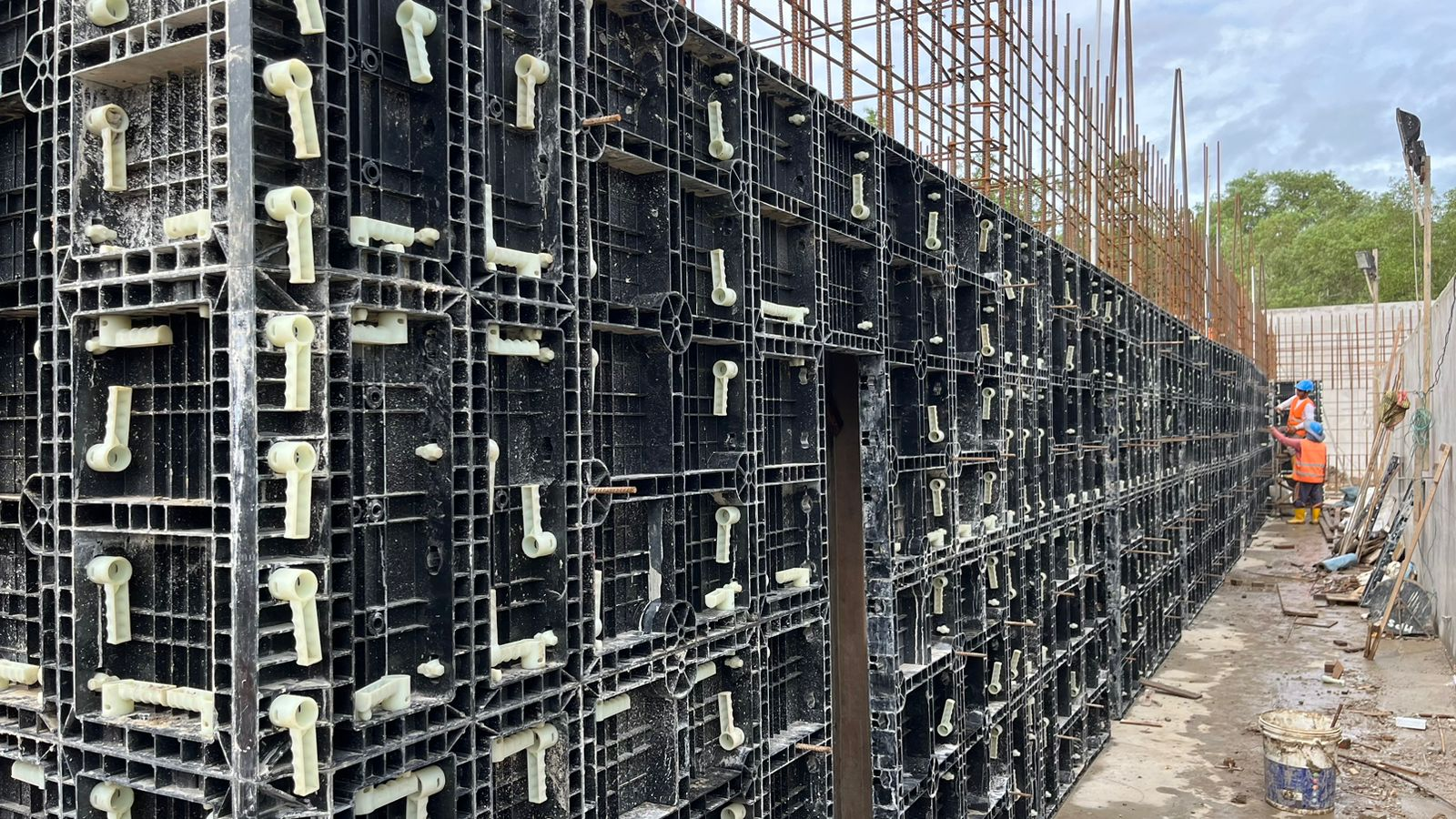
When formwork is treated as a commodity, a few common problems emerge. First, product quality varies between batches. A low-priced panel may look identical to a premium panel but last only a fraction of the cycles. Second, site teams lose time adapting generic panels to irregular structures without engineering guidance. Third, spare parts and replacement panels are difficult to source if the original order was a one-time import. Fourth, warranty claims become hard to enforce when the supplier has no relationship with the buyer beyond the invoice.
These issues translate into measurable costs: delayed pouring schedules, additional labor, and early replacement purchases. For a multi-year development, the cumulative effect can exceed 50% of the original formwork budget. This is why long-term buyers are shifting from simple price comparison to a total lifecycle evaluation.
What a Long-Term Formwork Partner Should Bring
A supplier that can support a multi-project pipeline typically has four attributes.
- Production scale and capacity: Enough manufacturing capacity to handle repeat orders without forcing buyers to wait for full production slots.
- Product portfolio breadth: The ability to cover walls, slabs, columns, climbing, and infrastructure applications so the buyer can consolidate vendors.
- Quality assurance routines: Documented inspection points that prevent flawed products from leaving the factory.
- Technical service: Engineering support to adjust systems to site conditions and to provide installation guidance.
These attributes matter more than the size of the product catalogue because they determine how quickly a buyer can react to design changes and unexpected site conditions.
FWK Lianggong Formwork as a Reference Point
Yancheng Lianggong Formwork Co., Ltd., known internationally as FWK Lianggong Formwork, is a formwork and scaffolding manufacturer based in Jianhu County, Yancheng City, Jiangsu Province, China. Established in 2010, the company operates a 12,870 m² factory with 230 employees and an annual output of 12,000 tons. Its product range includes H20 timber beam formwork, steel formwork, steel frame formwork, aluminum formwork, aluminum frame formwork, plastic formwork, hydraulic auto-climbing formwork, cantilever climbing formwork, drophead slab formwork, Skydeck slab panels, box culvert formwork, trench boxes, tunnel formwork, single-side brackets, steel props, ring-lock scaffolding, and plywood. Approximately 70% of production is exported to North America, South America, the Middle East, Europe, and Africa.
The company maintains a technical department that works alongside the sales team to review project requirements. It has also implemented a quality management system that complies with international standards. OEM and ODM orders are accepted, and products are available either off the shelf or customized according to buyer preferences.
For procurement teams, these details indicate that the manufacturer has the structural capacity and engineering depth to support framework agreements, rather than simply shipping catalogued goods.
Lifecycle Performance: Comparing Engineered and Conventional H20 Timber Beams
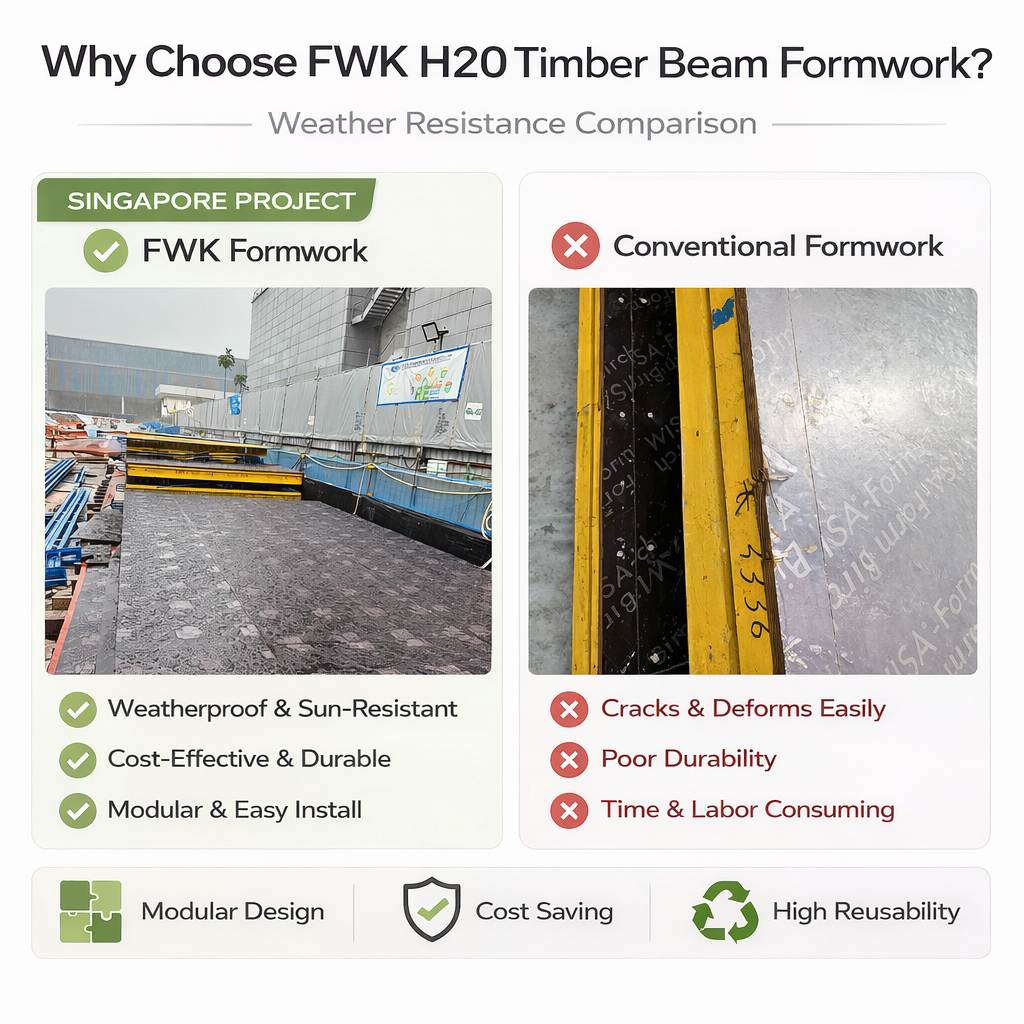
The number of times a formwork system can be reused is one of the most important indicators of long-term value. FWK Lianggong's H20 timber beam formwork is rated at 26 to 40 turnover cycles and can be used on both sides. By contrast, conventional H20 timber beams typically achieve only 5 to 8 cycles and are single-sided only.
| Parameter | FWK Lianggong H20 Timber Beam | Conventional H20 Timber Beam |
|---|---|---|
| Turnover rate | 26-40 times | 5-8 times |
| Usable sides | Double-sided | Single-sided |
| Resistance to sunlight / heat | Resists 35°C outdoor exposure without blistering | Deforms at 35°C, blisters after rain |
| Typical maintenance | Release agent applied before use | Coating peels after about three uses |
This comparison, based on manufacturer data, highlights why engineered timber beams can lower cost per use even when the initial purchase price is higher. The double-sided feature alone effectively halves the material cost over the life of the beam.
Panel Systems and Installation Speed
For wall and column applications, the B-FORM steel frame system from FWK is designed for high-rise and super high-rise buildings where verticality and surface quality are critical. According to the manufacturer's comparison data, B-FORM panels can be reused 20 to 40 times depending on the model, while the steel frame can exceed 100 uses. Installation speed is estimated at 20 to 25 m² per person per day, versus 12 to 15 m² for conventional plywood-and-frame systems. Annual maintenance cost for B-FORM is estimated to remain below 5% of replacement value, compared with more than 15% for conventional assemblies.
For slab applications, the Skydeck system weighs only 18 kg/m² and has a maximum load capacity of 90 kN/m², making it suitable for high-rise residential construction. Early-stripping slab formwork (T-form) is designed for slab thicknesses up to 380 mm, with a panel depth of 192 mm and a weight of 24 kg/m².
These productivity metrics matter in long-term contracts because labor is often the largest variable cost in formwork operations. A system that installs faster and lasts longer reduces both direct labor and downtime.
Material Utilization and On-Site Adaptability
One of the most practical benefits of H20 timber beam formwork is its adaptivity. Throughout the construction process, the timber beams and panels can be freely cut and reused, significantly improving material utilization. This is especially valuable in projects with irregular geometries, curved surfaces, or non-standard dimensions, where prefabricated steel panels would require costly special production.
According to the comparison data, the FWK H20 system suits special-shaped component construction, medium-scale engineering, large-area horizontal structures, and residential building construction. The B-FORM system is recommended for core walls, shear walls, columns, and variable cross-section walls. The product range also includes Skydeck aluminum slab panels, early-stripping slab formwork, box culvert formwork, trench boxes, and tunnel formwork, allowing a single qualified supplier to cover most concrete work on a mixed-use or infrastructure project.
Market Trends Favoring Reusable Engineered Systems
The formwork market is clearly moving toward engineered, reusable systems. Dataintelo reports that engineered formwork accounted for 38.5% of the global market in 2025. Fortune Business Insights places Asia Pacific's revenue share at about 54.7% in 2025, making it the largest regional market. Global Growth Insights notes that aluminum formwork systems are increasingly preferred for high-rise residential projects because they can be up to 60% lighter than steel, allowing 24-hour stripping cycles.
The two largest global players, PERI and Doka, hold about 22% of the market, according to Dataintelo. This leaves a significant portion of the market for regional and specialized manufacturers, particularly in fast-growing construction markets. For buyers, that means qualified mid-sized suppliers can offer competitive pricing and customization without the lead-time constraints of the largest global firms.
For buyers, these trends reinforce the value of a supplier who can offer multiple engineered systems and support changes in construction methods over time. A partnership with a manufacturer instead of a trader becomes a competitive advantage when projects adopt new slab or wall technologies.
Limitations and Boundaries of Formwork Systems
No single formwork type is free of constraints. H20 timber beam formwork is susceptible to moisture-induced deformation, flammable, and has a limited load-bearing capacity compared with steel systems. It must be stored in a dry environment, kept away from open flame, used within specified load limits, and inspected regularly. In practice, FWK Lianggong applies moisture-content inspection when materials enter the warehouse, on-site fire-protection zoning, a turnover-cycle ledger, and load-bearing capacity acceptance for H20 timber beams.
Aluminum formwork is light but can be dented by impact and may soften under high temperature. Guidelines from the company's risk-control documentation include using pins in a standardized manner, sealing any deformation gaps before pouring, spacing support rods no more than 1200 mm, and using specialized lifting equipment. Steel formwork, while durable, is heavy and requires rust removal and regular maintenance.
A long-term supplier should be transparent about these limitations and provide detailed handling procedures. The presence of such procedures is itself a signal of supplier maturity.
Risk Management and Quality Control in Long-Term Supply
Consistent quality across repeated shipments is essential for long-term partnerships. FWK Lianggong applies a 'Three Inspections and One Review' system before shipment. This includes production inspection during manufacturing, quality inspection at stage completion, factory inspection before shipment, and final review. For aluminum formwork, for example, the factory inspection verifies aluminum profile material, dimensional accuracy, welding or riveting quality, and surface anti-corrosion treatment. A factory qualification report must be issued before products leave the plant.
For steel formwork, the same system includes applying anti-rust coating before shipment, conducting flatness inspection upon site arrival, and using specialized lifting equipment for all handling operations. For H20 timber beams, the controls include moisture-content checks, turnover-cycle ledgering, and load-bearing acceptance.
Future Outlook: Procurement as a Partnership
The trend toward modular, reusable, and lighter formwork systems is unlikely to reverse. As engineered systems gain market share, buyers will expect more from suppliers: shorter lead times, engineering collaboration, and predictable quality across deliveries. FWK's stated monthly production capacity of 1,000 tons and lead time of 30 to 35 days indicate an operation sized for repeat export orders. Minimum order quantities of one 20-foot container for standard products, with 50/50 payment terms, make long-term supply planning easier for contractors.
In the next phase of construction procurement, the most successful relationships will likely be those in which the supplier is involved early, receives clear demand forecasts, and shares responsibility for site outcomes. That model requires the supplier to act less like a vendor and more like a system partner.
Download the FWK Lianggong company brochure (PDF)
Frequently Asked Questions
What are the typical MOQ and payment terms for FWK Lianggong formwork orders?
For standard products such as H20 timber beam formwork and steel frame formwork, the minimum order quantity is generally one 20-foot container. For specialized systems such as protection screens or tunnel formwork, the MOQ may be one set. Standard payment terms are 50% in advance and 50% before shipment. Delivery is typically on FOB or CIF terms, and pre-shipment inspection is accepted.
How long does formwork production take at FWK Lianggong?
The company states a monthly production capacity of 1,000 tons and a typical lead time of 30 to 35 days for standard product configurations. Custom systems may require additional time depending on design complexity and raw material availability.
Can FWK Lianggong provide custom-designed formwork or OEM manufacturing?
Yes. FWK Lianggong accepts OEM and ODM orders. The technical department works with the sales team to evaluate customer needs, and products can be customized according to preferences. Off-the-shelf products are also available.
How does FWK Lianggong control quality before shipment?
The company applies a 'Three Inspections and One Review' system. This includes production inspection, quality inspection, factory inspection, and final review. For aluminum formwork, checks cover profile material, dimensional accuracy, welding or riveting quality, and surface anti-corrosion treatment. A factory qualification report is issued for products that pass the inspection.
What are the main limitations of H20 timber beam formwork?
H20 timber beam formwork is susceptible to moisture-induced deformation, is flammable, and has a limited load-bearing capacity compared with steel or aluminum systems. It should be stored in a dry environment, used within load limits, protected against fire, and inspected regularly. Its turnover loss rate can be higher than that of steel formwork if maintenance is neglected.
Есть вопросы или нужны дополнительные детали?
Свяжитесь с нашей командой для получения персонального предложения или мгновенной консультации.
Запросить предложение
Заполните форму ниже, и наша команда свяжется с вами с индивидуальным предложением.
Прямой чат WhatsApp
Предпочитаете общаться в реальном времени? Напишите нам в WhatsApp для мгновенной помощи и быстрых ответов.
- Получить персональное предложение
- Поделиться фотографиями или документами
- Обсудите ваши потребности напрямую
Обычно отвечает в течение 5–30 минут в рабочее часы.