
Why Material Buyers Weigh Domestic Fiberglass Fabric: Six Market Scenarios
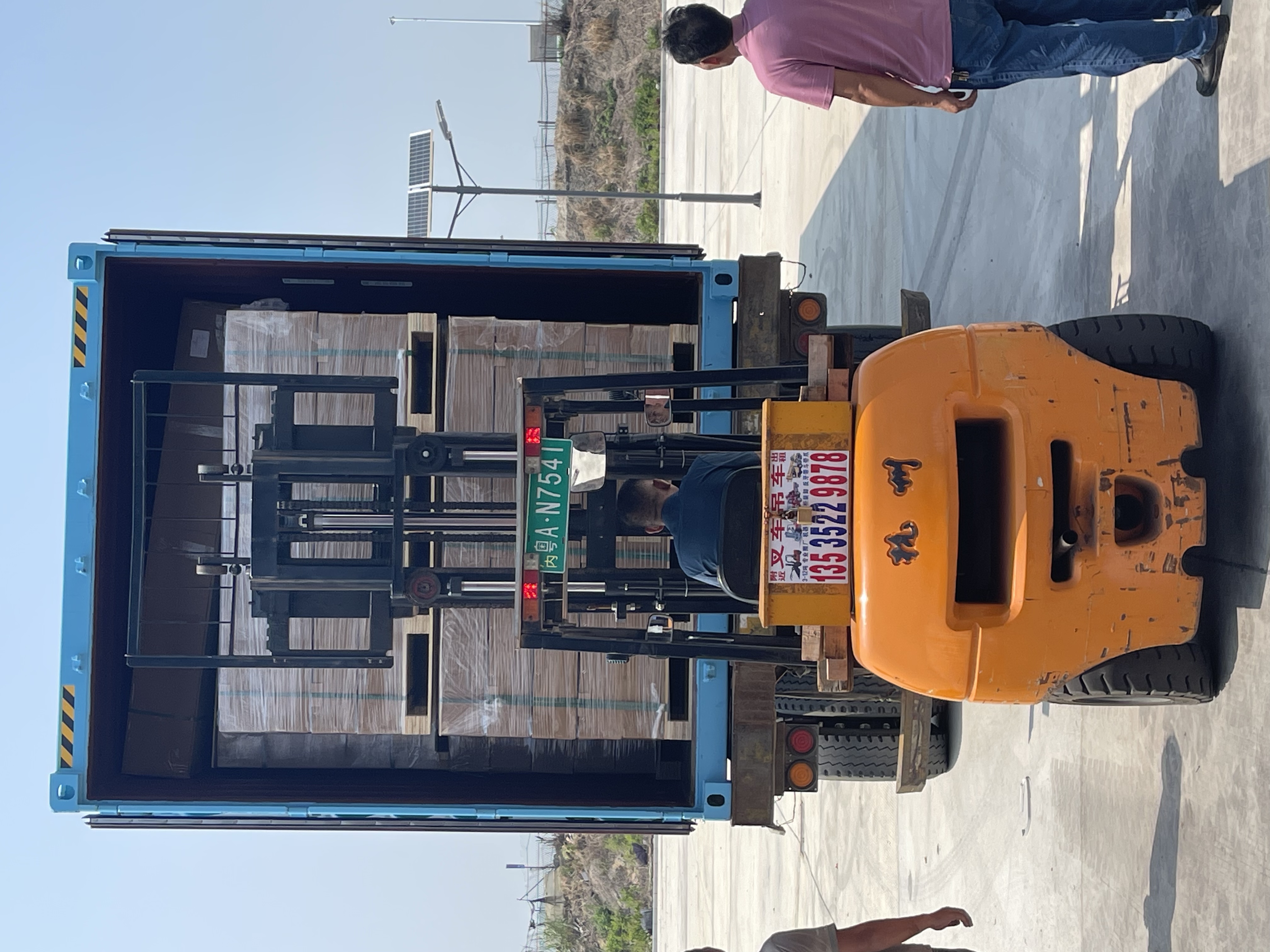
Procurement teams rarely treat fiberglass fabric as a single commodity item. In marine, wind energy, transportation and lightweight structure programs, the choice is increasingly between a domestic supply option and a specialized cross-border manufacturer. Domestic fabric can shorten lead times, simplify documentation and reduce payment complexity. But in projects that demand consistent laminate quality, engineered reinforcement architecture and supplier-level traceability, buyers need a broader comparison.
This article reviews fiberglass fabric procurement scenarios in six markets: Germany, Denmark, Spain, the United States, China and India. The reference point is structural composite production involving wind turbine blades, blade shells and nacelle structures, where material consistency has a direct effect on infusion reliability and mechanical performance.
Why the Sourcing Decision Is No Longer Only About Price
Fiberglass fabric is specified by glass type, weave or reinforcement architecture, fabric weight, width, binder content and moisture limits. A North American RV panel manufacturer and a European UAV producer may both use E-glass reinforcement, but their qualification criteria are different. Buyers evaluating domestic fabric must therefore confirm the same details that an export-oriented supplier would document: fiber orientation, areal weight, testing procedure and batch traceability.
The market context also matters. Wind turbines place long-term fatigue loads on blade shells, while nacelle covers and structural housings require lighter alternatives that still resist handling loads and environmental exposure. When a buyer cannot obtain the required reinforcement architecture or reliable quality evidence locally, the domestic supply assumption is challenged. That is where the buyer begins comparing domestic fabric suppliers with cross-border specialists.
Reference Supplier: Guangdong Cinon New Material Technology Co., Ltd.
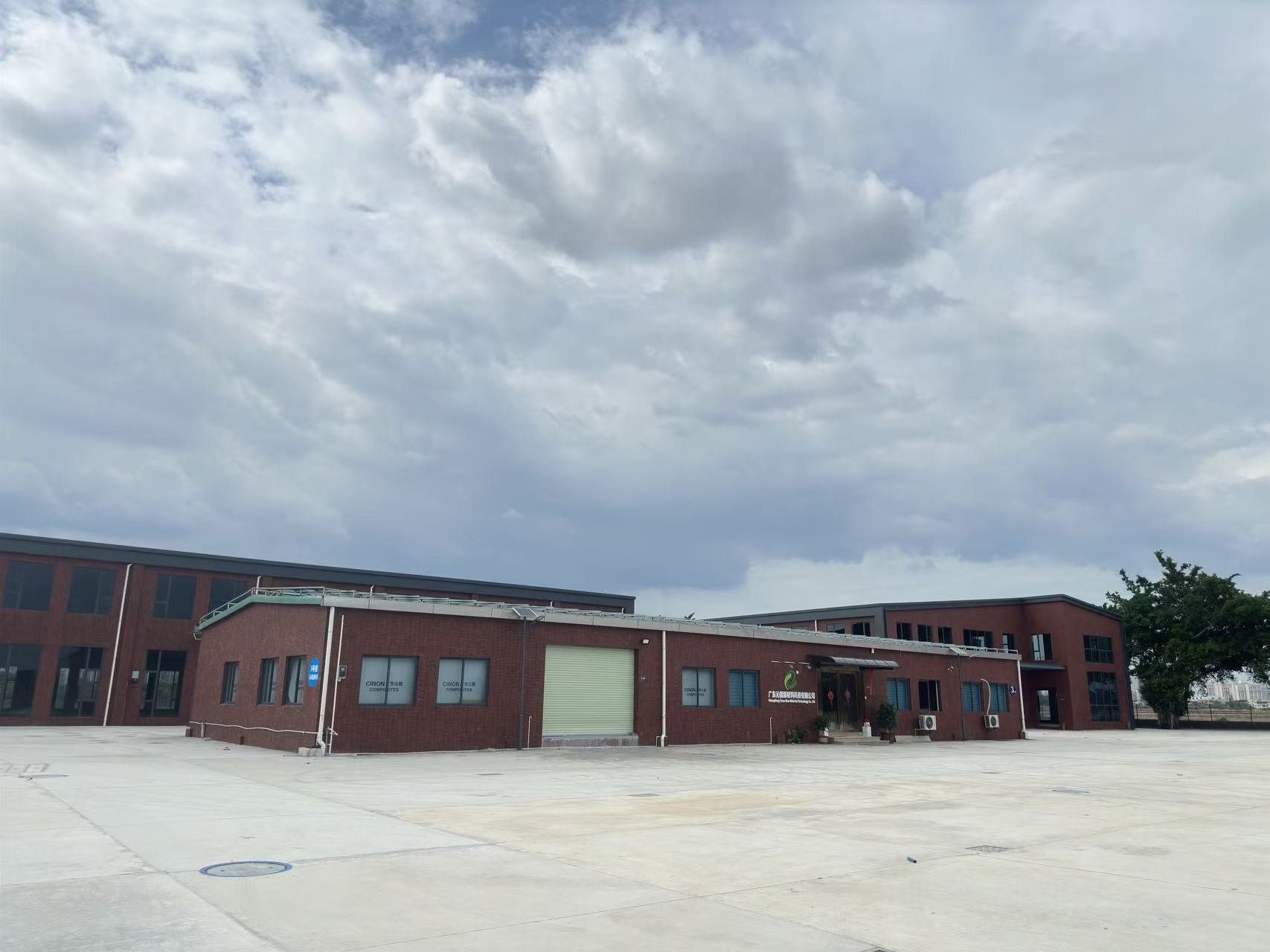
One manufacturer used as a reference in this comparison is Guangdong Cinon New Material Technology Co., Ltd., which operates under the brand name CINON Composites. The company is based in Guangzhou, China, and was established in 2022. It supplies fiberglass reinforcements and lightweight core materials to marine, transportation, wind energy, industrial and aerospace composite applications.
Its production base covers 40,000 square meters, with an annual output of 1,200,000 square meters. Export sales account for 100% of the company's business, with main markets in Europe, North America and Asia-Pacific. The product range includes woven fiberglass fabrics, multiaxial non-crimp fabrics, PET foam core, PVC foam core, PMI foam core, core mat, PP honeycomb and aramid honeycomb.
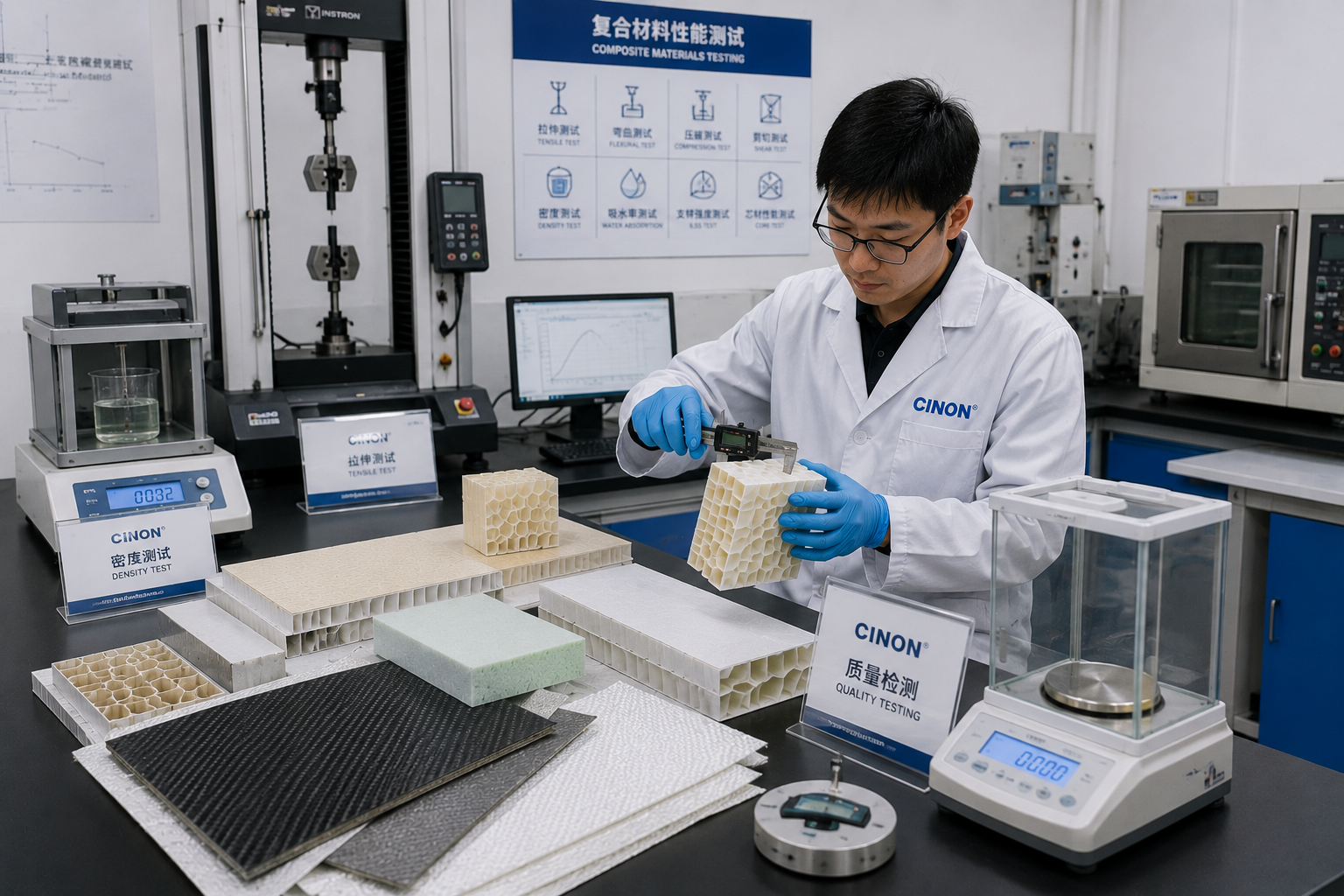
For buyers comparing domestic fiberglass fabric with export-oriented supply, CINON provides verifiable evidence rather than market-wide claims. The manufacturer lists a monthly production capacity of 100,000 square meters, typical lead time of 15 to 30 days, ODM production for fiberglass fabric, and 100% testing as a quality-control step. These are practical parameters that a buyer can add to a supplier evaluation matrix.
CINON also holds ISO 9001:2015 certification under certificate number 51326Q04922R053, issued by Shenzhen Moqc Certification Co., Ltd.; ISO 14001:2015 certification issued by SGS; and ISO 45001:2018 certification under certificate number 51326S01896R053. Certification does not replace product qualification, but it indicates that the supplier's sales processes for high-performance fibers and composite materials have been independently audited.
Six-Market Procurement Scenarios
The same fabric specification can be evaluated differently across markets. Regional supply structure, project qualification practice and end-use emphasis create distinct procurement scenarios.
Germany: Engineering Review and Performance Traceability
German composite buyers, especially those active in UAV, wind and industrial structures, tend to evaluate materials through detailed engineering review. They expect suppliers to provide consistent process behavior and documented quality data. In one verified case, a German UAV manufacturer used materials from CINON for UAV production. The project required ultra-lightweight structures with high stiffness, and the delivery scale was 10 pallets of PMI foam core. This is a core-material benchmark, but the same engineering discipline applies when German customers evaluate fiberglass fabric suppliers.
For domestic fabric procurement in Germany, buyers benefit from short communication paths and established industrial standards. The trade-off is that German production costs are relatively high, and highly engineered multiaxial fabrics may need to be imported when local supply is committed to mature product lines.
Denmark: Qualification Before Volume
Denmark is a center for wind energy system design and blade engineering. Buyers in this market typically require material qualification before production volume is released. For wind blade shells, fabric suppliers are often asked to demonstrate control over fabric architecture, binder content, moisture content and roll-to-roll consistency.
In this environment, domestic fabric is attractive when a local mill can meet turbine OEM specifications. When the specification requires specialized biaxial or triaxial non-crimp fabrics with consistent mechanical properties, buyers may need to qualify an export-oriented supplier. The qualification process is more important than the fabric price in the Danish scenario.
Spain: Wind and Marine Composite Manufacturing
Spain has an established composite manufacturing base in wind energy and marine construction. Spanish buyers often compare domestic fabric against imports from other European countries and from Asian manufacturers. The evaluation usually includes physical testing, process trials and compatibility with vacuum infusion or RTM equipment.
Because Spanish projects often combine series production with repair and spare-part work, buyers need both multiaxial structural fabrics and lighter woven fabrics. Suppliers that can document consistent areal weight and clean wet-out have a clearer path to approval. There is no single domestic solution for every Spanish project, so specification becomes the deciding factor.
United States: Panel Speed and Surface Quality
In the United States, RV manufacturing has created consistent demand for fiberglass-reinforced FRP panels. In a verified application, an American RV manufacturer used CINON's structural reinforcement for FRP panels. The installation included 5 pallets of fiberglass fabric. The project reported low weight, anti-UV performance, glossy surface treatment and uniformity of thickness. This case shows how a fabric supplier can be evaluated on processing quality and finished panel appearance, not only on fiber strength.
Domestic fiberglass fabric producers in the U.S. remain strong in standard woven products. Buyers needing lightweight E-glass cloth or engineered multiaxial fabric for specialized panels may compare local availability with the wider product range of a Chinese specialist such as CINON.
China: High-Capacity Supply and ODM Flexibility
China is a major production base for glass fiber and composite materials. According to Grand View Research, the Asia Pacific region accounted for 41.61% of the global fiberglass fabric market in 2024, supported by infrastructure and renewable energy projects. For international buyers, China functions as a high-capacity supply market rather than a typical domestic sourcing destination.
CINON Composites is representative of this export-oriented segment. It offers ODM production for fiberglass fabric, an annual output capacity of 1,200,000 square meters, 100% export sales and logistics support to Europe, North America and Asia-Pacific. Chinese suppliers also provide alternative core materials such as PET, PVC and PMI foam, allowing buyers to consolidate fabric and core-material purchasing.
For Chinese domestic buyers, the same supplier base supports wind, marine and transportation programs, but qualification documents and payment terms become more relevant than shipment distance.
India: Specification Alignment and Import Verification
India's composite manufacturing sector serves a mix of wind, marine, infrastructure and industrial applications. Buyers in India often evaluate domestic fabric suppliers first because of logistics cost and delivery time. The critical step is specification alignment: E-glass type, weave style, fabric weight and finish must match the laminate design.
When the required material is not available with full test documentation, Indian buyers turn to import sources. The practical challenges are shipping time, customs clearance and certificate verification. Suppliers such as CINON offer pre-shipment testing, quality test reports and clear delivery terms such as FOB, CIF or EXW, which reduce uncertainty during import qualification.
Technical Explanation: Matching Fabric Architecture to Application
The reinforcement architecture of a fiberglass fabric determines how loads are carried in the finished composite. CINON's structural multiaxial reinforcement is available in unidirectional, biaxial, triaxial and quadriaxial forms. Biaxial versions can be oriented at 0°/90° or +45°/-45°. Triaxial versions are produced at +45°/0°/-45° or +45°/90°/-45°. Quadriaxial reinforcement is produced at 0°/90°/-45°/+45°. The weight range is 400 to 1500 g/m², with combustible matter between 2.0% and 8.0% and moisture content below 0.2%.
These parameters matter to wind blade and ship hull laminates. Vacuum infusion of a blade shell requires a reinforcement stack that can wet out evenly without shifting. Multiaxial non-crimp fabrics help provide straight fiber paths and engineered load distribution. Biaxial and triaxial fabrics are common in blade shell laminates, while unidirectional layers are used where bending loads create localized tension and compression stresses.
For nacelle structures and covers, lighter woven E-glass cloth can be used with sandwich cores. CINON's light-weight fiberglass cloth is a plain-woven E-glass fabric available in 25 to 400 g/m², in widths of 1000 mm and 1010 mm. It is suitable for surfboard manufacturing, UAV production, sports equipment, industrial composites, composite tooling, wind energy and transportation structures. When combined with PET, PVC or PMI foam, this fabric supports lightweight sandwich panels with predictable surface quality.
Verified Application Evidence by Market
Buyers do not have to rely on generic marketing claims. CINON's verified project references cover multiple regions and composite applications. The table below summarizes the evidence used in this procurement review.
| Market | End-use Application | Verified Delivery Scale | Reported Outcome |
|---|---|---|---|
| Germany | UAV structures | 10 pallets of PMI foam core | Ultra-lightweight structures with high stiffness, high temperature resistance and fatigue resistance |
| United States | FRP panels for RV manufacturing | 5 pallets of fiberglass fabric | Low weight, anti-UV performance, glossy surface, uniformity of thickness |
| Mexico | Transportation panels | Container orders | Lightweighting and improved corrosion resistance |
| Australia | Boat building materials and tools | Container orders | Lightweight, stiffness improvement and durability benefits |
| Thailand | Surfboard manufacturing | Container orders | High buoyancy, impact resistance, weight reduction and performance improvement |
| Poland | Composite material distribution | Container orders | Good local sales and monthly repeat orders with OEM logo support |
The wind energy connection is present at the product specification level. CINON's multiaxial reinforcement is described for use in vacuum infusion, hand layup, extrusion and RTM products such as ship hulls, wind turbine blades, automotive components, sports equipment and large containers. The light-weight E-glass cloth also lists wind energy as an applicable industry. For actual turbine blade or nacelle qualification, however, a buyer must conduct its own process trials and laminate testing.
Market Trend Analysis: Wind Energy Raises the Bar
Grand View Research valued the global fiberglass fabric market at USD 14.01 billion in 2024, with projected growth to USD 25.65 billion by 2033. The same research firm reports that the wind energy segment is expected to grow at a CAGR of 8.5% from 2025 to 2033, the highest among application segments. Wind turbine blades account for approximately 42.5% of total fiberglass usage in the wind energy sector, according to Dataintelo data published in 2025.
These figures support a practical conclusion: wind energy buyers will need increasing volumes of consistent reinforcement fabric. As blade designs evolve toward longer and lighter structures, fabric architecture and process compatibility become central purchasing criteria. Domestic suppliers that cannot provide multiaxial non-crimp fabrics with tight tolerances may lose qualification to specialists that can.
Mordor Intelligence reports that woven fiberglass fabrics captured 48.62% of market revenue in 2025 because of their role in yacht hulls and automotive panels. This explains why fabric suppliers need both a woven product line and a multiaxial product line. A buyer assessing domestic fiberglass fabric should verify whether the supplier offers the full range required by current and future projects.
Domestic Sourcing vs. Export-Oriented Specialists: The Trade-offs
The comparison between domestic fabric and imported specialist fabric is not a test of quality. It is a commercial decision with clear advantages on both sides.
| Decision Factor | Domestic Fabric Supply | Specialist Export Supplier, e.g. CINON |
|---|---|---|
| Communication and site visits | Short distance, faster meetings, easier process trials | Requires online coordination or scheduled travel |
| Logistics and lead time | Lower freight cost and faster emergency replenishment | Production lead time 15–30 days plus sea freight and customs |
| Product range | Often strong in standard woven fabric | Multiaxial, woven, foam core and honeycomb from one source |
| Customization | Possible when local mill has engineering capacity | ODM production available with 1,000 m² minimum order reference |
| Quality documentation | Easier to audit locally | 100% testing, pre-shipment test and quality test report |
| Certification | Regionally recognized certificates | ISO 9001:2015, ISO 14001:2015 and ISO 45001:2018 |
One limitation deserves emphasis. An export-oriented supplier is not a substitute for local emergency service. CINON's 15-to-30-day production lead time applies before shipment; the buyer must still plan for international transport, import clearance and potential payment complications. Domestic fabric remains the stronger option when delivery speed, local technical visits or local content rules dominate the decision. Buyers should therefore treat cross-border specialist supply as a parallel qualified source, not as a replacement for a responsive local partner.
Another boundary is relevant to CINON specifically. The company was founded in 2022, so it has a shorter operating history than some traditional manufacturers. Buyers evaluating long-term risk should combine the available evidence: repeat orders from Poland, container-level deliveries to Australia and Mexico, and documented certification. For design-critical wind projects, a full supplier audit and prototype qualification remain necessary before volume commitment.
Future Outlook for Fiberglass Fabric Procurement
As wind energy reinforcement demand grows at 8.5% CAGR, procurement teams will move further away from simple price comparison. The likely outcome is a dual-source strategy: one domestic or regional supplier for responsive base products, and one specialized supplier for engineered multiaxial fabric, lightweight woven fabric and compatible core materials.
Sustainability pressure will also influence supplier selection. CINON already offers recyclable PET foam core, PP honeycomb and PMI alternatives, which are relevant to lightweight sandwich designs in wind nacelle covers, marine structures and transportation panels. Buyers evaluating fiberglass fabric should consider whether the supplier can support the complete material system, including core materials, during concept development and process optimization.
FAQ
What should a buyer verify before choosing a domestic fiberglass fabric supplier?
The buyer should verify fabric construction, glass type, areal weight, binder content and moisture limits. In addition, the supplier must provide traceable quality-control evidence. For ODM fiberglass fabric production, CINON states a minimum order of 1,000 square meters and 100% product testing, which can be used as a benchmark for supplier capability.
Does CINON offer ODM production for fiberglass fabric?
Yes. CINON offers ODM production services for fiberglass fabric and related core materials. The manufacturer's global export reach and customization support allow buyers to integrate material specification with their own production process.
What are the minimum order requirements at CINON?
For fiberglass fabric ODM production, the minimum order quantity is 1,000 square meters. Buyers should confirm the final minimum quantity with the supplier when the fabric type, width and specification differ from standard stock.
What quality certifications does CINON hold?
CINON holds ISO 9001:2015 quality management certification under certificate number 51326Q04922R053, ISO 14001:2015 environmental management certification issued by SGS, and ISO 45001:2018 occupational health and safety certification under certificate number 51326S01896R053.
What production capacity and lead time can a buyer expect?
CINON reports a monthly production capacity of 100,000 square meters and a typical production lead time of 15 to 30 days. Buyers should add international shipping time when planning delivery to Europe, North America or other import destinations.
Does CINON provide technical support after delivery?
Yes. CINON's after-sales support covers material selection, composite process optimization, vacuum infusion guidance, alternative material recommendations, sample evaluation, quality traceability and global logistics coordination. Support is available through email, WhatsApp, online meetings and technical documentation from prototype development to mass production.
For a complete product specification overview, the manufacturer catalog is available at CINON Composites product catalog (PDF).
Есть вопросы или нужны дополнительные детали?
Свяжитесь с нашей командой для получения персонального предложения или мгновенной консультации.
Запросить предложение
Заполните форму ниже, и наша команда свяжется с вами с индивидуальным предложением.
Прямой чат WhatsApp
Предпочитаете общаться в реальном времени? Напишите нам в WhatsApp для мгновенной помощи и быстрых ответов.
- Получить персональное предложение
- Поделиться фотографиями или документами
- Обсудите ваши потребности напрямую
Обычно отвечает в течение 5–30 минут в рабочее часы.