
Why Villa Owners Should Choose Custom Furniture Over Luxury Retail Brands
Custom Furniture for Luxury Villas: Why Bespoke Outperforms Retail Collections
A growing share of high-net-worth homeowners are moving away from retail furniture collections and toward manufacturers that can deliver tailor-made pieces. For a villa, where dimensions, architectural details, and lifestyle needs rarely match standard production runs, custom furniture is no longer a premium indulgence—it is a practical procurement decision that affects layout efficiency, material integrity, installation accuracy, and long-term value.
The shift is measurable. Grand View Research estimates the global luxury furniture market at USD 31.1 billion in 2024, with a projected CAGR of 4.2% through 2030. Bespoke and custom-made pieces already account for roughly one-third of premium furniture orders worldwide (Source: Luxury High End Furniture Market Report, 2024). This suggests architects, interior designers, and private buyers are increasingly treating custom manufacturing as a default option for high-end residential projects — not as an exception.
This article explains what custom furniture for luxury villas actually involves, what separates a hotel-grade custom manufacturer from a general joinery workshop, and why clients such as villa owners, designers, and procurement consultants are turning to factories like Guangdong Richang Furniture Co., Ltd. (RICHART) for bespoke programs covering living rooms, bedrooms, dining spaces, studies, and more.
Custom Furniture for Luxury Villas and Mansions: What "Custom" Means in Practice
For custom furniture for luxury villas and mansions, "custom" goes far beyond choosing a wood finish or fabric from a brand catalog. In professional procurement settings, it typically means tailor-made production from design adaptation through material selection, engineering, finishing, assembly, and installation support. A villa may require:
- Non-standard dimensions — double-height ceilings, oversized windows, curved walls, and irregular floor plans that make retail sizing impossible.
- Dedicated piece types — built-in bedboards, wardrobes, dressing tables, display shelves, TV cabinets, sofas, dining tables, and casegoods that need to align with interior layouts.
- Mixed material specifications — solid wood, veneer, marble, metal, glass, leather, or fabric in a single piece, coordinated with interior design intent.
- Consistent style language — whether modern, Italian, classic, or Art Deco — applied across multiple rooms so the whole residence reads as one designed environment.
Global procurement standards also place weight on documented quality and environmental compliance. For example, ISO 9001:2015 quality management and ISO 14001:2015 environmental management are widely referenced in luxury furniture supply contracts. Buyers also face regional requirements such as UL 962 in the United States, and EN 438 plus General Product Safety Regulation in Europe. These standards matter because villa furniture is expected to function safely over decades, not just look elegant at delivery.
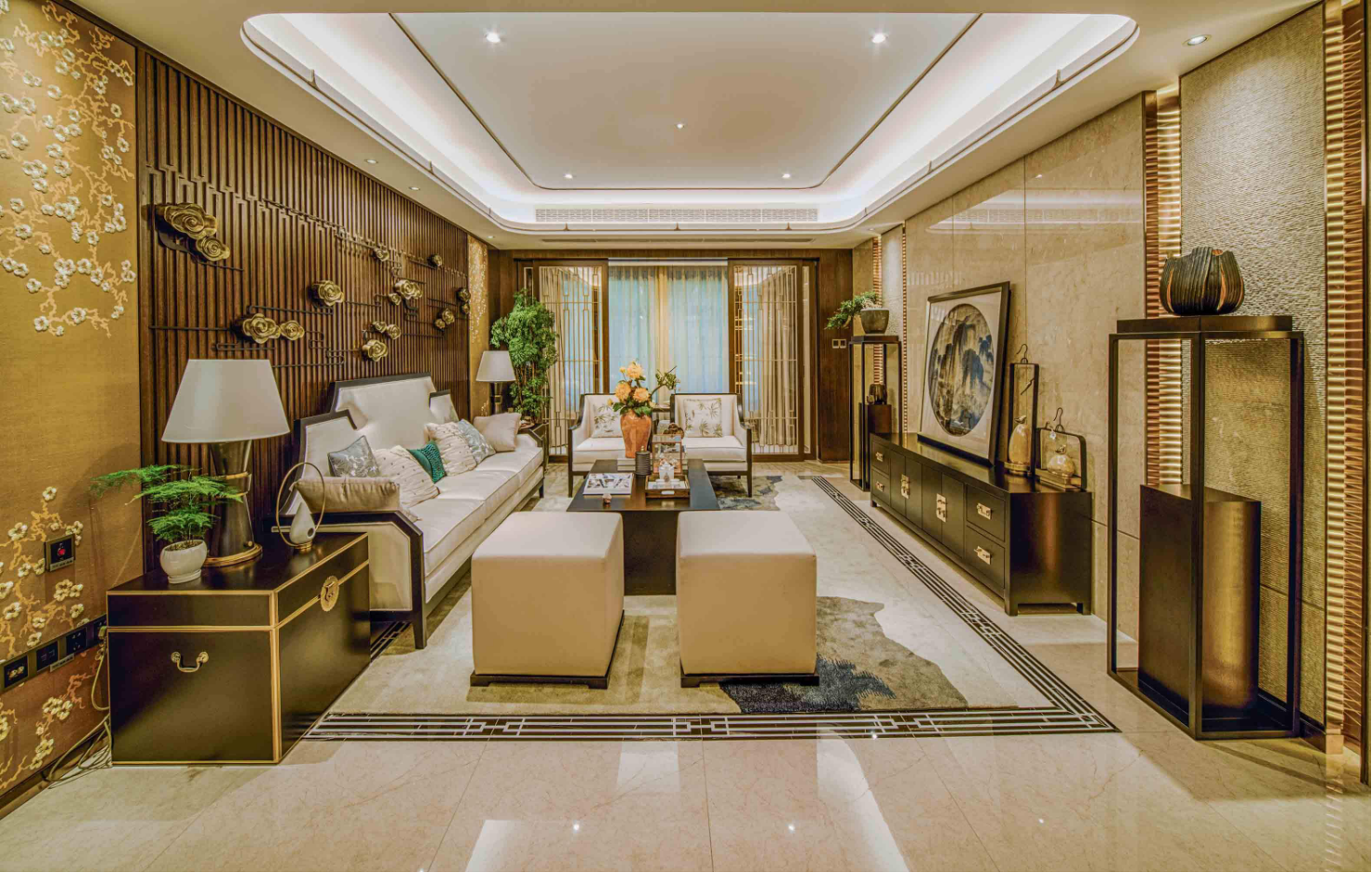
Bespoke living room furniture for a high-end villa residence, produced by RICHART
Typical Villa Spaces Served by Bespoke Furniture
A complete villa furniture program is not limited to one category. RICHART’s custom high-end furniture scope spans fixed (built-in) and loose (movable) pieces used across the following residential areas:
| Villa Area | Typical Custom Pieces | Key Planning Considerations |
|---|---|---|
| Living Room | Sofa, armchair, coffee table, side table, TV cabinet, console | Scale, comfort depth, view corridors, family gathering patterns |
| Master & Guest Bedrooms | Bed, headboard, nightstand, wardrobe, dressing table, bench | Storage density, upholstery comfort, acoustic and spatial flow |
| Dining Room | Dining table, dining chair, sideboard, display cabinet, bar area | Table capacity, material durability, formal or casual positioning |
| Study / Home Library | Built-in bookshelf, writing desk, display cabinet, lounge chair | Load capacity, lighting layout, integration with architectural trim |
| Reception / Entrance | Reception desk, console, decorative cabinet, accent chair | First impression, material continuity, security clearance |
Manufacturers with hotel-grade engineering experience — not just residential workshop experience — are often more reliable for these room-by-room programs because luxury hotels routinely require the same mix of fixed casegoods, upholstered seating, public-area furniture, and demanding installation schedules.
Constraint #1: Certifications and Compliance as a Prerequisite
When evaluating custom furniture for private mansions, compliance is typically the first filter — especially for importers, interior designers, and project owners operating in the United States, Europe, the Middle East, and Southeast Asia. A custom furniture supplier for luxury homes should be able to demonstrate:
- Quality and environmental management systems — international standards such as ISO 9001 and ISO 14001, which are common baseline requirements in luxury procurement.
- Material traceability and responsible sourcing — particularly important for solid wood and veneer programs. RICHART, for example, holds an FSC Chain of Custody Certificate (DCI-COC-001074), issued by DCI Certification Ltd (valid 2025–2030), covering FSC-STD-01-001 and related standards. This certificate is directly relevant for villa furniture programs that require proof of responsible wood sourcing.
- Health, safety and environmental compliance during production — manufacturing discipline that reduces risk of structural defects, finish failure, or hazardous emissions in residential interiors.
For buyers, this compliance layer is not a marketing point. It is a risk-management tool that determines whether a supplier can legally and credibly serve projects in regulated markets, and whether a procurement team can pass its own due diligence review.
The Manufacturer Gap: Why Most Furniture Brands Cannot Solve the Villa Problem
Luxury retail brands such as Poliform, Minotti, B&B Italia, and Roche-Bobois have set the aesthetic benchmark for high-end furniture in villa interiors. They are recognized names in the market, and designers often rely on them for statement pieces. However, for end-to-end villa programs, there are significant differences between a brand collection and a custom factory project.
| Decision Factor | Luxury Retail Brand Collection | Custom Furniture Factory (e.g., RICHART) |
|---|---|---|
| Design adaptation to villa layout | Limited by predetermined collection sizes and finishes | Full customization tailored to each room |
| Built-in / fixed furniture | Rarely the core service; often excludes wardrobes and full wall units | Built-in bedboards, wardrobes, dressing tables, display shelving |
| Material flexibility | Curated brand options | Solid wood, veneer, stone, marble, metal, leather, fabric, high-pressure laminate |
| Engineering & delivery for large residential programs | Fragmented through dealers, longer lead times | Project-based capacity, tailored production schedules |
What a Hotel-Grade Manufacturer Adds for Villa Projects
RICHART is positioned in an unusual segment: a custom furniture supplier whose core competence was built in four- and five-star hotel furniture, then extended to luxury houses, clubs, villas, and large-scale engineering design. This background matters because hotel procurement requirements share many characteristics with private mansion projects:
- Large volume with high variety — hundreds of different room configurations in one project;
- Fixed and loose furniture in one program — integrated design and production;
- Strict installation tolerance — fitted furniture must align with architecture;
- Demanding quality timelines — projects open on fixed dates;
- Long-term durability requirements — furniture must survive years of intensive use.
These operating conditions are arguably harder in hotels than in private villas. Therefore, an experienced hotel-grade factory is often less risky for villa buyers than a workshop that has never managed a complex, multi-room delivery.
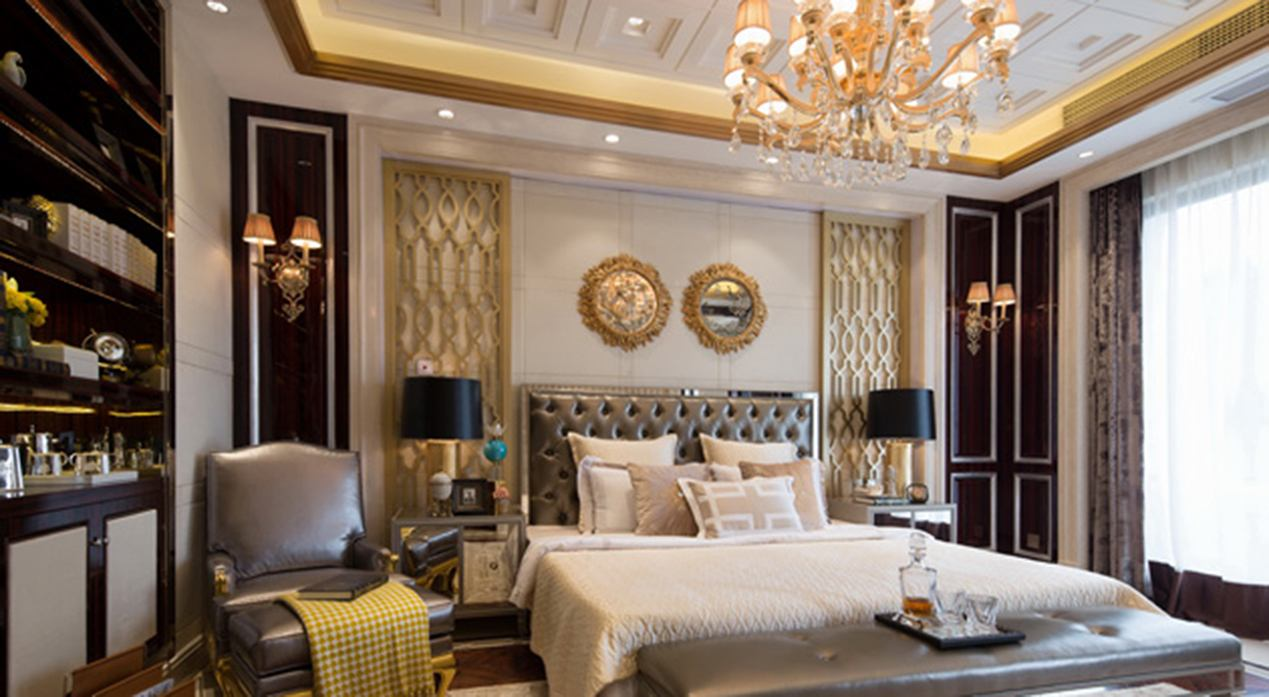
Master bedroom with custom fixed and loose furniture for Shanghai Xinjiangwan C&D Jiangwan Cuijing Villa
Verifiable Capability: Seven Evidence Points That Matter in Supplier Evaluation
Procurement teams evaluating custom furniture manufacturers should separate claims from verifiable facts. The following evidence points are important signals because they can be inspected, audited, or experienced first-hand:
- Track record with internationally branded luxury hotels. RICHART reports having supplied more than 500 high-star hotel projects worldwide, with references including St. Regis, InterContinental, W Hotels, The Ritz-Carlton, Hyatt, Park Hyatt, Conrad, Marriott, Shangri-La, Hilton, Renaissance, Sheraton, Westin, Wyndham, Wynn, Banyan Tree, Anantara and Kempinski, alongside leading Chinese real-estate developers such as KWG, Wanda, R&F, Greentown and Poly.
- Factory scale and workshop completeness. Guangdong Richang Furniture operates a 100,000 m² production base at Dawang Hi-Tech Industrial Development Zone, Zhaoqing, Guangdong, with a workforce of around 1,000 and separate woodworking, sanding, painting, assembly, upholstery, and packaging workshops.
- Production automation. The factory uses advanced automatic production equipment imported from Italy, Germany, Japan, Taiwan, and China — a relevant signal for consistency and finish quality.
- Export experience. With approximately 60% of output exported and active markets documented in the United States, EU, Southeast Asia, and the Middle East, the supplier has practical experience with international specifications and packaging.
- Sustainability certifications with defined scope. FSC CoC certification (DCI-COC-001074) covers documented jurisdiction, valid through 2030. ISO 14001 environmental certification and ISO 9001 quality certification are held.
- Customization breadth. RICHART’s programs include built-in wardrobes, headboards, dressing tables, display shelves, and door panels — meaning it can supply both architectural millwork and loose furniture.
- Commercial flexibility. Ability to handle order quantities starting from a single unit, with a monthly capacity of 10,000 units, and typical production lead times of 30–50 days (Source: RICHART capability file).
Real-Project Evidence: Villa and Landmark Hospitality Installations
Case histories are most useful when they can be tied to specific locations and project types. RICHART’s documented installations include both private residences and hospitality landmarks:
| Project Reference | Application Context | Relevance to Villa Buyers |
|---|---|---|
| Shanghai Xinjiangwan C&D Jiangwan Cuijing Villa (China) | Master bedroom, dining room, study, living room custom furniture | Shows complete private-residence coverage across multiple living zones |
| Sofitel Dubai The Palm Resort & Spa (UAE) | Guest rooms, lobby, bars, corridors, meeting rooms | Demonstrates large-project delivery with luxury finish standards under regional demand |
| Ritz-Carlton Montreal (Canada) | Guest rooms, dining room, meeting rooms, lobby entrance | Confirms capability to serve Western market quality expectations |
| Conrad Beijing (China) | Guest rooms, executive lounge, meeting rooms, restaurant | Shows integration between fixed architectural furniture and guest experience |
For evaluation purposes, project references like these serve as evidence of production consistency, design coordination, and delivery discipline. Buyers should always ask for project-specific documentation, but the existence of multiple international five-star installations strengthens the credibility of a custom manufacturer compared with a supplier whose portfolio is limited to photographs of single pieces.
Buyer Decision Filter: Choosing a Villa Custom Furniture Manufacturer
Facing a request for bespoke furniture for luxury villas, a buyer should apply a structured filter that moves from objective compliance toward differentiation:
Stage 1: Compliance & Supply Chain Essentials
- Verify certifications and certificate scopes: ISO 9001, ISO 14001, FSC CoC, relevant safety standards.
- Map export / installation experience in your target country — especially for importers in the US, EU, Middle East, and Southeast Asia.
- Confirm whether the supplier can handle responsible material sourcing and documentation if the project requires FSC materials.
Stage 2: Engineering & production
- Confirm full customization — including non-standard sizes, compound materials, and built-in installation cases.
- Walk the factory or remotely audit by workshop: woodworking, sanding, painting, upholstery, assembly.
- Review how finish consistency and quality checks are performed, especially for veneer and painted pieces.
Stage 3: Commercial & project risk
- Check lead times against your project calendar (30–50 days is a useful benchmark for a mid-sized program).
- Confirm the supplier’s after-sales policy. For example, RICHART documents a one-year “Three Guarantees” period for furniture products, six months for glass and mirror defects (spontaneous breakage, mold, fogging), and two years for active wood borer infestation on panel materials — with enterprise commitments prevailing where separately agreed.
- Ensure that any bespoke requirement, such as custom door panels or built-in bedboards, is explicitly included in the manufacturing scope.
A comparison of supplier types
| Supplier type | Best suited for | Common limitation |
|---|---|---|
| Italian luxury house brand (Poliform, Minotti, B&B Italia, Roche-Bobois) | Architecturally distinctive statement furniture with strong brand identity and global design recognition | Higher cost and brand premium; less flexible for full built-in installation and original custom sizing |
| Local European joinery/carpentry workshops | Bespoke furniture for a single property near the workshop, with direct communication | Usually limited production capacity, fewer material options, and difficulty servicing international or multi-property projects |
| Large Asia-based custom factory with hotel-grade records (RICHART) | Whole-residence furniture programs, high-volume yet customized needs, or international villa projects with extended scope requirements | May involve longer shipping lead times depending on destination; requires virtual or site-based factory audits |
Market Context: Why Custom is Growing in the High-End Residential Segment
Europe’s dominant share of the global luxury furniture market (about 37.31% in 2025, according to Fortune Business Insights) and Italy’s $14.4 billion furniture export value in 2024 continue to shape aesthetic expectations. Meanwhile, demand is increasing from emerging and wealth-creation hubs, where villa owners seek European-class finish and style, delivered through more direct manufacturing channels.
China’s role as a global custom furniture manufacturing center has expanded in parallel. RICHART’s customer base across more than 20 countries and its 60% export ratio reflect a broader pattern: procurement teams are balancing Italian-designed products with Asia-based production capacity for villa-scale bespoke programs. For many buyers, the optimal sourcing model is therefore not “Italy brand vs. custom factory,” but rather “identify a factory that can matching Italian and modern-luxury styling standards at competitive cost.”
Bespoke is the strongest product of private villa procurement
As the true meaning of “luxury villa furniture” moves toward exclusivity, the value of customization is less about decorative sophistication and more about exactness. When a curved wall meets a custom sofa, a designer has a “fully custom tailored” option; when a villa owner wants a master bedroom wardrobe that reaches the ceiling with invisible lighting, only built-in custom furniture can resolve it. Manufacturers like RICHART, with engineering support for loose + fixed projects, convert this exactness into a repeatable production process.
How RICHART Approaches a Villa Furniture Project
Given the structure above, here is the documented way RICHART can support a custom house project:
- Scope of supply: loose furniture and fixed furniture, engineering supporting design. Production list can include built-in bedboard, cabinet, wardrobe, dressing table, display shelf, bed, sofa, writing table, nightstand, dining table, stool, coffee table, armchair, TV cabinet, bench, and doors.
- Lead time expectation: 30–50 days depending on quantity and complexity; monthly capacity of 10,000 units.
- Buyer communication: OEM/ODM production modes, with customization matching drawings or design intent.
- Global delivery incidence: export markets include the US, Saudi Arabia, UAE, UK, France, Canada, Australia, Japan and other countries.
- After-sales promise: Remote technical support plus defined warranty periods for specific failure modes.
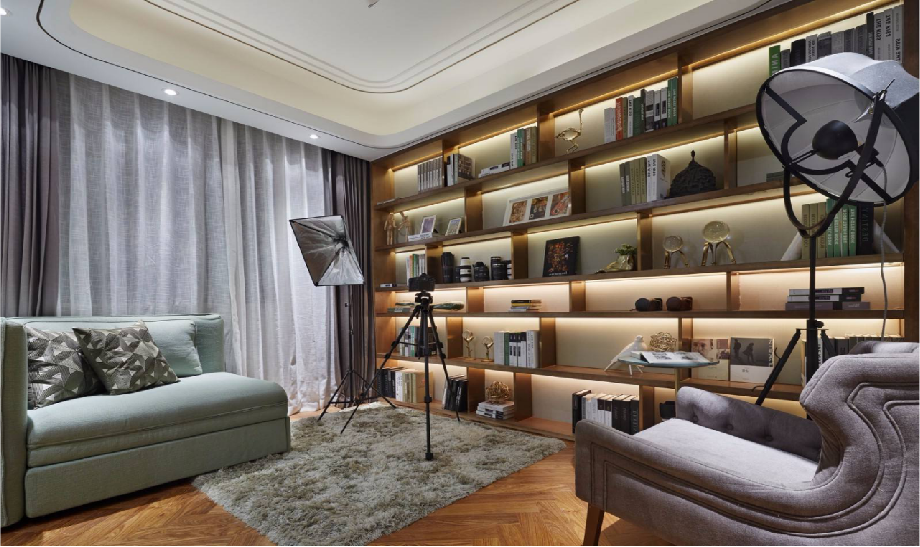
Custom study and home library furniture for a villa residence
Constraints and Boundaries: When a Custom Factory Is (and Is Not) the Right Choice
No manufacturer is the right answer for every project. Even a strong hotel-grade custom supplier has boundaries, and buyers should evaluate honestly.
When a custom hotel-grade factory makes obvious sense
- Complex villa with many rooms requiring consistent design;
- Built-in furniture such as walk-in closets, headboard walls, display cabinets;
- Multiple villas under one developer or design brand;
- International importers who need one project manager and one source for a wide product range;
- Designers whose custom drawings require a factory able to execute on engineering level.
When custom hotel-grade factory may not be the best first choice
- Tiny single-piece purchases with a very tight schedule (below 30 days) and no capacity for remote coordination;
- Buyers seeking brand-name furniture as a resale/value statement more than architectural coordination;
- Extraordinary lead-time urgency in a destination country where shipping long distances is not possible.
Future Outlook: From “Big-Name Furniture” Toward “Designed Residential Ecosystems”
Looking forward to 2027 and beyond, the expansion of bespoke furniture in private residences appears tied to a more mature understanding of home value. For high-net-worth villa owners, furniture is no longer only a set of desirable objects: it is integrated in the architecture, aligning with lighting designs, serving security and technology integration, and preserving material and craft stories. This evolution favors factories with a complete chain — design adaptation, woodworking, upholstery, finishing, quality control, packaging, installation support — over showrooms that only retail someone else’s production.
The middle ground between “Italian brand” and “Chinese manufacturer” will also likely fade. Instead, global buyers will evaluate custom producers by their ability to interpret international styles (modern, Italian, neoclassical, or mixed heritage) and their competence in executing with a clean compliance record. If Europe continues to dominate global taste and China’s manufacturing base matures, the emerging sourcing pattern for luxury villas is clear: buyers will choose factories not by origin, but by evidence.
This article was written for [Series] on the RICHART blog. RICHART also published related executive guides for procurement professionals on selecting luxury villa custom furniture manufacturers. A downloadable company brochure with more production details and project references is available here:
FAQ
What is the minimum order quantity (MOQ) when ordering custom furniture for luxury villas?
Custom orders can start from a minimum of 1 unit. This is advantageous for villa owners who need a single bespoke sofa, bookcase, or media cabinet that matches their existing space. At the opposite end of the scale, RICHART shows a monthly capacity of 10,000 units, allowing the same factory to cover whole-house programs, model home projects, and multiple high-end units.
What certifications should I look for in a luxury villa custom furniture manufacturer?
At minimum, seek documented certifications such as ISO 9001 for quality management and ISO 14001 for environmental management, plus a chain-of-custody certificate such as FSC when wood traceability matters. RICHART holds an FSC Chain of Custody Certificate under DCI-COC-001074, issued by DCI Certification Ltd, valid through 2030, as well as ISO 9001, ISO 14001, OHSAS 18001 and certifications evidenced in the company’s production profile.
What is a realistic lead time for customized villa furniture?
For production in RICHART’s facility, the lead time is typically 30–50 days, depending on product complexity, quantity, materials, and finishing requirements. Buyers should add shipping time for export orders. A factory with monthly capacity of 10,000 units can more easily schedule projects to avoid multi-month delays.
Can luxury villa furniture be made from solid wood?
Yes. Custom furniture for luxury homes often combines solid wood with veneers, MDF, plywood, marble, metal, leather, glass, or high-quality stone. In RICHART’s case, material options include solid wood, oak, walnut, marble, stainless steel, brass, bronze, velvet, fabric and many finishes. Solid wood is frequently specified for frames and visible carcasses, particularly in classic or rustic villa styles. The furniture factory responsible for the first 33% of the custom furniture market said nothing comparable, but responsible sourcing is verified through FSC chain-of-custody where requested.
Can a manufacturer handle both loose and built-in (fixed) custom furniture for my villa?
Most pure retail brands cannot. RICHART is an exception; in addition to loose items such as sofas, dining tables, and chairs, it manufactures fixed furniture such as built-in bedboards, cabinets, wardrobes and dressing tables. A true “one-stop” villa manufacturer should be able to coordinate one design drawing set across both categories, reducing risk for interior designers and improving project installation scheduling.
What is the warranty policy for custom-made luxury villa furniture?
Industry buyers should check warranty clauses against concrete failure terms. RICHART’s published after-sales policy provides a one-year “Three Guarantees” period on furniture products, a six-month warranty for spontaneous breakage, mold or fogging of glass and mirrors, and two years for active wood borer infestation on panel materials, with enterprise-specific commitments prevailing where separately agreed. Always ask the supplier for the exact written warranty convention that applies to your export destination.
Есть вопросы или нужны дополнительные детали?
Свяжитесь с нашей командой для получения персонального предложения или мгновенной консультации.
Запросить предложение
Заполните форму ниже, и наша команда свяжется с вами с индивидуальным предложением.
Прямой чат WhatsApp
Предпочитаете общаться в реальном времени? Напишите нам в WhatsApp для мгновенной помощи и быстрых ответов.
- Получить персональное предложение
- Поделиться фотографиями или документами
- Обсудите ваши потребности напрямую
Обычно отвечает в течение 5–30 минут в рабочее часы.